
 February 26, 2018 at 13:16
Why can't you cash out
- Transfer
The article is written for beginner investors who assess the risks of investing in cryptocurrencies, and not for experienced participants in the cryptocurrency market - approx. trans.
In public discussions and media articles about bitcoins, some assumptions are made:
All this is not true.
I'm looking at the CoinDesk Bitcoin Price Index [the first part of the article was published on December 19, 2017 - approx. per.). At the moment, the price is indicated there $ 19699.46. Oops, already $ 19,691.76! And now $ 19,690.70! Etc.
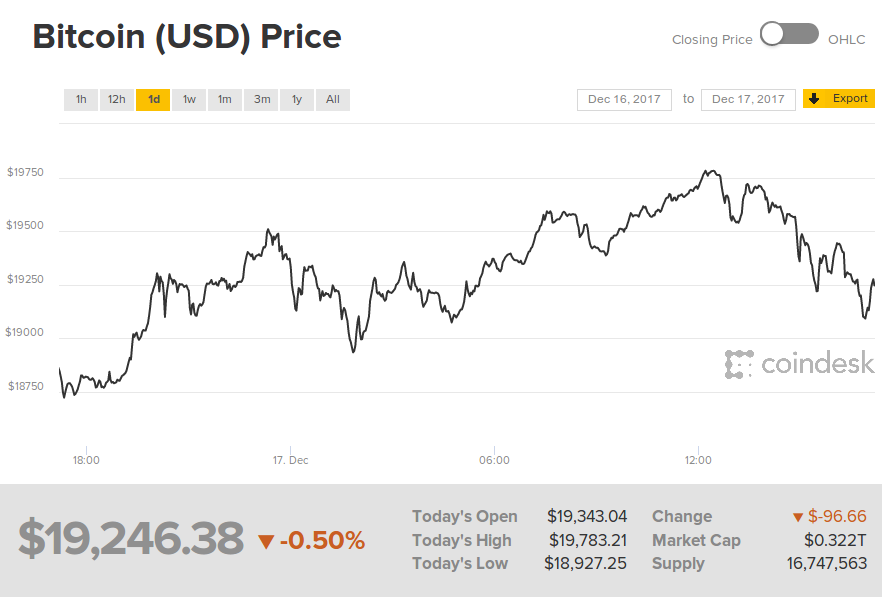
This figure is bitcoin marketing. It should create the impression that Bitcoin is a reliable traded asset with an orderly market structure, that you can reasonably indicate its price to a cent and that everything is fine and reasonable. But this is an illusion.
There is no single “price” for bitcoin - this is a fictitious figure. You cannot expect to exchange bitcoins at this price - this is averagethe price of the last transactions on the heap of exchanges (Coinbase, Bitstamp, itBit and Bitfinex exchanges are taken into account when calculating the CoinDesk index. Crypto adepts just exclaimed “what!” when mentioning the latter).
If you look at the spread between exchanges - the difference in price for the same bitcoin - you will see a spread of hundreds of dollars , and at times of volatility, and thousands.
If you wrote a number like $ 19,699.46 with seven significant digits with a 5% data spread, your high school physics teacher would give you a slap in the face. This is completely misleading. Something like “19700 plus or minus $ 500” should be written, and this beautiful line chart will turn into a thick gray bar .
"Market capitalization" is even worse. This is just the last price multiplied by the number of existing tokens. A dummy value that does not apply to anything at all - it is not equal to the money invested in cryptocurrency, it is not a realizable value, like the company's market capitalization, it does not affect prices - it is just a quickly calculated catchy number that looks beautiful in the header. Trading any cryptocurrencies is so modest, even bitcoin, that you can never realize even a small part of the specified amount. This is just marketing.
Why is bitcoin like this? Why is price not a reasonable, usable number?
(This briefly summarizes the magnificent article by Paulo Santos “Addition to the Bitcoin cycle - market structure” (there the reader needs to log in to read to the end and the author is paid).
In ordinary stock trading, if a stock is listed on several exchanges, then applications are often redistributed through the system automatic routing , so that a specific purchase or sale order is executed in the context of all order registers for a given stock, which avoids liquidity fragmentationwhen the registers of different exchanges are too isolated from each other. Because of this, trade is hindered, and each individual trading pool becomes more volatile. Routing between exchanges is simple, because unlike bitcoins, real exchanges do not need to keep shares in order to conduct a transaction.
This scheme does not work for bitcoin - on every single exchange all trading is isolated, and bitcoins are actually present on the exchange. This is the reason for the tremendous volatility and large price dispersion.
In addition, in regular stock trading, spreads between exchanges are quickly equalized through arbitrage — a purchase on one exchange to sell profitably on another. This pushes the price up on the first exchange and down - on the second.
The structure of the bitcoin market makes arbitrage difficult. If you want to profit from the spread in the price of bitcoin on different exchanges, you need:
These delays (from ten minutes to more than an hour) and commissions introduce enough difficulties to arbitration to create a spread between exchanges, even if we assume that everyone has trading bots with maximum speed.
Therefore, each exchange acts like an island. The “price” number does not apply to any of these exchange exchanges.
What is it like living on one of the islands?
When you buy ordinary stocks or goods, you assume that the trading environment is reasonably regulated and that exchanges comply with the rules established by law and, in essence, will not bother you .
In the case of Bitcoin, this is generally impossible to imagine. This is what unregulated means.
Regarding the stock market, it is important to understand that each regulation rule appeared because someone robbed many people in this way. Rules ensure market integrity. So even investors who are aware of the high risk, who understand that cryptocurrencies are ridiculously volatile and not provided with anything, even they may not be fully aware that the trading environment itself is part of the threat to cryptocurrency trading.
(One vivid example was the collapse of iGot in Australia in 2016, which hit many small investors: “I just assumed that if the exchange is in Australia, then there should be some kind of security system or regulation, or something like that, some minimum standards for the exchange to be responsible for its actions ”).
On cryptocurrency exchanges, fraud is common, which is not without reason prohibited on real stock exchanges:
The U.S. Commodity and Futures Trading Commission called many of these frauds (PDF) specific problems that are much more present in the cryptocurrency market than in other markets:
Since cryptocurrency exchanges live in the Wild West, the interface between them and the normal financial world is strictly regulated. Because of this, huge problems arise with the withdrawal of real money, as we will see in the next part. And dubious things arise that increase the price ...
Update : you should not leave comments on how you personally cashed your bitcoins, and therefore everything is fine ! It's good that you have developed, but you know that many beginning investors have problems - and it's worth talking about.
KYC / AML Standards (Know Your Client and About Anti-Money Laundering) is an endless headache for bitcoin traders.
The Know Your Customer Standards are adopted as part of the US Patriotic Act after the September 11 attacks. The idea was to detect money laundering by terrorists and criminals.
For ordinary users, the problem is that the law requires that the bank treat each client as a threat. And Bitcoin is known as the favorite tool of criminals and drug dealers, therefore, banks pay special attention to it.
This applies to cryptocurrency exchanges and banks. It is well known that Coinbase requires people to re-download scans of documents that they previously sent when accounts are transferred to “limited” mode (where you cannot withdraw your money). With a cashout, they require more documents for identification than with a deposit. All this is automated, with virtually no customer service. But they do this not just to delay your money - they are legally required to treat you as a threat.
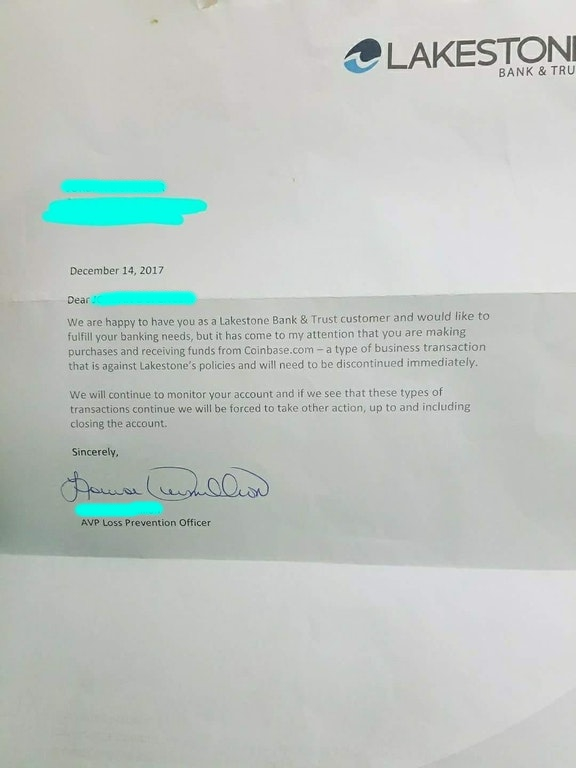
Even if your exchange clearly intends to send money to your bank, it may be afraid to have any business with bitcoin - for example, see this letter to one of Coinbase users :
(Companions of the offended user reacted as expected - that is, they attacked the bank’s pages on Facebook and Yelp like mad cultists).
The problem is that Bitcoin was originally intended as a means of avoiding government control. Its creators are idealistic anarcho-capitalists , who assumed that free independent citizens needed cryptocurrency to trade among themselves without the threat of state theft - i.e. taxation.
Obviously, this attracted the attention of criminals who are infinitely inventive in finding new ways to launder dirty money, as well as drug dealers and other individuals who have problems using ordinary money, so some surrogate is required.
That is, bitcoin was from the very beginning literally intended for money laundering and tax evasion. It is not technically anonymous - if you really need to, you can do the tedious work and track the movements of bitcoins on the blockchain - but your bank is not going to bear this burden so that you can cash out a few coins.
Another problem is that Bitcoin users are usually “serial entrepreneurs.” Sometimes this may mean the creation of a number of successful enterprises, but more often these are chronically unemployed, poor and fraud-prone people. Even if they provide the bank with the history of each bitcoin, they already fall into the category of risky customers.
(And there are also bitcoiners who are sure that they are smarter than bank employees who monitor compliance. For example, these guys prove to the bank that Coinbase is a site for collecting coins. Please believe me, this trick never works).
 Coinbase claims that a cashout is done at the click of a button. That is true for some, but too much for many. A cashout can be slow and painful.
Banks have strict reporting requirements. Banks are required to report large deposits, and sometimes refuse to transfer, which is considered doubtful.
This is especially true for those who discovered an old forgotten wallet with bitcoins - and wants to cash them out. I know about one such case when a user many years ago sold a car for bitcoins and wanted to make money on the current bubble. The best the exchange could offer him was sending several thousand dollars daily. Cashing out a million dollars for several thousand is not only tiring, but still similar to structuringwhen someone is trying to evade reporting requirements.
Customers of US banks are most exposed to these requirements. As I understand it, it is easier for residents of the UK and Australia - although your bank may still refuse to service you. One case in the UK from July last year shows that HSBC considered the direct sale transactions between users on LocalBitcoins as fraudulent, and the recipient’s account was blocked for several days until they figured out.
Contact your bank first. Be prepared to provide a complete history of each cryptocurrency you have ever received, and where the money to buy it came from. Be prepared to provide sufficient tax inspection information. If it’s a substantial amount, find a qualified accountant.
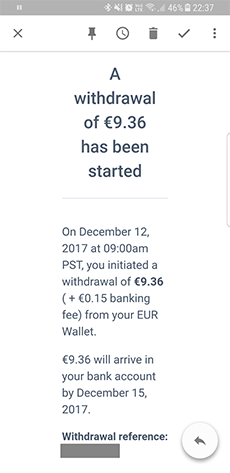
Messages from users give reason to believe that if you once successfully made a cashout and withdrew money, then there will be less problems with future transactions. Not entirely without problems - but less. The screenshot in the upper right was taken by a user from the UK on December 22, 2017. There he is sure that the money will be received by the 15th day ...
Exchanges take these issues very seriously, because KYC / AML problems can cut off the exchange from the entire banking system. And this happened.
Bitfinex, still the largest trading volume Bitcoin exchange, and its parent company Tether lost access to the U.S. banking system in April 2017, when Wells Fargo, their only correspondent bank (intermediary) between Taiwanese banks and their U.S. customers, refused to process transfers to and from the exchange. Bitfinex sued - a good way to guarantee that no other banks would want to deal with you - but to no avail. As Phil Potter of Bitfinex put it :
As described in detail in the eighth chapter of my book , I am almost sure that the 2017 crypto bubble started to inflate in this way - people could not withdraw US dollars from Bitfinex, so to buy funds they bought Bitcoin and other cryptocurrencies, pushing the price up.
So, you bought a bubble. Everything will be fine, you cannot lose money! And if he is blown away, just keep a position!
Oops! The price has just dropped from $ 19,000 to $ 11,000. What now?
There is no economy in bitcoin as such. That is, there are many “valuable” Bitcoin papers that may never be realized.
Twitter @Buttcoin at the end of last year published an explanation of how the bitcoin market works in practice and why old investors who have just left for cash are telling newcomers just to keep their positions. Or, as they put it , “HODL” :
Bitcoin is not a circulatory system of a functioning economy, there is no circular flow of income , that is, a continuous process of exchanging goods and services for money between the subjects of the economic system. There is very little that you can buy for bitcoins - even drug dealers refuse to accept them , because the commission goes through the roof . Bitcoin does not have its own economy.
A Bitcoin wallet is not a useful repository of capital that you can invest in profitable economic activity and increase wealth. All you can do is sell them again. From a practical point of view, bitcoin works only within the framework of a conventional currency system .
This makes Bitcoin a zero-sum investment - real money at the exit will never be more than real money at the entrance. (Or a little less, as miners cash out a reward from each mined block to pay for electricity). If the amount of money X is invested in bitcoin - the same amount of money X is immediately withdrawn by another person. That's all that happens.
Again, this is why the indicator “market capitalization” is misleading and useless. If someone bought bitcoins for $ 19,000, this does not make anyone a “Bitcoin billionaire,” whose bitcoins can be sold for $ 19,000, because the total amount of actual money in the system has not increased.
Try to de facto realize some significant part of these paper billions - and you will see a drop in prices, because there will not be enough actual money to cash everything. At some point, a mass exodus of users will begin, and most of them will receive nothing for their “profit”.
People invest in the hope of profit. This means that more money should come into the system - new people should be involved in the scheme. This is obvious to every "investor" - they will have to recruit .
In the end, the influx of “big fools” dries up in the system , the bubble bursts and many people remain sack holders .
Old investors receive money from new investors - this is a key characteristic of the financial pyramid. Functionally, it is a pyramid. Even if she does not have a specific operator. As evilweasel interpreted on Something Awful:
The problem with calling Bitcoin a “Ponzi scheme” or “financial pyramid” is that such a pyramid traditionally has a chief executive who makes money.
Bitcoin doesn't have that. (And adherents very much emphasize this as a reason not to call it a financial pyramid! Satoshi Nakamoto did not seem to have any back thoughts when creating Bitcoin.
Even considering Nakamoto’s widely documented political goals when creating Bitcoin as an anarchist-capitalist version of the gold standard , with conspiracy theories about the banking system along the way - he was extremely upset by the way the fans went crazy for profit, and he even asked them to refrain from mining on video cards, because it will prevent the system from spreading to all computers.
Nakamoto abandoned the project around 2011, and since then his million bitcoins have been moving without movement. But his followers keep pushing.
Preston Byrne describes how Bitcoin works as a pyramid without a top, which he calls the “Nakamoto scheme” :
Bitcoin is also a popular platform for Ponzi schemes and the like. The history of Pirateat40 is described in detail in the fourth chapter of the book, but “high-yield investment programs” have long been very popular to the point of stupidity. And they attract experienced Ponzi scheme operators such as Sergey Mavrodi from the MMM pyramid of the 1990s, who launched new bitcoin-based schemes .
In the future, cryptocurrencies proved to be slightly better. When Ethereum took cryptocurrency and introduced smart contracts, the very first contracts written by people turned out to be letters of happiness, lotteries and Ponzi's automatic schemes .
Something in cryptocurrencies attracts not just naive simpletons, but naive simpletons who think that Ponzi, letters of happiness and other openly fraudulent financial schemes are actually a good idea.
And where there are simpletons with burning eyes - there are scammers to hunt them. This is a new paradigm!
Part 1. Why is the "price" of bitcoin in many ways a fiction
In public discussions and media articles about bitcoins, some assumptions are made:
- Bitcoin has a price for which it can be sold or bought.
- Bitcoin can be compared with a share in a company or with a product like gold - the market works the same.
- Bitcoin is liquid - it is relatively easy to buy bitcoins or transfer them to money in your bank account.
All this is not true.
How much is bitcoin?
I'm looking at the CoinDesk Bitcoin Price Index [the first part of the article was published on December 19, 2017 - approx. per.). At the moment, the price is indicated there $ 19699.46. Oops, already $ 19,691.76! And now $ 19,690.70! Etc.
This figure is bitcoin marketing. It should create the impression that Bitcoin is a reliable traded asset with an orderly market structure, that you can reasonably indicate its price to a cent and that everything is fine and reasonable. But this is an illusion.
There is no single “price” for bitcoin - this is a fictitious figure. You cannot expect to exchange bitcoins at this price - this is averagethe price of the last transactions on the heap of exchanges (Coinbase, Bitstamp, itBit and Bitfinex exchanges are taken into account when calculating the CoinDesk index. Crypto adepts just exclaimed “what!” when mentioning the latter).
If you look at the spread between exchanges - the difference in price for the same bitcoin - you will see a spread of hundreds of dollars , and at times of volatility, and thousands.
If you wrote a number like $ 19,699.46 with seven significant digits with a 5% data spread, your high school physics teacher would give you a slap in the face. This is completely misleading. Something like “19700 plus or minus $ 500” should be written, and this beautiful line chart will turn into a thick gray bar .
"Market capitalization" is even worse. This is just the last price multiplied by the number of existing tokens. A dummy value that does not apply to anything at all - it is not equal to the money invested in cryptocurrency, it is not a realizable value, like the company's market capitalization, it does not affect prices - it is just a quickly calculated catchy number that looks beautiful in the header. Trading any cryptocurrencies is so modest, even bitcoin, that you can never realize even a small part of the specified amount. This is just marketing.
Why is bitcoin like this? Why is price not a reasonable, usable number?
Isolated islands that impersonate a continent
(This briefly summarizes the magnificent article by Paulo Santos “Addition to the Bitcoin cycle - market structure” (there the reader needs to log in to read to the end and the author is paid).
In ordinary stock trading, if a stock is listed on several exchanges, then applications are often redistributed through the system automatic routing , so that a specific purchase or sale order is executed in the context of all order registers for a given stock, which avoids liquidity fragmentationwhen the registers of different exchanges are too isolated from each other. Because of this, trade is hindered, and each individual trading pool becomes more volatile. Routing between exchanges is simple, because unlike bitcoins, real exchanges do not need to keep shares in order to conduct a transaction.
This scheme does not work for bitcoin - on every single exchange all trading is isolated, and bitcoins are actually present on the exchange. This is the reason for the tremendous volatility and large price dispersion.
In addition, in regular stock trading, spreads between exchanges are quickly equalized through arbitrage — a purchase on one exchange to sell profitably on another. This pushes the price up on the first exchange and down - on the second.
The structure of the bitcoin market makes arbitrage difficult. If you want to profit from the spread in the price of bitcoin on different exchanges, you need:
- Buy some bitcoins on one exchange.
- Withdraw them from the exchange — suppose directly to the deposit address of the second exchange — and confirm the transaction on the blockchain (with a delay of at least 10 minutes) by paying a large commission if you want to confirm the transaction in the nearest blocks. Or twice the commission for a guarantee.
- Sell bitcoins on another exchange.
These delays (from ten minutes to more than an hour) and commissions introduce enough difficulties to arbitration to create a spread between exchanges, even if we assume that everyone has trading bots with maximum speed.
Therefore, each exchange acts like an island. The “price” number does not apply to any of these exchange exchanges.
What is it like living on one of the islands?
What does “unregulated” mean in practice?
When you buy ordinary stocks or goods, you assume that the trading environment is reasonably regulated and that exchanges comply with the rules established by law and, in essence, will not bother you .
In the case of Bitcoin, this is generally impossible to imagine. This is what unregulated means.
Regarding the stock market, it is important to understand that each regulation rule appeared because someone robbed many people in this way. Rules ensure market integrity. So even investors who are aware of the high risk, who understand that cryptocurrencies are ridiculously volatile and not provided with anything, even they may not be fully aware that the trading environment itself is part of the threat to cryptocurrency trading.
(One vivid example was the collapse of iGot in Australia in 2016, which hit many small investors: “I just assumed that if the exchange is in Australia, then there should be some kind of security system or regulation, or something like that, some minimum standards for the exchange to be responsible for its actions ”).
On cryptocurrency exchanges, fraud is common, which is not without reason prohibited on real stock exchanges:
- wash trades - intentional actions to pump prices up / down or just to create the illusion of the volume of trading. Until recently, you could literally do this through the Bitfinex exchange engine .
- spoofing - where you place a large application to create the illusion of market optimism or pessimism, and take off as soon as the price approaches it. This is ubiquitous on Bitfinex and Coinbase / GDAX .
- Painting ribbon (painting the tape) - as a wash trade, only with two or more participants. Mark Karpeles admitted in court that he used Willybot to pump the price of bitcoin on the Mt.Gox exchange during an inflating bubble in 2013.
- front-running - when the exchange operator satisfies the purchase or sale request earlier than other clients can do it.
- Insiders with access to the exchange base trade on their own exchange - this was done by Bitfinex employees. They claim to have avoided conflicts of interest, but there is no control or transparency.
The U.S. Commodity and Futures Trading Commission called many of these frauds (PDF) specific problems that are much more present in the cryptocurrency market than in other markets:
In addition to its practical and speculative functions, the emergence of these emerging markets is marked by a variety of damage to retail customers, which requires the attention of the Commission. Among other things, these are sudden malfunctions and other violations of market trading 52 , deferred settlements 53 , alleged spoofing 54 , hacks 55 , alleged insider theft 56 , alleged manipulations 57 , vulnerabilities in the programming of smart contracts 58 , illegal agreements and other conflicts of interest 59. These types of cybercriminals' activity can impede innovation in order to strengthen the market, undermine its integrity and prevent further market development.
Since cryptocurrency exchanges live in the Wild West, the interface between them and the normal financial world is strictly regulated. Because of this, huge problems arise with the withdrawal of real money, as we will see in the next part. And dubious things arise that increase the price ...
Update : you should not leave comments on how you personally cashed your bitcoins, and therefore everything is fine ! It's good that you have developed, but you know that many beginning investors have problems - and it's worth talking about.
Part 2. Bitcoin, Money Laundering and KYC (Know Your Client)
KYC / AML Standards (Know Your Client and About Anti-Money Laundering) is an endless headache for bitcoin traders.
The Know Your Customer Standards are adopted as part of the US Patriotic Act after the September 11 attacks. The idea was to detect money laundering by terrorists and criminals.
For ordinary users, the problem is that the law requires that the bank treat each client as a threat. And Bitcoin is known as the favorite tool of criminals and drug dealers, therefore, banks pay special attention to it.
This applies to cryptocurrency exchanges and banks. It is well known that Coinbase requires people to re-download scans of documents that they previously sent when accounts are transferred to “limited” mode (where you cannot withdraw your money). With a cashout, they require more documents for identification than with a deposit. All this is automated, with virtually no customer service. But they do this not just to delay your money - they are legally required to treat you as a threat.
Banks hate bitcoin due to non-compliance
Even if your exchange clearly intends to send money to your bank, it may be afraid to have any business with bitcoin - for example, see this letter to one of Coinbase users :
We are glad to see you as a client of Lakestone Bank & Trust and are pleased to satisfy your requests for banking services, but my attention was drawn to the fact that you make purchases and receive funds from Coinbase.com - this type of business transaction is contrary to the rules of Lakestone and should be stopped immediately .
We will continue to monitor your account, and if we see that transactions of this type are ongoing, we will be forced to take other actions, up to closing the account.
(Companions of the offended user reacted as expected - that is, they attacked the bank’s pages on Facebook and Yelp like mad cultists).
The problem is that Bitcoin was originally intended as a means of avoiding government control. Its creators are idealistic anarcho-capitalists , who assumed that free independent citizens needed cryptocurrency to trade among themselves without the threat of state theft - i.e. taxation.
Obviously, this attracted the attention of criminals who are infinitely inventive in finding new ways to launder dirty money, as well as drug dealers and other individuals who have problems using ordinary money, so some surrogate is required.
That is, bitcoin was from the very beginning literally intended for money laundering and tax evasion. It is not technically anonymous - if you really need to, you can do the tedious work and track the movements of bitcoins on the blockchain - but your bank is not going to bear this burden so that you can cash out a few coins.
Another problem is that Bitcoin users are usually “serial entrepreneurs.” Sometimes this may mean the creation of a number of successful enterprises, but more often these are chronically unemployed, poor and fraud-prone people. Even if they provide the bank with the history of each bitcoin, they already fall into the category of risky customers.
(And there are also bitcoiners who are sure that they are smarter than bank employees who monitor compliance. For example, these guys prove to the bank that Coinbase is a site for collecting coins. Please believe me, this trick never works).
How it affects cashouts
Coinbase claims that a cashout is done at the click of a button. That is true for some, but too much for many. A cashout can be slow and painful. Banks have strict reporting requirements. Banks are required to report large deposits, and sometimes refuse to transfer, which is considered doubtful.
This is especially true for those who discovered an old forgotten wallet with bitcoins - and wants to cash them out. I know about one such case when a user many years ago sold a car for bitcoins and wanted to make money on the current bubble. The best the exchange could offer him was sending several thousand dollars daily. Cashing out a million dollars for several thousand is not only tiring, but still similar to structuringwhen someone is trying to evade reporting requirements.
Customers of US banks are most exposed to these requirements. As I understand it, it is easier for residents of the UK and Australia - although your bank may still refuse to service you. One case in the UK from July last year shows that HSBC considered the direct sale transactions between users on LocalBitcoins as fraudulent, and the recipient’s account was blocked for several days until they figured out.
Contact your bank first. Be prepared to provide a complete history of each cryptocurrency you have ever received, and where the money to buy it came from. Be prepared to provide sufficient tax inspection information. If it’s a substantial amount, find a qualified accountant.
Messages from users give reason to believe that if you once successfully made a cashout and withdrew money, then there will be less problems with future transactions. Not entirely without problems - but less. The screenshot in the upper right was taken by a user from the UK on December 22, 2017. There he is sure that the money will be received by the 15th day ...
KYC / AML standards apply to exchanges too
Exchanges take these issues very seriously, because KYC / AML problems can cut off the exchange from the entire banking system. And this happened.
Bitfinex, still the largest trading volume Bitcoin exchange, and its parent company Tether lost access to the U.S. banking system in April 2017, when Wells Fargo, their only correspondent bank (intermediary) between Taiwanese banks and their U.S. customers, refused to process transfers to and from the exchange. Bitfinex sued - a good way to guarantee that no other banks would want to deal with you - but to no avail. As Phil Potter of Bitfinex put it :
In the past, we had bank failures, we could always just work around a problem or solve it, open new accounts and so on ... register a new legal entity, a lot of tricks of playing cat and mouse.
As described in detail in the eighth chapter of my book , I am almost sure that the 2017 crypto bubble started to inflate in this way - people could not withdraw US dollars from Bitfinex, so to buy funds they bought Bitcoin and other cryptocurrencies, pushing the price up.
Part 3. Bitcoin is not a pyramid! Technically
“An aquarium without food, where fishes who have heard that there is a buffet continue to jump. And for the most vile fish, it is so ”(Sid Midnight)
So, you bought a bubble. Everything will be fine, you cannot lose money! And if he is blown away, just keep a position!
Oops! The price has just dropped from $ 19,000 to $ 11,000. What now?
There is no economy in bitcoin as such. That is, there are many “valuable” Bitcoin papers that may never be realized.
How Bitcoin Bubbles Transfer Money from New Members to Old
Twitter @Buttcoin at the end of last year published an explanation of how the bitcoin market works in practice and why old investors who have just left for cash are telling newcomers just to keep their positions. Or, as they put it , “HODL” :
An important note for newcomers to bitcoin: the old-timers don't give a damn about you. They actively laugh and taunt you when the price drops. They need your money, but they hate your presence.
Whenever a crash or crash occurs, if you dare to ask why the market behaves in this way, they will regularly taunt you and say that you “do not understand bitcoin”. That a fall of 40% is nothing new. And why are you newbies generally worried about big losses?
If you bought for $ 19,000, then you paid cash out to someone else, and now this person will call you an idiot if you panic about losing money. They will say that you are not smart enough to wait and slowly observe how your “stable supply of value” rots for years in anticipation of the next bubble.
Why hold a position? Translated, this means something like this: "Please do not drop the price, just sit and wait until new suckers come." No one buying in 2017 believes that bitcoin will replace fiat.
This is why people call Bitcoin a pyramid. Each time this bubble is inflated, new people are drawn into it and for YEARS they sit on their bitcoins until the market heats up and a new bubble inflates - and they can finally exit without a loss.
The money pool does not grow: it comes as much as it leaves
Bitcoin is not a circulatory system of a functioning economy, there is no circular flow of income , that is, a continuous process of exchanging goods and services for money between the subjects of the economic system. There is very little that you can buy for bitcoins - even drug dealers refuse to accept them , because the commission goes through the roof . Bitcoin does not have its own economy.
A Bitcoin wallet is not a useful repository of capital that you can invest in profitable economic activity and increase wealth. All you can do is sell them again. From a practical point of view, bitcoin works only within the framework of a conventional currency system .
This makes Bitcoin a zero-sum investment - real money at the exit will never be more than real money at the entrance. (Or a little less, as miners cash out a reward from each mined block to pay for electricity). If the amount of money X is invested in bitcoin - the same amount of money X is immediately withdrawn by another person. That's all that happens.
Again, this is why the indicator “market capitalization” is misleading and useless. If someone bought bitcoins for $ 19,000, this does not make anyone a “Bitcoin billionaire,” whose bitcoins can be sold for $ 19,000, because the total amount of actual money in the system has not increased.
Try to de facto realize some significant part of these paper billions - and you will see a drop in prices, because there will not be enough actual money to cash everything. At some point, a mass exodus of users will begin, and most of them will receive nothing for their “profit”.
People invest in the hope of profit. This means that more money should come into the system - new people should be involved in the scheme. This is obvious to every "investor" - they will have to recruit .
In the end, the influx of “big fools” dries up in the system , the bubble bursts and many people remain sack holders .
Old investors receive money from new investors - this is a key characteristic of the financial pyramid. Functionally, it is a pyramid. Even if she does not have a specific operator. As evilweasel interpreted on Something Awful:
Bitcoin distributes tokens among early adopters precisely in order to get them to promote the system. This is an automated system of dumps and dumps , an “honest financial pyramid”.
Bitcoin's main innovation is largely to create an “honest pyramid.” It works because early adopters automatically receive a direct monetary incentive to promote it.
Well, technically this is not Ponzi ...
The problem with calling Bitcoin a “Ponzi scheme” or “financial pyramid” is that such a pyramid traditionally has a chief executive who makes money.
Bitcoin doesn't have that. (And adherents very much emphasize this as a reason not to call it a financial pyramid! Satoshi Nakamoto did not seem to have any back thoughts when creating Bitcoin.
Even considering Nakamoto’s widely documented political goals when creating Bitcoin as an anarchist-capitalist version of the gold standard , with conspiracy theories about the banking system along the way - he was extremely upset by the way the fans went crazy for profit, and he even asked them to refrain from mining on video cards, because it will prevent the system from spreading to all computers.
Nakamoto abandoned the project around 2011, and since then his million bitcoins have been moving without movement. But his followers keep pushing.
Preston Byrne describes how Bitcoin works as a pyramid without a top, which he calls the “Nakamoto scheme” :
The Nakamoto scheme is an automated hybrid of the Ponzi scheme and the pyramidal scheme, where, from the point of view of managing a criminal enterprise, the strengths of both schemes are combined and their weaknesses are absent (at present).
The Nakamoto scheme draws strength from the very things that make the pyramids and Ponzi so compelling. It promises a crazy return on investment, is accessible to a person from the street with almost no effort, and recruits individual participants as new, interested evangelists.
Regulators blinded by lobbying from Silicon Valley viewed these schemes as futuristic and ultramodern, rather than what they really are: factories of victims who, in the next crash, will give rise to hundreds of thousands of screaming investors with virtually no legal resources over four years inaction by regulators.
Bitcoin as a Ponzi platform
Bitcoin is also a popular platform for Ponzi schemes and the like. The history of Pirateat40 is described in detail in the fourth chapter of the book, but “high-yield investment programs” have long been very popular to the point of stupidity. And they attract experienced Ponzi scheme operators such as Sergey Mavrodi from the MMM pyramid of the 1990s, who launched new bitcoin-based schemes .
In the future, cryptocurrencies proved to be slightly better. When Ethereum took cryptocurrency and introduced smart contracts, the very first contracts written by people turned out to be letters of happiness, lotteries and Ponzi's automatic schemes .
Something in cryptocurrencies attracts not just naive simpletons, but naive simpletons who think that Ponzi, letters of happiness and other openly fraudulent financial schemes are actually a good idea.
And where there are simpletons with burning eyes - there are scammers to hunt them. This is a new paradigm!