January 31, 2015 at 23:45
Warming data centers
According to DCD Intelligence statistics , the total heat generated by the servers of all the data centers of the planet would be enough to compensate for the annual electricity consumption of such a country as the United Kingdom, and from the technological point of view, the development and implementation of such technologies does not present any special difficulties. It is necessary to establish a technological link between the data center and the city heating system, but companies, in turn, are required to invest in the development and implementation of internal pipelines, pumps and control systems.

Engineers of many companies have long been working on the development of mechanisms that will use the thermal energy of servers inside data centers with profit. Until today, quite a few such projects have been implemented and quite successfully. The generated energy is used to heat the office premises adjacent to the data center. The most famous of them are: TELUS server farm in Canada (Vancouver), Telecity in France, Telehouse data center in the UK, as well as IBM data centers in Finland and Switzerland.
Another very interesting project, which we dwell on in more detail, is a new project of a 12-story data center. He was proposed for the Denny Triangle project , not far from Seattle, Washington. Engineers from companies such as Clise Properties and Graphite Design Group have already submitted the project plan for consideration to the local municipality. An unusual data center is planned to be built near the Amazon Rufus 2.0 campus; currently, there is a parking lot there.
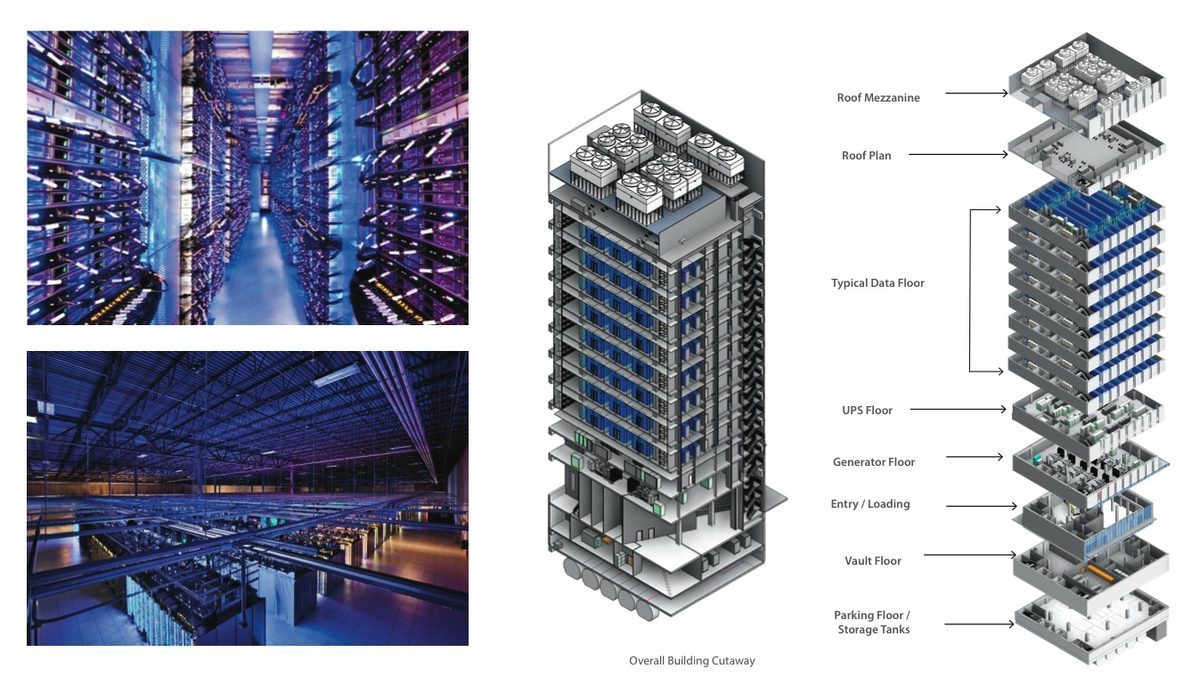
It is planned to use the entire space inside such a 12-story data center as efficiently as possible. On the lower floors, Clise Properties designers plan to deploy diesel generators and an uninterruptible power supply system (UPS). Each machine room with an area of about 1100 m 2planned to be placed on the remaining 8 floors. For fuel tanks, the basement of the data center will be allocated. It is planned to complete the construction of this project by the beginning of 2017.

Since the generator sets and diesel fuel tanks are planned to be located on the lower floors of the building, in case of emergency (power outages or a malfunction in the central power supply system), this will allow diesel generators to be efficiently supplied with fuel without the help of elevators, connecting the fuel truck directly to the tanks. This option is much more effective than the example to which many data center operators in New York had to resort to during the hurricane Sandy - living chains were created to transfer buckets of fuel to the upper floors, where generators are placed due to insufficient thought.
The temperature of the air that comes from the machine rooms of the server farms can be heated up to 38 o C. Heat, as a rule, is wasted. Clise Properties engineers have proposed a heat recovery system for the data center. Such a system allows the rational use of the generated heat, and even saves money on heating office and residential premises. Based on the calculations, this system will make it possible to recover up to 12 MW, this reduces the load on the central heating system by almost 6% and by 30% reduces the consumption of thermal energy, which goes to heating nearby residential complexes.

Clise Properties has plans to redirect surplus heat to nearby office and residential buildings in the same way that Amazon plans to use the heat generated by servers in Westin Building data centers to heat its campus. This is a project of Amazon’s new headquarters in the Washington state capital that includes three spherical and three office high-rise buildings, which will be part of the Denny Triangle office and retail campus, which covers an area of 30 hectares. Such spherical blocks with a height of 24 to 30 m, the architects themselves called "bi-domes." In addition to offices, canteens, recreation areas, meeting rooms and conferences, the complex will include almost 1700 m 2 of retail space for 1800 Amazon employees.

Seattle is known for its highly developed technology industry. Being the "homeland" of companies such as Amazon and Microsoft, this city has played an important role in the emergence of cloud services. The 12-story Clise Properties data center will contribute to the development of an ecosystem of high-tech companies.
Despite the fact that the project is still at the initial stage, said Richard Stevenson, president of Clise Properties, in an interview with the Puget Sound Business Journal, he is highly interested among potential tenants. Such a data center will be commercial, a variety of clients will be able to place their computing power here.

A good example in the use of such technologies for heat recovery of the data center is TELUS. The company's specialists use heat to heat the nearby tree nursery, where climate research is being conducted. The energy supply system is called the District Energy System (DES) and is used to ensure that the heating and cooling system of the neighboring Telus Garden residential and office complex is operational .

“By reusing energy, which, as a rule, is lost through recovery, we are able to create a truly innovative project. Telus Garden will be one of the most environmentally friendly facilities of its kind in North America, ”said Andrea Goretz, Telus Senior Vice President, Strategic Initiatives and Communications. The data center will provide the skyscraper with the necessary thermal energy by 80%.
WSP Group engineers developed an innovative heat recovery system for the Telehouse West data center with a capacity of about 9 MW in London to heat nearby homes and businesses. $ 180 million was spent on the construction of the data center, part of the money was used to develop the next mechanism for using heat from the server farm.

The heat generated by the data center is used to heat water in a nearby pool. Excess heat generated during the operation of server and network equipment accumulates and heats water. In turn, water is pumped into the heat exchange system of a nearby pool, thereby heating the water that enters the pool itself. At the same time, a data center can generate up to 2800 MW of heat per year.
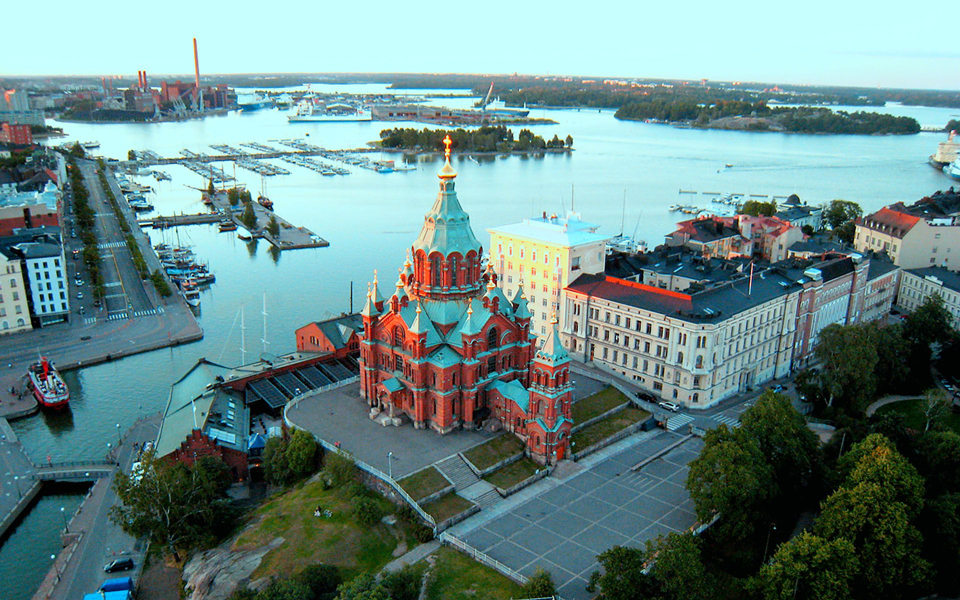
At a depth of 30 meters under the Assumption Cathedral is a 2 MW data center. The cooling system uses cold seawater. The exhausted hot air from the servers is piped through the heat pumps to the district heating network, which supplies the residents and residents of Helsinki with the body and hot water. The data center is able to provide heat to 500 private houses.
The data center was built by IBM at a private university in Syracuse, NY using micro-turbines using natural gas to generate electricity. These environmentally friendly 65 kW micro-turbines are integrated directly into the double conversion UPS. Turbines generate electricity, create thermal energy and power the cooling systems of the data center, as well as buildings that are located next to the data center.
Quebecor, a Canadian media company in which the heat generated from servers in a data center in Winnipeg, is directed to heat the local office of the local newspaper. A second pipe was laid from the place of heat collection into the pickup pipe of the office, which is located on top.
 The technical implementation of the described solution is not difficult. Heat pumps have been known for many decades. The obstacles to implementation in Moscow are tariffs for heat and electricity, as well as, oddly enough, a fairly well-developed centralized heating infrastructure in places where the data centers are located.
Consider the example of Moscow. For an industrial consumer, the cost of 1 MWh is about 1000 rubles for heat and 3500 ... 4000 rubles for electric energy. To convert 1 MWh of low potential heat from data centers (maximum 45 ... 50) to heat used in the heating network (90 ... 110), using a heat pump, approximately 0.25-0.3 MWh is needed It is easy to see that the cost of thermal energy obtained in this way is 1000 rubles. It is unlikely that the heat supply company will buy more than it sells itself. Given that the data center also incurs capital costs of $ 250 ... 750 thousand, then it is generally not clear why this is necessary.
Already in 2015, the price of electricity in Russia for industrial consumers will be almost the highest in Europe. Perhaps such a scheme would make sense if there were consumers for whom it was necessary to build new heating networks and boiler houses (as described in the article), but usually data centers are located in areas with a fairly developed infrastructure of heating networks and expensive data center energy is not particularly needed . The described solution is used in data centers, but in a limited mode and only during a period of lack of heating. Then, after converting the heat, the data centers can be used to easily heat the heating batteries in the same data centers or to prepare hot water for the needs of personnel, replacing direct electric heating (boilers, oil radiators). Such use of heat is economically viable. But these are fractions, a maximum of a unit percent of that the data center emits into the atmosphere. Thus, in order for Moscow data centers to become a serious source of heat, a rare combination of conditions is needed.
 The idea, of course, is very beautiful, but, alas, at current prices for heat, energy in Russia looks somewhat premature. We ourselves think in this direction - in particular, heating our offices on the street. Borovaya is partially provided by the heat generated by the data center. Thanks to a special heat pump, the heat from the cooling center of the data center is used to heat water in the heating radiators and air in the supply ventilation: in this way the offices are heated. The air in a number of infrastructure facilities and technical corridors of the data center on Borovaya and Korovinskoye shosse is heated by the heat of the machine rooms through plate heat exchangers.
But there are a few nuances. The data center "dumps" low-grade heat. The temperature of “warm” water in our cooling system is about 12 oC, and in order to get a temperature sufficient for heating, you have to install a heat pump - a refrigeration machine that takes heat from the water in the cooling system and gives it to the water in the heating system, heating it to about 45 ° C. It is spent on heat transfer electricity: for pumping 3 kW of thermal power, approximately 1 kW of electric power must be consumed. Now in Moscow, thermal energy costs about 4 times cheaper than electricity - it is clear that in this situation the use of a heat pump is more expensive than heating from the city’s heating networks. Furthermore, typical thermal engineering solutions involve the use of water at a temperature of from 80 to C, so in the case of the standard heat pump (not more than 45 authorizing ofC) you have to put larger radiators.
As for the heating of air from the machine rooms through recuperators, this solution does not consume electricity, but works only for neighboring rooms (it is completely irrational to pull air ducts over a large distance).
In the central office of DataLine, located above the OST data center on Borovaya, while one heat pump is installed. Using it, we recycle up to 15% of the heat “discharged” by the OST data center. This is enough to heat to 1500 m 2 of office space (during periods when the outdoor temperature does not fall below -15 on C, more severe frosts have reheated in an electric water boiler). It is difficult to talk about the payback of such a decision, and we treat this project more like an experiment.
 The idea of heating entire cities using the heat generated by data centers will be difficult to apply in modern realities. The temperature of the coolant returned after the machine rooms is not too high compared to the temperature of the coolant used in central heating batteries of Russian apartment buildings. In addition, data centers are located outside residential areas (these are the increased data center needs for energy, which are not in residential areas, and the requirements for a safety regime), and the transfer of heat over distances in our climate would be accompanied by additional significant heat losses. As of the current day, the option using the heat generated by the data center looks realistic and, in some cases, realized,
Engineers of many companies have long been working on the development of mechanisms that will use the thermal energy of servers inside data centers with profit. Until today, quite a few such projects have been implemented and quite successfully. The generated energy is used to heat the office premises adjacent to the data center. The most famous of them are: TELUS server farm in Canada (Vancouver), Telecity in France, Telehouse data center in the UK, as well as IBM data centers in Finland and Switzerland.
Unusual 12-story data center (USA)
Another very interesting project, which we dwell on in more detail, is a new project of a 12-story data center. He was proposed for the Denny Triangle project , not far from Seattle, Washington. Engineers from companies such as Clise Properties and Graphite Design Group have already submitted the project plan for consideration to the local municipality. An unusual data center is planned to be built near the Amazon Rufus 2.0 campus; currently, there is a parking lot there.
It is planned to use the entire space inside such a 12-story data center as efficiently as possible. On the lower floors, Clise Properties designers plan to deploy diesel generators and an uninterruptible power supply system (UPS). Each machine room with an area of about 1100 m 2planned to be placed on the remaining 8 floors. For fuel tanks, the basement of the data center will be allocated. It is planned to complete the construction of this project by the beginning of 2017.
Since the generator sets and diesel fuel tanks are planned to be located on the lower floors of the building, in case of emergency (power outages or a malfunction in the central power supply system), this will allow diesel generators to be efficiently supplied with fuel without the help of elevators, connecting the fuel truck directly to the tanks. This option is much more effective than the example to which many data center operators in New York had to resort to during the hurricane Sandy - living chains were created to transfer buckets of fuel to the upper floors, where generators are placed due to insufficient thought.
The temperature of the air that comes from the machine rooms of the server farms can be heated up to 38 o C. Heat, as a rule, is wasted. Clise Properties engineers have proposed a heat recovery system for the data center. Such a system allows the rational use of the generated heat, and even saves money on heating office and residential premises. Based on the calculations, this system will make it possible to recover up to 12 MW, this reduces the load on the central heating system by almost 6% and by 30% reduces the consumption of thermal energy, which goes to heating nearby residential complexes.
Clise Properties has plans to redirect surplus heat to nearby office and residential buildings in the same way that Amazon plans to use the heat generated by servers in Westin Building data centers to heat its campus. This is a project of Amazon’s new headquarters in the Washington state capital that includes three spherical and three office high-rise buildings, which will be part of the Denny Triangle office and retail campus, which covers an area of 30 hectares. Such spherical blocks with a height of 24 to 30 m, the architects themselves called "bi-domes." In addition to offices, canteens, recreation areas, meeting rooms and conferences, the complex will include almost 1700 m 2 of retail space for 1800 Amazon employees.
Seattle is known for its highly developed technology industry. Being the "homeland" of companies such as Amazon and Microsoft, this city has played an important role in the emergence of cloud services. The 12-story Clise Properties data center will contribute to the development of an ecosystem of high-tech companies.
Despite the fact that the project is still at the initial stage, said Richard Stevenson, president of Clise Properties, in an interview with the Puget Sound Business Journal, he is highly interested among potential tenants. Such a data center will be commercial, a variety of clients will be able to place their computing power here.
Telus Garden (Canada)
A good example in the use of such technologies for heat recovery of the data center is TELUS. The company's specialists use heat to heat the nearby tree nursery, where climate research is being conducted. The energy supply system is called the District Energy System (DES) and is used to ensure that the heating and cooling system of the neighboring Telus Garden residential and office complex is operational .
“By reusing energy, which, as a rule, is lost through recovery, we are able to create a truly innovative project. Telus Garden will be one of the most environmentally friendly facilities of its kind in North America, ”said Andrea Goretz, Telus Senior Vice President, Strategic Initiatives and Communications. The data center will provide the skyscraper with the necessary thermal energy by 80%.
Telehouse (UK)
WSP Group engineers developed an innovative heat recovery system for the Telehouse West data center with a capacity of about 9 MW in London to heat nearby homes and businesses. $ 180 million was spent on the construction of the data center, part of the money was used to develop the next mechanism for using heat from the server farm.
The heat generated by the data center is used to heat water in a nearby pool. Excess heat generated during the operation of server and network equipment accumulates and heats water. In turn, water is pumped into the heat exchange system of a nearby pool, thereby heating the water that enters the pool itself. At the same time, a data center can generate up to 2800 MW of heat per year.
Underground Data Center (Finland)
At a depth of 30 meters under the Assumption Cathedral is a 2 MW data center. The cooling system uses cold seawater. The exhausted hot air from the servers is piped through the heat pumps to the district heating network, which supplies the residents and residents of Helsinki with the body and hot water. The data center is able to provide heat to 500 private houses.
IBM and Syracuse University (USA)
The data center was built by IBM at a private university in Syracuse, NY using micro-turbines using natural gas to generate electricity. These environmentally friendly 65 kW micro-turbines are integrated directly into the double conversion UPS. Turbines generate electricity, create thermal energy and power the cooling systems of the data center, as well as buildings that are located next to the data center.
Quebecor (Canada)
Quebecor, a Canadian media company in which the heat generated from servers in a data center in Winnipeg, is directed to heat the local office of the local newspaper. A second pipe was laid from the place of heat collection into the pickup pipe of the office, which is located on top.
Expert Comments
Alexei Soldatov, CEO of DataPro:
The technical implementation of the described solution is not difficult. Heat pumps have been known for many decades. The obstacles to implementation in Moscow are tariffs for heat and electricity, as well as, oddly enough, a fairly well-developed centralized heating infrastructure in places where the data centers are located.Consider the example of Moscow. For an industrial consumer, the cost of 1 MWh is about 1000 rubles for heat and 3500 ... 4000 rubles for electric energy. To convert 1 MWh of low potential heat from data centers (maximum 45 ... 50) to heat used in the heating network (90 ... 110), using a heat pump, approximately 0.25-0.3 MWh is needed It is easy to see that the cost of thermal energy obtained in this way is 1000 rubles. It is unlikely that the heat supply company will buy more than it sells itself. Given that the data center also incurs capital costs of $ 250 ... 750 thousand, then it is generally not clear why this is necessary.
Already in 2015, the price of electricity in Russia for industrial consumers will be almost the highest in Europe. Perhaps such a scheme would make sense if there were consumers for whom it was necessary to build new heating networks and boiler houses (as described in the article), but usually data centers are located in areas with a fairly developed infrastructure of heating networks and expensive data center energy is not particularly needed . The described solution is used in data centers, but in a limited mode and only during a period of lack of heating. Then, after converting the heat, the data centers can be used to easily heat the heating batteries in the same data centers or to prepare hot water for the needs of personnel, replacing direct electric heating (boilers, oil radiators). Such use of heat is economically viable. But these are fractions, a maximum of a unit percent of that the data center emits into the atmosphere. Thus, in order for Moscow data centers to become a serious source of heat, a rare combination of conditions is needed.
Yuri Samoilov, CEO of DataLine:
The idea, of course, is very beautiful, but, alas, at current prices for heat, energy in Russia looks somewhat premature. We ourselves think in this direction - in particular, heating our offices on the street. Borovaya is partially provided by the heat generated by the data center. Thanks to a special heat pump, the heat from the cooling center of the data center is used to heat water in the heating radiators and air in the supply ventilation: in this way the offices are heated. The air in a number of infrastructure facilities and technical corridors of the data center on Borovaya and Korovinskoye shosse is heated by the heat of the machine rooms through plate heat exchangers. But there are a few nuances. The data center "dumps" low-grade heat. The temperature of “warm” water in our cooling system is about 12 oC, and in order to get a temperature sufficient for heating, you have to install a heat pump - a refrigeration machine that takes heat from the water in the cooling system and gives it to the water in the heating system, heating it to about 45 ° C. It is spent on heat transfer electricity: for pumping 3 kW of thermal power, approximately 1 kW of electric power must be consumed. Now in Moscow, thermal energy costs about 4 times cheaper than electricity - it is clear that in this situation the use of a heat pump is more expensive than heating from the city’s heating networks. Furthermore, typical thermal engineering solutions involve the use of water at a temperature of from 80 to C, so in the case of the standard heat pump (not more than 45 authorizing ofC) you have to put larger radiators.
As for the heating of air from the machine rooms through recuperators, this solution does not consume electricity, but works only for neighboring rooms (it is completely irrational to pull air ducts over a large distance).
In the central office of DataLine, located above the OST data center on Borovaya, while one heat pump is installed. Using it, we recycle up to 15% of the heat “discharged” by the OST data center. This is enough to heat to 1500 m 2 of office space (during periods when the outdoor temperature does not fall below -15 on C, more severe frosts have reheated in an electric water boiler). It is difficult to talk about the payback of such a decision, and we treat this project more like an experiment.
Mikhail Lukovnikov, Director of the TrustInfo data center (Servionika, Ai-Teco Group of Companies):
The idea of heating entire cities using the heat generated by data centers will be difficult to apply in modern realities. The temperature of the coolant returned after the machine rooms is not too high compared to the temperature of the coolant used in central heating batteries of Russian apartment buildings. In addition, data centers are located outside residential areas (these are the increased data center needs for energy, which are not in residential areas, and the requirements for a safety regime), and the transfer of heat over distances in our climate would be accompanied by additional significant heat losses. As of the current day, the option using the heat generated by the data center looks realistic and, in some cases, realized,