June 24, 2014 at 17:03
Vacuum transistor can overcome the threshold of 1 THz
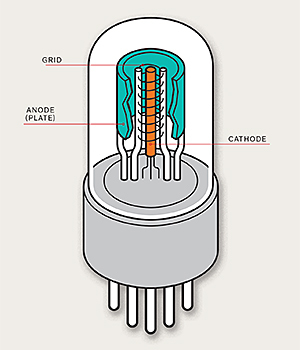 In the second half of the 20th century, silicon transistors (MOSFETs) completely replaced radio tubes in electronic devices. This is quite natural, taking into account the numerous advantages of semiconductors: miniature, low cost, efficiency, strength, reliability, and most importantly - an efficient process for the chemical etching of transistors in integrated circuits. The technology has allowed the creation of chips with billions of transistors. Over the years, they became smaller, the distance between the source and the drain was reduced, due to which the productivity of electronics increased (Moore's law).
Despite these shortcomings, electron tubes have certain advantages over transistors: vacuum itself is a better medium for electron transfer than a solid body, where interference occurs due to collisions of electrons with atoms of the material, noise and distortion. In addition, radio tubes are more resistant to radiation damage.
If vacuum were used in conventional transistors, it would be possible to combine the advantages of both technologies. Theoretically, a vacuum transistor can operate at terahertz frequencies, an order of magnitude faster than existing silicon counterparts. Employees at the NASA Ames Research Center have long been experimenting in this direction. They managed to achieve quite promising results, writes IEEE Spectrum.
Silicon microcircuits have come to the physical limits of miniaturization, and now several areas of further development of the technology are being considered: carbon nanotubes, graphene, nanowires, etc. A vacuum channel transistor complements this list.

In a radio tube, an electronic filament, similar to a filament in an incandescent lamp, heats the cathode to such an extent that it emits electrons. This design is the reason for the high energy consumption and low reliability of the radio tubes, which often fade. But there is no filament in the vacuum channel transistor, and the cathode does not need to be heated.
If the device is made in miniature size, field emission becomes possible under the influence of an external electric field without preliminary excitation of electrons.
NASA Ames engineers solved the problem of having a pure vacuum under pressure by reducing the distance between the cathode and anode so that it becomes less than the mean free path of an electron before it collides with a gas molecule. Under normal atmospheric pressure, the mean free path of an electron is about 200 nm. And if you use helium, then it increases to 1 micron. At a sufficiently low voltage, the electrons will not have enough energy to ionize the helium, so that the cathode does not degrade.
The prototype NASA Ames Vacuum Transistor uses a standard silicon dioxide gate to control the transistor, as in the MOSFET.
“Although our work is still at an early stage, we believe that our improvements in the design of vacuum channel transistors may someday have a significant impact on the electronics industry, especially in applications where productivity is important,” the researchers write. “Our first prototype operates at a frequency of 460 GHz, which is about 10 times higher than the best silicon transistor.”
Engineers believe that it is the vacuum transistor that will be the first to overcome the boundary of 1 terahertz.
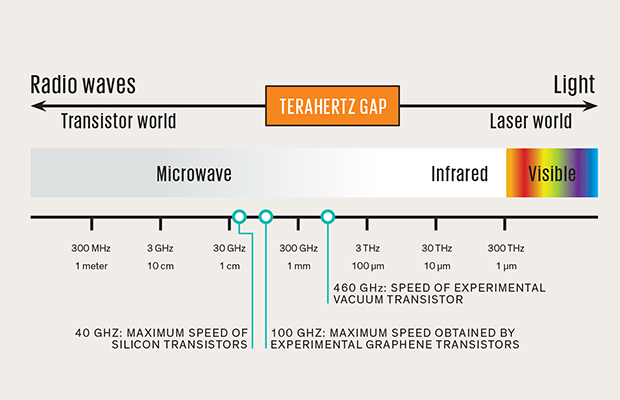
True, it will have to solve several problems, including energy consumption. The NASA Ames Vacuum Transistor is powered by 10 volts. You also need to find a way to place multiple vacuum transistors on a single chip.