June 2, 2014 at 10:54
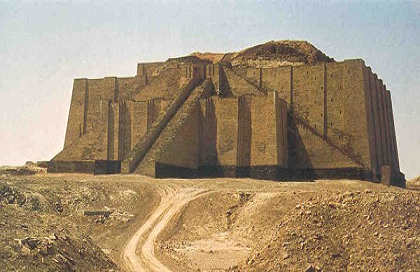
On the outskirts of Ur
 In one instant, see Eternity,
 A huge world - in a grain of sand,
In a single handful - infinity,
And the sky - in a cup of flower.
sir William Blake
One drop of water ... - a person who can think logically can conclude that the Atlantic Ocean or Niagara Falls can exist, even if he has not seen one or the other and has never heard of them.
Sir Arthur Conan Doyle "A Study in Scarlet "
Today, I want to support the initiative of the respected Unlimionand talk about an attempt to restore the rules of the game, which is considered, to date, the oldest of the known games related to moving chips on the board. The boards for this game were found in 1926-1927, by the famous archaeologist Sir Leonard Woolley, during excavations of the ruins of the city-state of Ur in Mesopotamia. The game itself dates from 2600-2500 BC. Since the name of the game is still unknown, it is named after the city in which it was found.
 As is often the case with archaeological finds, quite a lot of sets for the game were found, but how to play them was completely incomprehensible. The set for the game included a board of a very original form, 7 flat chips, for each of the players (one side of each chip was marked with 5 dots), as well as a set of 3 game “dice”. The bones were also unusual. Each of them was a tetrahedron , two of the four peaks of which were painted white. A little later, archaeologist Irwin Finkel found a clay tablet with a set of rules.
 However, she did not bring any particular clarity. Only a few can read it in our time, and the ancient chroniclers, apparently, did not particularly bother to describe the issues that they considered obvious. In addition, there is generally no certainty that the tablet found described the same game. At the same time, the question of the rules was acute, since the British Museum was very interested in selling souvenir copies of the game. Archaeologists have proposed several options , which, unfortunately, had one "fatal flaw." These, in many respects, certainly highly respected people, apparently, never tried to play by the rules that they proposed. To fix this annoying oversight, our compatriot, science fiction writer, board game historian and just a very good person tookDmitry Skiryuk . I will say right away that of all the proposed options for the rules, its option seems to me the most interesting, in terms of games. Dmitry’s
 article is an excellent example of the application of the “deductive method” in real life and would honor Sherlock Holmes himself. In my opinion, he proposed rules that explain almost everything:
- The strange shape of the board and its layout
- Using flat chips to play
- Using chip notes
- Unusual set of game "dice"
The gameplay of the resulting game is great. Of course, it is possible that the ancient Sumerians played it differently, but, in this case, I believe that they simply punished themselves. After getting acquainted with the proposed rules, it is simply impossible to imagine that this game can be played differently.

So, each player has seven chips. The goal of the game is to draw each of the chips along the path shown above, removing them, thereby, from the board. To perform the last move, removing the chip from the board, an “accurate” throw is required. It is easy to see that along the central (common for players) line, each chip moves first towards the small block, and then, in the opposite direction.
In order not to get confused in the directions of movement, after passing the “transformation field” (the extreme cell closest to the player in the small block), the chip is flipped over. Chips can “chop” each other by standing on a busy square (the cut chip is returned to the player’s starting set), but Dmitry suggests that only the same chips can chop each other - the inverted one cannot “chop” the unverted one and vice versa. From myself I can see that this really makes the game more interesting. In some cases, enemy chips represent a target, in others an obstacle.
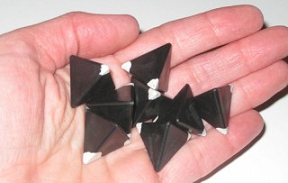 The number of steps a chip can move determines the roll of “bones”. Dmitry offers the following interpretation of the results of these throws:
- One pyramid of three fell with a white top up - you can move any chip by one cell or put one of the chips of the starter set on the first field of the board
- Two white vertices up - two cells or putting a new chip on the second cell
- Three white peaks - move on three squares or the third position in the direction of movement on the board
- All the pyramids fell black side up - a four-cell move or putting a chip on the first “socket”
A strange set of "bones" is quite meaningful. Instead of three bones with two possible states, one could use one with four (at least the same tetrahedron painted in 4 colors), but, in this case, all possible results of the rolls would be equally probable. In the case of using a set of three bones, one and two-point shots are more likely than the throw of three or four points. This fact directly affects the gameplay.
With this interpretation of moves, “sockets” make sense. Dmitry suggests that stopping at such a cell, the player has the right to make an additional move. Throwing out one “four”, you can quickly run through the entire board, not even giving the enemy the opportunity to move! Even throwing points other than the “fours”, I was able to move 3-4 moves in a row, moving several chips. The game turns into a real battle for the "outlet".
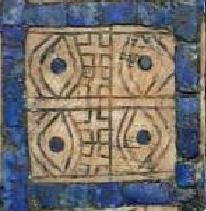 Even in this form, the rules are quite playable, but Dmitry went further, trying to explain the markup of the remaining fields. According to him, the only reason for using flat chips for the game is the ability to install them on top of each other. But the ability to “cut down” enemy chips is also very important tactically. Perhaps it is possible to "cut" chips, but not everywhere? Fields with strange markings with four "eyes" are located in very convenient places that allow you to "unload" the board, avoiding unnecessary "congestion" in the game. According to Dmitry, in these fields, the chips can be arranged in a column, up to four pieces, but provided that they are all the same color. Similarly, fields with markup from four groups of five points can work (I recall that one of the sides of each game chip is marked in the same way).
It is clear that here we enter the field of assumptions, but with the introduction of these rules, the game literally takes on a new dimension. Additionally, Dmitry introduces a rule that does not allow “cutting down” an inverted chip standing on the last cell of the board. Since this field “locks” the output of the upside-down chips from the initial fields, tactically, this rule is also interesting.
Having first read about “Ur,” I set about trying to realize it. In fact, I saw several Senet options, but I could not find any implementation of Ur. But this game is no less interesting! In technical terms, work on the game fully met all my expectations. I had to tinker with the unusual “transformation” of the chips (the chip is not turned over when the transformation is set on the field, but when passing through it) and with building the chips in a column. Those who wish can watch the history of all these ordeals on GitHub . Almost at the curtain, ZoG struck:

At the end of the game, as a result of constant “cutting” and returning to the game of chips, a “critical mass” of repeating positions accumulates. ZoG counts out the third repetition and announces that the game ended in a draw! I can say that it is very disappointing, having almost finished the game, on the last turn, to find out that, according to the program, a draw has occurred. The saddest thing is that you can’t cancel this check (which obviously does not make much sense in games with random generation). You can’t even increase the number of repetitions at which the game ends! This is exactly what I call the dark side of ZRF .
I had to add options for a game with a random opponent (since games for one player are considered as puzzles in ZoG, for obvious reasons, position repetition control is disabled in them), while simultaneously refusing to use the very convenient friend predicate ? (it suddenly turned out that the random house has no friends). In the end, all the problems with the implementation were resolved, bringing back to life a game that, perhaps, was played 5000 years ago.
We forgot a lot ...
But we remember the lost ...
Or create something new