May 16, 2014 at 16:42
Recover Virgin Cyberstorm MK-III Accelerator for Amiga Computers
Epigraph
AMIGAA !! 11
Instead of a foreword
Easy John colleaguefor debugging a homemade peripheral card, he gave me his freshly purchased A4000 with the Cyberstorm MK-III accelerator well known in narrow circles. The accelerator is well-known not only for its “cadillac” of the 68K family of processors - 68060 - but also for nasty problems with the socket of this processor itself. The socket is PGA (pin grid array), and it is soldered to SMD spots, that is, not to the board holes, but to the pads on top. Since the board is quite large, and in the process of installing / removing it, as well as adding / removing memory modules, various physical exercises are applied to it, then in places of such interracial, I would say, rations sooner or later occur a phenomenon named after the famous mountain not far from Kramatorsk. (Everything, everything, I won’t talk about Ukraine anymore)
To business
After working out the day with this setup, and having been tormented, I don’t even know what more - with glitches in my Verilog or with paranormal events from the side of the accelerator - I decided to see if the accelerator was disappointed in life in general and in the socket in particular.

It seems that the cooler is also attached (a practically pointless thing for 060; the processor heats up much less than its older brother 040, and the cooler only makes noise), and the paste is noticeable in some places. Wait a minute, what is it that can be seen there?
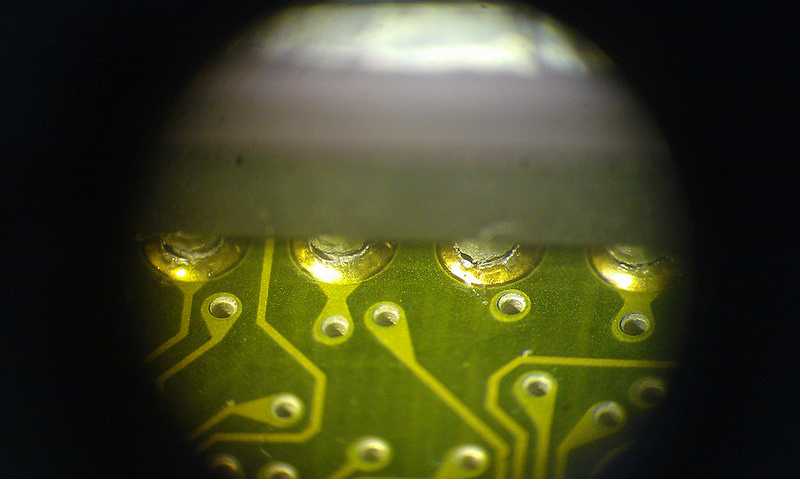
Here it is, the curse of the Baskervilles. In fact, it is known how to treat it: here it is proposed to blow off the socket, and instead to twist a lot of collet nests, something like this:
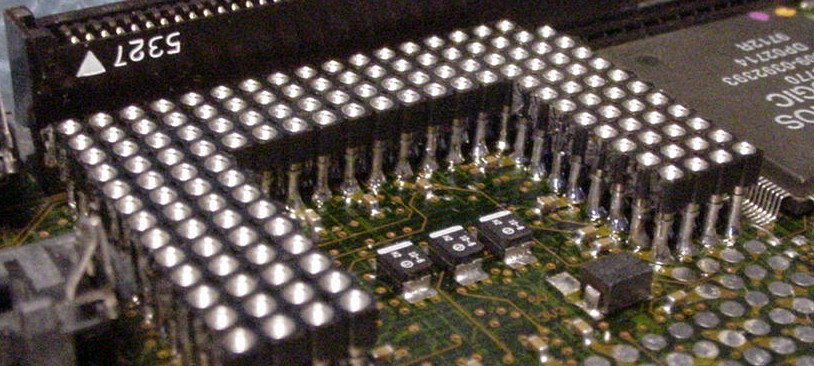
But I was completely unprepared for such a feat (266 cozy nests, a soldering iron, uphill and against the wind). In addition, I didn’t have any nests at hand (and all the more money to buy them in the Chip and Dip boutique), and I wanted to keep the old panel.
Therefore, a Chinese thermostat was removed under the light of God, under a panel where it was possible a non-washing gel flux was filled with the hope that when heated it would spread and moisten everything, including the other legs of the panel, and the delicate parts of the board were glued with aluminum adhesive tape. (As you know, almost everything can be repaired with silver tape - and what cannot be repaired with silver tape cannot be repaired at all. But this is not about that.)
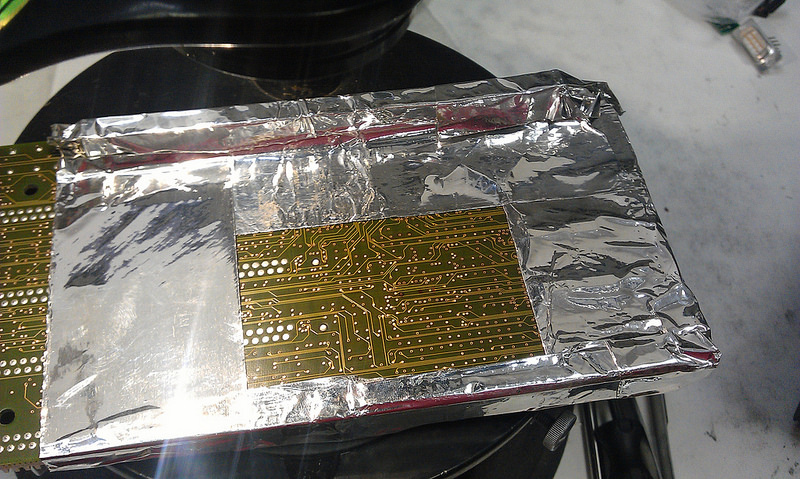
Turn on the thermostat and go to drink tea. The thermostatic, although Chinese, has a Baltic temperament: the heating rate is good if it is 1 degree in 2 seconds. This is so that the boards and parts warm up evenly, without rushing, without different twists and other deformations there. Previously, I trained on a pair of old dead boards, experimentally taking out knowledge of 300 degrees of useful temperature near the surface and 280 degrees of

When everything was well warmed up and the flux began to evaporate intensively, we gently help the top with a hot air gun (without fanaticism!).

Done, let the circuit board cool down and again we touch the eyepieces of the microscope (MBS-1 biological stereo microscope, around the end of the sixties of the last century, a smart thing, if you replace it with an LED backlight):

Well, well:
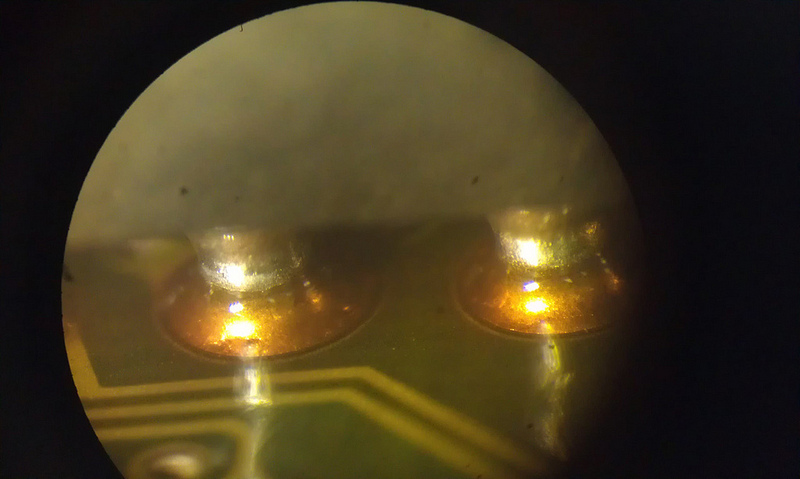
Looks convincing. We put the board on combat duty and see if smoke comes from somewhere. The smoke did not go, everyone is alive and well.
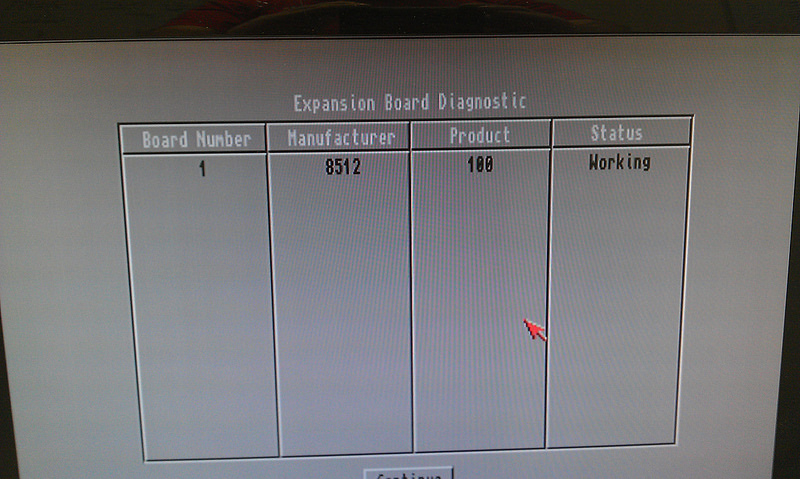
And peace on earth, but good will in man, as St. Luke said on another, incidentally, occasion.