March 19, 2014 at 02:56
ATM. Some features
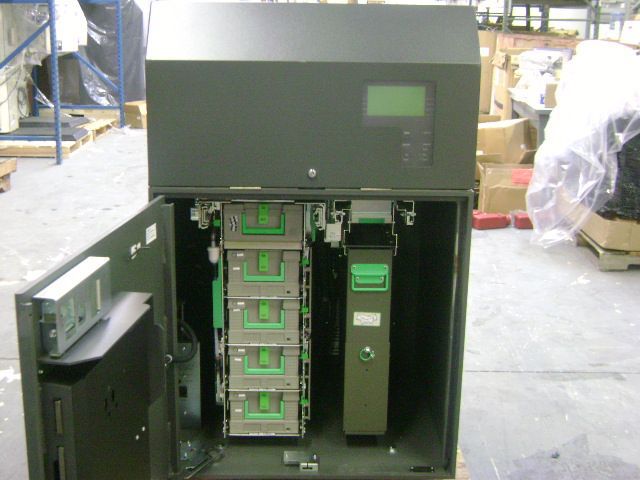
None of us will surprise you with an ATM (ATM) . Even older people are gradually getting used to this device and are able to somehow take off their pension. However, among other things - an ATM is an extremely interesting thing from a technical and organizational point of view. Even employees of banking institutions (including those related to payment cards) do not always imagine the subtleties of his work. In a past life, for many years I was connected with payment cards and ATM service. I had occasion to warm it with a hairdryer and pick out the
Unfortunately, the main emphasis of this activity of mine fell on the period when even a 0.3MP camera on the phone was a considerable luxury - therefore, I have practically no own photos.
40 bills
The ATM issues no more than 40 bills at a time. This is due to the feed mechanism itself. Therefore - when withdrawing money from an ATM - if it displays on the screen “ There are 50, 200 bills ” - and you need to withdraw a large amount - you can immediately figure out how much maximum money the ATM can give you. If you try to enter more than 40 banknotes, the ATM will think and refuse. And you will wonder why.
30 seconds
The response interval for each operation, after the client’s action should be no more than 30 seconds. This is a requirement of international payment systems. The client inserted a card - you can think for 29 seconds and give an answer. Selected a menu item - again, you might think. Etc. Previously, when the connection was not very good, it was an important point. Now - with this easier.
Supervisor White Card

Yes - just that. Comes with every ATM in the kit. Like regular cards, it also has a PIN code and expiration date.
It may be suitable for other ATMs. I can’t provide detailed details here - by mistake I used a card from one ATM for another my ATM and it worked - it should be so or it works within the framework of one processing center (processing center) - I don’t know. It was probably necessary to go to the ATM of another bank and check. But there was reluctance to sit.
So - the card is required to perform cash collection / audit of the ATM and some technical functions - you can give out any number of notes from the cassettes
Brain
In addition to the “system unit” (let's call it that) , the keyboard of an ATM, the card reader unit and the display have their own brains. You can’t just take and connect the details of one ATM to another. When connecting new devices, it is required to enter cryptographic 3DES keys . They are written to these plug-in devices and allow them to work with this particular ATM. Keys are 2 envelopes (like PIN envelopes for regular cards) containing a sequence of numbers. Two people receive the envelope and enter the keys.
Cash cassettes
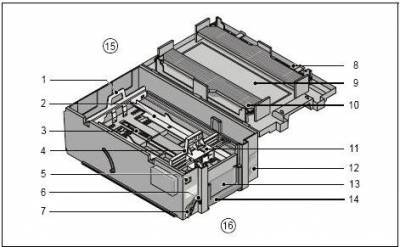
At an ATM, usually 4-6 cassettes with bills. ~ 2.5 thousand banknotes are placed in the cartridge. Each cassette is tuned to a specific banknote. Therefore, even if the ATM cassettes are mixed up in places - the chip in the cassette is still the same - it will not allow you to give out money from there. The reverse side of the coin - if you add fifty dollars to the cassette for twenty - then (with a fair amount of luck - if the characteristics of the notes are more or less similar), the ATM will start issuing notes of a higher denomination. The cashier of the ATM and the cashier can immediately shell out and cover the shortage. It also happened ...
Cassette
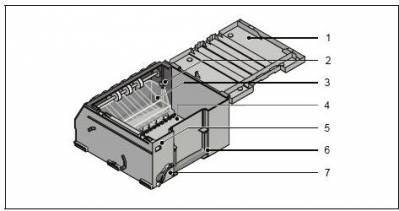
Bonded banknotes, banknotes that the ATM doesn’t like for one reason or another, as well as money that you didn’t take from the issuing slot, are tilted to the culling cassette. In size, it is less than half the standard.
ATM is cold
Outdoor ATM has 100% moisture resistance. However, it is sensitive to cold. In the early ATM models there was no
Seized cards
At an ATM people leave their cards. Sometimes by accident, sometimes - by entering the PIN code incorrectly three times, sometimes - you withdraw money, the voltage disappears - the ATM turns off and, as it were, everything else is optional — you cost as much as you can and wait for your card (which, which is typical when voltage appears - will go outside - and if not you, then someone will pick it up if you have time) or you will go home, and then the ATM will take the card to you. Often, no one applied for cards. For several years we have collected a fair collection of cards of different banks. Including foreign.
Old ATM
A lot of used ATMs from Europe / USA were brought to Ukraine in 2002-2004. Here they were brought into a divine form, they did maintenance and sold to banks. They were approximately 8-12 times cheaper (5-8 thousand dollars) of new modern ATMs (80-110 thousand dollars) . They worked, frankly, lousy, but because the card business was just in its infancy and incomes were small (ATMs are not set up for their customers, but for strangers) - not all banks could afford new ATMs in the required volumes. Therefore, they set what is cheaper. At the ATM there were old CRT monitors with burned out emblems of European banks (previous owners) . The kosher operating system for the ATM of that time was OS / 2.
ATM safe
It stores cassettes with money and a cassette culling. It is, as a rule, a safe with a key and a rotary wheel. The wheel code needs to be changed regularly. It is very unpleasant when, when changing the code and closing the door, you realize that the code does not fit and the safe does not open anymore.
Checks
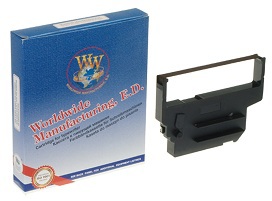
Printers are used matrix (old ATM models) and thermal printers. Paper tape for checks - in bobbins. Usually 2-5 thousand checks on a bobbin. Matrix problem - it's hard to find cartridges. The problem of thermal printers - when it’s cold and you are warming an ATM with a hairdryer - if you get a stream of air on the check tape, there will be a black tape.
Mouse
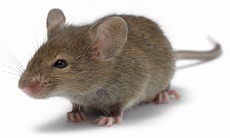
Winter. The ATM was located in the bank branch, but in a distant empty room, and his face stood outside the window. Coldly. The mouse found a loophole (there are a lot of them in ATM - cable entry) and climbed inside to warm up. As a result, the money supply mechanism pressed her heartily. I ended up there because the ATM stopped working and money in the blood was sticking out of the culling cassette. I had to disassemble half of the ATM - in order to get what was left of the mouse and three torn notes. She died the death of the brave, but was with the money.
If the article was interesting, I can continue the topic about banking pieces of iron.
UPD 2014/03/21:
Continued: Card Games
As a Bonus:
Configuration of an old NCR 5684 ATM (for understanding components)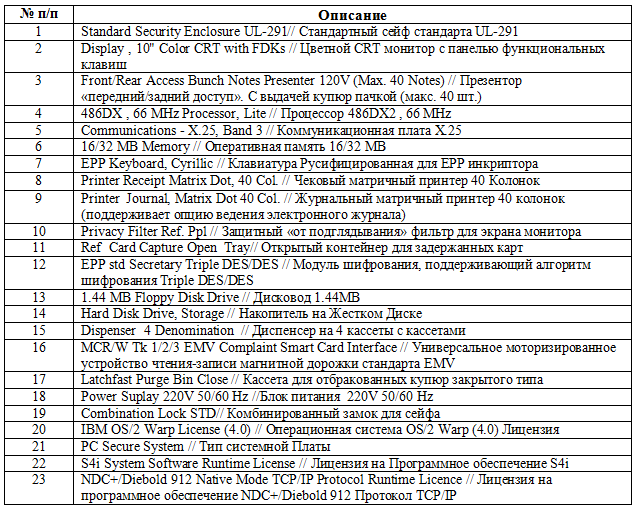
In 2003, such a used ATM cost 46,740 UAH. (8 thousand dollars)