Testing IBM FlashSystem 820
With the current level of development of the IT industry, the performance of servers and storage systems is becoming an increasingly critical factor. Customers are ready to invest more and more to achieve maximum performance. In most cases, the use of flash-based drives can significantly increase the performance of highly loaded applications such as databases, OLTP, OLAP, etc.
In the middle of this year, IBM introduced the FlashSystem line , which includes products that use flash memory. The line includes 4 models: FlashSystem 710 / 720 , 810 / 820 . The models 710 / 720It used SLC, and 810 / 820 more reliable eMLC memory. Distracted from the study of our beloved PCIe SSDs , our test lab temporarily had a demo copy of the FlashSystem 820 model with a capacity of 10 TB for a more detailed acquaintance.


The architecture of this series of storage systems does not have a single point of failure, due to duplication of the main components (PSU, built-in battery, controllers), as well as flash modules with hot swappability. Performance and reliability are the main reasons for using eMLC memory instead of regular MLC in IBM products. Reliable data storage is also provided by IBM Variable Stripe RAID technology.
Testbed configuration:
Platform - IBM X3650 M4
Processor - Xeon E2603
Memory - 8 GB
Hard drives - 3xSAS 146GB 10k We
tested the storage using our standard set of test packages, which we have already used in our articles.
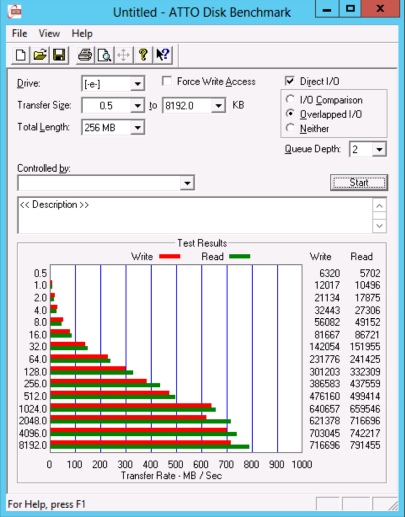
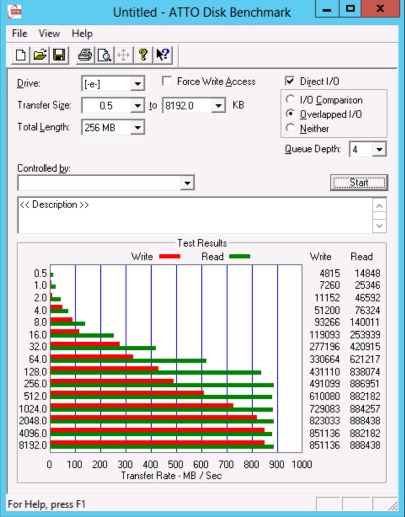
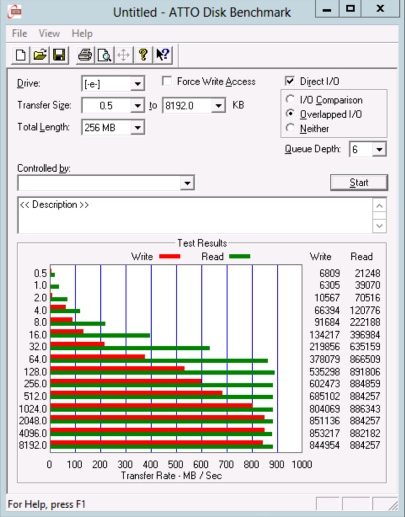
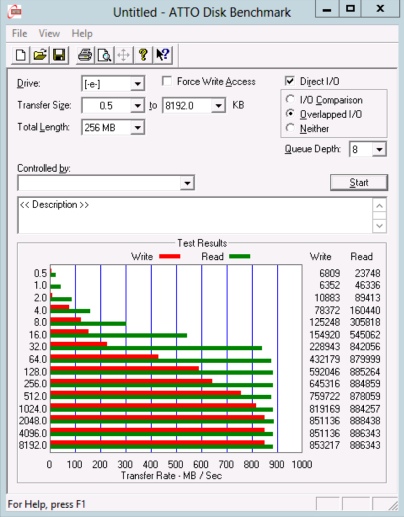
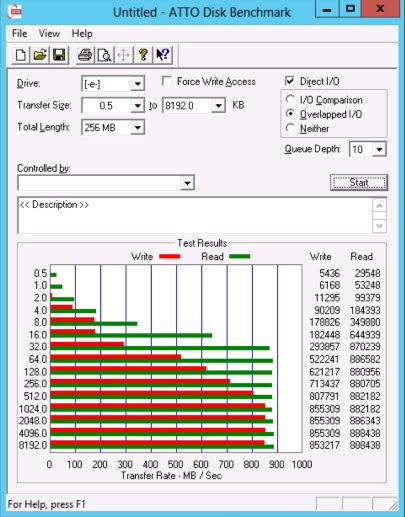
ATTO Disk Benchmark
We tested with the following parameters:
Total Length = 256 Mb
Queue Depth = 2-10
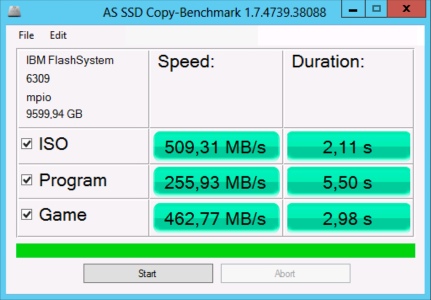
AS SSD Benchmark
CrystalDiskMark

Iometer
For testing, we selected a set of patterns that we had already tested:
As results, the maximum obtained values were selected during testing.

Fio

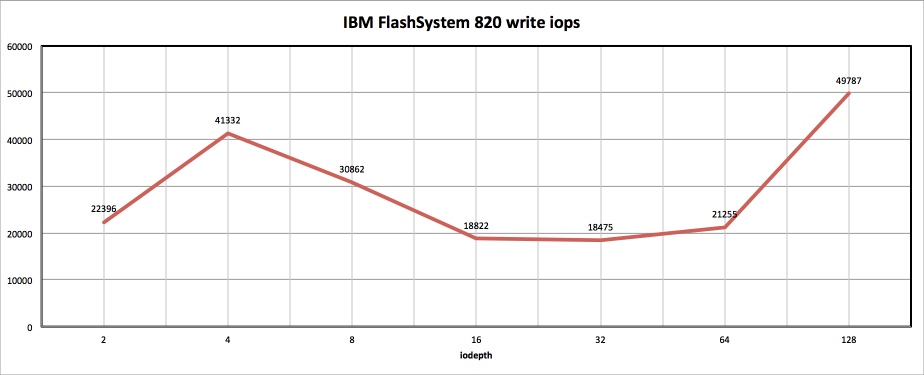
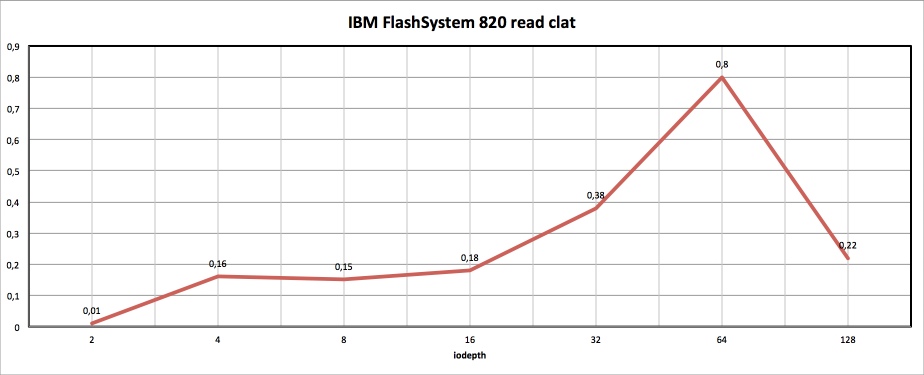
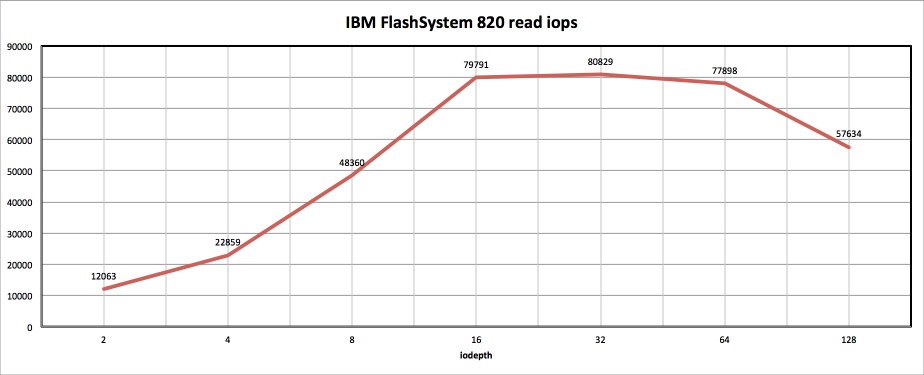
For those who want to see all the numbers with their own eyes, I propose a test log:
iodepth = 2
iodepth = 4
iodepth = 8
iodepth = 16
iodepth = 32
iodepth = 64
iodepth = 128
This time we decided not to publish the results of the SQLIO package test, because that we got too low performance indicators, and no matter how much we played with the test launch parameters (number of threads, requests), we were not able to get reliable information. Unfortunately, storageI stayed with us for a very limited amount of time and we were not able to study in detail what the problem was. I hope that when it falls into our hands again, we will be able to fill this gap.
Flash memory is increasingly entering the corporate market. Now they already exist in various variations, and as SAS disks, as PCIe SSD drives, as a cache in storage systems, etc. Flash memory provides the highest performance, extremely low latency and is an excellent option for those customers who are interested in the performance of a storage system in combination with a large volume.
Posted by Korp
In the middle of this year, IBM introduced the FlashSystem line , which includes products that use flash memory. The line includes 4 models: FlashSystem 710 / 720 , 810 / 820 . The models 710 / 720It used SLC, and 810 / 820 more reliable eMLC memory. Distracted from the study of our beloved PCIe SSDs , our test lab temporarily had a demo copy of the FlashSystem 820 model with a capacity of 10 TB for a more detailed acquaintance.
Features:
- IBM Variable Stripe Redundant Array of Independent Disks (RAID) technology allows you to reduce system interruptions without sacrificing performance or available capacity
- Faster decision making across multiple applications, including online transaction processing (OLTP) and online data analysis (OLAP) databases
- Extremely high density 1U storage systems help improve IT infrastructure efficiency and throughput, as well as I / O per second without compromising response speed
- Eco-friendly storage that provides fast data access with low power consumption offers tremendous benefits
- Starting to get a return on investment almost immediately thanks to the rapid deployment of the system.
- Ability to use flash memory with single-level cells (SLC) or enterprise-class modules with multi-level memory cells (eMLC)
- Allows organizations to quickly analyze data using both traditional tools and new technologies developed for Big Data analysis
- Scalable storage devices save space and energy.
The architecture of this series of storage systems does not have a single point of failure, due to duplication of the main components (PSU, built-in battery, controllers), as well as flash modules with hot swappability. Performance and reliability are the main reasons for using eMLC memory instead of regular MLC in IBM products. Reliable data storage is also provided by IBM Variable Stripe RAID technology.
IBM Variable Stripe RAID (VSR)
- Patented technology for resizing stripe in RAID
- If one chip on a chip fails, this chip is bypassed, the data is distributed over the remaining chips
- VSR reduces flash maintenance requirements
Testbed configuration:
Platform - IBM X3650 M4
Processor - Xeon E2603
Memory - 8 GB
Hard drives - 3xSAS 146GB 10k We
tested the storage using our standard set of test packages, which we have already used in our articles.
ATTO Disk Benchmark
We tested with the following parameters:
Total Length = 256 Mb
Queue Depth = 2-10
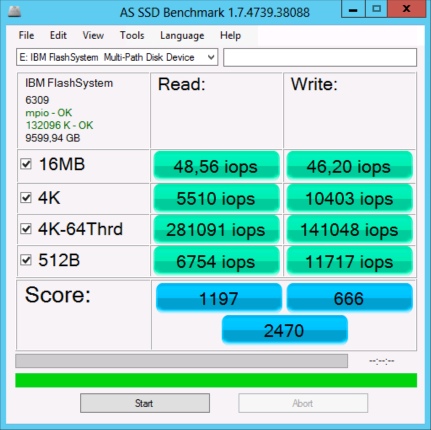
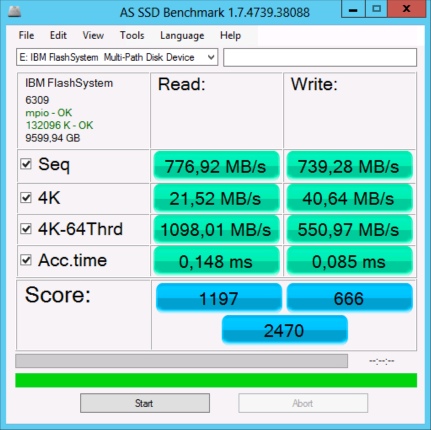
AS SSD Benchmark
CrystalDiskMark
Iometer
For testing, we selected a set of patterns that we had already tested:
- Database
- File server
- Workstation
- Webserver
As results, the maximum obtained values were selected during testing.
Fio
For those who want to see all the numbers with their own eyes, I propose a test log:
iodepth = 2
iodepth = 4
iodepth = 8
iodepth = 16
iodepth = 32
iodepth = 64
iodepth = 128
This time we decided not to publish the results of the SQLIO package test, because that we got too low performance indicators, and no matter how much we played with the test launch parameters (number of threads, requests), we were not able to get reliable information. Unfortunately, storageI stayed with us for a very limited amount of time and we were not able to study in detail what the problem was. I hope that when it falls into our hands again, we will be able to fill this gap.
Flash memory is increasingly entering the corporate market. Now they already exist in various variations, and as SAS disks, as PCIe SSD drives, as a cache in storage systems, etc. Flash memory provides the highest performance, extremely low latency and is an excellent option for those customers who are interested in the performance of a storage system in combination with a large volume.
Posted by Korp