Lenovo: third (or fourth) place on the smartphone market
Last week, several analytical companies published the results of their research on the global smartphone market in the second quarter of 2013.
Perhaps the most curious moment that has found a place in the IDC and Canalys reports is Lenovo’s position. Both offices said that from now on, the Chinese manufacturer (though not quite the manufacturer - Lenovo does not have its own factories for assembling smartphones, the devices are manufactured under a contractual scheme) is one of the five largest smartphone suppliers in the world. For the first time in its history.
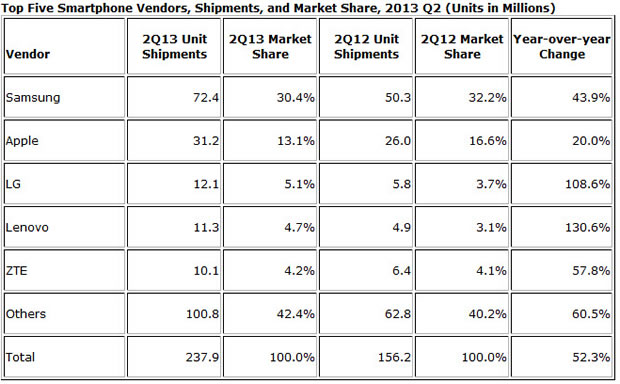
More interesting. Here is a label compiled by IDC:
And here is her “sister” published by Canalys:
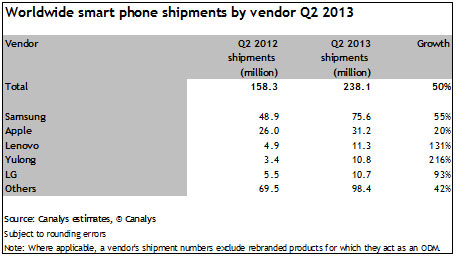
It is easy to notice that the sales volumes of Samsung and Apple are comparable in both reports, but the data for LG differ markedly. The number of devices sold by Lenovo is the same, but due to differences in estimates of LG shipments, IDC put Lenovo in fourth place, while Canalys in third. At the same time, ZTE did not enter the TOP-5 suppliers according to Canalys, which took fifth place at IDC.
One way or another, Lenovo is truly in the lead. True, leadership is, in fact, limited to the native China, where Lenovo has second place with 12.3%. (The first is at Samsung with 17.6%.) It is easy to calculate that Lenovo sells about 95% of its smartphones in the Chinese market. In fact, in addition to China, Lenovo models are sold only in Russia and a couple of countries with a distribution model of sales. Meanwhile, carrier markets such as Japan, Europe and Lenovo, the most coveted USA, are not yet subject to it, they need to be able to work with telecommunication companies (read, local operators), and Lenovo does not have such experience. But in China, everything is simpler: the giant China Mobile relies on cheap smartphones with support for TD-SCDMA networks (this is 3G, if anyone does not know), and is happy to work with Lenovo. And with Yulong too. (The only question is
In general, entry-level smartphones are the backbone of the Lenovo lineup. According to their characteristics, they differ little from the products of local Russian brands - the kingdom of MediaTek, two SIM-cards and all that. There are, of course, more interesting solutions - like the Lenovo IdeaPhone K900 with an Intel Atom processor, a metal case and a Full HD screen. True, according to eyewitnesses (are there any lucky owners here), this model was created under the leadership of Intel, and was created, so to speak, in a hurry: it crammed all the best that is on the market, but only the “glue” was chosen not successful. Read - it’s like a top kit, but it’s difficult to use. Because Lenovo, again, has no experience in creating top-class solutions.
By the way, a curious story is connected with the Lenovo mobile division. In 2008, the company sold its telephone division Lenovo Mobile Communication Technology to a group of investors led by the Hony Capital fund. The new owners for the year released a number of models under the Lenovo brand, and in December 2009, Lenovo, which decided to re-engage in the production of communications, bought the unit back. For a long time, dozens of purely Chinese “clone” phones hung on the Chinese Lenovo Mobile website (some resembled Samsung models, others copied Sony Ericsson phones), and then Lenovo SUDDENLY grabbed onto smartphones. I mean that a serious approach to telecom from Lenovo, with all due respect to it (and it is, and not imaginary at all), is still missing. It is "grown" for years, if not decades.
And finally, I’ll say the following: Canalys claims that the five largest Chinese “smartphone” brands - Lenovo, Yulong, Huawei, ZTE and Xiaomi - in total control 20% of the global smartphone market. A year earlier it was 15%. It’s scary to imagine what will happen in 2014 ...
Perhaps the most curious moment that has found a place in the IDC and Canalys reports is Lenovo’s position. Both offices said that from now on, the Chinese manufacturer (though not quite the manufacturer - Lenovo does not have its own factories for assembling smartphones, the devices are manufactured under a contractual scheme) is one of the five largest smartphone suppliers in the world. For the first time in its history.
More interesting. Here is a label compiled by IDC:
And here is her “sister” published by Canalys:
It is easy to notice that the sales volumes of Samsung and Apple are comparable in both reports, but the data for LG differ markedly. The number of devices sold by Lenovo is the same, but due to differences in estimates of LG shipments, IDC put Lenovo in fourth place, while Canalys in third. At the same time, ZTE did not enter the TOP-5 suppliers according to Canalys, which took fifth place at IDC.
One way or another, Lenovo is truly in the lead. True, leadership is, in fact, limited to the native China, where Lenovo has second place with 12.3%. (The first is at Samsung with 17.6%.) It is easy to calculate that Lenovo sells about 95% of its smartphones in the Chinese market. In fact, in addition to China, Lenovo models are sold only in Russia and a couple of countries with a distribution model of sales. Meanwhile, carrier markets such as Japan, Europe and Lenovo, the most coveted USA, are not yet subject to it, they need to be able to work with telecommunication companies (read, local operators), and Lenovo does not have such experience. But in China, everything is simpler: the giant China Mobile relies on cheap smartphones with support for TD-SCDMA networks (this is 3G, if anyone does not know), and is happy to work with Lenovo. And with Yulong too. (The only question is
In general, entry-level smartphones are the backbone of the Lenovo lineup. According to their characteristics, they differ little from the products of local Russian brands - the kingdom of MediaTek, two SIM-cards and all that. There are, of course, more interesting solutions - like the Lenovo IdeaPhone K900 with an Intel Atom processor, a metal case and a Full HD screen. True, according to eyewitnesses (are there any lucky owners here), this model was created under the leadership of Intel, and was created, so to speak, in a hurry: it crammed all the best that is on the market, but only the “glue” was chosen not successful. Read - it’s like a top kit, but it’s difficult to use. Because Lenovo, again, has no experience in creating top-class solutions.
By the way, a curious story is connected with the Lenovo mobile division. In 2008, the company sold its telephone division Lenovo Mobile Communication Technology to a group of investors led by the Hony Capital fund. The new owners for the year released a number of models under the Lenovo brand, and in December 2009, Lenovo, which decided to re-engage in the production of communications, bought the unit back. For a long time, dozens of purely Chinese “clone” phones hung on the Chinese Lenovo Mobile website (some resembled Samsung models, others copied Sony Ericsson phones), and then Lenovo SUDDENLY grabbed onto smartphones. I mean that a serious approach to telecom from Lenovo, with all due respect to it (and it is, and not imaginary at all), is still missing. It is "grown" for years, if not decades.
And finally, I’ll say the following: Canalys claims that the five largest Chinese “smartphone” brands - Lenovo, Yulong, Huawei, ZTE and Xiaomi - in total control 20% of the global smartphone market. A year earlier it was 15%. It’s scary to imagine what will happen in 2014 ...