April 17, 2013 at 01:31
Lexicon and Pirates
Legend has it that the prototype of the Lexicon, the multi-window editor of E-9, was conceived by a young employee of the USSR Academy of Sciences Zhenya Veselov during the holidays of the pre-perestroika 84th on the Crimean beach, and in order to speed up testing, the author once exposed a bottle of beer to users who discovered errors. Although the method paid off and the program quickly became operational, it is regrettable to note that the marketing policy of subsequent copyright holders is not so fresh - they no longer give beer. Soon typing in Russian and understandable without studying in special courses, the Lexicon spread widely throughout the country, becoming a "Russian folk text editor." Technical revolutions in the field of computers have passed and are coming again, the USSR has disappeared,This is the story of Grigory Schmerling, who joined the development of the Lexicon a little later, and in the end, was the “Lexicon Project Manager”.
Without a doubt, Lexicon is a legendary software product. But he did not immediately become such; but having become, he did not stay too long.
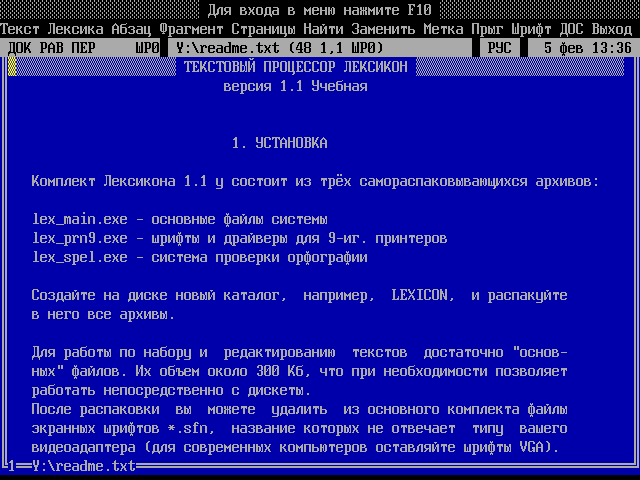
In 1990, the Lexicon is mentioned among the "well-known application systems" along with Lettrix- a resident driver of the American development, which intercepted the output of text to a printer, and replaced it with graphic output using custom fonts. The name LEXICON in that article was typed in Latin, and it is not clear whether its author was aware that the Lexicon was created by his compatriots, and not “expropriated from the bourgeoisie” along with most of the software of that time. The Lexicon did not have any organized “distribution model” at that time - everyone wrote it off from a neighbor along with a pile of other “useful programs”, without thinking for a minute where these programs came from and whether the developer would expect a bribe for their use.
Which developer? Where? Somewhere overseas? Wow, the capitalists are snickering! (shakes fist)
Article "How to sell programs in Russia, or Berries of the commercial director "Olga Uskova from Cognitive Technologies (next time I want to upload her article in its entirety) refers to 1995, but it starts in a similar spirit:" One and a half years ago in Russia there was an idea that the program - This is such a thing that scholarly cranks or naive foreign companies provide free to resourceful Russian users. To have a licensed copy was considered as embarrassing as buying a ticket on public transport or observing traffic rules. the psychological aspects of this problem would have to start from the time of Ivan the Terrible ... "
Meanwhile, Veselov’s team and the Lexicon roamed in search of financing from one optimistic cooperative to another, and as a result, they entered into an alliance with the Soviet-Hungarian joint venture Microinform, which until then was engaged in the sale of computer equipment and computer courses. The fruitful cooperation of programmers and businessmen was crowned with the release in 1992 of elegant boxes with the Lexicon version 8.96, renamed Lexicon 1.0 on this occasion. Only from this moment did the development of the Lexicon become a commercial enterprise, and illegal copying began to worry developers (or rather, their sponsors in Microinform). Initially, Veselov’s motives were much simpler - “I wanted to write something better just to make it easier to enter and edit my own programs and articles. The result is an E-9 editor,


News note on ComputerPress 9'92:
Registration of illegal users of the Lexicon text editor
MIKROINFORM has decided to legalize unregistered users of LEXICON. This decision is justified by the fact that the company recognizes that in conditions of legal uncertainty. to date, copyright infringement was unintentional.
All registered users are provided with a range of services to support the product and discounts when purchasing new versions.
In April 1992, at COMTEK 92, MIKROINFORM presented a new - industrial - version of the LEXICON text editor. It is called LEXICON 1.0.
Unlike previous versions, LEXICON 1.0 has a complete presentation (packaging, documentation) and in terms of functionality exceeds them in many respects. In particular, LEXICON 1.0 includes expanded support for dot-matrix and laser printers, the ability to use index, mathematical and Greek fonts, a set of converters for converting files prepared in LEXICON to Xerox Ventura Publisher and Microsoft Word formats. LEXICON 1.0 uses advanced font and printer driver formats, so it is not possible to use these drivers and fonts for previous versions (6.67 and 8.92).
Focusing mainly on the domestic market, MICROINFORM prepared national versions of LEXICON 1.0 with the possibility of simultaneous processing of at least 3 different languages within one document. Currently MIKROINFORM supplies the Armenian, Belarusian, Georgian, Kazakh, Uzbek, Ukrainian versions.
By the end of 1992, it is planned to release a new version of LEXICON 2.0 as part of the new window technology.
The telephone number of the user registration group is (095) 233-00-06.
It is not even surprising that Shmerling, who brought to us the legend of Veselov on the Crimean beach, has only one memory in the FIDO7 archive; it refers to 1996 - and then in the "Break-out Hit Parade" in the echo of SU.HUMOR. Second place in this hit parade was taken by the following heart-rending story:
(RU.BBSNEWS) The silver bummer of the current issue belongs to Cherlite BBS sysop Jan Chernyak (/ 6xx). Chernyak’s name was mentioned on the pages of the PC-WEEK newspaper, but - alas - it did not bring him any joy, since the article where Ian was featured was devoted to piracy. Someone Grigory Schmerling, an employee of Microinform, investigated several Moscow BBS-ok for the presence of the stolen “Lexicon” there. He told the general public about the results of the audit. Among the pirate "boards" was Cherlite. Ian decided to close BBS “in connection with the denunciation of PC-WEEK.” I will not comment on this bummer, since everyone has a different attitude to piracy and depends on the thickness of the wallet. And I do not want to talk about my wallet.

In addition to stigmatizing the pirates, G. Schmerling and Olga Dergunova (now Deputy Minister of the Russian Federation , and then Director of Sales and Marketing at Microinform) gave interviews for the media on behalf of the developers of the Lexicon, sincerely respected by all the foremost leaders of the domestic software industry:
(ComputerPress 8'92)
N perhaps everyone in our country, if they didn’t work with him, at least heard about the Lexicon text editor. Probably, many are aware of the existence of an integrated Master package. From this issue we begin to print a series of articles about the above products, as well as about their developers.
JV "Microinform". Faithful path, gentlemen, comrades!
Start
On June 23, 1988, the USSR Ministry of Finance registered the 60th joint venture. The founder of the joint venture on the Soviet side was the Central Interdepartmental Institute for Advanced Studies of senior executives and construction specialists (51% of the million registered capital), and on the foreign side, the Hungarian company Telefondiar. The new enterprise is called Microinform. There were 10 people in the staff at that time, but even they were hardly accommodated in several rooms of the old house No. 3 on Kozhevnicheskaya Street.
Three years later, Mikroinform celebrated a housewarming party, investing 3 million foreign currency in the repair and restoration of a dilapidated building. Now the company is housed in a beautiful four-story mansion on Ostrovsky Street, 44. Obviously, the marriage concluded in the summer of 88 was calculated to be successful!
Computers
Question: What could earn such money in 3 years?
Answer:Of course on computers! But ... not everything is so simple (otherwise there would be nothing to write about). Listen to what Boris Mikhail Fridman, General Director of Microinform, says about his company: “We set ourselves the goal of providing the country with products that are equally competitive with foreign products. For the production of computers, there is a source base, components, and technology — all that is needed is a mechanism, a structure for realizing the available capabilities. We are not ready yet to organize even assembly production in the country. Today it is more profitable to invest in the rational sharing of the free capacities of high-tech industries available in the West. The components of our fully compatible with IBM AT computers are purchased from leading Western companies, and for the assembly of machines we rent a production line from the German company Soft-tronik, being our partner. Everyone benefits from such an organization of production, and above all, our customers. ”
And you can order a lot of good and different things at Microinform. Having established relations with foreign partners, Mikroinform can acquire and supply the customer with the necessary products from other companies - for example, full-page vertical format monitors and other special equipment for modern computer publishing systems, network equipment.
Equally important is the presence in Microinform of a technical center involved in the installation, maintenance, warranty and post-warranty repair of equipment. In case of technical troubles, clients of the company do not need to look for whom to turn for help.
Software
As a rule, Microinform is not limited to supplying bare machines - customers are offered ready-to-use hardware and software systems. Mikroinform is an official distributor of products from Computer Associates and Rank Xerox, supplying and supporting a number of programs in the USSR. Xerox is famous not only as the founder of photocopiers that made the company name common, but also the development of the Xerox Ventura Publisher publishing system. The version of Ventura Publisher offered on our market is fully Russified and supplied with company documentation in Russian.
Of course. Computer Associates products also deserve attention: the project management system Super Project Expert (a tool for the head of a large organization) and the well-known SuperCalc table processor.
Numerous SuperCalc users are well aware of both its wide capabilities and its main drawback: it is not possible to make signatures and notations in Russian on charts and graphs. This is so, unless ... you do not purchase the SuperCalc 5 package at Microinform, for which the company provides software Russification (HELP, screen and printer graphic fonts), as well as a set of company documentation translated into Russian. Those who are interested in the capabilities of SuperCalc 5 will refer to the article by O.F. Litvin published in ComputerPress No. 4'91.
Master and Lexicon
Perhaps the most interesting aspects of the activity of Microinform are its own software development. The combination under the roof of one small computer supply company and the creation of software would hardly justify itself in a developed market of programs and equipment. However, in our conditions it is more reliable for the customer to get the hardware and software (as well as training and service) from one source, therefore it is such a complete service that has become the basic principle of the work of Microinform.
The main works of Microinform are in line with the technology of the Master software package - a completely original, licensed clean integrated system. A part of this system and at the same time an independently developing product is known to almost all Soviet users of IBM-compatible machines - the Lexicon text editor.
The master and the Lexicon are the brainchild of E.N. Veselov, who this year became the technical director of Microinform.
What is remarkable lexicon? After all, there are much more powerful word processors with rich document processing capabilities, inclusion of graphic illustrations in the text, automated work with the internal structure of the text (chapters and sections, footnotes, links), built-in card files, calculators, etc.
Nevertheless, most users willingly work with the Lexicon - a copy of one or another version of it will be found in our country, probably on every second computer. This is explained by:
- The lexicon is easy to learn, you can start work without any training, gradually accumulating experience and skills;
- with external simplicity of work, he has all the necessary functions of word processing;
- you don’t need to know a word in English for work; on the other hand, you can work with English and mixed texts;
- Almost any printer is suitable for printing: both dot matrix and laser.
Take a look at one of the software sales departments that finally appeared in our large bookstores. A typical picture: luxurious boxes of Western firms are crowded on the shelves, and below, under the glass of the counter, there is a scattering of floppy disks produced by “our own Platons and Newton’s quick minds”, equipped with leaflets with advertisements and explanations that came out from under 9 needles.
Thanks to the collaboration with the Kazan Software Plant, it was finally possible to create not just the next version of the program, but the real Software Product with all its attributes - a user manual, passport and registration card, labels, colorful packaging. It is pleasant to pick up the box with the Lexicon and the Master who followed it and is not ashamed to put it on the window.
Weighty glossy bricks of the Master became an important and rather risky step of Microinform to the civilized market: the Master began to be delivered without copy protection. Since the complete set of the instrumental system is mainly aimed at developers, there is hope that colleagues will prefer the thorny legal path, promising support for the company, on the beaten track of DISKCOPY.
Unfortunately, the Lexicon is still issued only in a protected form - it is too easy to learn and its users are too wide for business or ethical reasons to prevent pirate reproduction. But how much inconvenience and headache bring both “key disks“ and “installations“ to programmers and users ...
But our land is not yet talented! For every defense there are craftsmen who can crack it and hunt for excursions into other people's programs (pockets, apartments - according to their abilities). Unfortunately, legislation still favors computer pickpockets, and homeless copies of programs with a damaged security system roam the country. The authors, instead of improving the programs, are forced to take care of more and more ingenious constipation - otherwise they would soon have to retrain as janitors.
Deprotection does not always go unnoticed. If one day when working with such a copy while writing the typed text to disk, the machine “freezes” and the results of hours of work go to dust - do not blame the viruses, the program or the equipment, it is only your hindsight that is to blame. So, if you have an old or illegal version of the Lexicon on your computer and you like working with this program - get ready and destroy it! Use only legal copies of the program! Even for the most incomplete story about the integrated system, the Master framework of a small article is cramped, about it, as well as about the Lexicon, it will be much more detailed in the next issues of ComputerPress, now only a brief introduction.


The wizard provides the user with the capabilities of a multi-window word processor similar to the Lexicon, a system of interconnected spreadsheets, visualization tools and creating a window type user interface, and, finally, powerful tools for working with databases and a high-level programming language Master. When programming on the Master, you can do literally anything with the DBMS and the information environment, but already the number of functions of the Master is about 200! - says that mastering the system at the language level will take time and effort. However, you don’t have to postpone the start of practical work with the system until the language learning is completed - the “Pilot” program included in the system allows you to perform all the work of creating a database in a dialogue mode without using procedural programming (set the database structure, descriptions of sets and fields, various indexing options, necessary relational relationships). In case of difficulty, you can always refer to the rescue item “Help” in the menu and get a context-sensitive help.
If there are no programmers in your organization at all, and there is a need for a complex specialized software system, it is better to turn to professional "craftsmen" to develop a custom application system.
A number of ready-made systems are also available that work in the environment of the Wizard and are addressed to the end user - economist, engineer, accountant, editor.
To study, study and study, as the Great bequeathed ...
And now we’ll go back to the old communal apartment on Kozhevnicheskaya to talk about the third whale “Microinform” - its training center. It was a bit crowded, to say the least. The entire program and technical department was located in one room fenced with shields and screens, and in order to get to the computer, sometimes it was necessary to solve a chess-like problem with “knight” moves between tables and several castling with colleagues. The next room, the largest, was reserved for a computer class. This class worked with full load from the moment of the birth of Microinform until the day when new spacious halls replaced it.
What can be said today about studying at Microinform? Even an inexperienced neophyte gets a good starting push here. He overcomes the first psychological barrier in working with a computer - after all, a “living” machine is on every table and even in a hotel where Microinform accommodates nonresident listeners. After completing 8-hour classes with a lunch break in a nearby restaurant, it is not forbidden to sit in the classroom until the last programmer has gone home, and this moment at the end of the official working day at 6 p.m. often drags on until midnight.
Skills of confident work with the Lexicon and SuperCalc will allow the listener, returning to his native enterprise, to immediately please his superiors with the quick preparation of business calculations and documents instead of endlessly stacking Tetris cubes or wandering through villainous dungeons and star wars. Having also received some knowledge about the beginning of all beginnings - the MS-DOS operating system and database management systems and integrated environments (using the classical dBASEIII + and the Wizard as examples), the listener will be able to consciously approach the choice of software tools for solving more complex problems and to cope with their development. As for specialists, experienced users and programmers, for them, the head of the training center, O.F. Litvin, has the following menu:


- system support, operation and repair of personal computers,
- LAN installation and administration, Novell software, application systems on the network;
- development of data processing programs in C;
- development of interactive information systems in the DBMS, Clipper DBMS environment, in the Master tool system;
- Ventura Publisher desktop publishing system.
Particularly worth mentioning is the collaboration with Novell: at the Microinform training center, a red banner with the inscription “Novell Education“ proudly flutters over the authorized class of the company. It trains graduates in computer networks just like in any Novell class in any country in the world.
For dessert, individual and group training for specific target programs is offered. Training at Microinform was conducted by groups of specialists from the ministries of energy and civil aviation, oil industry workers and employees of the Moscow representative office of Rank Xerox.
What awaits us ahead?
And the same thing awaits us ahead, the company is not going to turn off the road on which it has been moving for the fifth year. Future plans of Microinform include expanding the network of existing branches and concluding new contracts for supplying state-of-the-art personal computers to enterprises and farms of the country, and there are also new items such as creating national versions of products that support simultaneous work in three languages. Ukrainian, Kazakh and Georgian versions of the Lexicon have already been prepared, and work is underway on others. A group of system programmers led by Veselov is developing the Master-2 project, which, unlike the previous Master, should not be a closed software system, but an open technology that can be transferred to various window platforms. There is no end to the affairs ahead, but the main thing is
O. Dergunova, G. Schmerling
It is curious that in the boxes with Lexicon 1.x there were five-inch floppy disks, which were already then disused - the more fanciful the advertisement of the Lexicon looks, raising this technological gap to its banner: (December 1992) They write that by 1994 Microinform had released 40,000 boxes, accompanying it with intensive advertising on all channels; but only 25,000 boxes were sold. Not discouraged by the modest success of sales - in fact, after all, the Lexicon was used on almost every domestic computer! - Microinform released Lexicon 2.0 for Windows in 1995, finally on three-inch floppy disks: But here the success was even more modest - along with trophy-free Windows, MS Office came to Russia, supporting the Cyrillic alphabet no worse than the Lexicon. If it makes no difference, why pay?


Microinform curtailed the development of the Lexicon as a loss-making and unpromising product; Then he was bought by Arsenal as part of the Russian Office project.
News article at Computerra, August 1997:
Lexicon is everywhere
Kirill Rozhkovsky
On August 1, Arsenal, a well-known Russian manufacturer of office applications, announced the release of a developer toolkit called the Lexicon — the Viewer Toolkit, which can be used to create a window for viewing and printing text documents in any application. The package is a set of dynamic libraries for Windows 3.1 / 95 / NT.
Lexicon — The Viewer Toolkit allows you to create programs that can open and save text files in the doc (Word 6.0 / 7.0), rtf, txt, and Lexicon 97 and Lexicon for DOS formats. In programs created using the Viewer Toolkit, you can select text and copy it to the Clipboard, search for words and phrases in the text, change the display scale of the document, print the document or part of it.
The package contains 16- and 32-bit libraries (DLL, LIB) for Windows 3.1 and Windows 95 and NT, respectively.
In September, Arsenal intends to release another product, the Lexicon — the Editor Toolkit, with which software manufacturers will be able to embed a fully functional text editor in their applications. The estimated cost of the package is $ 500. (Pay attention at the same time, how even it was customary to set the price for a fully domestic product in dollars. Well, and for the advertisement: “The presence of analog and digital lines with access speeds up to 56 Kb / s. Enter our world for only $ 42 per month without traffic and time accounting. ”It is no less symbolic that the Netscape window was the symbol of the Internet - IE captured the minds only later.)

Subsequently, Arsenal released several more Lexicon and near-lexicon utilities releases - but could not find a niche not occupied by “shareware” foreign products, primarily MS Office. The irony is that Schmerling led the development of new versions of the legendary editor in the Arsenal, and Dergunova switched to the side of the “Lexicon killers”, leading the Microsoft office in Russia and the CIS.
In September 2001, Lexicon 5.1 was released. This version is the latest. Soon, in 2004, the Arsenal itself was gone.