Features and Benefits of Freecooling Technology in EcoBreeze Data Center Cooling System
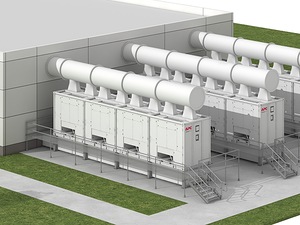 At the end of September, APC by Schneider Electric held a press conference in Moscow dedicated to the start of deliveries of the EcoBreeze modular cooling system to Russia. This system is ideal for countries with cold climates and is the most energy-efficient solution among all currently known options. The use of EcoBreeze for cooling large data centers can significantly reduce the need for electricity and reduce the cost of maintaining the system itself. What is the EcoBreeze solution and what role does “free cooling” or freecooling play in improving cooling efficiency? Let's try to figure it out.
Before looking directly at the EcoBreeze solution itself, let us recall the interesting features of modern data center cooling systems. Most of them have rather high energy consumption, because most of the time the compressor is involved.
Until recently, even the best data centers had an energy efficiency coefficient of about 1.6, and the worst showed an indicator equal to 3. The PUE coefficient (Power Usage Effectiveness - the ratio of the total power supplied to the data center to the usable power reaching the consumer) equal to 3 means that every kilowatt consumed by the servers, another 2 kilowatts is uselessly consumed by engineering systems due to the inefficiency of their work.

Far from being a rarity, there are also such data centers in which the fans of the air conditioning system, delivering air to the servers through a narrow space, consume more electricity than the server racks cooled by them.
A year ago, it was simply impossible to obtain an energy efficiency coefficient of less than 1.3 or 1.4 on the most efficient technologies that have become industrially distributed. Currently, thanks to the EcoBreeze solution, this indicator has been reduced to 1.25.
The main engineering systems that ensure the functioning of the data center and consume the most energy are the power supply system and the air conditioning system. The power supply system over the past few years has completely changed and at the moment its contribution to the total energy loss is minimal. Currently, energy security of data centers is provided by UPS with very low losses, the efficiency of which is about 97-98%. Thus, in addition to computer systems, the main contributor to the overall energy consumption of computer centers is the cooling system. And it is precisely the transformation of this system that will reduce energy costs and increase energy efficiency.
How can you improve the efficiency of the cooling system and at the same time reduce energy consumption? The solution turned out to be simple - it’s cheaper to use cold ambient air to cool servers. This technology is called “free cooling” or free cooling, and it is based on air heat transfer without mixing the outside and inside air.
Freecooling
At high outside temperatures: Carnot cycle (compressor)
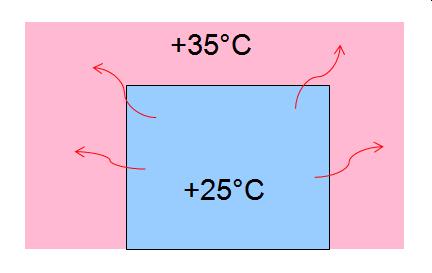
At low outside temperatures: free heat transfer from a more to less heated environment
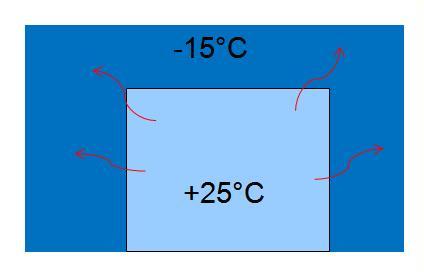
There are several schemes for implementing freecooling, as shown in the illustrations below.
Examples of freezing implementations:
Outdoor air freecooling
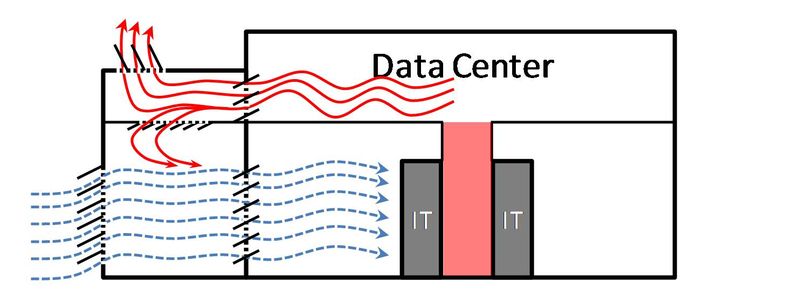
Freecooling using a precision air conditioner with two heat exchangers

Freecooling using a heat wheel
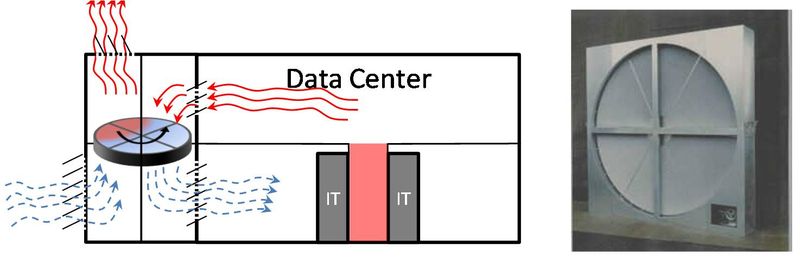
The EcoBreeze system combines the best freecooling technology and takes advantage of the local climate. Depending on the situation, the system can automatically switch to one of three cooling methods.
Direct air heat exchange - hot air from the computer equipment of the data center is pumped by electronically switched fans through the internal channels of the indirect evaporative cooler (IEC), after the initial cooling, the air from the computer equipment leaves IEC, passes through the heat exchanger of the cooling system and returns to the data center.
Direct heat exchange
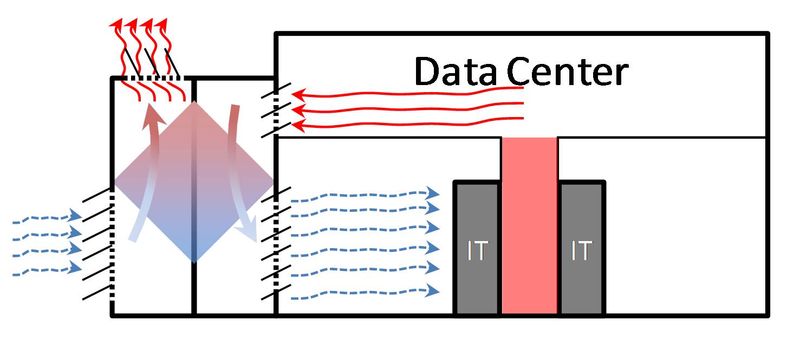
Indirect evaporative heat transfer - heat from the air coming from the data center premises is removed due to the evaporation of water on the outer surface of the channels of the air-air heat exchanger.
Evaporative Heat Transfer Scheme
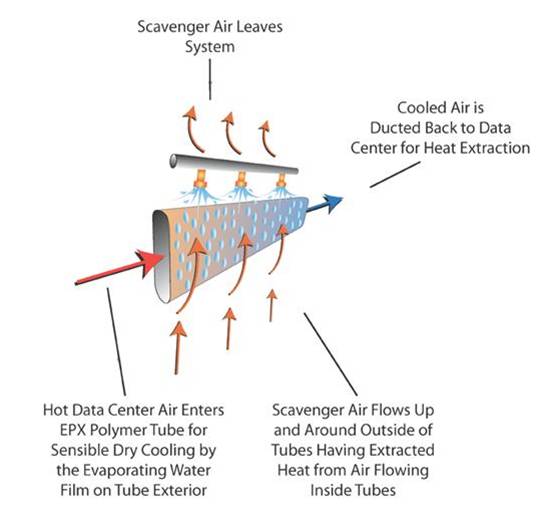
• Heat is removed by evaporating water on the outside of the heat exchanger channel.
• Water is supplied evenly by spray nozzles over the entire area of the heat exchanger.
• Supports setting the amount of air supplied
When the ambient temperature exceeds a threshold of 7 ° C (this value can be adjusted depending on the air parameters in the data center), additional irrigation is connected, and at a temperature of 27 ° C (the value can also change depending on the data center parameters) proportional freon circuit.
Proportional circuit design
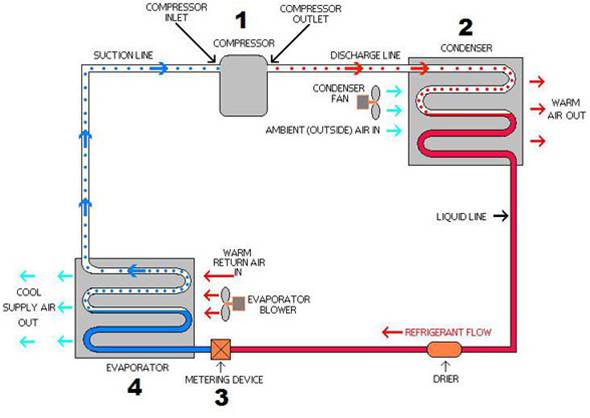
• Variable power compressor achieves optimal freon cooling efficiency
• Supplements evaporative cooling to maintain supply air temperature
• Designed for 60% full load
• R410a freon refrigerant
Thus, at low temperatures the system can do without water and without freon working only in ambient air. When the temperature and the amount of outside air is not enough to maintain a given temperature of the air supplied to the data center, an irrigation system is connected. If the connected system with additional irrigation ceases to provide the specified temperature regime, the compressor system comes into effect.
EcoBreeze Cooling System
The EcoBreeze cooling system is built on a modular basis and consists of units with a cooling capacity of up to 50 kW, which can be combined into groups of up to four (200 kW) or eight (400 kW) modules.

Combining several modules into a system allows you to choose the cooling system required for each particular case and avoid unnecessary costs.
The use of EcoBreeze in conjunction with other energy-efficient components of the data center engineering infrastructure allows achieving average annual PUE values of the entire data center within 1.25-1.3. The possibility of combining the three cooling methods makes it possible to obtain a refrigeration coefficient unattainable for traditional cooling systems. When reducing the load on the cooling system, for example, when building a fail-safe system of level 2N, the effectiveness of this solution only increases due to the fact that free cooling works almost all year round without connecting a compressor system.
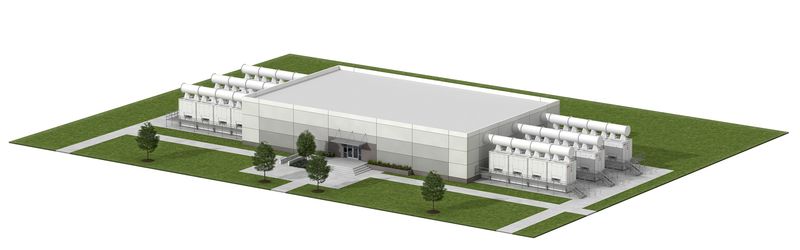
EcoBreeze has many fundamental differences compared to the classic air conditioning systems used for data centers. The entire air conditioning system extends beyond the data center, and if earlier in the cooling systems used perimeter air conditioners that supplied air under the raised floor, or intra-row cooling systems that were built in between the racks, this solution was still built into the data center and occupied such a scarce free space . EcoBreeze is designed in such a way that all its elements are outside the main hall of the data center. The system can be installed on the ground, next to the data center or on the roof of the building, directly above the engine room. Another important feature of the EcoBreeze system is its modularity and support for scalability. When,
Flow diagram of EcoBreeze cooling system with raised floor

When constructing a cooling system with raised floor, air circulation is carried out as follows: the hot air generated by the servers is limited by the Hot Aisle Containment System (HACS, by the way, the technology is patented by APC by Schneider Electric ), then it rises to the ceiling and is fed into the return system of the EcoBreeze pipes where it is cooled, after which it is fed back to the data center through the space under the raised floor in the “cold” corridor. Cold air is fed into the cold aisle and is used to maintain a safe temperature for server operation.
EcoBreeze cooling system air flow diagram without raised floor
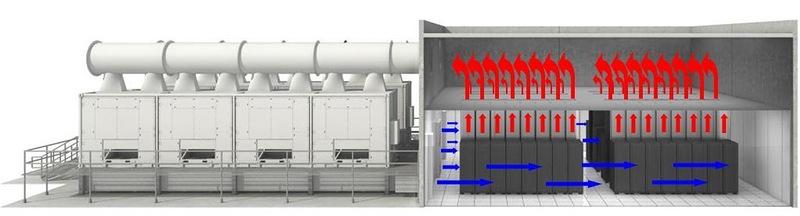
The distribution scheme of air flows in a room without a raised floor looks a little different: the hot air coming from the servers is limited by the "hot" corridor, then it rises to the ceiling and is fed into the return pipe system EcoBreeze. After cooling, air is fed back to the engine room using distributors located in the “cold” corridor.
Since the EcoBreeze cooling system is designed to work in cold climates, the manufacturer sees the main customers in the countries of northern Europe and Russia. Despite the fact that EcoBreeze shipments are scheduled for November – December 2011, two large projects are already in the design process, one of which will be located in St. Petersburg. The harsh climate of the Northern capital will be a good test of strength and fault tolerance.