
 September 30, 2011 at 16:54
OpenGTS open-source vehicle tracking solution
Introduction
48 hours on the road, or even more, many do not even know how to spend so much time behind the wheel. Of course, they realize that there are such professions as a trucker, a trucker, but, I dare to suggest, they did not even think about what a long road was and how to spend time behind the wheel.
I love traveling and love my motorcycle. There was a time when I could overcome up to 1000 km per day. This is a lot, even for a country like Russia.
The first thing you should think about for a person who travels very far on their own transport is safety. Anything can happen on a long journey: accidents, breakdowns, sudden health problems, and gasoline can simply end. Know, even if you are a lone wolf, there are people to whom you are dear, who think and worry about you.
We’ll talk about the solution that allows you to track vehicles in real time today.
Decision
OpenGTS (“Open GPS Tracking System”) is the first open-source solution designed specifically for monitoring vehicles in web browsers using data from GPS receivers.
It looks something like this:

Solution Architecture
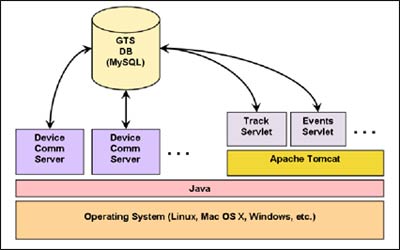
In the image above, the OpenGTS architecture is schematically shown. Various device communication servers (modules that receive GPS data from various devices) are launched as independent Java processes. The Track servlet, which is responsible for the web interface, as well as other servlets (including the http-based device communication server), run on an application server known as Apache Tomcat.
Http-based communication server
We will consider the simplest data transfer from client to server, based on HTTP-GET requests (http-based devices). For these purposes, the gprmc servlet is connected to the server. Installing it and launching it on Tomcat gives access to the following URL:
http://opengts.mechsoft.ru:8080/gprmc/Data
All arguments for the URL are listed in the documentation, but we will consider the simplest test request to the server:
http: //opengts.mechsoft.ru:8080/gprmc/Data?acct = ... & dev = ... & gprmc = ...
The server response below tells us that the data was transferred successfully:
OK
Let's analyze the request arguments:
acct - identifier of the account for which data is being transferred;
dev - identifier of the vehicle that is registered for the account;
gprmc is a NMEA-0183 format string that contains data from a GPS receiver.
Mobile client
For the http-based servlet, the simplest client for the Android mobile platform has been created. As shown above, the client’s task is to query the server using correctly configured HTTP -GET requests.
A program that can do this is GPS2OpenGTS. Appearance of the application is Spartan. The main screen displays information about the coordinates, the number of satellites, speed and direction of movement, the name of the server to which HTTP-GET requests are sent and their intensity.

What does it look like
The included GPS receiver is very "gluttonous", so the battery of a mobile device can quickly drain. Before leaving, it is recommended that you think about charging your mobile device on the go. In my case, I used a regular wire for a car cigarette lighter. I brought the cigarette lighter on a motorcycle on my own. It turned out quite functional:
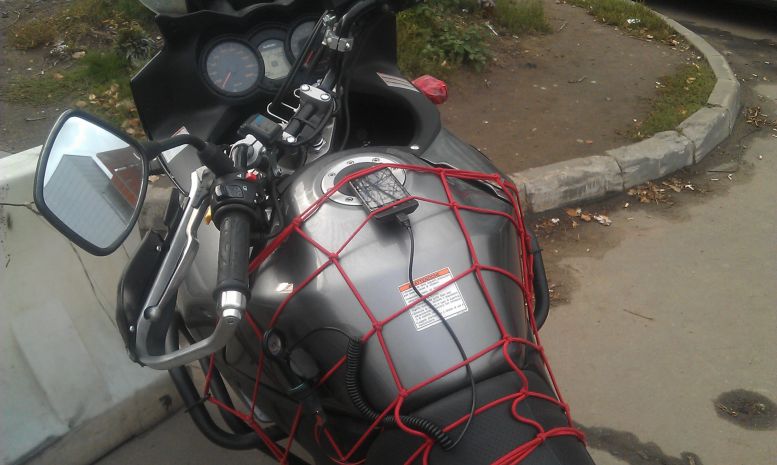
I used OpenGTS on my server when I traveled from Moscow (Russia) to the Nord Cap (Norway) via Finland.
I wonder how I rode? This data is available. You can connect to the server http://opengts.mechsoft.ru:8080/track/Track using an account:
| Account: | public |
| User: | guest |
| Password: | guest |
then, in the upper right corner of the window, select the dates:
| From: | August 12, 2011 |
| To: | August 18, 2011 |
And click on the “Update” button.
Instead of a conclusion
Moving along the roads, I can say for sure that now there are a lot of people who travel. It's nice to see cars with license plates from other regions of the country that are different about where you are going, and if it will be a motorcyclist, you should definitely get acquainted with this at the next gas station. Travel ...
Cons:
- You must have your own server, accessible via the Internet, to install OpenGTS;
- You need an Internet connection on mobile devices (in roaming conditions this can be expensive).
Pros:
- Free software;
- You can track several vehicles at once, combining them into groups;
- Reports on the movement of registered vehicles;
- A huge range of GPS devices that can be used to collect data.