Every year, pop music becomes more and more monotonous, because the same people compose it
Rimsky-Korsakov at work. Now single composers are becoming less common. Compositions created by entire groups of people break into the tops
. No one doubts that the listeners' musical preferences change with the passage of time. Every year, the fashion for music differs from the previous one — the new direction becomes dominant. Accordingly, if there is a demand, then there is an offer. And this means that more and more performers are starting to compose music belonging to the most popular trend - this allows you to make money, a lot of money. It's simple.
The situation is not new, it is repeated from year to year. Something similar was observed, for example, in the 60s (rock), 80s (pop), 90s (hip hop). All this is relevant for the present. But, as it turned out, now musicians are beginning to compose very similar music. Sometimes the voice of the artist, the music and the artists themselves are so similar to each other that it becomes difficult to distinguish them.
But these are personal impressions. Perhaps in reality everything is different? Experts set out to check this point. For this, it was decided to use the data of the Music Genome Project. This, by the way, is the engine that drives Pandora. Project team members identify more than 400 attributes of musical compositions, including genre, song style, tempo, instrumental content.
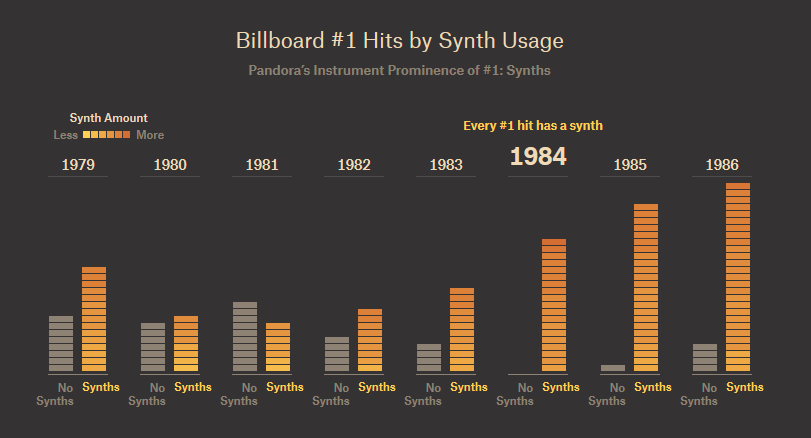
Studying the various attributes of different musical compositions, one can understand how similar they are. As an example, the above is an 80s music analysis chart. Here there is only one parameter by which the melodies were analyzed - the presence of a synthesizer. As you can see, over time, almost all hits of that time have a sound “interference” of synthesizers.
For 1984, there is a peak in the use of these musical instruments - there is not a single song where a synthesizer would not be used. It was they who determined the homogeneity (that is, the homogeneity) of the musical environment of that time. But still the songs of that time sound differently, it’s enough to take the song “Jump” by Van Alain and “I Just Called to Say I Love You” by Stevie Wonder.
Using the very attributes of musical compositions, in 2005, student Tristan Jehan published the work “Making music through listening”. This is a framework for generating computer music files. According to the creator, it simplifies this way: you give new songs to the computer, and he, in turn, generates works, the style is good similar to the previously heard songs.
The development of Jehan was used to develop an algorithm for dividing any musical composition into a small set of characteristics, according to which the “digital imprint” of the composition itself is composed.
Soon after writing the work, the former student already became one of the co-founders of EchoNest. She herself was later used by Spotify for her recommendation system. The user is offered to listen to exactly the music that he likes, for which there is a special selection below.
In EchoNest, by the way, for comparison of musical compositions not 400, but only 8 parameters are used. With their help, participants in the study on the "similarity of music" decided to check out the music from the "top 100 music tracks." In theory, compositions with similar characteristics highlighted by EchoNest should be similar.
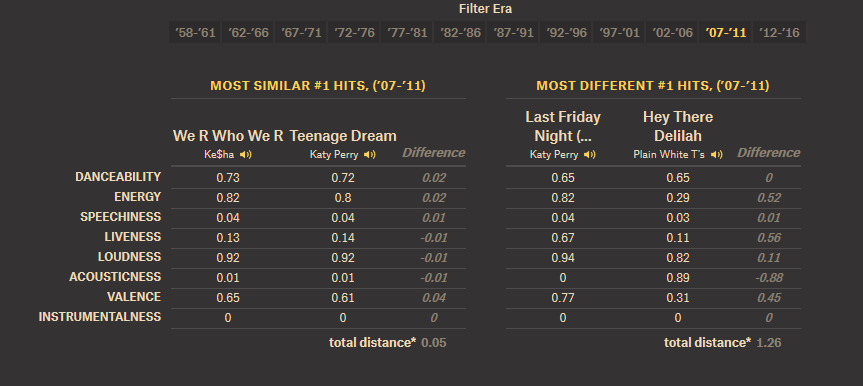
So it all happened. For example , the composition of Katy Perry’s “Teenage Dream” and the song from Kesha - “We R Who We R” are very similar in terms of the main characteristics. But perhaps other songs are similar? To do this, you can take hits from different years and check them using the EchoNest algorithm.

The graph above shows that the similarity of musical compositions increases over time. The lower the points of the graph fall along the y-axis, the higher the similarity. As it turned out, the compositions that went from 2012 to 2016 are most similar to each other. According to some music experts, at present, song creation has become almost an automatic process, different from what it was a couple of decades ago.
If earlier the music was composed by 1-2 authors, and it was like the flour of the musician's creativity shown in the films, sitting with a pen in the hands of the piano and hastily recording the found notes, now it is a conveyor. Little is what distinguishes the music industry from the factory - the same specialization, where in the "shop" a few people are engaged in the creation of individual parts, and then everything gets together. Someone makes a bass track, someone - an additional arrangement, someone else collects all the "Circuits". All this can actually be called a “hit factory”, the truth here is more than it seems.
In the 80s, two people worked on most hits. And only 7 famous songs of that time composed more than three people. Now, about 50% of musical compositions are prepared by 4 or more specialists. Songs, where the "developers" of about 10 are not uncommon. The same Havana was going to a team of 11 people. As a result, the songs are not as unique as before, similar compositions are just mass.
Audio and video editors, the ability to transfer individual elements of the composition over the network ledto the fact that now 100 songs can be created in less time than before it took to write 2-3 songs - if they were engaged in a group of people in the same room. It is known that from 2010 to 2014, the top 10 producers were behind 40% of the songs from the top 5 Billboard Hot 100 melodies. In the 80s, this figure was two times lower. Enlarge image In other words, more and more songs create fewer and fewer people. Naturally, this affects the uniqueness of each melody - it is very difficult for one and the same person to give each time something unique, not like everything that appeared before. Well, the trends are also set by the same people.