
 January 18, 2011 at 13:20
3Par InServ Architecture
So, we continue to get acquainted with the latest in the line of HP storage systems that appeared after the acquisition of 3Par. Let me remind you that the first date took place here - there we learned about the past life of 3Par products and made up the first impression. Now we will get closer even closer and look at the subtleties of their architecture.
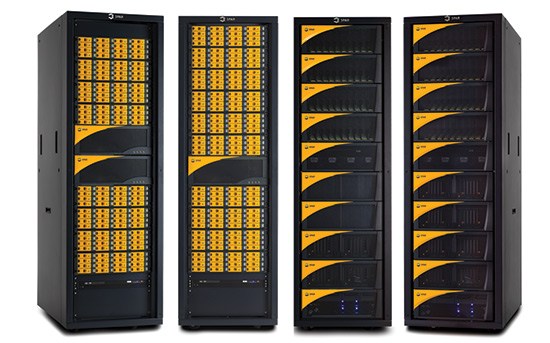
Now the 3Par InServ lineup consists of four systems: two F-Series, supporting up to 384 drives, and two T-Series, which support up to 1280 drives. If traditional modular disk arrays (for example, HP StorageWorks EVA) are built on the basis of two clustered controllers, the 3Par InServ array architecture supports up to eight controllers, which together form a fully-connected multi-node full-mesh cluster.
Of course, this architecture provides more flexible load balancing between controllers and provides more opportunities for scaling disk array performance. It also provides some insurance if one of the controllers fails. For the same purpose, the Persistent Cache mechanism is used, which provides mirroring of the controller cache.
The second feature of the hardware of 3Par arrays is the use of an ASIC chip in each controller, which implements additional useful functionality at the iron level. For example, the thin provisioning, which we will talk about later, as well as the independent processing of control commands and data streams, which allows the array to efficiently process different I / O streams in parallel: both with a large amount of data and with a large number of transactions .
Over the past three years, thin provisioning support has become a standard feature for middle and high-end arrays. But it was 3Par that back in 2003, the industry's first storage system to implement such functionality, laying it in the architecture of the first generation of its disk arrays. Since then, the company has continuously improved thin provisioning, ahead of other manufacturers.
In addition to the primary purpose of thin provisioning — dynamically allocating capacity from virtual pools for applications — 3Par engineers implemented thin conversion and thin reclamation mechanisms. The first serves to quickly migrate data from a traditional disk array to an array with thin provisioning without sacrificing performance. And the second - to return the unused allocated capacity to the virtual pool.
The use of these "thin" technologies greatly increases the efficiency of the use of storage system resources, saves the administrator’s working time and eliminates the need to purchase additional disks for future use.
For virtualization of disk space in 3Par arrays, a three-level structure is used:
The virtual domain system allows you to slice a disk array into virtual private arrays isolated on a logical level . This feature is very popular among service providers, since it can be used to guarantee the safe storage of data belonging to different clients (or different divisions of the corporation) on one disk array. For example, Savvis, one of the largest US service providers, has been using 3Par products since 2004 and has installed more than thirty InServ systems with a total capacity of more than 2 PB in 28 of their data centers.
“Nice to meet you!” HP 3Par Arrays say. Questions?
Now the 3Par InServ lineup consists of four systems: two F-Series, supporting up to 384 drives, and two T-Series, which support up to 1280 drives. If traditional modular disk arrays (for example, HP StorageWorks EVA) are built on the basis of two clustered controllers, the 3Par InServ array architecture supports up to eight controllers, which together form a fully-connected multi-node full-mesh cluster.
Of course, this architecture provides more flexible load balancing between controllers and provides more opportunities for scaling disk array performance. It also provides some insurance if one of the controllers fails. For the same purpose, the Persistent Cache mechanism is used, which provides mirroring of the controller cache.
The second feature of the hardware of 3Par arrays is the use of an ASIC chip in each controller, which implements additional useful functionality at the iron level. For example, the thin provisioning, which we will talk about later, as well as the independent processing of control commands and data streams, which allows the array to efficiently process different I / O streams in parallel: both with a large amount of data and with a large number of transactions .
Where "thin", there ... the sheer benefit
Over the past three years, thin provisioning support has become a standard feature for middle and high-end arrays. But it was 3Par that back in 2003, the industry's first storage system to implement such functionality, laying it in the architecture of the first generation of its disk arrays. Since then, the company has continuously improved thin provisioning, ahead of other manufacturers.
In addition to the primary purpose of thin provisioning — dynamically allocating capacity from virtual pools for applications — 3Par engineers implemented thin conversion and thin reclamation mechanisms. The first serves to quickly migrate data from a traditional disk array to an array with thin provisioning without sacrificing performance. And the second - to return the unused allocated capacity to the virtual pool.
The use of these "thin" technologies greatly increases the efficiency of the use of storage system resources, saves the administrator’s working time and eliminates the need to purchase additional disks for future use.
From each according to his ability, to each according to his needs
For virtualization of disk space in 3Par arrays, a three-level structure is used:
- the structure is based on 256 megabyte segments into which physical disks are divided.
- segments are grouped into logical volumes based on the required level of service and data protection. Within a single logical volume, there may be several regions with different types of disks (Fiber Channel, SATA or SSD), RAID levels, and fault tolerance. At the same time, the logical volume may include segments from different physical disks located on different disk shelves of the array.
- in turn, logical volumes are grouped into virtual disks , which the servers connected to the array “see”.
Note to provider
The virtual domain system allows you to slice a disk array into virtual private arrays isolated on a logical level . This feature is very popular among service providers, since it can be used to guarantee the safe storage of data belonging to different clients (or different divisions of the corporation) on one disk array. For example, Savvis, one of the largest US service providers, has been using 3Par products since 2004 and has installed more than thirty InServ systems with a total capacity of more than 2 PB in 28 of their data centers.
“Nice to meet you!” HP 3Par Arrays say. Questions?