
 January 6, 2011 at 18:51
Processors. Sandy bridge
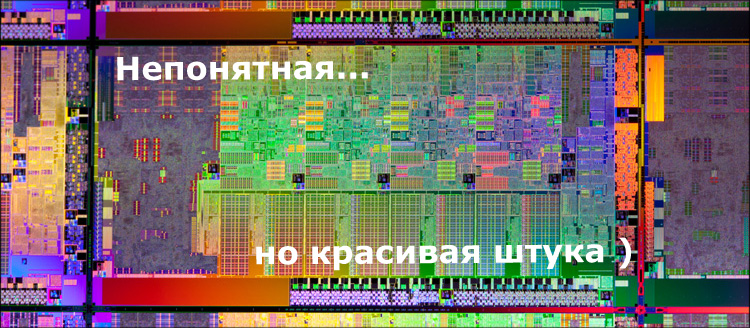
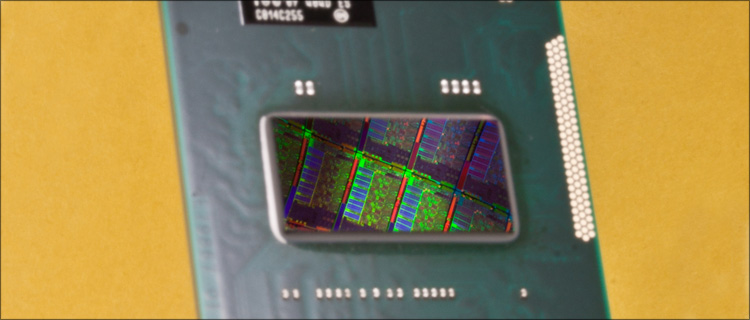
Finally, Intel officially announced the new processors running on the new Sandy Bridge microarchitecture . For most people, the “announcement of Sandy Bridge” is just a word, but by and large, Intel Core ll generations are, if not a new era, then at least an update to almost the entire processor market.
Initially, the launch of only seven processors was reported, but on the most useful page ark.intel.com , information about all the new products has already appeared. The processors, or rather their modifications, turned out to be slightly larger (in brackets I indicated the approximate price - each processor in a batch of 1000 pieces will cost so much):
 Intel Core i5-2510E (~ $ 266)
Intel Core i5-2520M
Intel Core i5-2537M
Intel Core i5-2540M
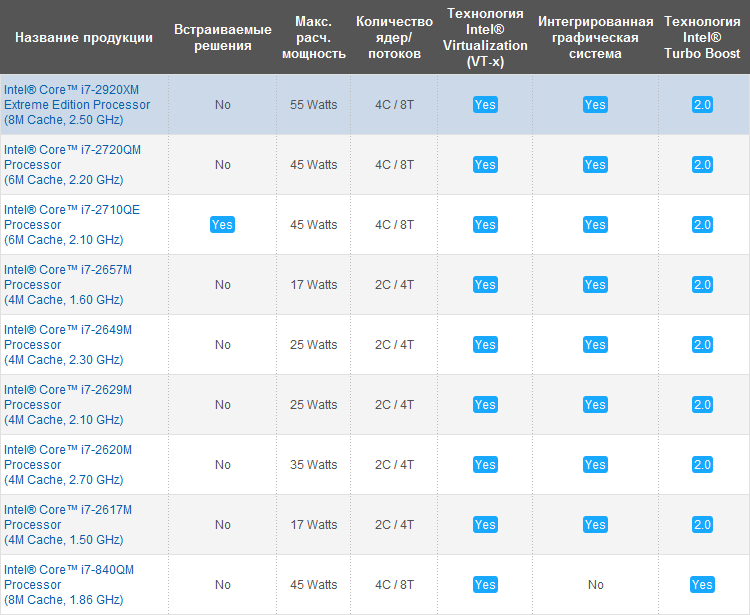
 Visual detailed comparison of the second generation Intel Core i5 mobile processors. Intel Core i7-2617M
Intel Core i7-2620M
Intel Core i7-2629M
Intel Core i7-2649M Intel Core i7-2657M Intel Core i7-2710QE (~ $ 378) Intel Core i7-2720QM Intel Core i7-2820QM Intel Core i7-2920XM Extreme Edition A clear, detailed comparison of second-generation Intel Core i7 mobile processors.
Visual detailed comparison of the second generation Intel Core i5 mobile processors. Intel Core i7-2617M
Intel Core i7-2620M
Intel Core i7-2629M
Intel Core i7-2649M Intel Core i7-2657M Intel Core i7-2710QE (~ $ 378) Intel Core i7-2720QM Intel Core i7-2820QM Intel Core i7-2920XM Extreme Edition A clear, detailed comparison of second-generation Intel Core i7 mobile processors.


 Intel Core i3-2100 (~ $ 117)
Intel Core i3-2100T
Intel Core i3-2120 ($ 138)
A clear, detailed comparison of the second-generation Intel Core i3 desktop processors. Intel Core i5-2300 (~ $ 177)
Intel Core i5-2390T
Intel Core i5-2400S
Intel Core i5-2400 (~ $ 184) Intel Core i5-2500K (~ $ 216) Intel Core i5-2500T Intel Core i5-2500S Intel Core i5-2500 (~ $ 205) A clear, detailed comparison of the second-generation Intel Core i5 desktop processors. Intel Core i7-2600K (~ $ 317)
Intel Core i7-2600S
Intel Core i7-2600 (~ $ 294) Visual detailed comparison of the second generation Intel Core i7 desktop processors.
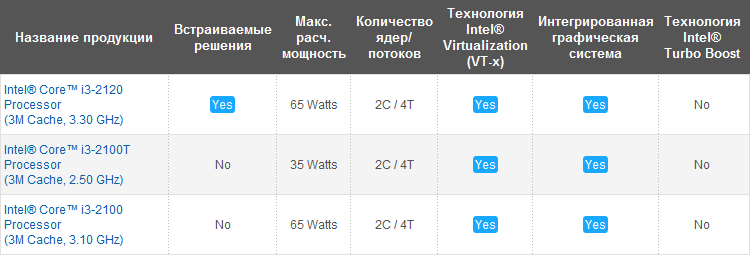
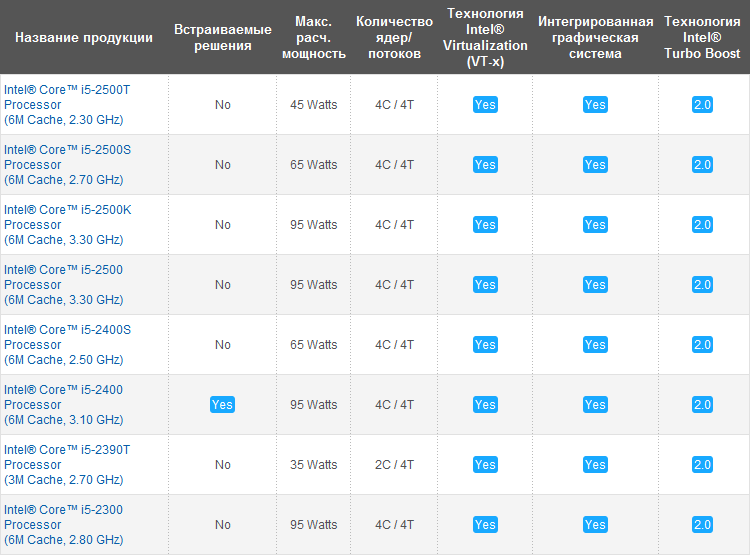
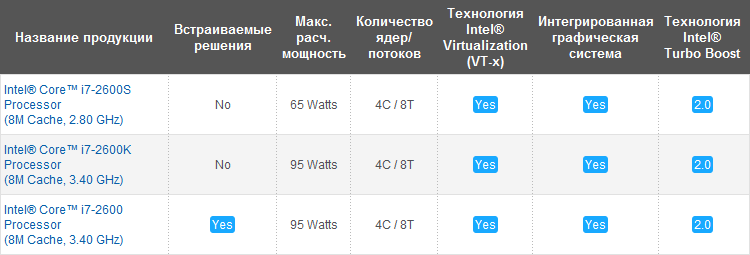
As you can see, the model names now have four digits in the name - this is done so that there is no confusion with the processors of the previous generation. The lineup turned out to be quite complete and logical - the most interesting i7 series are clearly separated from i5 by the presence of Hyper Threading technology and an increased cache size. And processors of the i3 family differ from i5 not only in fewer cores, but also in the absence of Turbo Boost technology .
Perhaps you also paid attention to the letters in the names of the processors, without which the lineup has greatly thinned. So, the letters S and T indicate reduced power consumption, and K is a free factor.
Visual structure of new processors:
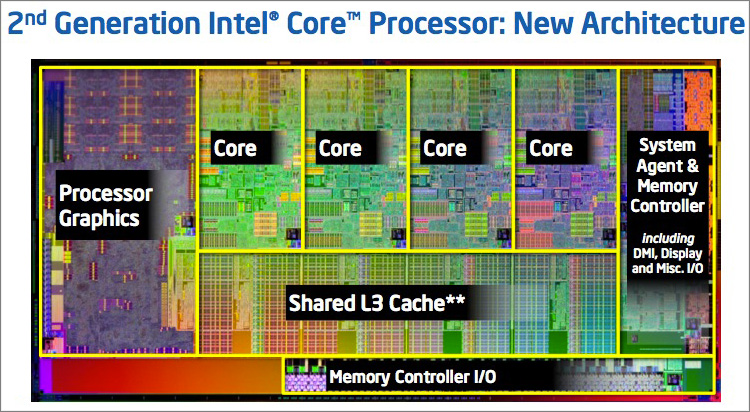
As you can see, in addition to the graphic and computing cores, the cache memory and the memory controller, there is the so-called System Agent - a lot of things have been dumped there, for example, DDR3 memory controllers and PCI-Express 2.0, the power management model and the units responsible for the work at the hardware level built-in GPU and for outputting the image if used.
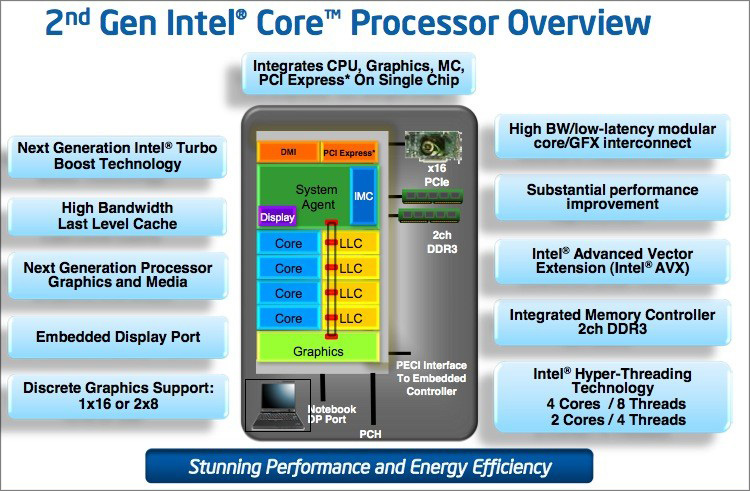
All “nuclear” components (including the graphics processor) are interconnected by a high-speed ring bus with full access to the L3 cache, which has increased the overall data exchange rate in the processor itself; what's interesting is that this approach allows you to increase performance in the future, simply increasing the number of cores added to the bus. Although now everything promises to be on top - in comparison with the processors of the previous generation, the performance of the new ones is more adaptive and according to the manufacturer, in many tasks it can demonstrate a 30-50% increase in the speed of tasks!
If there is a desire to learn more about the new architecture, then in Russian I can advise these three articles - 1 , 2 , 3 .
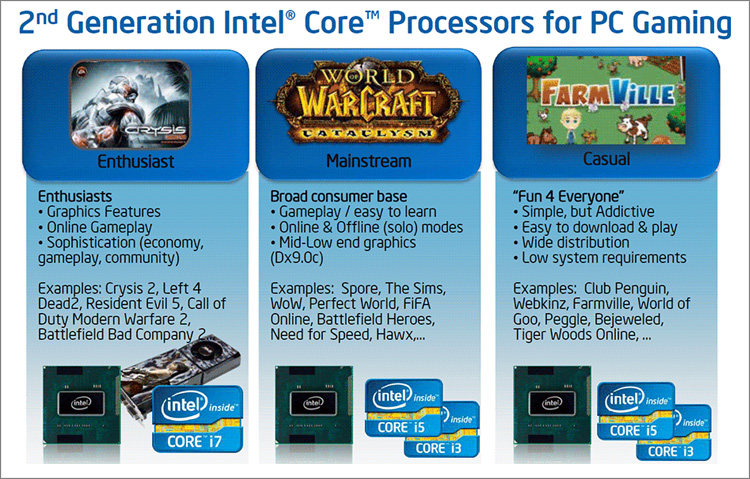
The new processors are fully and completely implemented according to the standards of the 32-nm process technology and for the first time have a “visually smart” microarchitecture that combines the best in class computing power and 3D-graphics processing technology on a single chip. The Sandy Bridge graphics really have a lot of innovations, aimed mainly at increasing productivity when working with 3D. You can argue for a long time about the "imposition" of an integrated video system, but so far there is no other solution. But there is such a slide from the official presentation, which claims to be plausible, including in mobile products (laptops):
I already spoke partly about the new technologies of the second generation of Intel Core processors , so I will not repeat myself. I will dwell only on the developmentIntel Insider , the appearance of which many were surprised. As I understand it, this will be a kind of store that will give computer owners access to high-definition films directly from the creators of these films - something that previously appeared only some time after the announcement and the appearance of DVD or Blu-ray discs. To demonstrate this feature, Intel vice president Muli Eden (Mooly Eden) invited on stage Tsuzhiharu Kevin (Kevin Tsujihara), the president of Warner Home Entertainment Group. I quote:
 “Warner bros finds personal systems the most versatile and widespread platform for delivering high-quality entertainment content, and now Intel is making this platform even more reliable and secure. From now on, with the help of the WBShop store, as well as our partners, such as CinemaNow, we will be able to provide PC users with new releases and films from our catalog in real HD quality"- Muli Eden demonstrated the work of this technology on the example of the film" Beginning ". In collaboration with leading industry studios and media content giants (such as Best Buy CinemaNow, Hungama Digital Media Entertainment, Image Entertainment, Sonic Solutions, Warner Bros. Digital Distribution, and others), Intel is creating a secure and piracy-free (hardware-level) ecosystem for distribution, storage and playback of high-quality video.
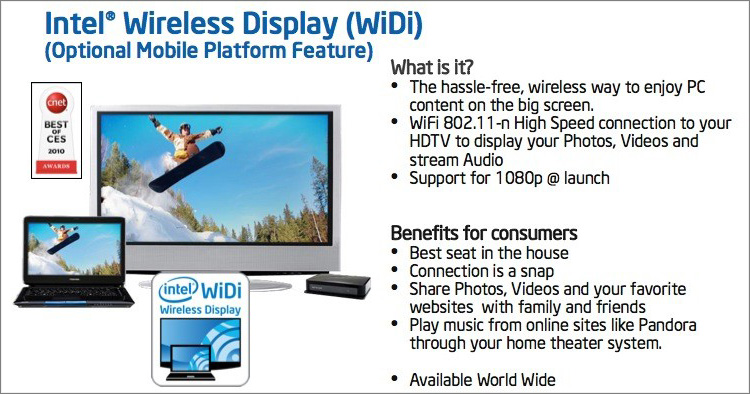
The work of the technology mentioned above will be compatible with two equally interesting developments that are also present in all models of new generation processors. I'm talking about Intel Wireless Display 2.0 (Intel WiDi 2.0) and Intel InTru 3-D. The first is designed for wireless transmission of HD-video (with support for resolutions up to 1080p), the second is designed to display stereo content on monitors or high-definition televisions via an HDMI 1.4 connection .
Two other functions for which I did not find a more suitable place in the article are Intel Advanced Vector Extensions (AVX). Support for these commands by processors increases the speed of data-intensive applications, such as audio editors and professional photo editing software.
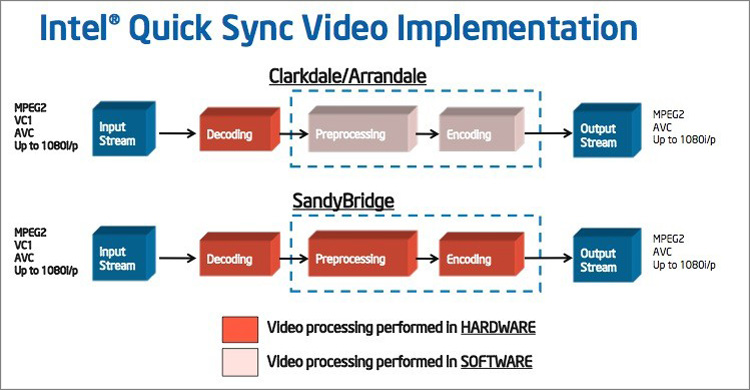
... and Intel Quick Sync Video- Thanks to joint work with software companies such as CyberLink, Corel and ArcSoft, the processor giant was able to increase the performance in this task (transcoding between H.264 and MPEG-2 formats) by 17 times compared with the performance of the integrated graphics of the previous generation.
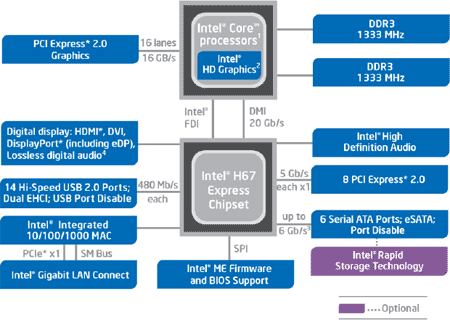
Let's say there are processors - how to use them? That's right - with them were also announced new chipsets (logic sets), which are representatives of the "sixtieth" series. Apparently, only two sets are reserved for thirsty Consumer novelties, these are Intel H67 and Intel P67on which most of the new motherboards will be built. The H67 is capable of working with a video core integrated into the processor, while the P67 is endowed with Performance Tuning to overclock the processor. All processors will work on the new socket, 1155 .
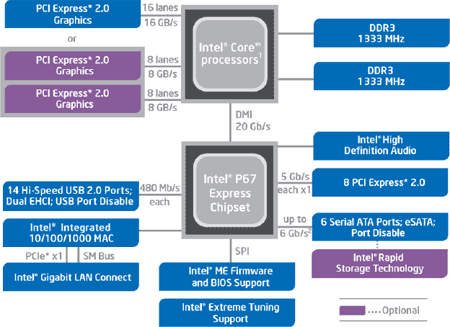
I am glad that it seems that the new processors have laid compatibility with Intel processor sockets with the architecture of the next generation. This plus is useful for both ordinary users and manufacturers who do not have to re-design and create new devices.
In total, Intel introduced more than 20 chips, chipsets and wireless adapters, including the new Intel Core i7, i5 and i3 processors, Intel 6 Series chipsets and Intel Centrino Wi-Fi and WiMAX adapters. In addition to those mentioned above, such “badges” may appear on the market:


This year, more than 500 models of desktop computers and laptops of leading world brands are expected to be released on new processors.
And finally, once again awesome-movie, suddenly someone did not see:

 Mobile:
Intel Core i5-2510E (~ $ 266) Intel Core i5-2520M
Intel Core i5-2537M
Intel Core i5-2540M
Visual detailed comparison of the second generation Intel Core i5 mobile processors. Intel Core i7-2617M
Intel Core i7-2620M
Intel Core i7-2629M
Intel Core i7-2649M Intel Core i7-2657M Intel Core i7-2710QE (~ $ 378) Intel Core i7-2720QM Intel Core i7-2820QM Intel Core i7-2920XM Extreme Edition A clear, detailed comparison of second-generation Intel Core i7 mobile processors. Board:
Intel Core i3-2100 (~ $ 117) Intel Core i3-2100T
Intel Core i3-2120 ($ 138)
A clear, detailed comparison of the second-generation Intel Core i3 desktop processors. Intel Core i5-2300 (~ $ 177)
Intel Core i5-2390T
Intel Core i5-2400S
Intel Core i5-2400 (~ $ 184) Intel Core i5-2500K (~ $ 216) Intel Core i5-2500T Intel Core i5-2500S Intel Core i5-2500 (~ $ 205) A clear, detailed comparison of the second-generation Intel Core i5 desktop processors. Intel Core i7-2600K (~ $ 317)
Intel Core i7-2600S
Intel Core i7-2600 (~ $ 294) Visual detailed comparison of the second generation Intel Core i7 desktop processors.As you can see, the model names now have four digits in the name - this is done so that there is no confusion with the processors of the previous generation. The lineup turned out to be quite complete and logical - the most interesting i7 series are clearly separated from i5 by the presence of Hyper Threading technology and an increased cache size. And processors of the i3 family differ from i5 not only in fewer cores, but also in the absence of Turbo Boost technology .
Perhaps you also paid attention to the letters in the names of the processors, without which the lineup has greatly thinned. So, the letters S and T indicate reduced power consumption, and K is a free factor.
Visual structure of new processors:
As you can see, in addition to the graphic and computing cores, the cache memory and the memory controller, there is the so-called System Agent - a lot of things have been dumped there, for example, DDR3 memory controllers and PCI-Express 2.0, the power management model and the units responsible for the work at the hardware level built-in GPU and for outputting the image if used.
All “nuclear” components (including the graphics processor) are interconnected by a high-speed ring bus with full access to the L3 cache, which has increased the overall data exchange rate in the processor itself; what's interesting is that this approach allows you to increase performance in the future, simply increasing the number of cores added to the bus. Although now everything promises to be on top - in comparison with the processors of the previous generation, the performance of the new ones is more adaptive and according to the manufacturer, in many tasks it can demonstrate a 30-50% increase in the speed of tasks!
If there is a desire to learn more about the new architecture, then in Russian I can advise these three articles - 1 , 2 , 3 .
The new processors are fully and completely implemented according to the standards of the 32-nm process technology and for the first time have a “visually smart” microarchitecture that combines the best in class computing power and 3D-graphics processing technology on a single chip. The Sandy Bridge graphics really have a lot of innovations, aimed mainly at increasing productivity when working with 3D. You can argue for a long time about the "imposition" of an integrated video system, but so far there is no other solution. But there is such a slide from the official presentation, which claims to be plausible, including in mobile products (laptops):
I already spoke partly about the new technologies of the second generation of Intel Core processors , so I will not repeat myself. I will dwell only on the developmentIntel Insider , the appearance of which many were surprised. As I understand it, this will be a kind of store that will give computer owners access to high-definition films directly from the creators of these films - something that previously appeared only some time after the announcement and the appearance of DVD or Blu-ray discs. To demonstrate this feature, Intel vice president Muli Eden (Mooly Eden) invited on stage Tsuzhiharu Kevin (Kevin Tsujihara), the president of Warner Home Entertainment Group. I quote:
“Warner bros finds personal systems the most versatile and widespread platform for delivering high-quality entertainment content, and now Intel is making this platform even more reliable and secure. From now on, with the help of the WBShop store, as well as our partners, such as CinemaNow, we will be able to provide PC users with new releases and films from our catalog in real HD quality"- Muli Eden demonstrated the work of this technology on the example of the film" Beginning ". In collaboration with leading industry studios and media content giants (such as Best Buy CinemaNow, Hungama Digital Media Entertainment, Image Entertainment, Sonic Solutions, Warner Bros. Digital Distribution, and others), Intel is creating a secure and piracy-free (hardware-level) ecosystem for distribution, storage and playback of high-quality video. The work of the technology mentioned above will be compatible with two equally interesting developments that are also present in all models of new generation processors. I'm talking about Intel Wireless Display 2.0 (Intel WiDi 2.0) and Intel InTru 3-D. The first is designed for wireless transmission of HD-video (with support for resolutions up to 1080p), the second is designed to display stereo content on monitors or high-definition televisions via an HDMI 1.4 connection .
Two other functions for which I did not find a more suitable place in the article are Intel Advanced Vector Extensions (AVX). Support for these commands by processors increases the speed of data-intensive applications, such as audio editors and professional photo editing software.
... and Intel Quick Sync Video- Thanks to joint work with software companies such as CyberLink, Corel and ArcSoft, the processor giant was able to increase the performance in this task (transcoding between H.264 and MPEG-2 formats) by 17 times compared with the performance of the integrated graphics of the previous generation.
Let's say there are processors - how to use them? That's right - with them were also announced new chipsets (logic sets), which are representatives of the "sixtieth" series. Apparently, only two sets are reserved for thirsty Consumer novelties, these are Intel H67 and Intel P67on which most of the new motherboards will be built. The H67 is capable of working with a video core integrated into the processor, while the P67 is endowed with Performance Tuning to overclock the processor. All processors will work on the new socket, 1155 .
I am glad that it seems that the new processors have laid compatibility with Intel processor sockets with the architecture of the next generation. This plus is useful for both ordinary users and manufacturers who do not have to re-design and create new devices.
In total, Intel introduced more than 20 chips, chipsets and wireless adapters, including the new Intel Core i7, i5 and i3 processors, Intel 6 Series chipsets and Intel Centrino Wi-Fi and WiMAX adapters. In addition to those mentioned above, such “badges” may appear on the market:
This year, more than 500 models of desktop computers and laptops of leading world brands are expected to be released on new processors.
And finally, once again awesome-movie, suddenly someone did not see: