December 15, 2010 at 21:37
The speed of light becomes a bottleneck for speed trading
Physicists from the Massachusetts Institute of Technology want to help financiers create the optimal structure of data centers for high-speed (high-frequency) trading. As you know, in this type of trading, the key advantage is the speed of data acquisition. For example, when hosting is hosted on the same platform as the exchange servers, a delay of less than 500 microseconds can be achieved. For comparison, the speed of the pulse (the speed of light) between two maximally distant points on the globe is 67 milliseconds - 135 times slower! In reality, an application from New York is placed on the London Stock Exchange in 50 ms, that is, unimaginably slow. This makes impossible high-frequency trading on overseas platforms.
Since 52 world stock exchanges form a single world-wide working market around the clock, prices tend to reach the same level. A competitive advantage in the market is that trading office, which receives data from the ocean several milliseconds faster than competitors. The geographical proximity to the exchange is becoming a valuable resource for high-frequency traders.
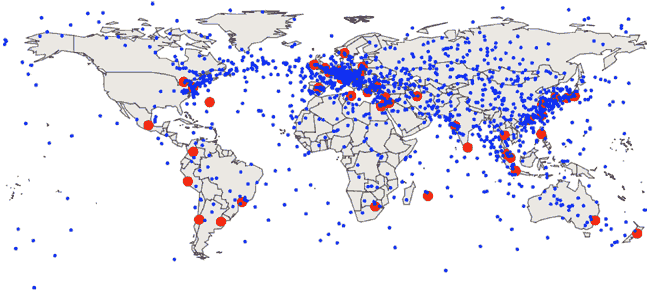
So what did the physicists at MIT come up with? They published ( PDF ) in the journal Physical Review a purely theoretical model of “relativistic statistical arbitrage” (relativistic statistical arbitrage), in which they calculate the optimal location of the coordination data centers for each pair in a set of 52 major exchanges. Scientists have proven that such a location is optimal.
Although many centers are located in areas with dense fiber optic coverage, others are located in remote corners of the earth and even in the middle of the oceans.
Since 52 world stock exchanges form a single world-wide working market around the clock, prices tend to reach the same level. A competitive advantage in the market is that trading office, which receives data from the ocean several milliseconds faster than competitors. The geographical proximity to the exchange is becoming a valuable resource for high-frequency traders.
So what did the physicists at MIT come up with? They published ( PDF ) in the journal Physical Review a purely theoretical model of “relativistic statistical arbitrage” (relativistic statistical arbitrage), in which they calculate the optimal location of the coordination data centers for each pair in a set of 52 major exchanges. Scientists have proven that such a location is optimal.
Although many centers are located in areas with dense fiber optic coverage, others are located in remote corners of the earth and even in the middle of the oceans.