Comparative testing of 6 types of shoes for winter
Even during the construction of my house in the cold winter of 2013, I realized that there was no better felt boots. But repeatedly I saw people in frost below -20 degrees in boots, boots and even sneakers. And it would be fine if those who move from the car to the entrance or the store, but there were also those who walked like this all day. And only now I matured to the test of various types of shoes: from felt boots to sneakers. Interesting continuation under the cut.
So, the decision is overdue, I scored different shoes, selected only the right side of each pair and decided to come up with a way to measure heat resistance. Perhaps one of the most important parameters for winter shoes is whether the owner freezes in it or not. But man is a warm-blooded creature and he constantly heats himself up. But how to determine how well the shoes keep warm?
Then it was decided to boil the chicken eggs, immediately wrap them in foil (solely so that the burst egg does not spoil the shoes) and lower it inside, instead of the foot. The shoes were at room temperature and above +20 degrees.

The egg itself was a temperature of 60 degrees.
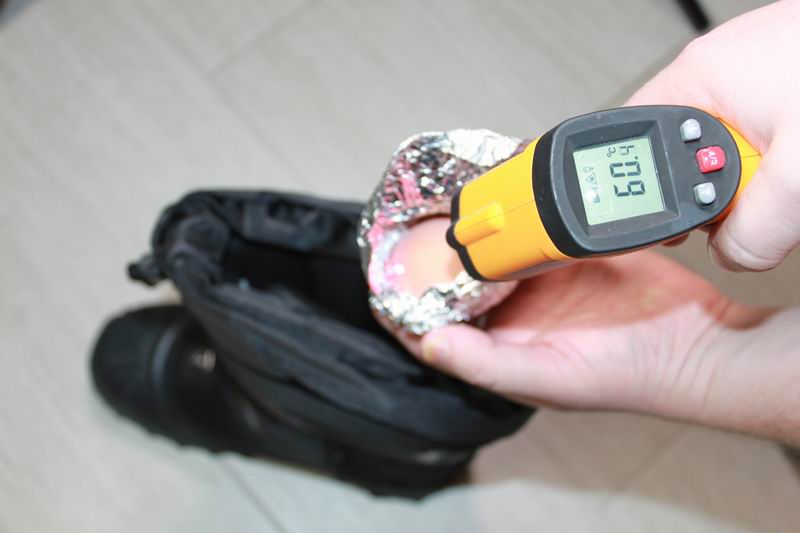
Thus, we created local heating, and then we sealed the top of the shoe and placed a thermal sensor inside. Outside there was a screen with readings. It was decided to take a temperature reading every 20 minutes. All measurements were taken on the street. At this time, the temperature was -10 degrees Celsius.

The following shoes took part in the test:
- Winter boots. Baffin Selkirk Representative
- Boots from the made foam rubber (EVA) with a heater. Representative TORVI T -60 ° C
- Felt boots. Representative ordinary unnamed valenki with rubber soles
- Rubber boots with insulation. Representative Pskov-Polymer
- Winter boots with fur. Representative Tervolina
- Summer sneakers. Representative Quechua forclaz 500 helium
Observations and Results
| name / time | 0 minutes | 20 minutes | 40 minutes | 60 minutes |
|---|---|---|---|---|
| Baffin selkirk | 60 ° C | 11.5 ° C | 4.8 ° C | 2 ° С |
| TORVIT -60 ° C | 60 ° C | 6 ° С | 3.7 ° C | 0.5 ° C |
| Boots with soles | 60 ° C | 8 ° С | 4 ° C | -1 ° C |
| Tervolina Boots | 60 ° C | 4.7 ° C | 2.9 ° C | -2 ° С |
| Quechua forclaz 500 helium sneakers | 60 ° C | 1 ° C | 0 ° C | -3.7 ° C |
| Rubber boots Pskov-Polymer | 60 ° C | 1.8 ° C | -1.5 ° C | -4 ° C |
It turned out that the shoes are so different that even summer sneakers can "beat" demi-season rubber boots. But I was more surprised that the boots made of natural wool were lost to the shoes made of artificial materials. But I will tell a little more about each shoe. I'll start from bad to good.
Rubber boots Pskov-Polymer

6th place
Price: 990 r
Limiting temperature: -5
Rubber boots are one of the favorite types of children's shoes, because they can walk in puddles. And certainly the best type of footwear for walking through the swampy forests for berries and mushrooms. The presented boots are produced by the Russian factory Pskov-Polymer and honestly work out their money in spring, summer and autumn. But with frosts they freeze out instantly, even despite the insulated insulation. The surface area of the boot and the heat transfer of the rubber is such that within half an hour the temperature inside has reached 0 degrees. And in the cold they dubeyut much.
Quechua forclaz 500 helium sneakers

5th place
Price: 3500 r
Limiting temperature: 0
I have repeatedly seen that the choice of urban residents, even in winter, is sneakers. Convenient, easy and warm. But it is good only when you go from the doorway to the car and back. Snow slush or deep puddles are unlikely to be able to pass as easily as it is done in rubber boots. The more interesting it was that the sneakers were warmer than rubber boots.
Tervolina Boots

4th place
Price: 4500 r
Limiting temperature: -20
Normal winter city boots: on top of the skin, and inside the fur. In principle, for the urban winter of central Russia this shoe will be enough, but in Siberia on a thin sole the legs will freeze out pretty quickly. Actually, the test demonstrated this: the shoes did not keep the positive temperature inside even an hour.
Boots with soles

3rd place
Price: 1500 r
Limit temperature: -120
When I was looking for a list of temperature limits for various types of shoes, I did not believe my eyes at first. But this is not a mistake: the lower limit temperature for felt boots is -120 ° C. It is at this temperature that the wool becomes brittle and the boots begin to break, and before that the boots keep the feet warm very efficiently. True wetted boots very quickly lose their insulating properties and shape, so some models equip with rubber soles. Great shoes available and common.
TORVIT -60 ° C

2nd place
Price: 2100 r
Limit temperature: -60
Another rubber boots in the review, but this time from the EVA material . Simplifying - it is foamed rubber that does not pass water and has good thermal insulation. Well, to make it even warmer and the foot is not rubbed when it comes into contact with rubber, there is a warmed liner. It is all the more interesting that the declared lower working limit of temperature for these boots is -60 ° C. At first I was surprised, but in the store where I saw these boots, they suggested that they take mostly fishermen and hunters: it’s not wet and not cold.
Baffin selkirk

1st place
Price: 15200r
Limiting temperature: -70 The
second in frost resistance (extreme temperature), but the first in the comparative test are Baffin boots. The boot itself is also multi-layered: there is a nylon outside, a 7-layer liner inside, and a sole with rather aggressive hooks. The manufacturer promises that with active movement, the legs will not freeze even at a temperature of -60 ° C. Judging by the test, when the temperature in the shoes remained positive for an hour - this statement may be true. Honestly, I would not want to go where you can check this statement.
BONUS
Separately, outside of the test, I decided to try electrically heated insoles. I have already met chemical thermal insoles more than once, which heat up as the reaction proceeds. As a rule, they are disposable, so I was interested in these insoles. I took Thermacell insoles of 41 sizes. They can be tailored to fit your shoes, cutting along the dotted line. They are charged through their adapter, and controlled by the remote control via radio. Heating is in the front of the foot, where the fingers are often frozen. Two modes of heating 38 and 44 degrees is enough in any shoe to keep warm. The battery will last for 5 hours in Medium mode. In general, a very convenient and interesting thing, only the price bites (about 6500r) and they can not bend and drench.

Conclusion
All pairs of shoes are worthy of attention and all of them are exploited in various conditions, although sometimes at the same time of the year. I can say that I was somewhat surprised by how quickly the boots felt cold and by how long the Baffin boots kept their temperature. Rubber boots Torvit from EVA material are also interesting, especially to fishermen on the ice, when there is often water under their feet. And I wish all readers not to be ill, to dress according to the weather and not to forget warm shoes!