Review of the e-book ONYX Boox Robinson Crusoe 2
Older readers will surely remember Vladimir Vysotsky’s song about the world-famous navigator, “One scientific mystery or why the aborigines ate Cook”:
... But why did the aborigines eat Cook?
For what, it is not clear, science is silent.
It seems to me a very simple thing -
They wanted to eat and ate Cook ...
It was in his honor that the new e-ink book ONYX Boox James Cook was named , but today we will not talk about it :) Today we will talk about the reading room (also new), also named after another navigator - Robinson Crusoe.
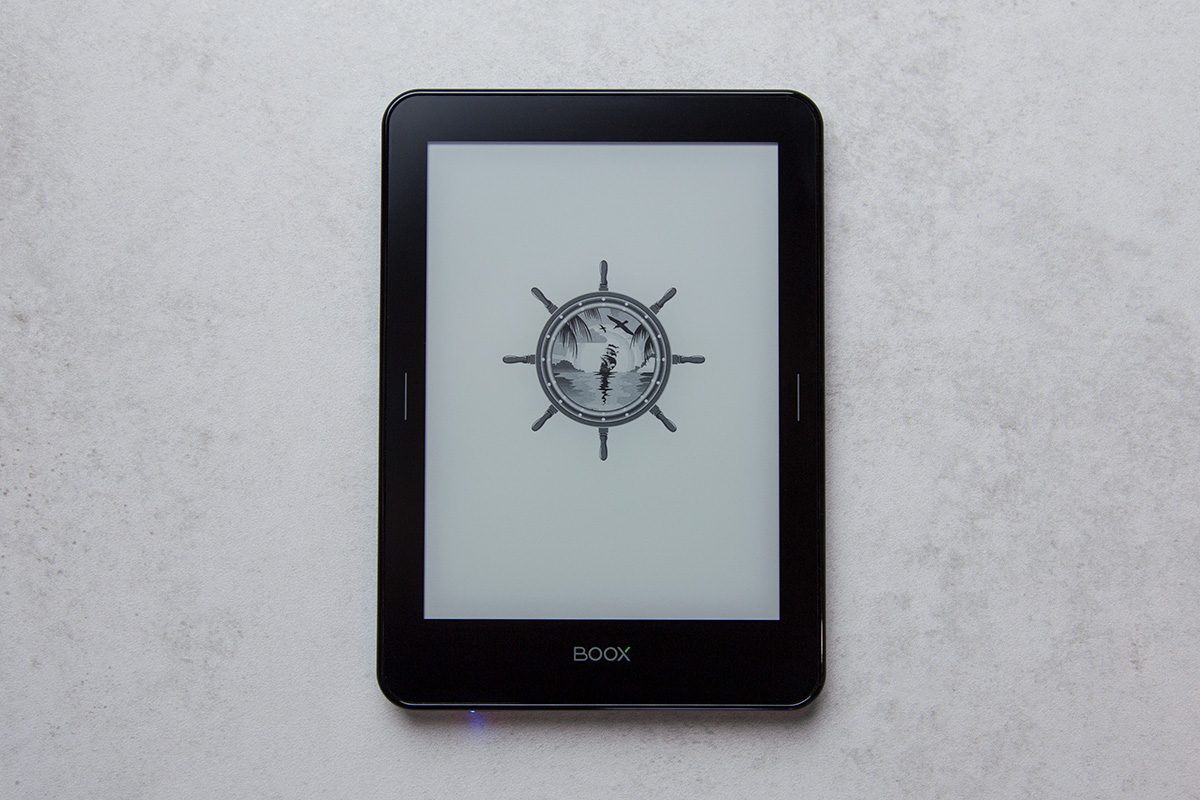
It is great that the company gives its devices names, not just unforgettable tsiferki;)
“Robinson Crusoe is a novel by English writer Daniel Defoe (1660-1731), first published in April 1719, telling about the moral revival of man in communication with nature. Written as an autobiography of the sea traveler and planter Robinson Crusoe, who wanted to get even more rich soon and illegally, but as a result of a shipwreck he fell on an uninhabited island and spent 28 years there. ”
/ Wikipedia
An exceptionally enjoyable work that deservedly enters the school curriculum and which will be especially pleasant to read on the e-book of the same name from today's review. More precisely, the second version of the device, which, judging by the recall, turned out to be successful and the company decided to make it even better.
ONYX BOOX Robinson Crusoe 2 is an updated edition of a premium e-ink reader, equipped with the latest generation E Ink Carts Plus screen, with ASAHI protective glass, MOON Light backlight, SNOW Field function and protection from splashes and moisture. On a desert island - the most it.
At the request of readers, we publish the price of the device at the beginning of the review: € 12,490
Like ONYX Chronos from the previous review , “Robinson” is sold in a white cardboard box - it doesn’t look like a collector's edition of a book, rather, a collection box for CDs. But the statement is true that if you tie it up with a red ribbon, you will get a great gift (including the New Year):


Inside it’s the same arsenal: the device itself, corporate case, instruction, USB-microUSB cable and adapter for charging from the network. The e-book supports microSD memory cards, but it is not included (most users have enough internal memory).

The first thing you will see when unpacking will be the original cover with matting texture (like cloth or linen paper):

Although it increases the dimensions of the reader, it reliably protects it from external cataclysms (which will certainly occur during everyday use, especially Something in a backpack). The ends of the device remain “vulnerable” - so that functional elements (buttons and connectors) are always available and so as not to interfere with the control when reading:
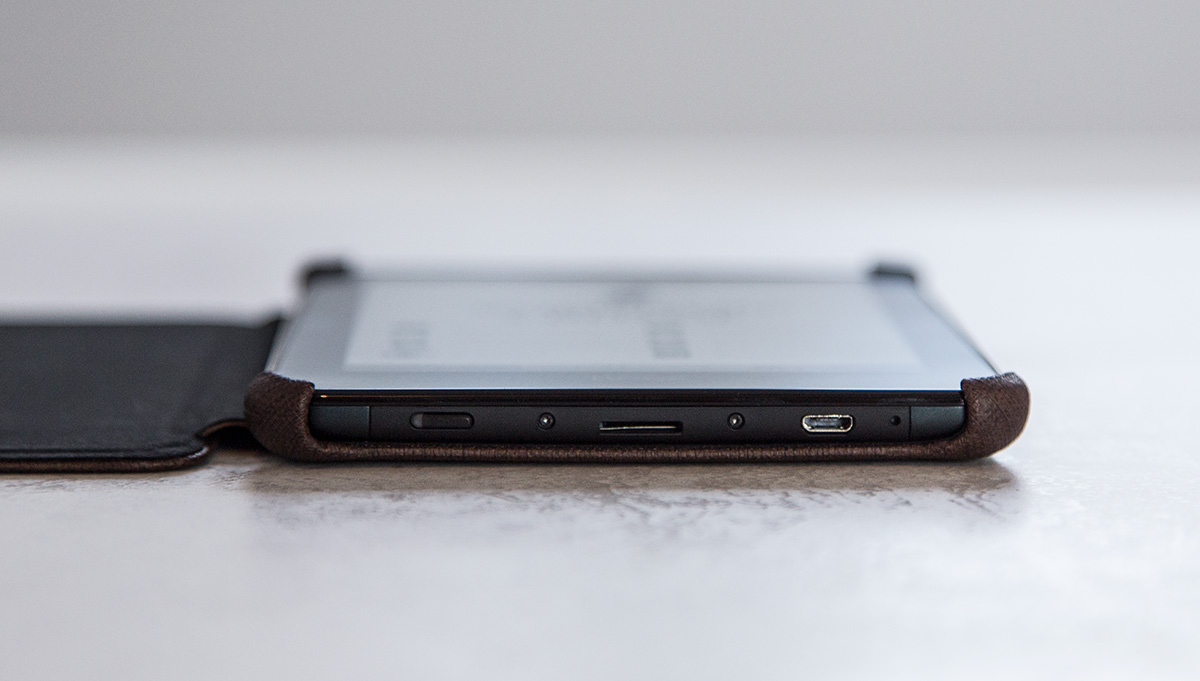
Here are the same "legs" in the corners, which securely cling to the device and do not fly off during use. Not only do not fly off, but do not interfere. The inside of the case is made of suede, the case is stitched around the perimeter. The “cover” has built-in magnets, thanks to which it “closes” itself, automatically placing the device (in which there is a Hall sensor) in sleep mode.

You wrote in the comments that over time, the case loses its appearance (by the way, any case does so with active use) - in this case you can buy a new one: original or compatible (from the Monte Cristo booklet) for £ 1290 .
Externally and according to the characteristics, Robinson Crusoe 2 is identical to the ONYX BOOX Monte Cristo 3 reader, but there is one significant difference: it has moisture-proof properties implemented using the HZO technology. It is not waterproof - water can get into the case, just all the elements are covered with a special varnish, which makes the device immune to high levels of humidity, for example, on a bed in an aquapark or at the beach. Robinson would be appreciated!
The main part of the device's front panel is occupied by a 6-inch touchscreen (capacitive) E Ink Carta Plus screen with a resolution of 1072 × 1448 (pixel density is 300 ppi). 16 shades of gray, 14: 1 contrast ratio, multitouch support, backlighting - everything is there.

And there is also a protective glass ASAHI, which protects the delicate screen from mechanical effects and glare (due to the anti-reflective coating) not to the detriment of the picture quality. Like Gorilla Glass for smartphones, only ASAHI and for e-books.
The glass is installed flush with the device body, without additional sides - due to this, the device looks more modern, more comfortable and practical to use (dust and screen prints are removed with a single sleeve movement, without special tools and bristling along the frames).

On the sides of the screen are the touch buttons for browsing ("there" and "here" or "here" and "there"?), And the inscription BOOX below it performs the function "Back" (exit from books and applications or cancel the current operation). Pressing the buttons for a long time regularly performs other functions: “Menu”, Back and turning the backlight on / off. There are no other functional elements on the front side, nothing will distract from reading.

Surprisingly, on the right and left sides, too. A few more standard functional elements are only below: there is a relief power button with LED (activates sleep mode or turns off the device when pressed for a long time), a slot for memory cards (microSD up to 32GB), a microUSB connector for charging and synchronization, and a hole for pressing a button Reset

There are no speaker nets or minijack again, so audiobooks and music ... ahem, no, not canceled - as is the case with the Chronos book, you can listen to audio content through any Bluetooth headset.
The body is made of aluminum-magnesium alloy, which is painted in matt black. The case is tactilely very pleasant, it feels monolithic - it’s even a pity to hide such beauty in the case.

The “Robinson” filling is quite productive: there is a dual-core processor with a frequency of 1 GHz, 512 MB of RAM and 8 GB of internal memory for data storage. Comments like "I have every indicator at least twice as much in a Chinese smartphone" are somewhat irrelevant - these characteristics are enough for comfortable work with any content intended for a device with an E Ink screen.
Also on board there are modules Wi-Fi (802.11 b / g / n) and Bluetooth. All this is powered by a lithium-polymer battery with a capacity of 3000 mAh, which lasts about a month to read (one hour per day) without illumination, and somewhere 20% less with illumination (depending on the intensity).

Oh, right, forgot to add about the highlight. Yes, in “Robinson” there is a MOON Light backlight (turned on by long pressing the “BOOX” label under the screen or through the application settings) with a rather large amount of brightness gradation: from “barely” to “oo, it is necessary to subtract.” The backlight is uniform, does not flicker, the color temperature is cold, but it performs its function perfectly well - thanks to it, comfortable reading becomes possible not only with external light sources, but also in complete darkness. By the way, in OReader you can change the brightness of the backlight with a swipe on the right edge of the screen.

One of the trump cards of ONYX Boox readers is that they work on the Android OS, in this case it is quite old 4.2.2. But again, for the "reader" innovations and tsatski are not needed, and everything you need here works like a clock: a touch screen, wireless modules, Google Play, etc.


Accordingly, the presence of an "android" on board makes it possible to install third-party applications that can solidly pump over the device's capabilities - you can install applications from your favorite sites (Habr, Medusa, Lepris, Layfhaker, etc.), RSS readers, Yandex.Disk (Dropbox, unfortunately , nominally not supported) and Pocket, browser-mailers-maps and other messengers (Telegram works and looks rather unusual). For this reason, among other things, it does not make much sense to talk about the interface and a set of standard applications pre-installed on the device — this was discussed in the previous review .


However, one of the nuances worth mentioning. By default, the device has two readers, OReader and Neo Reader, which together cover most of the popular content formats. But it's not the number of extensions that is more pleasant, but the fact that the SNOW Field technology works in these applications - thanks to it, in the process of reading, no redrawing of the image remains on the screen, which positively affects the amount of reading pleasure.
(Continuing the previous paragraph): add here a really convenient control (you can flip through pages with tapes, swipes, buttons or via autolist), additional functions like scaling (including gestures), dictionary (especially useful in Neo), bookmarks, etc. ... and that we get? That is - a compact and monolithic reading room with backlighting, which, like a meat grinder, grinds in itself any books. Is this not a book lover's dream? )

... But why did the aborigines eat Cook?
For what, it is not clear, science is silent.
It seems to me a very simple thing -
They wanted to eat and ate Cook ...
It was in his honor that the new e-ink book ONYX Boox James Cook was named , but today we will not talk about it :) Today we will talk about the reading room (also new), also named after another navigator - Robinson Crusoe.
It is great that the company gives its devices names, not just unforgettable tsiferki;)
“Robinson Crusoe is a novel by English writer Daniel Defoe (1660-1731), first published in April 1719, telling about the moral revival of man in communication with nature. Written as an autobiography of the sea traveler and planter Robinson Crusoe, who wanted to get even more rich soon and illegally, but as a result of a shipwreck he fell on an uninhabited island and spent 28 years there. ”
/ Wikipedia
An exceptionally enjoyable work that deservedly enters the school curriculum and which will be especially pleasant to read on the e-book of the same name from today's review. More precisely, the second version of the device, which, judging by the recall, turned out to be successful and the company decided to make it even better.
ONYX BOOX Robinson Crusoe 2 is an updated edition of a premium e-ink reader, equipped with the latest generation E Ink Carts Plus screen, with ASAHI protective glass, MOON Light backlight, SNOW Field function and protection from splashes and moisture. On a desert island - the most it.
At the request of readers, we publish the price of the device at the beginning of the review: € 12,490
Equipment
Like ONYX Chronos from the previous review , “Robinson” is sold in a white cardboard box - it doesn’t look like a collector's edition of a book, rather, a collection box for CDs. But the statement is true that if you tie it up with a red ribbon, you will get a great gift (including the New Year):
Inside it’s the same arsenal: the device itself, corporate case, instruction, USB-microUSB cable and adapter for charging from the network. The e-book supports microSD memory cards, but it is not included (most users have enough internal memory).
| An interesting fact: about Robinson Crusoe in the treasury of world literature included only one work by Daniel Defoe, although the novel has two more parts, but less popular: "Further Adventures of Robinson Crusoe" (1719) and "Serious Thoughts of Robinson Crusoe" (1720). There is a frequent case when the following parts are not as successful as the opening picture. |
Appearance
The first thing you will see when unpacking will be the original cover with matting texture (like cloth or linen paper):
Although it increases the dimensions of the reader, it reliably protects it from external cataclysms (which will certainly occur during everyday use, especially Something in a backpack). The ends of the device remain “vulnerable” - so that functional elements (buttons and connectors) are always available and so as not to interfere with the control when reading:
Here are the same "legs" in the corners, which securely cling to the device and do not fly off during use. Not only do not fly off, but do not interfere. The inside of the case is made of suede, the case is stitched around the perimeter. The “cover” has built-in magnets, thanks to which it “closes” itself, automatically placing the device (in which there is a Hall sensor) in sleep mode.
You wrote in the comments that over time, the case loses its appearance (by the way, any case does so with active use) - in this case you can buy a new one: original or compatible (from the Monte Cristo booklet) for £ 1290 .
Externally and according to the characteristics, Robinson Crusoe 2 is identical to the ONYX BOOX Monte Cristo 3 reader, but there is one significant difference: it has moisture-proof properties implemented using the HZO technology. It is not waterproof - water can get into the case, just all the elements are covered with a special varnish, which makes the device immune to high levels of humidity, for example, on a bed in an aquapark or at the beach. Robinson would be appreciated!
The main part of the device's front panel is occupied by a 6-inch touchscreen (capacitive) E Ink Carta Plus screen with a resolution of 1072 × 1448 (pixel density is 300 ppi). 16 shades of gray, 14: 1 contrast ratio, multitouch support, backlighting - everything is there.
And there is also a protective glass ASAHI, which protects the delicate screen from mechanical effects and glare (due to the anti-reflective coating) not to the detriment of the picture quality. Like Gorilla Glass for smartphones, only ASAHI and for e-books.
| ASAHI - a Japanese company, the world's largest glass maker, is part of the Mitsubishi company. The same company owns the Belgian company Glaverbel, which owns 88% of the Borsky glass factory in Nizhny Novgorod - if you ever had to change the glass in a car, then surely this particular manufacturer was advised to you by glaziers and friends. |
On the sides of the screen are the touch buttons for browsing ("there" and "here" or "here" and "there"?), And the inscription BOOX below it performs the function "Back" (exit from books and applications or cancel the current operation). Pressing the buttons for a long time regularly performs other functions: “Menu”, Back and turning the backlight on / off. There are no other functional elements on the front side, nothing will distract from reading.
Surprisingly, on the right and left sides, too. A few more standard functional elements are only below: there is a relief power button with LED (activates sleep mode or turns off the device when pressed for a long time), a slot for memory cards (microSD up to 32GB), a microUSB connector for charging and synchronization, and a hole for pressing a button Reset
There are no speaker nets or minijack again, so audiobooks and music ... ahem, no, not canceled - as is the case with the Chronos book, you can listen to audio content through any Bluetooth headset.
The body is made of aluminum-magnesium alloy, which is painted in matt black. The case is tactilely very pleasant, it feels monolithic - it’s even a pity to hide such beauty in the case.
| Interesting fact 2: since 1902, at least 24 films were devoted to the main character of the novel, the last of which was released in 2016. → All Filmography |
Turn on and work
The “Robinson” filling is quite productive: there is a dual-core processor with a frequency of 1 GHz, 512 MB of RAM and 8 GB of internal memory for data storage. Comments like "I have every indicator at least twice as much in a Chinese smartphone" are somewhat irrelevant - these characteristics are enough for comfortable work with any content intended for a device with an E Ink screen.
Also on board there are modules Wi-Fi (802.11 b / g / n) and Bluetooth. All this is powered by a lithium-polymer battery with a capacity of 3000 mAh, which lasts about a month to read (one hour per day) without illumination, and somewhere 20% less with illumination (depending on the intensity).
Oh, right, forgot to add about the highlight. Yes, in “Robinson” there is a MOON Light backlight (turned on by long pressing the “BOOX” label under the screen or through the application settings) with a rather large amount of brightness gradation: from “barely” to “oo, it is necessary to subtract.” The backlight is uniform, does not flicker, the color temperature is cold, but it performs its function perfectly well - thanks to it, comfortable reading becomes possible not only with external light sources, but also in complete darkness. By the way, in OReader you can change the brightness of the backlight with a swipe on the right edge of the screen.
One of the trump cards of ONYX Boox readers is that they work on the Android OS, in this case it is quite old 4.2.2. But again, for the "reader" innovations and tsatski are not needed, and everything you need here works like a clock: a touch screen, wireless modules, Google Play, etc.
Accordingly, the presence of an "android" on board makes it possible to install third-party applications that can solidly pump over the device's capabilities - you can install applications from your favorite sites (Habr, Medusa, Lepris, Layfhaker, etc.), RSS readers, Yandex.Disk (Dropbox, unfortunately , nominally not supported) and Pocket, browser-mailers-maps and other messengers (Telegram works and looks rather unusual). For this reason, among other things, it does not make much sense to talk about the interface and a set of standard applications pre-installed on the device — this was discussed in the previous review .
However, one of the nuances worth mentioning. By default, the device has two readers, OReader and Neo Reader, which together cover most of the popular content formats. But it's not the number of extensions that is more pleasant, but the fact that the SNOW Field technology works in these applications - thanks to it, in the process of reading, no redrawing of the image remains on the screen, which positively affects the amount of reading pleasure.
ONYX BOOX Robinson Crusoe 2 Specifications
| Display | 6 ", E Ink Carta Plus, 16 shades of gray, 14: 1 contrast ratio, 1072 × 1448 pixels, pixel density - 300 ppi |
| Touch screen | Capacitive with multi-touch function |
| Backlight | MOON Light |
| Protective glass | ASAHI |
| CPU | 2-core, 1 GHz |
| RAM | 512 MB |
| Internal memory | 8 GB |
| Expansion slot | For microSD / microSDHC memory cards |
| Wired interface | microUSB |
| Supported File Formats | TXT, HTML, RTF, FB2, FB2.zip, FB3, MOBI, CHM, PDB, DOC, DOCX, PRC, EPUB, CBZ, PDF, DjVu, JPG, PNG, GIF, BMP |
| Беспроводной интерфейс | Wi-Fi IEEE 802.11 b/g/n |
| Аккумулятор | Литиево-полимерный, ёмкость 3000 мАч |
| Операционная система | Android 4.2 |
| Материал корпуса | Алюминиево-магниевый сплав |
| Размеры | 158,9 × 114 × 8 мм |
| Цвет | Чёрный |
| Вес | 205 г |
| Комплектация | Электронная книга ONYX BOOX Robinson Crusoe 2 Руководство пользователя Чехол-обложка USB-кабель Сетевой адаптер питания 220 В Гарантийный талон |
| Гарантийный срок | 1 год |
Total
(Continuing the previous paragraph): add here a really convenient control (you can flip through pages with tapes, swipes, buttons or via autolist), additional functions like scaling (including gestures), dictionary (especially useful in Neo), bookmarks, etc. ... and that we get? That is - a compact and monolithic reading room with backlighting, which, like a meat grinder, grinds in itself any books. Is this not a book lover's dream? )