Mini Supercomputer: 1000 Raspberry Pi Clustered
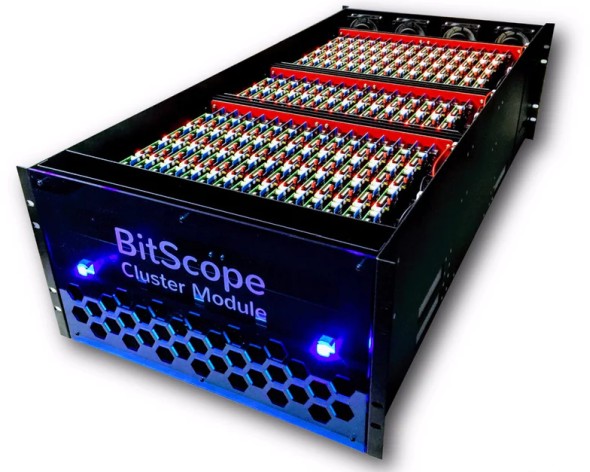
The BitScope Cluster module contains 150 Raspberry Pi mini-computers with integrated network switches. Photo: BitScope
Programmers and scientists do not always have free access to this high-performance supercomputer to try out their programs. Moreover, supercomputers are usually busy 24 hours a day with other software. It's hard to find a window. You need to write an application in advance and get in line. How will the new program work in a real multiprocessor environment, how well is the task parallelized?
To help developers commissioned by the High-Performance Computing Department of the Los Alamos National Laboratory, Australian company BitScope has developed “test” computing modules BitScope Clusterof 150 Raspberry Pi mini-computers that can be clustered and checked for their programs.
The Los Alamos National Laboratory employs one of the ten most powerful supercomputers in the world - Trinity .
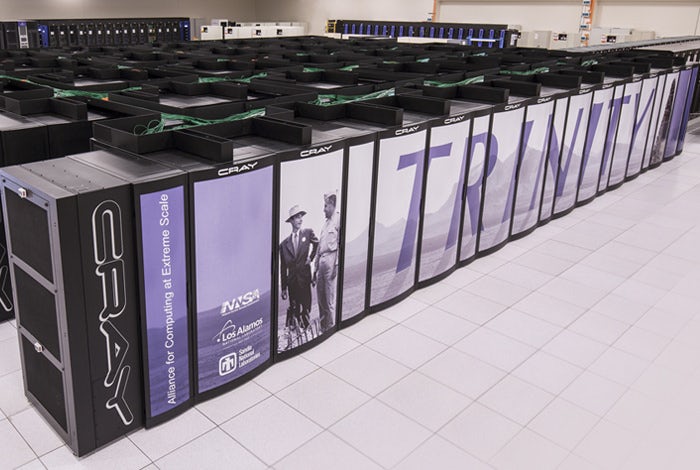
Trinity supercomputer at the Los Alamos National Laboratory
The laboratory management set the task of finding a way to give developers access to high-performance parallel computing without actually accessing the supercomputer itself so that they can test their programs.
“The Raspberry Pi modules enable developers to figure out how to write such software and make it work reliably without having to have a test bench of the same size costing a quarter of a billion dollars and consuming 25 megawatts of electricity,” saysGary Glider from the Los Alamos National Laboratory.
In fact, 25 megawatts of electricity to test its own program is too much (it does not take into account the cost of energy for cooling, which is several times higher than the power consumption of the computing system itself).
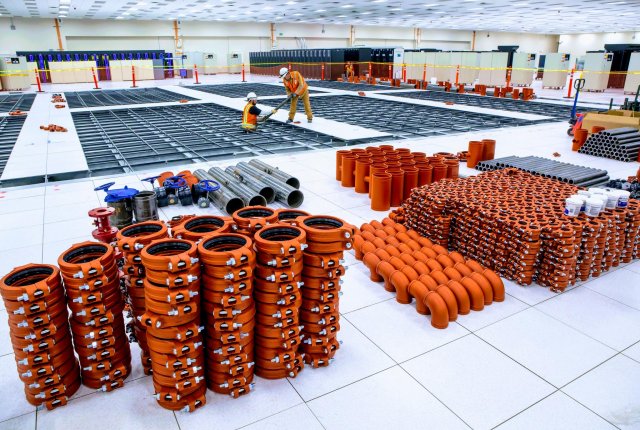
Installation of water cooling system for Trinity supercomputer, which effectively uses the system of sanitary wastewater reclamation
Each module has 144 active nodes, six spares and one control node. The module has a 6U format when installed in the server rack of a data center. As reported on the official website, a cluster of 1000 nodes occupies a 42U rack at a cost of about $ 120-150 per node. This is a rather large margin compared to the standard price of the Raspberry Pi 3, which is, as we know, $ 35.
Each BitScope Cluster module consists of building blocks - the so-called “cluster packs” (Cluster Pack). Installation in the rack for one unit is in the form of these "packages".

Cluster pack
One node (Raspberry Pi 3 mini-computer) contains a 64-bit four-core ARMv8 processor at 1.2 GHz. Thus, if we imagine a cluster, for example, of five modules, then there will be 720 active nodes, that is, 2880 active processor cores. It is quite enough for testing how well the program is parallelized.
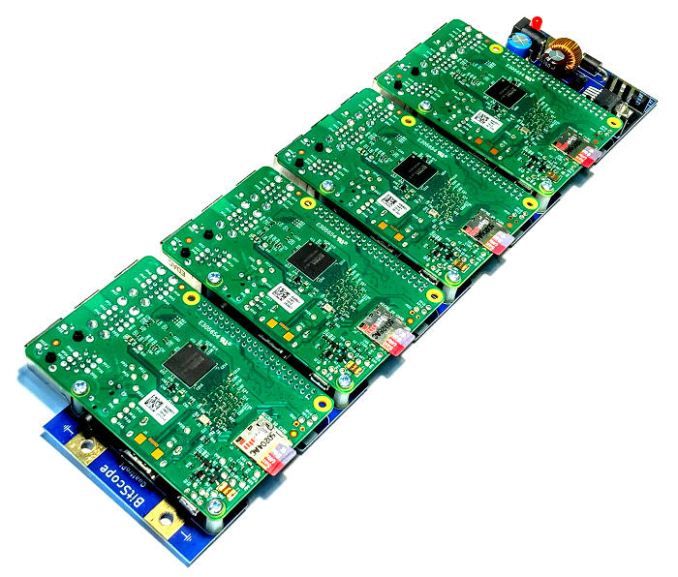
This is how close one row of mini-computers looks in Cluster Pack
Although this solution is indeed much cheaper than a supercomputer, you still cannot call it a budget one. Only a large research organization can afford a mini-cluster for $ 100 thousand or $ 150 thousand purely for testing programs. Actually, such modules are designed, probably, for these rich organizations - owners of supercomputers. Nevertheless, the creators of the mini-supercomputer say that this is “the most cost-effective scalable solution in the world: it is inexpensive to build, manage, and support.”
Modules BitScope Cluster and provide significant savings in power consumption. You can calculate the energy consumption of each of them, counting at 5 watts per node. If we assume that the spare nodes have minimum power consumption, then the modules remain 144 active and one control node. A total of 145 × 5 = 725 watts.
BitScope intends to release these modules for free sale sometime in early 2018.
According to the company, in addition to software development, such clusters can be useful as simulators of sensor networks, in research of high-performance networks and the Internet of things.