Facebook highlights F8 Keynote
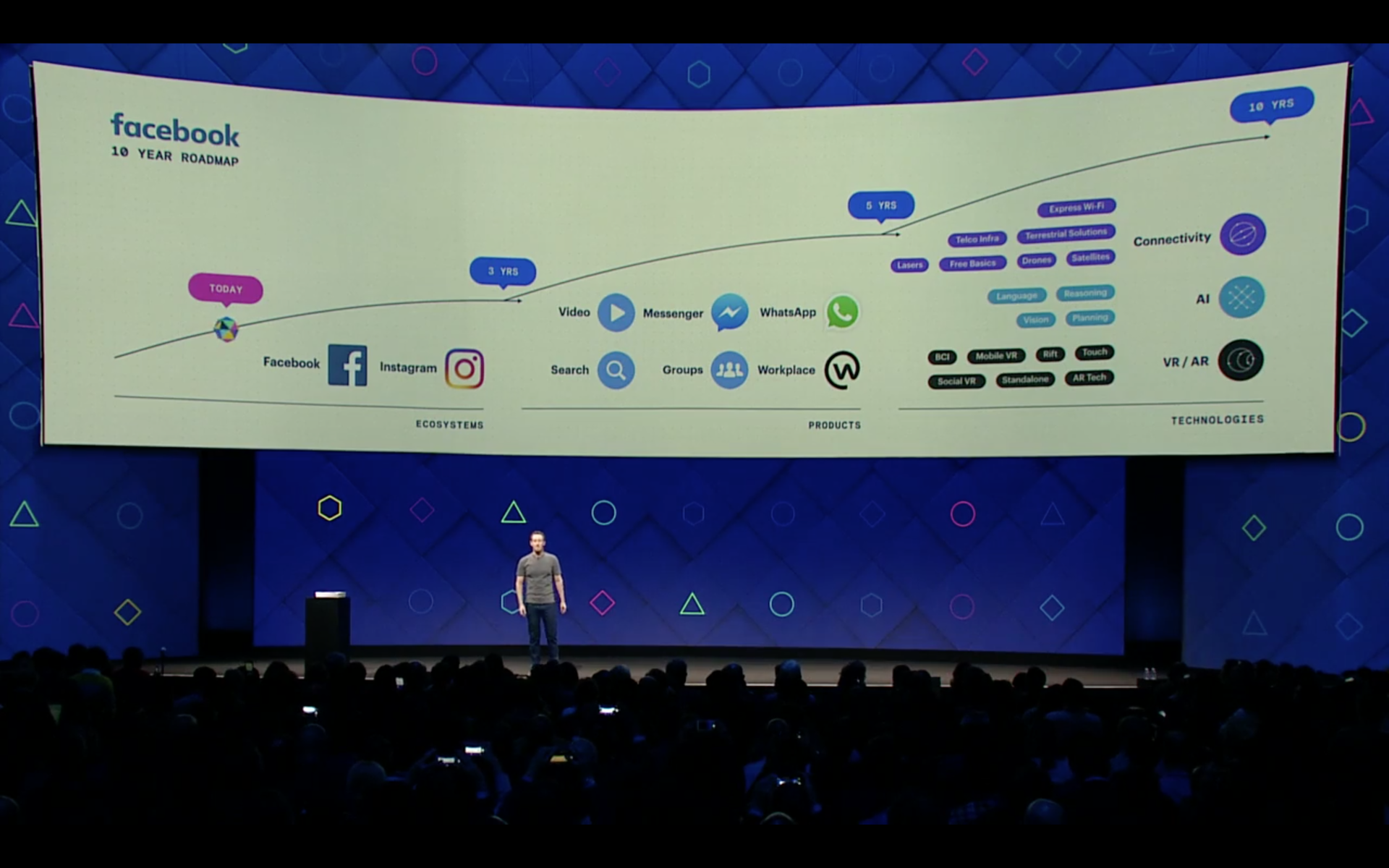
Facebook F8 conference started today. The event is interesting exactly the way Facebook sees the future. This amount of futuristic fantasies in my head is not born either after WWDC or after Google IO. As expected, great emphasis was placed on additional and virtual realities, but the main task for Facebook from the words of Mark Zuckerberg is building communities. If earlier the goal was to simply connect friends and acquaintances, now it is about forming interest groups.
Facebook Spaces

The company announced Spaces - a social network for Oculus Rift. In this service, users are presented in the form of avators, whose image is built on the basis of profile pictures. With the help of Messenger, you can get in touch with your friends, or rather with their characters, which imitate live communication in any specified place. And the objects drawn in the virtual space turn into interactive objects that can be used. It looks all very cool.
At the current stage, up to four users can take part in one VR session. In the future, Facebook plans to open access to Spaces and other VR devices. “In the end, we want to be present on all VR platforms,” said Michael Booth, head of social VR projects at Facebook.
Camera effects platform
Facebook has developed the Camera Effects platform, which consists of Frame Studio and AR Studio. The first is, in principle, a banal overlay of layers for a photo. But the second is a kind of “MSQRD constructor”, but not only for processing human faces, but for everything. The tool allows you to add steam effects to coffee or run small sharks into a cup, change the lighting in the room or fill it with M & Ms and so on.
Using AR Studio, you can also make it so that when you click on a bottle of wine, a map of the liquor stores and a link for the purchase will be displayed. The potential is impressive, however, for some reason this idea reminded me of the Internet of the late nineties or the beginning of zero. Will the dominance of advertising and banners of the new formation come or will everything look organic?
In general, the Camera Effects Platform is something insanely interesting, flowing from experiments with photo effects into virtual reality. I want to quickly hear about the first experience of working with the platform. Multiple repetition of the abbreviation AI and phenomenal object recognition technologies from the presentation look impressive. But if everything is at such a high level, then why does the corporation still have problems with prohibited content?
Messenger platform 2.0
A few weeks before the conference on TechCrunch they wrote that group bots would appear in Messenger. Something corresponding to this concept called Chat Extensions did appear, but it is significantly different from the existing capabilities in Telegram or Slack. Chat Extensions are chat apps in the form of tooltips without access to the contest contest for inline tasks only.
The Discover Tab has appeared - a catalog of bots and extensions and Parametric QR avatars in Messenger contain information for real-world interaction.
New features of the Facebook M assistant were also shown, offering various tips throughout the conversation. For example, you wrote what you want to eat, “M” will offer you the function of ordering from existing Chat Extensions. How this is determined is not stated.
In the telegram channel Groks there was an interesting entry affecting this topic:
The Information reports that “M” is capable of processing only 30% of all messages. In this regard, Facebook makes a “pivot”, and “M” will be designed for contextual advertising inside Messenger. In other words, an offer to buy something will soon appear in the dialogs at the “appropriate moment”. Here you have the real situation, which is hidden under the guise of loud slogans about cool encryption and innocuous collection of meta-data from instant messaging services.
Messenger uses 1.2 billion people for whom more than 100,000 bots have already been developed. Game bots in the last 90 days have used more than 1.5 billion times.