March 19, 2017 at 18:14
Autism and the brain
- Transfer
Sheldon Cooper, BBC Sherlock and Ebed from the " Community " go to the bar. The bartender looks up and says: “Is this a joke about the overuse of the autistic image in movies?”
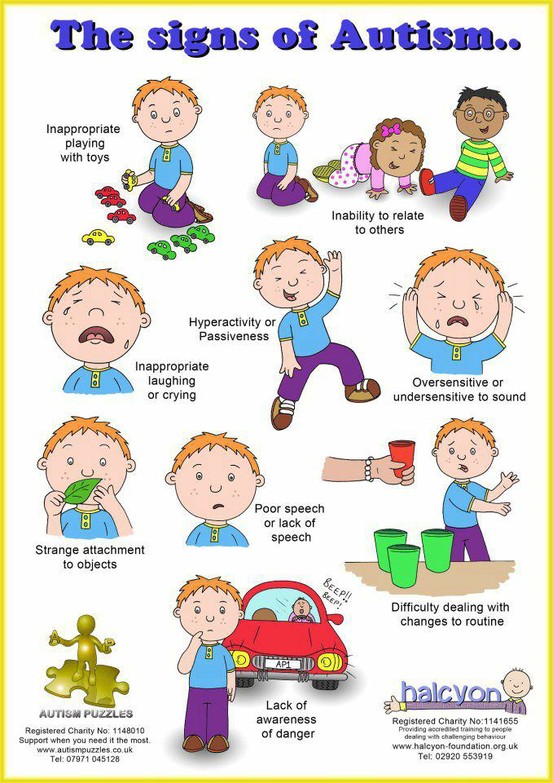
Symptoms of autism: unusual handling of toys; inability to build relationships with others; laughter or crying out of place; hyperactivity or passivity; Too big or small sensitivity to sounds; strange attachment to objects; poor speech or lack thereof; difficulties with changing habits; inattention to danger.
If you put aside my amazing sense of humor, then if there is any mental disorder that is too often mentioned in the media, then this is ( highly functional) autism. Scriptwriters love to include brilliant, socially unsuitable nerds in the narrative that solve unsolvable puzzles and make ordinary people look illogical. But how does this stereotype correspond to reality? And what is autism if it is not Sheldon Cooper? Some believe that it can be equated to the possibility of a “ rain man ” to count the number of matches in a box after a quick look at it, while others may decide that this leads to a lack of social skills and to a large collection of bottle caps. For the most part, the truth is somewhere in between: autism is a very broad concept (for good reason it is called an autism spectrum disorder), and there are no two identical diagnoses in this area. So let's see what it really is, and what kind of participation the brain takes here.
Autism Spectrum Disorder (ASD) is the name of a group of brain development disorders. This disorder is quite common: approximately 1% of all people have it (in men it occurs 4-7 times more often than in women). In addition to autism itself, this disorder includes Asperger Syndrome , known as a more sparing and highly functional version of autism, and a penetrating developmental disorder(something like an intermediate state between Asperger and autism). All of these conditions are characterized by impaired socialization and communication skills and repetitive / structured behavior and attachments. The severity of certain violations determines where the person is on the spectrum. Someone can remain silent and spend hours completely immersed in some kind of repetitive activity, someone can talk about their interests without interruption without perceiving hints of stopping the story and not understanding irony or sarcasm.
RAS does not imply the presence of brilliant intelligence by default (sorry, Sheldon!). The level of cognitive function in autism ranges from disability to superintelligence.. Although associating autism with a small IQ is no longer fashionable (scientists are beginning to admit that this may be due to the fact that standard IQ tests do not reflect the cognitive abilities of autistic children), recent studies have shown that almost half of children with ASD have an average intelligence or slightly above average. In addition, to confuse the topic, I mention that in a fairly recent study published in Nature , it was shown that genes associated with an increased risk of autism can be associated with high intelligence (in addition, people who have this genetic combination but have not demonstrated ASD , coped better with cognitive tests).
ASD does not have one known cause. It is believed that genetics plays an important role in it (autism is found in relatives, the likelihood of its occurrence in both identical twins is higher than in twin twins, etc.). However, it is not clear what is happening: there is no one “autism gene”, but only a complex set of interactions ( 1 , 2 , 3 ). However, it is clear that at least some genes are responsible for abnormal brain development in ASD.
A brain with autism is quite different from a “neurotypical” one in many aspects. First, children with ASD have a larger brain ( 1 , 2 , 3) One possible reason is a greater amount of white matter than people without autism. Between 6 and 14 months, children usually go through a phase of rapid growth of synapses (connections between nerve cells), followed by a “cleansing” process when unnecessary connections are eliminated. It is believed that in children with ASD this cleaning is not going well and they have an unusually large number of synapses that interfere with the normal dissemination of information. One study examined the brains of autistic children of different ages (who died under different circumstances). It turned out that at the last stages of childhood the number of synapses in their brain fell by only 16%, in contrast to control cases in which this number was halved. They also discovered a possible reason for this: damage to the protein, which under normal conditions should help the cells, no matter how sharply it sounds, destroy some of its parts (autophagy). As a result, extra synapses remained in the brain, and its cells were clogged with old and damaged parts, which could not be eliminated. Scientists were able to restore autophagy and cleansing, and reverse autistic behavior in mice, providing them with medicine that restores the functioning of this protein.
Another factor that may play a role in increasing the size of the brain is the number of neurons in the prefrontal cortex, which is responsible for such complex things as reasoning, communication, social interactions, etc. It was found that in autistic boys in the prefrontal cortex67% more neurons, and their brain weighs 17% more than their peers without autism. In this case, the quantity is not equal to quality: this leads to a sharp increase in potential connections, and therefore potential problems in nerve cell networks. It is also worth mentioning that neurons of the prefrontal cortex are born during pregnancy, that is, autism may begin in the womb. This will help to understand the exact molecular mechanisms associated with the appearance of an excessive number of neurons, and perhaps - a little dream - to develop methods of treatment.
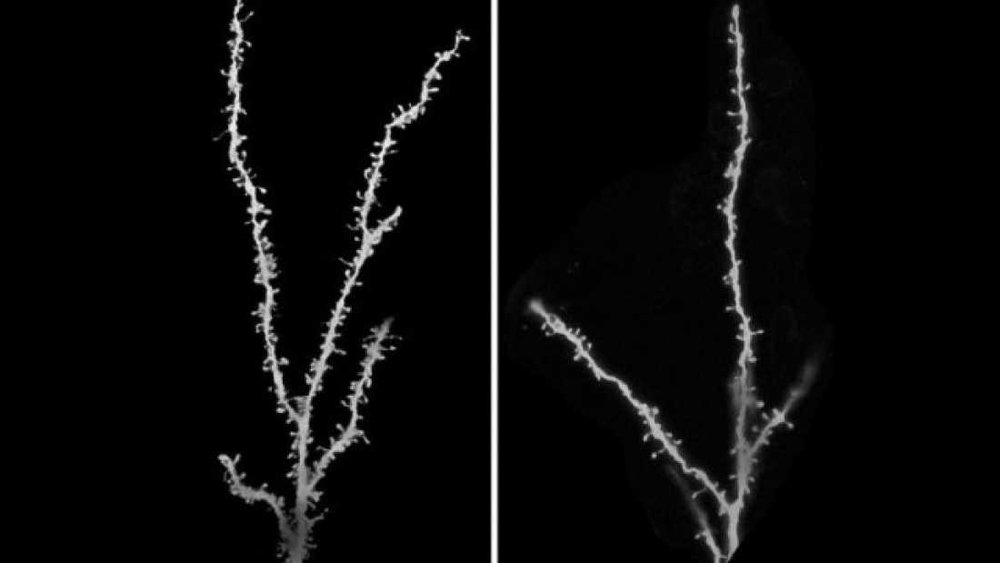
Small white pimples (dendritic spines) are the sites of attachment of neuron connections. On the left there are too many of them. On the right, autophagy protein works, and the number of spines decreases to normal.
Speaking of connections. We know that the autistic brain has a different structure, but we don’t know exactly how (since the results of the study of connections contradict each other due to different methods and tests). Some studies have found that a brain with ASD has too strong connections , while others that are too weak . Nevertheless, scientists believe that in this confusion patterns begin to manifest themselves, for example , fewer connections between distant parts of the brain (and these connections are weaker), and more connections at short distances.
The theory of " intensive world " is based on these discoveries."She claims that local hyperconnection in certain parts of the brain leads to excessive functioning, which, in turn, leads to hypersensitivity to information and the extreme work of attention and sensation processing. This doesn’t sound so bad and can explain the possibilities of geniuses, but weak communication of remote sites complicates the awareness of all this incoming information and the ability to choose a priority source of information (since the information cannot be integrated correctly) .This quickly overloads the consciousness that’s why people with ASD are trying to cope with sensory overload, moving away from society or going into repetitive actions (which help create a sense of stability and keep the world too bright in some way) .Although this is actually a very interesting theory, it needs to be be careful
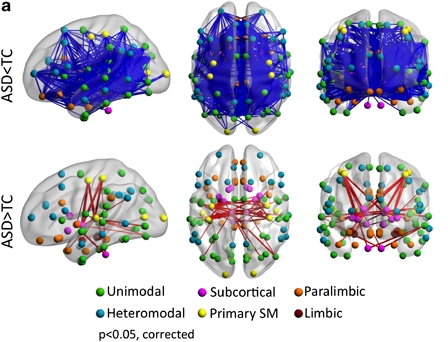
Upper row: weaker connections in patients with ASD compared with healthy people.
Bottom row: those connections that people with ASD are stronger.
One of the main signs of ASD is a disorder of social interactions. Autists may look like people who are not interested in social hints, or as people who are unable to read them. Among the most common problems, to varying degrees of severity, are the inability to decipher facial expressions, sarcasm, irony, feelings and points of view of other people. There are a couple of things in the brain that can explain this phenomenon. In one of the models for the development of social skillsit is claimed that we have an innate facial recognition ability, and that the cerebellar tonsil, one of the emotional centers, enhances this ability in infants, giving them pleasure when looking at the faces of the people caring for them. As a result, we often look at faces and gain a lot of experience by processing and reading their expressions. This occurs with the help of a “fusiform face area” (FFA), which, thanks to the experience gained, increases the ability to analyze facial expressions. In the model, it is believed that this experience becomes a reference in the understanding of non-verbal communications and complex social interactions. And in the case of children with autism, it seems that FFA and cerebellar tonsil do not develop correctly, which weakens the production of social experience.
There is evidence for this idea. Tracking eye movements shows that people with ASD have a certain pattern: they either devote less time to studying faces than healthy people, when watching a video with people, or when studying faces, they look at the mouth and not at the eyes (unlike healthy subjects ) This pattern of vision coincides with skipping social hints and with the problems of communicating with people, which are often shown by people with ASD. Another study shows that autists tend to look away from other people's eyes , and the longer the eye contact persists, the more active the cerebellar tonsil is - which indicates attempts to avoid unpleasant sensations (the tonsil is also responsible for avoiding an unpleasant experience).
Moreover, with age, the tonsil in autists decreases more than in neurotypical people. The spindle-shaped area also undergoes atypical changes: it reacts much weaker to autistic faces, and its connections with the amygdala are weakened (which is consistent with a study showing that children with autism have problems recognizing facial expressions). Moreover, in a recent study, scientists were able to turn on and off
empathic behavior in rats, manipulating a certain contour in the cerebellar tonsil. When the middle part of the tonsil was turned off, the rats calmly perceived how their rodent friend was shocked. When it turned on, they suddenly again showed empathy (in the case of rats, this means that they froze in solidarity with the injured comrade). Another potential target for pharmacological intervention!
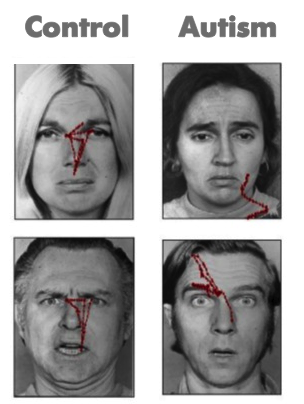
The red line is the gaze of people with (right column) and without (left) autism.
Another thing autists may have problems with is empathy (it comes in two varieties: cognitive, that is, “I understand that a person feels” and emotional, “I feel the same”) and with a model of the human psyche. MPS means the ability to understand that other people have their own thoughts, emotions, and points of view. It allows us to predict the behavior of others based on what we think about what they can think. Of course, it would be too much simplification to say that autists do not understand that other people have their own points of view, beliefs, etc. Depending on the position on the spectrum scale, many of them understand this. It's just that these beliefs are often a secret to them. A typical test for the lack of MPS in a child is the Sally-Ann task presented in the picture. Autistic children usually fail to resolve it correctly.
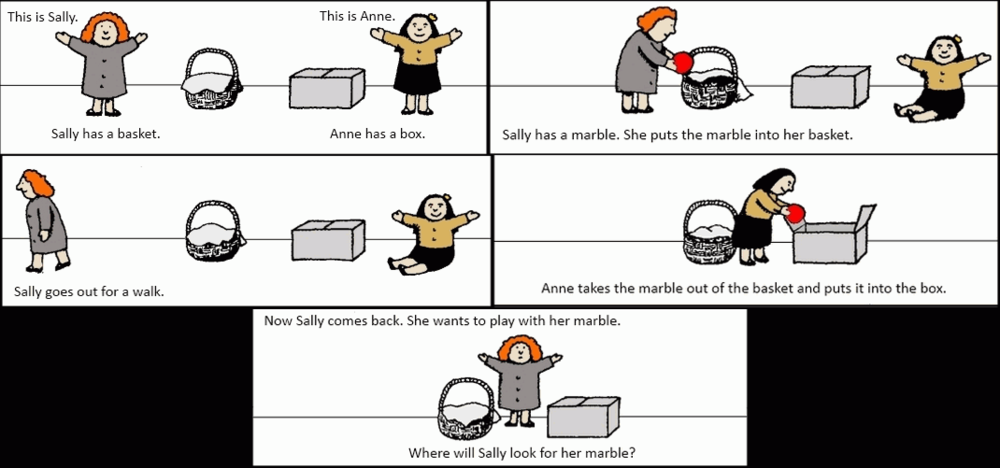
It is usually more difficult for autistic children to understand that Sally will first look for the ball in the basket where she first put it
With problems with empathy, too, is not so simple. Some studies suggest that people who have problems with MPS have problems with cognitive empathy - it is difficult for them to “take the place of another person” and understand how they feel ( 1 , 2 , 3 ). But with emotional empathy, the problems seem to be less - if they can understand what the other person feels, they will be able to experience the same feelings and demonstrate the same emotional reaction. But psychopaths demonstrate the opposite: they understand well what other people feel, but generally can not show sympathy , both in unpleasant and in pleasant situations.
There are several candidates for the role of the IPU framework. Temporal-parietal node(WTU) is one of the main members of this network. They say that he is responsible for determining the thoughts of another person (what he feels and what he thinks), assessing the visual perception of another person (as he sees it), and other processes necessary for MPS. It has been shown that in patients with ASD it is less activated in the tasks associated with MPS, and this activation correlates with the severity of the symptoms (the stronger they are, the less activation). In addition, it was found that in autists the entire network of sites involved in MPS is hypoactive .
In a couple of studies, scientists found out whether it is possible to affect the empathy or perception of human MPS using non-invasive brain stimulation (by controlling brain activity through electromagnetic fields or electric current). And when VTU's work was suppressed, people showed worse results in tests for cognitive abilities and empathy. With his excitement, people began to better evaluate the visual point of view of other people. Interestingly, in one study not specifically aimed at emotional awakening (they simply tried to measure the effect of stimulation on how people recognize objects), a six-month course of transcranial magnetic stimulation made a person with Asperger Syndrome feel the following: "" Somehow I read the expressions of her face and instinctively and correctly reacted to them. Most people take such abilities for granted, but I have not been able to recognize such things all my life and said not what I need - sometimes the worst of everything possible - in response to the logical words spoken by others. An inner voice told me that I could look into their souls. Then I felt a new surge of emotions and I had to go out when this wave swept over me. People eyes turned into windows , and the flow of them pouring em I was very strong. Somehow, my ability seemed instinctive and natural to me, as if she had always been with me. "Wow. I feel emotions every day, and they still amaze me. For him, all this should have been to be quite difficult.
Summarizing all this, we can say that non-invasive brain stimulation offers promising opportunities for the treatment of ASD. Several studies have successfully adapted transcranial stimulation to facilitate obsessive repetition, improved speech, and the like. Transcranial stimulation using direct current, tDCS, despite the cheapness and simplicity, also looks worthy of attempts to study it. Wouldn’t it be cool if we could uniquely identify the switch, by clicking which, it would be possible to connect empathy and MPS?
And last but not least. Do vaccines lead to autism? Not.
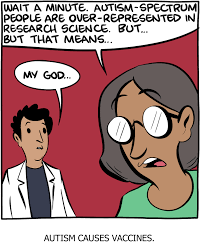
Just a second ... Indeed, in science there are quite a few people with disorders from the autistic spectrum. It does mean ... That autism leads to vaccines!
Symptoms of autism: unusual handling of toys; inability to build relationships with others; laughter or crying out of place; hyperactivity or passivity; Too big or small sensitivity to sounds; strange attachment to objects; poor speech or lack thereof; difficulties with changing habits; inattention to danger.
If you put aside my amazing sense of humor, then if there is any mental disorder that is too often mentioned in the media, then this is ( highly functional) autism. Scriptwriters love to include brilliant, socially unsuitable nerds in the narrative that solve unsolvable puzzles and make ordinary people look illogical. But how does this stereotype correspond to reality? And what is autism if it is not Sheldon Cooper? Some believe that it can be equated to the possibility of a “ rain man ” to count the number of matches in a box after a quick look at it, while others may decide that this leads to a lack of social skills and to a large collection of bottle caps. For the most part, the truth is somewhere in between: autism is a very broad concept (for good reason it is called an autism spectrum disorder), and there are no two identical diagnoses in this area. So let's see what it really is, and what kind of participation the brain takes here.
Autism spectrum disorder
Autism Spectrum Disorder (ASD) is the name of a group of brain development disorders. This disorder is quite common: approximately 1% of all people have it (in men it occurs 4-7 times more often than in women). In addition to autism itself, this disorder includes Asperger Syndrome , known as a more sparing and highly functional version of autism, and a penetrating developmental disorder(something like an intermediate state between Asperger and autism). All of these conditions are characterized by impaired socialization and communication skills and repetitive / structured behavior and attachments. The severity of certain violations determines where the person is on the spectrum. Someone can remain silent and spend hours completely immersed in some kind of repetitive activity, someone can talk about their interests without interruption without perceiving hints of stopping the story and not understanding irony or sarcasm.
RAS does not imply the presence of brilliant intelligence by default (sorry, Sheldon!). The level of cognitive function in autism ranges from disability to superintelligence.. Although associating autism with a small IQ is no longer fashionable (scientists are beginning to admit that this may be due to the fact that standard IQ tests do not reflect the cognitive abilities of autistic children), recent studies have shown that almost half of children with ASD have an average intelligence or slightly above average. In addition, to confuse the topic, I mention that in a fairly recent study published in Nature , it was shown that genes associated with an increased risk of autism can be associated with high intelligence (in addition, people who have this genetic combination but have not demonstrated ASD , coped better with cognitive tests).
ASD does not have one known cause. It is believed that genetics plays an important role in it (autism is found in relatives, the likelihood of its occurrence in both identical twins is higher than in twin twins, etc.). However, it is not clear what is happening: there is no one “autism gene”, but only a complex set of interactions ( 1 , 2 , 3 ). However, it is clear that at least some genes are responsible for abnormal brain development in ASD.
Autism Brain
A brain with autism is quite different from a “neurotypical” one in many aspects. First, children with ASD have a larger brain ( 1 , 2 , 3) One possible reason is a greater amount of white matter than people without autism. Between 6 and 14 months, children usually go through a phase of rapid growth of synapses (connections between nerve cells), followed by a “cleansing” process when unnecessary connections are eliminated. It is believed that in children with ASD this cleaning is not going well and they have an unusually large number of synapses that interfere with the normal dissemination of information. One study examined the brains of autistic children of different ages (who died under different circumstances). It turned out that at the last stages of childhood the number of synapses in their brain fell by only 16%, in contrast to control cases in which this number was halved. They also discovered a possible reason for this: damage to the protein, which under normal conditions should help the cells, no matter how sharply it sounds, destroy some of its parts (autophagy). As a result, extra synapses remained in the brain, and its cells were clogged with old and damaged parts, which could not be eliminated. Scientists were able to restore autophagy and cleansing, and reverse autistic behavior in mice, providing them with medicine that restores the functioning of this protein.
Another factor that may play a role in increasing the size of the brain is the number of neurons in the prefrontal cortex, which is responsible for such complex things as reasoning, communication, social interactions, etc. It was found that in autistic boys in the prefrontal cortex67% more neurons, and their brain weighs 17% more than their peers without autism. In this case, the quantity is not equal to quality: this leads to a sharp increase in potential connections, and therefore potential problems in nerve cell networks. It is also worth mentioning that neurons of the prefrontal cortex are born during pregnancy, that is, autism may begin in the womb. This will help to understand the exact molecular mechanisms associated with the appearance of an excessive number of neurons, and perhaps - a little dream - to develop methods of treatment.
Small white pimples (dendritic spines) are the sites of attachment of neuron connections. On the left there are too many of them. On the right, autophagy protein works, and the number of spines decreases to normal.
Speaking of connections. We know that the autistic brain has a different structure, but we don’t know exactly how (since the results of the study of connections contradict each other due to different methods and tests). Some studies have found that a brain with ASD has too strong connections , while others that are too weak . Nevertheless, scientists believe that in this confusion patterns begin to manifest themselves, for example , fewer connections between distant parts of the brain (and these connections are weaker), and more connections at short distances.
The theory of " intensive world " is based on these discoveries."She claims that local hyperconnection in certain parts of the brain leads to excessive functioning, which, in turn, leads to hypersensitivity to information and the extreme work of attention and sensation processing. This doesn’t sound so bad and can explain the possibilities of geniuses, but weak communication of remote sites complicates the awareness of all this incoming information and the ability to choose a priority source of information (since the information cannot be integrated correctly) .This quickly overloads the consciousness that’s why people with ASD are trying to cope with sensory overload, moving away from society or going into repetitive actions (which help create a sense of stability and keep the world too bright in some way) .Although this is actually a very interesting theory, it needs to be be careful
Upper row: weaker connections in patients with ASD compared with healthy people.
Bottom row: those connections that people with ASD are stronger.
One of the main signs of ASD is a disorder of social interactions. Autists may look like people who are not interested in social hints, or as people who are unable to read them. Among the most common problems, to varying degrees of severity, are the inability to decipher facial expressions, sarcasm, irony, feelings and points of view of other people. There are a couple of things in the brain that can explain this phenomenon. In one of the models for the development of social skillsit is claimed that we have an innate facial recognition ability, and that the cerebellar tonsil, one of the emotional centers, enhances this ability in infants, giving them pleasure when looking at the faces of the people caring for them. As a result, we often look at faces and gain a lot of experience by processing and reading their expressions. This occurs with the help of a “fusiform face area” (FFA), which, thanks to the experience gained, increases the ability to analyze facial expressions. In the model, it is believed that this experience becomes a reference in the understanding of non-verbal communications and complex social interactions. And in the case of children with autism, it seems that FFA and cerebellar tonsil do not develop correctly, which weakens the production of social experience.
There is evidence for this idea. Tracking eye movements shows that people with ASD have a certain pattern: they either devote less time to studying faces than healthy people, when watching a video with people, or when studying faces, they look at the mouth and not at the eyes (unlike healthy subjects ) This pattern of vision coincides with skipping social hints and with the problems of communicating with people, which are often shown by people with ASD. Another study shows that autists tend to look away from other people's eyes , and the longer the eye contact persists, the more active the cerebellar tonsil is - which indicates attempts to avoid unpleasant sensations (the tonsil is also responsible for avoiding an unpleasant experience).
Moreover, with age, the tonsil in autists decreases more than in neurotypical people. The spindle-shaped area also undergoes atypical changes: it reacts much weaker to autistic faces, and its connections with the amygdala are weakened (which is consistent with a study showing that children with autism have problems recognizing facial expressions). Moreover, in a recent study, scientists were able to turn on and off
empathic behavior in rats, manipulating a certain contour in the cerebellar tonsil. When the middle part of the tonsil was turned off, the rats calmly perceived how their rodent friend was shocked. When it turned on, they suddenly again showed empathy (in the case of rats, this means that they froze in solidarity with the injured comrade). Another potential target for pharmacological intervention!
The red line is the gaze of people with (right column) and without (left) autism.
Another thing autists may have problems with is empathy (it comes in two varieties: cognitive, that is, “I understand that a person feels” and emotional, “I feel the same”) and with a model of the human psyche. MPS means the ability to understand that other people have their own thoughts, emotions, and points of view. It allows us to predict the behavior of others based on what we think about what they can think. Of course, it would be too much simplification to say that autists do not understand that other people have their own points of view, beliefs, etc. Depending on the position on the spectrum scale, many of them understand this. It's just that these beliefs are often a secret to them. A typical test for the lack of MPS in a child is the Sally-Ann task presented in the picture. Autistic children usually fail to resolve it correctly.
It is usually more difficult for autistic children to understand that Sally will first look for the ball in the basket where she first put it
With problems with empathy, too, is not so simple. Some studies suggest that people who have problems with MPS have problems with cognitive empathy - it is difficult for them to “take the place of another person” and understand how they feel ( 1 , 2 , 3 ). But with emotional empathy, the problems seem to be less - if they can understand what the other person feels, they will be able to experience the same feelings and demonstrate the same emotional reaction. But psychopaths demonstrate the opposite: they understand well what other people feel, but generally can not show sympathy , both in unpleasant and in pleasant situations.
There are several candidates for the role of the IPU framework. Temporal-parietal node(WTU) is one of the main members of this network. They say that he is responsible for determining the thoughts of another person (what he feels and what he thinks), assessing the visual perception of another person (as he sees it), and other processes necessary for MPS. It has been shown that in patients with ASD it is less activated in the tasks associated with MPS, and this activation correlates with the severity of the symptoms (the stronger they are, the less activation). In addition, it was found that in autists the entire network of sites involved in MPS is hypoactive .
In a couple of studies, scientists found out whether it is possible to affect the empathy or perception of human MPS using non-invasive brain stimulation (by controlling brain activity through electromagnetic fields or electric current). And when VTU's work was suppressed, people showed worse results in tests for cognitive abilities and empathy. With his excitement, people began to better evaluate the visual point of view of other people. Interestingly, in one study not specifically aimed at emotional awakening (they simply tried to measure the effect of stimulation on how people recognize objects), a six-month course of transcranial magnetic stimulation made a person with Asperger Syndrome feel the following: "" Somehow I read the expressions of her face and instinctively and correctly reacted to them. Most people take such abilities for granted, but I have not been able to recognize such things all my life and said not what I need - sometimes the worst of everything possible - in response to the logical words spoken by others. An inner voice told me that I could look into their souls. Then I felt a new surge of emotions and I had to go out when this wave swept over me. People eyes turned into windows , and the flow of them pouring em I was very strong. Somehow, my ability seemed instinctive and natural to me, as if she had always been with me. "Wow. I feel emotions every day, and they still amaze me. For him, all this should have been to be quite difficult.
Summarizing all this, we can say that non-invasive brain stimulation offers promising opportunities for the treatment of ASD. Several studies have successfully adapted transcranial stimulation to facilitate obsessive repetition, improved speech, and the like. Transcranial stimulation using direct current, tDCS, despite the cheapness and simplicity, also looks worthy of attempts to study it. Wouldn’t it be cool if we could uniquely identify the switch, by clicking which, it would be possible to connect empathy and MPS?
And last but not least. Do vaccines lead to autism? Not.
Just a second ... Indeed, in science there are quite a few people with disorders from the autistic spectrum. It does mean ... That autism leads to vaccines!