Automated Orchidarium
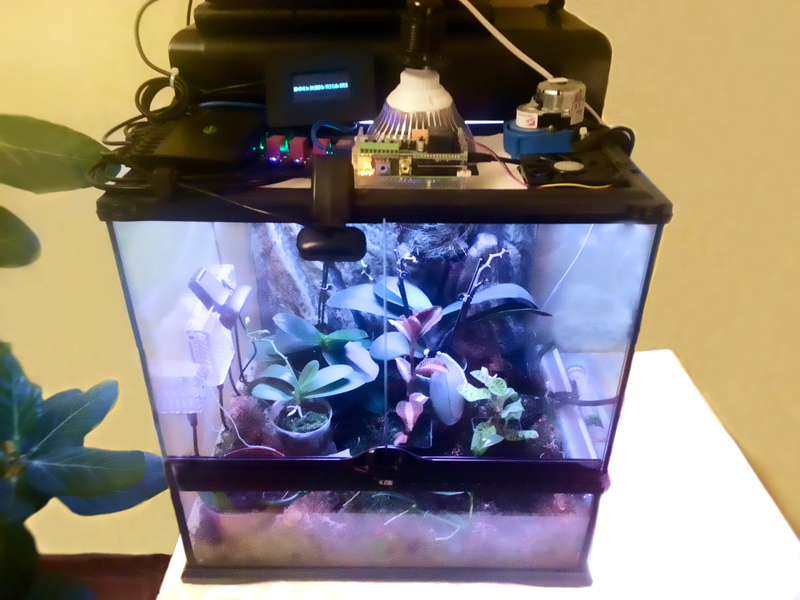
I want to tell you about the device I created for growing capricious and exotic plants. Plants that require a certain temperature, humidity, changes in the length of daylight will feel great, grow and please the eye without the need for constant monitoring. Experience of use within two years, pictures are attached.
Why do you need it
It so happened that I have a very peculiar hobby - growing exotic plants. But it’s impossible to keep track of them, maintain humidity, water, highlight on a schedule, for

Procurement and assembly of components
The first thing I ordered a terrarium ( like this ), and it fit perfectly. The lower part does not pass water, the upper part opens and provides good access inside.
It also required the purchase of halogen lamps, which, according to my calculations, should have been enough for active growth. As practice has shown, they have little power, so soon I had to buy more.

As for the sensors, I took the following:
- a humidity, temperature and pressure
sensor - a light sensor
- a carbon dioxide concentration
sensor - a soil temperature sensor (in the form of a thermocouple)
- 2 webcams to capture the growth of plants from different angles.

I placed all orders here . Then I connected sensors and relays via usb through one big usb hub. The control code was written on python. Thanks to this article for the story about them.
In addition to the sensors, I also bought:
- 4 control relays
- a LED display
- another special LED lamp
- a micropump
- a heating cable
- an ordinary computer cooler
- a usb hub for connecting sensors.
I chose raspberry pi as the “brain”, which I later replaced with an old netbook.
I placed the sensors inside the orchidarium, fixing it with silicate glue. The rest of the system components carried out on the top cover. Initially, this cover was wooden, but from the increased humidity it began to dampen and bend. I had to replace it with thick paper.

To create an optimal environment inside the orchidarium, it was necessary to solve the following tasks:
- Creating an optimal temperature.
- Creating an optimal level of humidity.
- Regulation of daylight hours (day-night).
- Automated watering.
- Periodic air ventilation.
I'll tell you more about each.
Creating and maintaining optimal temperature
Since the miracle device is in the apartment, the problem of maintaining the optimum temperature was not acute. Air heating occurred due to terrarium fluorescent
lamps, which were faintly shining, but were very warm. In summer, when the temperature in the terrarium rose above 30 degrees, the main lighting was turned off, only the LED lamp remained to work. When the temperature returned to normal, the lighting was restored.
In the winter (including nights), the temperature never fell below 24 degrees.
When the lamps were turned off at night, the temperature decreased, and daily fluctuations in temperature occurred.
Creating an optimal level of humidity
When planning the design, I was afraid that this would be a difficult task. A variety of ideas came to mind: from the usual wet (periodically wetted) fabric inside, to the pre-chamber with evaporators. In the end, everything was decided much easier. I put a heat cable on the bottom of the terrarium, a layer of expanded clay was placed on it (Diagram 1). This part of the terrarium is constantly in the water. When the humidity drops below the threshold, the heat cable is turned on, it warms the water, increasing evaporation and thereby increasing the humidity. The water temperature at the same time increases by only a few degrees. Also, the plants themselves create humidity. As a result, when the humidity rises, the heat cable is turned off. As a measure to combat excessive moisture, ventilation is carried out.

Regulation of daylight hours (day-night)
Here, too, everything is relatively simple: according to the schedule, we turn on / off the light bulbs using a relay. To simulate dawn and dusk, we turn on not all the spotlights at once, but in turn.
Automated watering
Automated irrigation is implemented using a micropump, which according to the schedule once a week pumps water from the reservoir to the lower part of the orchidarium. Watering individual plants does not occur for the following reasons:
- Because of the high humidity, it is simply not necessary.
- Damage to the plant from soil moisture over more than a small lack of moisture.

Periodic air ventilation
Implemented with the help of control relays, schedules and computer cooler.
Common device
The final structure consists of:
External part:
- Terrarium building;
- Halogen lamp + UV lamp;
- LED lamp;
- Netbook;
- Raspberry;
- USB hub;
- Relay;
- Micropump;
- Cooler.
The inner part:
- A layer of expanded clay, constantly residing in the water;
- A layer of expanded clay is not in the water;
- A layer of moss;
- Pots with tropical plants.
The moss was bought and laid out on top of a layer of expanded clay. It performs a disinfecting function and maintains moisture. At the moment, each plant is in its own separate pot for convenience and additional control from over-wetting the roots. In the future, I plan to plant them right in the moss.
One plant is suspended from the back wall imitating a stone.
Dynamics of plant development for 2 years
Plants grow very actively. If such a device is an orchid species grow bigger, releasing one a couple of leaves and roots in a month, then inside the cage there is
Initially, a 10-centimeter shoot of Vanilla orchid-creeper was planted in the terrarium. For 2 years I had to cut and remove its regrown stalk from the terrarium three times, because it flooded the entire orchidarium.
The moss that I laid out on the bottom went through various stages of development.
From getting into a moist warm environment, he turned green and even tried to grow a little. But either the conditions were not the same, or it was not worth experimenting with fertilizers - in the end he turned gray and then blackened. I did not want to observe such a picture, so for a while I removed all the moss, so that at the bottom of the terrarium only clay and water temporarily remained. The aesthetics, of course, suffered from this, and I decided to make a second attempt. I bought mosses of different species (mostly sphagnum) and laid them out in a thicker layer. Did not help. The moss turned gray and black again. Frustrated, I sprinkled it with the remnants of the purchased moss, so that it was not so conspicuous. And, lo and behold! On humus began to grow small green shoots. Honestly, I still do not know what kind of species it is, but in a couple of months it has grown and filled the entire orchidarium. It looks good.
Also in the orchidarium were introduced two seeds of willow, which successfully germinated. One grows right in the moss layer, and it has to be cut regularly so that the leaves do not cover the rest of the plants.
Feil, failures, funny moments
In the process of using this modified terrarium, of course, there were failures. Here are some of them.
Perhaps the biggest failure was the death of one of the most overgrown orchids. This was due to the lack of experience and information on growing plants in orchids and the Pygmalion effect. After reading a couple of books about the life of orchids in natural conditions, I found out that orchids often come into symbiosis with mushrooms. Therefore, when something gray and faintly resembling the fungal mycelium began to grow in one of the pots, I was happy as a child. The result turned out to be sad - after a month of such active growth of the “fungus” the orchid began to turn yellow and shed the leaves one by one every 2 days. After reading the smart books more closely, I realized that this is a mushroom-parasite, which appeared from waterlogging. He ate the orchid from the inside, I managed to save only 20% of the plant. I had to cut almost all the roots and the tip. Nevertheless, new growth points were formed, and now the orchid continues to grow.
When the miniature precious orchid first decided to bloom (under normal conditions it rarely happens), I thought that the stem was stretched too much due to the lack of light, cut the peduncle and put the plant closer to the light. Later I realized my mistake, now the orchid is going to bloom again.
Once, for the sake of experiment, I changed the LED lamp to another - with the spectrum shifted to the red part. All orchids stopped growing and, as if on cue, bloomed.
In addition, I failed to use the raspberry pi as the “brain” of my device. There were constantly data transfer errors from sensors to raspberry. When replacing it with an old netbook with Linux, everything worked perfectly.
Conclusion
In my opinion, it turned out a good device to automate the process of growing capricious plants. And, watching a small tropical oasis at home, you can get aesthetic pleasure after a long working day.