November 17, 2015 at 01:40
Discovered fossils of the brain aged 520 million years changed the minds of paleontologists
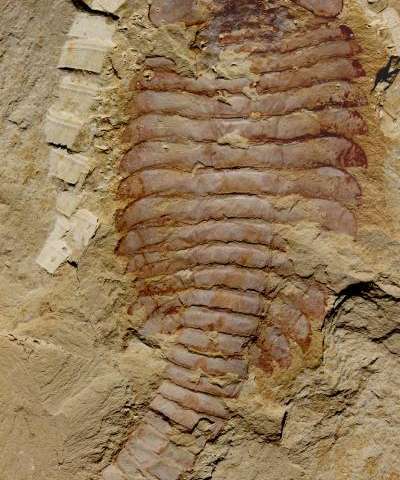
The remains of Fuxianhuia protensa
In their joint work, Chinese, British and American paleontologists confirmed a fact unexpected for science: not only hard tissues can turn into fossils. The evidence gathered confirms: thanks to a successful, but not very rare coincidence, the brains of ancient arthropods can also turn into fossils.
Despite the initial skepticism of scientists about this fact, it now appears that the textbooks on paleontology will need to be supplemented. Paleontologists provided additional evidence for their work three years ago, in which they described the fossilized brains of an ancient arthropod.
Fossil remains belong to Fuxianhuia protensa - an arthropod living in the Cambrian period (about 520 million years ago). The ancient crustacean was very similar in appearance to the modern shrimp, and, as the analysis of the fossilized brain shows, the similarity of their nervous systems is also obvious.

The remains of as many as seven fossils were found in the Maotian Shan shale area, located in the central part of Yunnan province in China. Fossils were "mothballed" due to a giant landslide. Chinese scientists have been actively researching the fauna of the Maotian Shan shale since 1995.
In 2012, Nicholas Strausfeld et al published a paper in the journal Naturewith a description of the fossilized remains of the arthropod brain. But most of their colleagues reacted with disbelief to this work. However, through joint efforts, scientists from the three countries gathered more evidence and presented to the scientific community a detailed work describing the remains of seven animals, which no doubt contained the remains of nerve tissue.

Fossil brain traces noted
Due to the sudden and large landslide, ancient animals were covered with rock at high pressure and without oxygen. They were inaccessible to both predators and bacteria. Due to the high density, their brain was not injured, and high external pressure gradually replaced the fluid from it. Among modern animals, it is in arthropods that the nervous tissue has the highest density. As a result, brains were preserved in the form of thin carbon films interspersed with pyrite crystals.
In a new work, in particular, experiments are described on the artificial reconstruction of the conditions necessary for the formation of fossil remains of the brain. Ostrichfeld and his colleagues were bombarded with a thick layer of silt in the laboratory of experimental sandworms and cockroaches. The experimental results are in good agreement with theory.
“Water displacement is different from dehydration, a process that runs more smoothly,” says Strausfeld. - In this process, the brain retains its structure, gradually flattens and persists. All this became possible, apparently due to the high density of F. protensa's tissues. ” Thanks to this discovery, scientists began to describe the evolution and development of the brain of animals over the past half billion years.