Imitation Game: Wasabi Secret from Japanese Restaurants
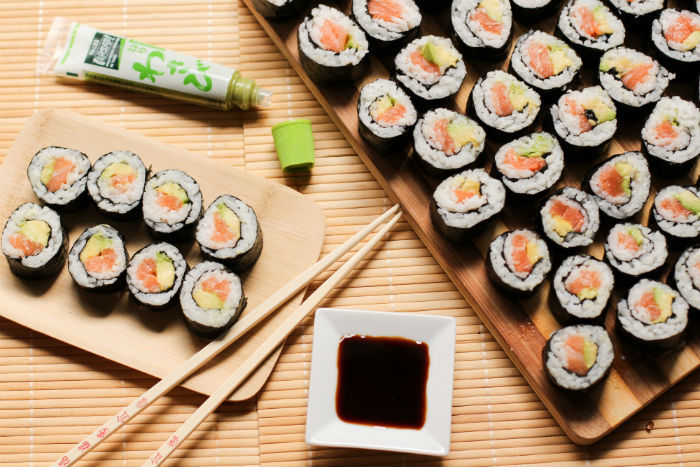
In our blog we write about how restaurants automate their work using special systems (for example, Jowi ), take care of the comfort of visitors with the right light and sound , and also use psychological tricks to increase the average check.
But there are still quite a few unanswered questions. One of these infrequently discussed topics is the fact that some products and ingredients in a restaurant are not what many visitors consider them to be. The most striking example of this is wasabi seasoning, which invariably accompanies sushi and rolls in Japanese cuisine. How to write the journalists The Washington Post, Wasabi Japanese restaurant has little to do with real wasabi.
What is wasabi in Japanese restaurants
Together with the rolls of spicy tuna (known as “spicy tuna”), sushi restaurants serve a mixture of grated horseradish diluted with green food coloring, various types of mustard and, as often happens, mixed with many other chemicals. Trevor Corson - The Story of Sushi: An Unlikely Saga of Raw Fish (Trevor Corson - author of The Story of Sushi: An Unlikely Saga of Raw Fish), spoke quite abruptly about wasabi several years ago:
“[...] it's just old horseradish with a mixture of mustard extracts, citric acid, yellow dye No. 5 and blue dye No. 1. It [imitation of wasabi] is supplied in large industrial packages in the form of powder, and the cook, before serving the wasabi on the table, dissolves the powder in water so that a sharp paste is obtained. "
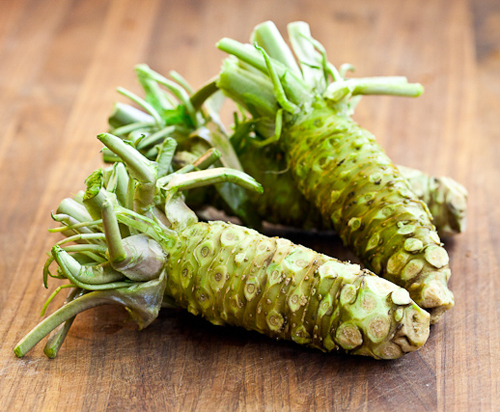
This is what a wasabi plant looks like.
A real wasabi is very different from imitation. It is obtained from the stem of a wasabi plant, which, growing, reaches a length of about 70 cm, and it is very difficult to collect. Most often it is sold with stems and served to the table just grated. Corson wrote: “A real wasabi has a more sophisticated, complex, and sweet taste than all the wasabi imitations you are used to.”
The elusive wasabi
Real wasabi is so rare that very few people have tried it. “Real wasabi can hardly be found, and there are a lot of imitations,” said Brian Ots, president of Pacific Coast Wasabi, which calls itself “the only commercial producer of high-quality wasabi in North America.” "Probably about 99% of all wasabi in North America are imitations." In principle, the same as everywhere else. And even in Japan, although some people may not be aware of this. “I would say that in Japan, about 95 percent of wasabi are imitation,” he added.
Hiroko Shimbo, the sushi cook and author of The Sushi Experience (Hiroko Shimbo), agrees. She said: "99% is pretty close to the truth, although probably 95% will be more accurate."
According to Ots, even in cases where real wasabi is used, its share in the composition of the whole paste is extremely small - less than 1 percent.
Ots also writes that the real reason [of the mass imitation of wasabi] is that a fresh, real wasabi is rarely served, mainly for economic reasons. Demand for it is much more than supply (mainly because the wasabi root is difficult to grow and hard to care for) - this has been a long time. As a result, serving fresh, freshly grated wasabi to sushi restaurant visitors, or even selling dried roots in bags, is expensive. This means that it will need to be sold for a higher price than many would like to pay - from $ 3 to $ 5 dollars for one regular wasabi ball served with sushi.
Instead of combining expensive raw fish with the popular, but expensive and fragrant real wasabi, industry has come up with a much cheaper alternative - imitation. And they did it long before sushi became popular in the United States. “It was first invented in Japan, even before sushi got to America,” Simbo said. "People who love food, like gourmets from New York, probably know this, but most certainly not."