
 August 30, 2015 at 15:22
The first moments of photosynthesis calculated on a supercomputer
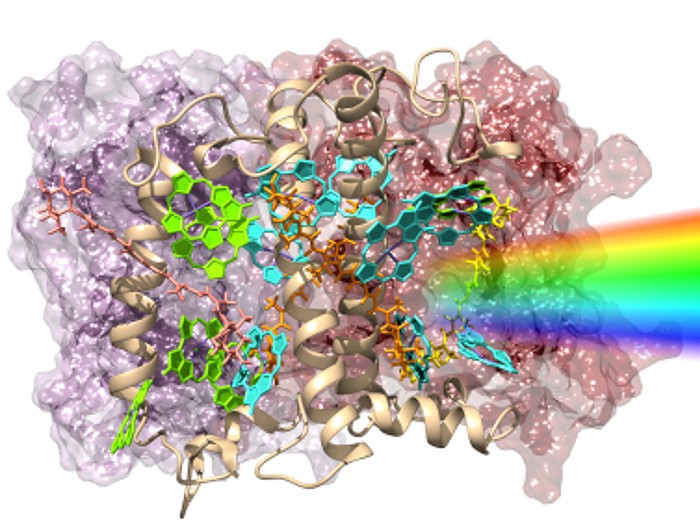
Scheme of the LHC-II complex for collecting light energy: chlorophyll a is shown in turquoise color, chlorophyll b is green.
Photosynthesis in plants and animals is the process of absorption of light quanta energy by the reaction center of an organism with its conversion and chemical accumulation. The synthesized organic substances then serve as fuel in intracellular reactions.
Reaction center- A large protein supercomplex with many photo-harvesting antennas. Scientists still continue to study its structure and functionality. Maybe someday it will turn out to make an artificial analog with the same high efficiency. A joint group of scientists from the University of the Basque Country (Spain), the University of Barcelona (Spain), the Livermore National Laboratory (USA, Halle-Wittenberg University (Germany), the University of Liège (Belgium), and the University of Coimbra (Portugal) contributed to this study by studying fotosobirayuschih building complexes LHC-II (Light Harvesting complex II ) with chlorophyll. LHC-II The simulation ran on several powerful supercomputers in Europe at the same time.
for more information on creating a software code for a distributed Octopus super network described in our PCanother scientific article . The developers managed to create a reliable computer model of the processes of quantum mechanics occurring in the reaction complex during photosynthesis.
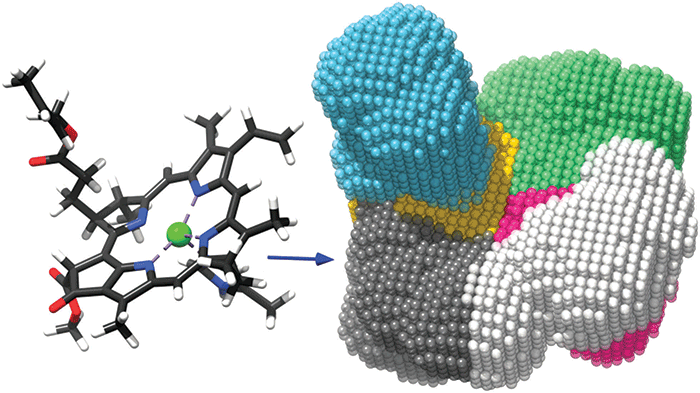
The illustration below shows an example of a simplified simulation, an adaptive grid for a chlorophyll molecule a with a distance between nodes of 0.5 Å and a radius of 2.5 Å. Each color corresponds to an area that can be transferred for calculation to a separate processor for massive parallel computing on one or more supercomputers simultaneously.
The LHC-II complex works at the first stage of photosynthesis in plants and consists of 17,000 atoms. It is not known for certain how exactly quantum processes occur in this complex upon receipt of a photon, although there are reliable theories on this subject.
Thanks to the parallelization of the process, scientists were able to run emulation on several supercomputers that worked in parallel. The experiment involved the German supercomputer Juqueen (458 752 cores), the Italian Fermi (163 840 cores), the German Hydra (65 320 cores), the Catalan MareNostrum III (48 896 cores) and other supercomputers installed in European universities.
The main goal was to optimize the Octopus code, study it in a real distributed system and select the correct program parameters. Simulation of the whole LHC-II molecule is an unrealistic task, therefore, scientists used models with 5759, 4050 and 6075 atoms. Today it is the largest simulation of the photosynthesis process in the LHC-II complex.
Thanks to the experiment, it was possible to confirm the theory that describes the photosynthesis reaction inside LHC-II in the first 15 femtoseconds after the photon arrives.
Thanks to Moore’s law and the optimization of the Octopus code, there is hope that it will soon be possible to emulate the photosynthesis process for a complete molecule with all 17,000 atoms. Moreover, scientists from other countries can use Octopus free software for distributed computing and simulation of molecules other than LHC-II.
The results of the scientific work were published in the article " Insights into color-tuning of chlorophyll optical response in green plants " in the journal Physical Chemistry Chemical Physics July 17, 2015, the article is in the public domain ( pdf)