Electric generator inside the shoe
Alizar already wrote about the wearable electric generator . Now there is news about generators that are built into the shoe sole and allow you to generate electricity by walking in such shoes.
Researchers from the Institute of Micro and Engineering Technologies (HSG-IMIT — Institute of Micromachining and Information Technology, Villingen-Schwenningen, Germany) and the Department of Microsystems Engineering — IMTEK, Freiburg, Germany) published a paper [1] in which they presented and researched miniature electromechanical electricity generators developed by them.
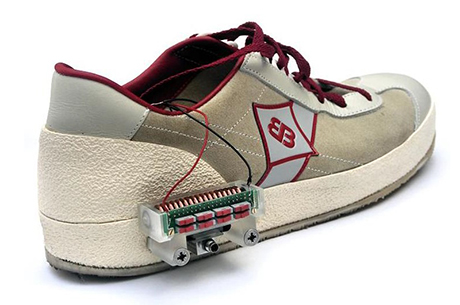
The authors of [1] presented two types of generators: pendulum and shock excitation. Both types of generators use the effect of the appearance of electric current as a result of electromagnetic induction, when the magnet moves inside a coil of wound wire. The generators are miniaturized so much that they are built into the shoe sole. The pendulum generator generates electricity when a person moves his foot while walking. Shock excitement - when a person steps on his foot [1-4].
In this generator, 14 magnets move through a group of coils when a person’s foot and shoes accelerate while moving. With a width of this generator of 41 mm and its length of 70 mm, it is capable of generating a series of pulses with an average power of up to 0.84 mW (peak - up to 50 mW). The time dependence of power at a speed of 6 km / h has characteristic pulse groups for each step. The duration of this group at the level of half the maximum power is 0.04 s, the pulses completely decay after 0.1 s. At speeds less than this, the power of the generated signal decreases, at high - it remains at approximately the same level.
This generator is placed in the heel of the shoe sole, it is 40 mm wide and 60 mm long. It is able to generate a sequence of pulses with an average power of up to 4.13 mW (peak - up to 45 mW) when a person moves at a speed of 5 km / h on a hard surface [3]. A decrease in the speed of movement is expressed in a decrease in the power of the generated signal. Fluctuations in the power of the generated signal last almost 0.25 s (at the level of half the power of a series of pulses) at a speed of 6 km / h after each step. They completely fade out after 0.5 s.
A temperature sensor connected to the generator and integrated into the shoes is shown in the illustration below. During the experiments, the generators were able to power the sensors for subsequent transmission of temperature data inside the shoe to a distance of 10 m. They were able to transmit data up to seven times for each step taken.

An interesting point is that the authors modeled the value of the power of the generated signal depending on the step speed. Moreover, they achieved a good agreement between the results of their model and the results of experiments.
In an interview with the BBC [4], lead developer Klevis Ylli (Eng. Klevis Ylli) noted that initially such generators were designed for use in self-lacing shoes for old people. But there is another area of use for such generators. If we place the acceleration and angular velocity sensors inside the shoe, then according to the sensor measurements, they could calculate how far and in what direction the person went in these shoes and find this person in the case of a search operation.
There are similar works [5,6], in which the authors presented special shoe insoles that also work as electricity generators.
ps Thanks to REU , who wrote below about another insole generator [6].
[1] K. Ylli, D Hoffmann, A. Willmann, P. Becker, B. Folkmer and Y. Manoli, " Energy harvesting from human motion: exploiting swing and shock excitations ," Smart Mater. Struct. 24 025029, 2015, doi: 10.1088 / 0964-1726 / 24/2/025029
[2] Im Gehen Strom erzeugen
[3] Announcement of the article on the site IOP Smart shoe devices capture the power of walking
[4] News and interviews of the developer on the site BBC News Smart shoe devices generate power from walking
[5] Te-Chien Houa, Ya Yanga, Hulin Zhanga, Jun Chena, Lih-Juann Chenb, Zhong Lin Wang, " Triboelectric nanogenerator built inside shoe insole for harvesting walking energy ," Nano Energy , 2013, dx.doi.org/10.1016/j.nanoen.2013.03.03.001
[6]Insole Generator
Researchers from the Institute of Micro and Engineering Technologies (HSG-IMIT — Institute of Micromachining and Information Technology, Villingen-Schwenningen, Germany) and the Department of Microsystems Engineering — IMTEK, Freiburg, Germany) published a paper [1] in which they presented and researched miniature electromechanical electricity generators developed by them.
The authors of [1] presented two types of generators: pendulum and shock excitation. Both types of generators use the effect of the appearance of electric current as a result of electromagnetic induction, when the magnet moves inside a coil of wound wire. The generators are miniaturized so much that they are built into the shoe sole. The pendulum generator generates electricity when a person moves his foot while walking. Shock excitement - when a person steps on his foot [1-4].
Pendulum generator
In this generator, 14 magnets move through a group of coils when a person’s foot and shoes accelerate while moving. With a width of this generator of 41 mm and its length of 70 mm, it is capable of generating a series of pulses with an average power of up to 0.84 mW (peak - up to 50 mW). The time dependence of power at a speed of 6 km / h has characteristic pulse groups for each step. The duration of this group at the level of half the maximum power is 0.04 s, the pulses completely decay after 0.1 s. At speeds less than this, the power of the generated signal decreases, at high - it remains at approximately the same level.
Shock Excitation Generator
This generator is placed in the heel of the shoe sole, it is 40 mm wide and 60 mm long. It is able to generate a sequence of pulses with an average power of up to 4.13 mW (peak - up to 45 mW) when a person moves at a speed of 5 km / h on a hard surface [3]. A decrease in the speed of movement is expressed in a decrease in the power of the generated signal. Fluctuations in the power of the generated signal last almost 0.25 s (at the level of half the power of a series of pulses) at a speed of 6 km / h after each step. They completely fade out after 0.5 s.
Application area
A temperature sensor connected to the generator and integrated into the shoes is shown in the illustration below. During the experiments, the generators were able to power the sensors for subsequent transmission of temperature data inside the shoe to a distance of 10 m. They were able to transmit data up to seven times for each step taken.
An interesting point is that the authors modeled the value of the power of the generated signal depending on the step speed. Moreover, they achieved a good agreement between the results of their model and the results of experiments.
In an interview with the BBC [4], lead developer Klevis Ylli (Eng. Klevis Ylli) noted that initially such generators were designed for use in self-lacing shoes for old people. But there is another area of use for such generators. If we place the acceleration and angular velocity sensors inside the shoe, then according to the sensor measurements, they could calculate how far and in what direction the person went in these shoes and find this person in the case of a search operation.
There are similar works [5,6], in which the authors presented special shoe insoles that also work as electricity generators.
ps Thanks to REU , who wrote below about another insole generator [6].
References
[1] K. Ylli, D Hoffmann, A. Willmann, P. Becker, B. Folkmer and Y. Manoli, " Energy harvesting from human motion: exploiting swing and shock excitations ," Smart Mater. Struct. 24 025029, 2015, doi: 10.1088 / 0964-1726 / 24/2/025029
[2] Im Gehen Strom erzeugen
[3] Announcement of the article on the site IOP Smart shoe devices capture the power of walking
[4] News and interviews of the developer on the site BBC News Smart shoe devices generate power from walking
[5] Te-Chien Houa, Ya Yanga, Hulin Zhanga, Jun Chena, Lih-Juann Chenb, Zhong Lin Wang, " Triboelectric nanogenerator built inside shoe insole for harvesting walking energy ," Nano Energy , 2013, dx.doi.org/10.1016/j.nanoen.2013.03.03.001
[6]Insole Generator