February 10, 2015 at 16:30
Deathmatch: three applicants, two SIM cards, one budget. Choosing an inexpensive smartphone
Good afternoon, Giktayms! It just so happened that the electronics prices are not pleasing to anyone this year, but the new phone as I wanted, and I want it. Flagship smartphones of even the last generation cost indecent money, and in the “middle” segment, as usual, a mess. In pursuit of the MSRP targets (RRP, the recommended price for retail chains), the profit from the production and sale of one device, the creators of relatively inexpensive smartphones have to save on one or the other.
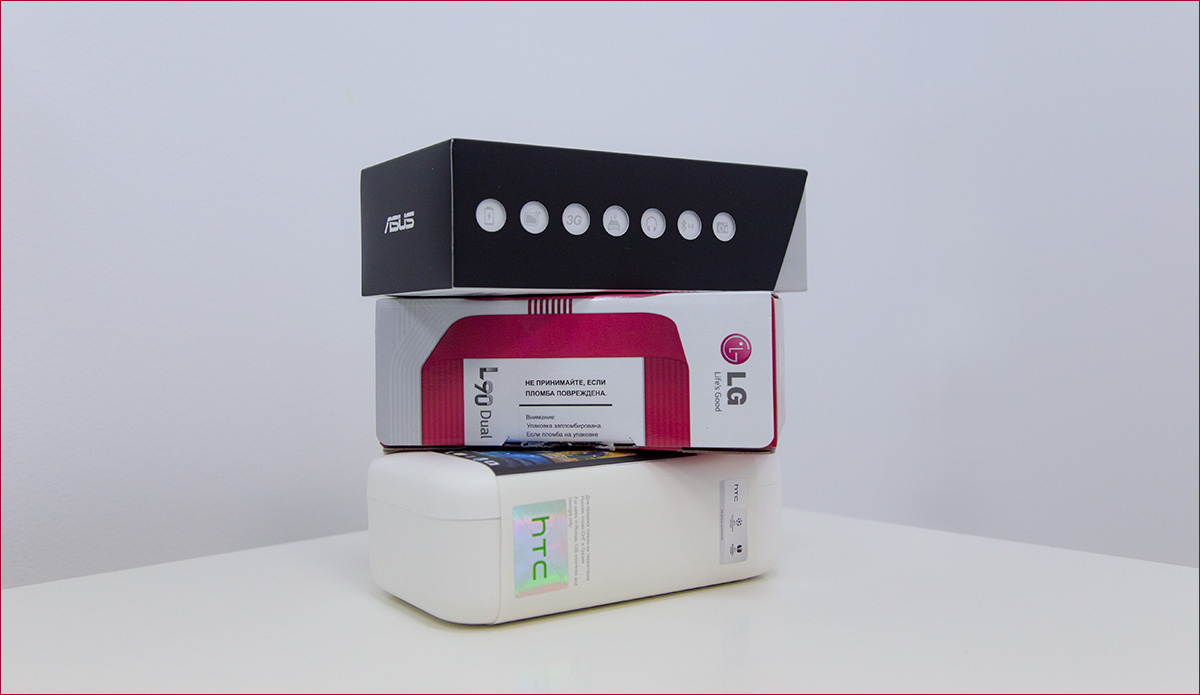
Therefore, today we will look for a worthy anti-crisis solution. Our guests are three smartphones in the price range of 10-12 thousand rubles, all of them from different vendors, with a different approach to "saving" money, built-in software and the very idea of a "budget" device.
ASUS Zenfone 5, LG L90 and HTC Desire 601 will compete for the title of the most rational spending of resources. Curiously, all three models from the review have a dual-SIM performance. However, these same models are found with one SIM card (and in the case of HTC or ASUS, they also have an LTE module), their differences from monochromatic ones are mostly cosmetic.
The army begins with a military registration and enlistment office, and all devices - with packaging. Before the advent of the iPhone and Apple's active expansion into the smartphone market, a typical phone box could compete in size with a box, say, from under a shoe or an ATX-format motherboard.

Now everyone is trying to pack the smartphone as compactly as possible, while maintaining the aesthetic performance of the telephone storage at a fairly high level. Unfortunately, in budget smartphones, every cent counts, so even an extra pair of stickers or a complex form of cutting can affect the final cost of the device, which will increase even more when it reaches retail.

The design is designed to match the product lines familiar to brands. LG preferred the classic simple box with a color print. ASUS pleased with a neat and strict box-slider, and HTC, as usual, relied on premium perception. A box of pressed round pulp, a neat ribbon with a concise image of a smartphone in different colors. In principle, even the boxes show which path each of the vendors has chosen. LG tried to save on everything that does not apply directly to the device; ASUS just wants to look tidy in everything, and HTC, even in relatively inexpensive devices, remains true to the “eco-style” and loves to make it look “richer”.

To get a Zenfone 5 or Desire 601 box as a gift is a hundred times more pleasant than LG, but what will please us inside? In the end, we’ll call out of the box and not go on the Internet from high-quality cardboard.

Inside, as usual, devices. All three smartphones are protected from scratches and dust by a special film. LG and ASUS with typical Asian love placed the main “buns” on it in terms of characteristics: core-megabytes-megahertz and other delights, while HTC (despite its Asian origin) continues to bend the premium line, considering that the user has it all no need: the name of the model, branded services, matte and very nice tactile silky film, in general, all thirty-three of the pleasure of unpacking.
In addition to devices in the boxes you can find:

LG has: a charger, a USB-microUSB cable, a warranty card, a quick guide, removed from the smartphone’s battery (45% charged for long-term storage without consequences for the resource);

ASUS has exactly the same configuration, but without the battery, it is not removable at ZenFone;

Well, a comparable, but much more pleasantly designed package bundle can be seen in the box HTC. The papers are beautifully decorated, all the packaging packages are “silky”, the film on which the smartphone is packed tells how-what-where-what, plus the Taiwanese did not forget to put a headset in the smartphone kit. Not a fountain, but better than the nihilistic version from ASUS and LG. The battery is removable, but originally installed in the device.
To avoid unnecessary questions, I think it is worth voicing the hardware capabilities of each platform. We will deal with performance and software a bit later. So:
All three smartphones differ in display diagonals. On the one hand, this is a minus, like models in unequal conditions, on the other, everyone can choose a diagonal to their taste, and you can always look at models of the same manufacturer that are close in price: the filling there will be about the same, but the diagonal can differ significantly.

HTC Desire 601 has a display diagonal of 4.5 ”, with a width of 67 mm and a height of 134.5 mm. The case is folding, the battery is removable. The total thickness of the device is almost 1 centimeter, but it does not seem thick, and the sloping edges mask the not-so-slender figure of the smartphone. Desire 601 weighs only 130 grams, two grams less than the cheapest iPhone (5C).

On the front side are stereo speakers with the brand name BoomSound, a silver logo, two (illuminated) touch “buttons” - “back” and “home”. Above the screen is a light sensor, proximity sensor and the “eye” of the front camera. On a silver smartphone, they are visible better:

The back surface of the smartphone is a continuous soft-touch cover with the glossy HTC logo recessed into it, a camera lens and a flash. The socket is removed entirely, along with the buttons. Under it are two slots for microSIM, a microSDXC memory card slot (64 GB sees, 128 were not checked). The battery is removable.

In principle, the smartphone is assembled for five with a plus - it doesn’t play anything anywhere, doesn’t creak, it’s crumpled, and you can’t say by any means that it is collapsible. There is one small problem. The lid sits DAMAGE tight.

Open it without nails is very difficult. Thank you at least for the fact that the opening instructions were “printed” on the back side of the wrapping film, without it you can search for a tray for SIM-cards and a hole for “clip” for a long time, being fully confident that the smartphone is not separable.

The microUSB connector is hidden from the bottom to the right, and on top of the left is the screen lock button (fu fu, it’s very uncomfortable to reach for it) and an audio jack (3.5 mm). Volume buttons - on the right side, separate. To be honest, everyone who held the smartphone in their hands tried to lock / unlock the screen with them, and their tactile feedback is indistinct, you can only understand if you pressed or not pressed by looking at the screen.

The LG L90 has a slightly larger display diagonal of 4.7 inches. The physical dimensions almost do not differ from Desire, however, LG have access to the thin-frame displays they produce. In larger diagonal smartphone atsame one millimeter than HTC 601 (66 mm), three millimeters shorter (131.5 mm), also slightly thinner. In this case, the LG L90 weighs only 124 grams. As a case material, dvuhsimochnik has black or white plastic with a silver plastic edging.

In our hands was a white smartphone, black does not differ in design even a bit. The back cover is “corrugated”, to the touch it resembles a very-very stretched fabric of coarse weaving. Unlike HTC, it’s immediately clear that it is being removed. Inside - nothing special. Unfortunately, the SIM slots are located “sandwich” - the solution is not the most reliable, but if you do not plan to rearrange the SIM cards at least regularly - it will do. Saving is such a saving. By the way, LG did not come up with a bicycle, and placed the lock key on the right, the volume swing on the left. The distance and the course of the buttons are perfectly matched, lie under your fingers, do not cause any negative emotions.
The front side is decorated with a neat speaker grid on top, a proximity sensor / “eye” of the camera to the right of it. The model has no light sensor. Under the display are four silver touch buttons (back, home, menu, SIM card change), but they are deprived of backlight. Of course, in a couple of days you will get used to poking blindly, but anyway, saving on engraving and backlighting is a dubious decision.

By the way, the L90 odnosimochnik differs in the design of the front panel, in it there was a place and means for the hardware home button,combined with the status LED 1 ,

At the rear is the output of the ringing speaker, which has a characteristic “pimple” so as not to rest against the table, camera lens and flash.

MicroUSB and 3.5 mm jacks are located on the bottom and top, respectively.

In my opinion, the audio jack below is much more convenient, but many manufacturers neglect this solution or put it only in premium devices.
The "shovel" from ASUS has a five-inch display: the diagonal is about the same, for example, the Nexus 5, HTC One M8, and Galaxy S4. The physical dimensions do not inspire fear, but the device cannot be called a tongue anymore: it’s almost 73 mm wide, 148 mm high, and its thickness is slightly larger than a centimeter. With all this, the smartphone from ASUS weighs a decent 145 grams. For comparison, the Nexus 5 and Galaxy S4 weigh 15 grams less.

Zenfon design is the same for the entire line of devices. The front side is covered with a protective glass, under the display - touch keys "back", "home", "multitasking". Even lower is a section made of aluminum with a circular notch. The smartphone is available in different colors:

Above the display - only the earpiece and the “eye” of the front camera, it was not possible to visually detect the proximity or light sensor, but they are. Perhaps the manufacturer uses cunning software and a front camera module as these sensors.

On the right side is a screen lock button and a volume control swing. They are located almost perfectly.

On the left - nothing, on the back - a panel of soft-touch plastic, on which there is a mesh speaker, camera lens, flash, and modest logos ASUS and Intel.

The cover is removed without problems, under it there are two slots for SIM cards and a slot for microSD. The shape of the back panel is rather sloping, hides the “thickness” of the smartphone.

With enclosures and materials, everything is more or less clear. Unfortunately, cost savings dictate strict rules of the game, each of the manufacturers interprets them in its own way.
LG preferred to save on production processes by simplifying and standardizing iron with a single-label as much as possible. Unfortunately, the smartphone is deprived of the backlighting of the buttons on the front panel, the light sensor, but at the same time it is well-cut, firmly knocked down, does not slip out of the hands, even if they are wet; It looks as neutral as possible and does not cause a feeling of cheap trinket, as happens with cheap Samsung smartphones and some Chinese brands. On the packaging, to put it mildly, they scored, however, it is better to let these 10 cents go to the phone.
ASUS aggressively uses minimalism in design, and this is beneficial for the ZenFone series: the smartphone does not look cheap, you can’t even say how much it costs. The only negative is the pseudo-metal die sticking out under the screen. Yes, it is beautiful, but it would be better if the smartphone was shorter by almost a centimeter than just had an incomprehensible look decorative gizmo. For the rest, Zen is Zen. Strictness, lack of all that is superfluous, modesty - all this makes the smartphone look more expensive than many models and for 20-25 thousand rubles.
HTC is spinning the brand premium to its fullest. Expensive materials in the package, expensive materials of the case, neat design, lack of savings on small things like backlighting keys. As with all this, the Desire 601 remains competitive at the same price as the LG L90 - a mystery. Unfortunately, there were some cons. The lock button is located in an uncomfortable place, and the back and home buttons are addictive. For all the rest, they are located in the usual places, here they are very spaced around, and between them there is a logo that click, don’t click, nothing will happen.
Since we have touchscreen smartphones, we should pay maximum attention to the screens in this case.
LG and HTC opted for a resolution of 960x540 pixels. In the case of HTC, this solution does not raise questions: the picture for four and a half inches is not bad, the fonts (thanks to the proprietary shell) look neat. The brightness margin is not very large, but there are no problems using the display on the street. The adjustment also does not fail to the “minimum” side: at night the device does not blind.
LG has a slightly larger diagonal display, and the resolution is on the verge of comfort. Fonts do not go with teeth, the pixel of the eye does not hurt, but alas, there is no the same smoothness as 720p screens with such a diagonal have. The brightness margin is greater than that of HTC, in addition, the display uses a transreflective substrate. With the screen locked and the backlight turned off, the display surface can easily be used as a mirror. There are no problems in the sun.
ASUS at its five inches is ready to please with an honest HD-resolution: 1280x720 pixels. In my opinion, such a choice is more than justified. The picture is clear, the load on the processor and video accelerator is on the verge of a reasonable one (problems could start on FullHD, especially in games). Unfortunately, the price of a high-quality picture was not the most outstanding highlight: in the room it is enough with the head, but the bright sun can cause problems. The minimum level can be called comfortable for night conditions.
As for color balance, contrast and brightness: here are photos of all three smartphones at the highest possible level of backlight and with the same picture. I think everything is clear without words. LG fries, HTC moderates, ASUS lags behind in brightness and saturation, but at the same time pleases with some pastel softness. The eyes from the ZenFone display do not get tired.
The scourge of all three models is an oleophobic coating. It is, but the quality of performance in C grade. The prints are erased better than with ordinary glass, but a simple movement of the sleeve of a sweatshirt, lint-free cloth or jeans will not be enough. It is necessary to rub hard. Sticking a protective film solves this problem.
Of all the trinity, the most “gift” appearance, of course, HTC. It is packaged, as if it were made by Apple, perfectly designed, looks good, is pleasant in the hands, and is universal in terms of size. No one will say how much it costs until it turns on the smartphone. And after switching on, too, to be honest, I can’t name the price right away. HTC competently masked the shortcomings of a budget smartphone with a beautiful design and a pleasant set of software.
ASUS ZenFone is a balanced option. The design is completely not ashamed, it is faceless and does not say anything: just a black smartphone. Extremely minimalistic and at the same time tasteful, not poor. The screen is pleasing to the eye, the materials are pleasant, packed neatly and beautifully. A little shovel, this can not be taken away.
LG in this trinity, at first glance, the ugly duckling. It looks completely Korean. It can be seen that the smartphone is from "inexpensive" (that is, from non-flagships). However, with all this, it pleases with a reliable design, convenient location of controls, good build quality and affordable (and, most importantly, easily found on sale) accessories such as book covers that are installed instead of the back panel. Also to the pluses I would include his materials. Yes, there are few premiums in them, but with all this, the scratches will not be as noticeable as on “smooth” competitors, and the material with the characteristics ~ corresponding to Gorilla Glass 2 is used as a protective coating on the screen.
Impressions of impressions, but what about devices with performance? And then to buy a beautiful, well-packed, perfectly packaged set of brakes is a dubious pleasure.
Two of the three smartphones work on the familiar ARM hardware: the popular Qualcomm Snapdragon 400 chip is used, however, in a different configuration.
HTC has installed in their Desire a younger version of MISCELLANEOUS hardware. Yes, you heard right. In a single-label processor - two 1.4 GHz Krait 300 cores (ARM V7) each, Adreno 305 is used as a dual accelerator. The dual-core processor got a quad-core from Broadcom (1.2 GHz), and their VideoCore IV accelerator. Why was it necessary to change the chip in the dual-SIM card - a riddle from the riddles, because the Qualcomm Snapdragon 400 works quietly with two SIM cards.
In both cases, you will also get 1 GB of RAM (regardless of version), most likely, LPDDR2-format, 4 GB of internal memory. In theory, for the operation of the device, the characteristics are more than normal.
LG dispensed with perversions: that in a monosymbol, that in a dual-simulator identical iron works. Qualcomm Snapdragon 400 in the quad-core version, time-tested Adreno 305 is responsible for graphics output. All this magnificence went to 1 GB of LPDDR2 RAM. Despite the fact that the iron can hardly be called the newest (and MTK chips are more interesting today, and Qualcomm released updated lines) - it fully meets modern requirements. It knows how to work with energy saving, it shows modern graphics, it’s also popular: three-dimensional toys will not show off; developers are already aware of the capabilities of such a bundle of processor, video accelerator and memory and are able to optimize their products for such hardware.
ASUS has long and successfully been installing Atoms on smartphones and tablets. I can’t say that the solution is bad: an x86 1.6 GHz chip successfully allows you to fasten ARM puffs, and in the case of ZenFone it’s still cooler - there is a dual-core Z2560 in conjunction with PowerVR 544MP2. The single-core version of the 544th is not bad in itself, but here its "two-headed" version in conjunction with a fairly powerful processor.
A nice bonus is 2 GB of RAM, with LPDDR3, and 16 GB of file storage with expansion options using memory cards.
To tell you the truth, there is nothing here. Here are the pictures for you, all the results are present on them. All tests were carried out after a complete cleaning of the memory (closing other applications), 3 times, to take into account the loss of performance during heating. The screenshots show the minimum (worst) results from all three tests. I only note separately that all tests on Android OS are more or less "tailored" to measure the performance of ARM processors, because of this, the Intel Atom, built on the x86_32 architecture, can show strange results.

From left to right: HTC Desire 601 dualsim, LG L90, ASUS Zenfone 5.
What surprised me personally was the superiority of the little-known 3D accelerator over the proven Adreno 305.
Testing three-dimensional graphics was carried out by the Ice Storm Extreme benchmark in the 3D Mark package.

From left to right: HTC Desire 601 dualsim, LG L90, ASUS Zenfone 5.
Surprisingly, the “rootless” graphics from Broadcom, installed in HTC, even surpassed the powerful PowerVR 544 in some ways!
Synthetic battery tests are available here:
HTC Desire 601 Dualsim | LG L90 Dualsim | ASUS Zenfone 5 Dualsim
Due to the high battery capacity (LG is one of the world leaders in the field of "packing" electrons in batteries) and advanced energy saving, LG worked in the benchmark for almost 10 hours!
As you know, getting on a Christmas tree and leaving your pants whole is a non-trivial task. You can create a super flagship with space characteristics and a price of 150 bucks to the detriment of everything else: software, screen, packaging, bundling, support, but who will buy it? All three manufacturers interpret the possibilities of a budget phone in their own way, and here is the picture that looms:
HTC relies on appearance: it looks expensive, it fits nicely in your hand, and it is like premium. Unfortunately, the payback for the “show-offs” is a slightly less productive filling than, say, LG or other classmates.
L90 is assembled according to the principle "without this, no one will die, but our smartphone does not slow down." Indeed, in everyday use it is quite difficult to make the main state employee from LG slow down or lag. In games - yes, it does happen, but do not forget that we do not have a game console, but a budget smartphone.
ASUS is a little more expensive than competitors in this post, but it has an amazing balance of features, design, usability and capabilities. If you are not confused by five inches - an unequivocal favorite in terms of iron and body.
The most interesting thing: how proprietary software is combined with the device capabilities of smartphones, what manufacturers shells are ready to please us with, what you can play and how much the smartphone lives under real load - in the next release. Stay in touch!
Our previous reviews:
» ASUS Transformer Pad
» Razer Kraken headsets
» Midland GXT-1050 radios
» NVIDIA SHIELD game console
» Testing AA-size Ni-MH batteries
» Sony Smartwatch 3
» Lenovo Yoga 2 Pro transformer
» LEGO Mindstorms EV3
1 - According to the user Serezha_zp , the L90 does not have a LED indicator in the single-symbol version. It's a shame, in the last generation of the L-series, he was.
Therefore, today we will look for a worthy anti-crisis solution. Our guests are three smartphones in the price range of 10-12 thousand rubles, all of them from different vendors, with a different approach to "saving" money, built-in software and the very idea of a "budget" device.
ASUS Zenfone 5, LG L90 and HTC Desire 601 will compete for the title of the most rational spending of resources. Curiously, all three models from the review have a dual-SIM performance. However, these same models are found with one SIM card (and in the case of HTC or ASUS, they also have an LTE module), their differences from monochromatic ones are mostly cosmetic.
Boxes and Filling
The army begins with a military registration and enlistment office, and all devices - with packaging. Before the advent of the iPhone and Apple's active expansion into the smartphone market, a typical phone box could compete in size with a box, say, from under a shoe or an ATX-format motherboard.
Now everyone is trying to pack the smartphone as compactly as possible, while maintaining the aesthetic performance of the telephone storage at a fairly high level. Unfortunately, in budget smartphones, every cent counts, so even an extra pair of stickers or a complex form of cutting can affect the final cost of the device, which will increase even more when it reaches retail.
The design is designed to match the product lines familiar to brands. LG preferred the classic simple box with a color print. ASUS pleased with a neat and strict box-slider, and HTC, as usual, relied on premium perception. A box of pressed round pulp, a neat ribbon with a concise image of a smartphone in different colors. In principle, even the boxes show which path each of the vendors has chosen. LG tried to save on everything that does not apply directly to the device; ASUS just wants to look tidy in everything, and HTC, even in relatively inexpensive devices, remains true to the “eco-style” and loves to make it look “richer”.
To get a Zenfone 5 or Desire 601 box as a gift is a hundred times more pleasant than LG, but what will please us inside? In the end, we’ll call out of the box and not go on the Internet from high-quality cardboard.
Inside, as usual, devices. All three smartphones are protected from scratches and dust by a special film. LG and ASUS with typical Asian love placed the main “buns” on it in terms of characteristics: core-megabytes-megahertz and other delights, while HTC (despite its Asian origin) continues to bend the premium line, considering that the user has it all no need: the name of the model, branded services, matte and very nice tactile silky film, in general, all thirty-three of the pleasure of unpacking.
In addition to devices in the boxes you can find:
LG has: a charger, a USB-microUSB cable, a warranty card, a quick guide, removed from the smartphone’s battery (45% charged for long-term storage without consequences for the resource);
ASUS has exactly the same configuration, but without the battery, it is not removable at ZenFone;
Well, a comparable, but much more pleasantly designed package bundle can be seen in the box HTC. The papers are beautifully decorated, all the packaging packages are “silky”, the film on which the smartphone is packed tells how-what-where-what, plus the Taiwanese did not forget to put a headset in the smartphone kit. Not a fountain, but better than the nihilistic version from ASUS and LG. The battery is removable, but originally installed in the device.
Brief characteristics
To avoid unnecessary questions, I think it is worth voicing the hardware capabilities of each platform. We will deal with performance and software a bit later. So:
| HTC Desire 601 dualsim | LG L90 D410 | ASUS ZenFone 5 | |
| Platform | Snapdragon 400, 2 cores at 1.4 GHz, ARM v7, Adreno 305 video accelerator in a single-sim version. Broadcom, 4 cores at 1.2 GHz, ARM V7, video accelerator VideoCore IV (BCM23550) in the dual- SIM version. | Snapdragon 400, 4 cores at 1.2 GHz, ARM v7. Video accelerator Adreno 305. | Intel Atom Z2560, 2 cores at 1.6 GHz, x86. Video accelerator PowerVR 544MP2. |
| RAM | 1 GB | 1 GB | 2 GB |
| Built-in memory | 4 GB | 8 GB | 16 GB |
| Memory expansion | MircoSD XC (up to 64 GB) | MircoSD XC (up to 32GB claimed. 64GB work, require phone formatting) | MircoSD XC (up to 64 GB) |
| Display | ScLCD2, 4.5 ”, 960x540 245 PPI | IPS, 4.7 ”, 960x540, transflective 234 PPI | IPS, 5.0 ”, 1280x720 294 PPI |
| Camera | 5 MP, flash, autofocus, 0.3 MP front. | 8 MP, flash, autofocus, 0.3 MP front. | 8 MP, flash, autofocus, 2 MP front. |
| Battery | Removable, 2100 mAh | Removable, 2540 mAh | Built-in, 2110 mAh |
| Preinstalled software | Android 4.2.2 + Sense UI 5.0 | Android 4.4.2 + Optimus UI | Android 4.4.2 + Zen UI |
Design and usability
All three smartphones differ in display diagonals. On the one hand, this is a minus, like models in unequal conditions, on the other, everyone can choose a diagonal to their taste, and you can always look at models of the same manufacturer that are close in price: the filling there will be about the same, but the diagonal can differ significantly.
HTC Desire 601 has a display diagonal of 4.5 ”, with a width of 67 mm and a height of 134.5 mm. The case is folding, the battery is removable. The total thickness of the device is almost 1 centimeter, but it does not seem thick, and the sloping edges mask the not-so-slender figure of the smartphone. Desire 601 weighs only 130 grams, two grams less than the cheapest iPhone (5C).
On the front side are stereo speakers with the brand name BoomSound, a silver logo, two (illuminated) touch “buttons” - “back” and “home”. Above the screen is a light sensor, proximity sensor and the “eye” of the front camera. On a silver smartphone, they are visible better:
The back surface of the smartphone is a continuous soft-touch cover with the glossy HTC logo recessed into it, a camera lens and a flash. The socket is removed entirely, along with the buttons. Under it are two slots for microSIM, a microSDXC memory card slot (64 GB sees, 128 were not checked). The battery is removable.
In principle, the smartphone is assembled for five with a plus - it doesn’t play anything anywhere, doesn’t creak, it’s crumpled, and you can’t say by any means that it is collapsible. There is one small problem. The lid sits DAMAGE tight.
Open it without nails is very difficult. Thank you at least for the fact that the opening instructions were “printed” on the back side of the wrapping film, without it you can search for a tray for SIM-cards and a hole for “clip” for a long time, being fully confident that the smartphone is not separable.
The microUSB connector is hidden from the bottom to the right, and on top of the left is the screen lock button (fu fu, it’s very uncomfortable to reach for it) and an audio jack (3.5 mm). Volume buttons - on the right side, separate. To be honest, everyone who held the smartphone in their hands tried to lock / unlock the screen with them, and their tactile feedback is indistinct, you can only understand if you pressed or not pressed by looking at the screen.
The LG L90 has a slightly larger display diagonal of 4.7 inches. The physical dimensions almost do not differ from Desire, however, LG have access to the thin-frame displays they produce. In larger diagonal smartphone atsame one millimeter than HTC 601 (66 mm), three millimeters shorter (131.5 mm), also slightly thinner. In this case, the LG L90 weighs only 124 grams. As a case material, dvuhsimochnik has black or white plastic with a silver plastic edging.
In our hands was a white smartphone, black does not differ in design even a bit. The back cover is “corrugated”, to the touch it resembles a very-very stretched fabric of coarse weaving. Unlike HTC, it’s immediately clear that it is being removed. Inside - nothing special. Unfortunately, the SIM slots are located “sandwich” - the solution is not the most reliable, but if you do not plan to rearrange the SIM cards at least regularly - it will do. Saving is such a saving. By the way, LG did not come up with a bicycle, and placed the lock key on the right, the volume swing on the left. The distance and the course of the buttons are perfectly matched, lie under your fingers, do not cause any negative emotions.
The front side is decorated with a neat speaker grid on top, a proximity sensor / “eye” of the camera to the right of it. The model has no light sensor. Under the display are four silver touch buttons (back, home, menu, SIM card change), but they are deprived of backlight. Of course, in a couple of days you will get used to poking blindly, but anyway, saving on engraving and backlighting is a dubious decision.
By the way, the L90 odnosimochnik differs in the design of the front panel, in it there was a place and means for the hardware home button,
At the rear is the output of the ringing speaker, which has a characteristic “pimple” so as not to rest against the table, camera lens and flash.
MicroUSB and 3.5 mm jacks are located on the bottom and top, respectively.
In my opinion, the audio jack below is much more convenient, but many manufacturers neglect this solution or put it only in premium devices.
The "shovel" from ASUS has a five-inch display: the diagonal is about the same, for example, the Nexus 5, HTC One M8, and Galaxy S4. The physical dimensions do not inspire fear, but the device cannot be called a tongue anymore: it’s almost 73 mm wide, 148 mm high, and its thickness is slightly larger than a centimeter. With all this, the smartphone from ASUS weighs a decent 145 grams. For comparison, the Nexus 5 and Galaxy S4 weigh 15 grams less.
Zenfon design is the same for the entire line of devices. The front side is covered with a protective glass, under the display - touch keys "back", "home", "multitasking". Even lower is a section made of aluminum with a circular notch. The smartphone is available in different colors:
Above the display - only the earpiece and the “eye” of the front camera, it was not possible to visually detect the proximity or light sensor, but they are. Perhaps the manufacturer uses cunning software and a front camera module as these sensors.
On the right side is a screen lock button and a volume control swing. They are located almost perfectly.
On the left - nothing, on the back - a panel of soft-touch plastic, on which there is a mesh speaker, camera lens, flash, and modest logos ASUS and Intel.
The cover is removed without problems, under it there are two slots for SIM cards and a slot for microSD. The shape of the back panel is rather sloping, hides the “thickness” of the smartphone.
Subtotals
With enclosures and materials, everything is more or less clear. Unfortunately, cost savings dictate strict rules of the game, each of the manufacturers interprets them in its own way.
LG preferred to save on production processes by simplifying and standardizing iron with a single-label as much as possible. Unfortunately, the smartphone is deprived of the backlighting of the buttons on the front panel, the light sensor, but at the same time it is well-cut, firmly knocked down, does not slip out of the hands, even if they are wet; It looks as neutral as possible and does not cause a feeling of cheap trinket, as happens with cheap Samsung smartphones and some Chinese brands. On the packaging, to put it mildly, they scored, however, it is better to let these 10 cents go to the phone.
ASUS aggressively uses minimalism in design, and this is beneficial for the ZenFone series: the smartphone does not look cheap, you can’t even say how much it costs. The only negative is the pseudo-metal die sticking out under the screen. Yes, it is beautiful, but it would be better if the smartphone was shorter by almost a centimeter than just had an incomprehensible look decorative gizmo. For the rest, Zen is Zen. Strictness, lack of all that is superfluous, modesty - all this makes the smartphone look more expensive than many models and for 20-25 thousand rubles.
HTC is spinning the brand premium to its fullest. Expensive materials in the package, expensive materials of the case, neat design, lack of savings on small things like backlighting keys. As with all this, the Desire 601 remains competitive at the same price as the LG L90 - a mystery. Unfortunately, there were some cons. The lock button is located in an uncomfortable place, and the back and home buttons are addictive. For all the rest, they are located in the usual places, here they are very spaced around, and between them there is a logo that click, don’t click, nothing will happen.
Information Display
Since we have touchscreen smartphones, we should pay maximum attention to the screens in this case.
LG and HTC opted for a resolution of 960x540 pixels. In the case of HTC, this solution does not raise questions: the picture for four and a half inches is not bad, the fonts (thanks to the proprietary shell) look neat. The brightness margin is not very large, but there are no problems using the display on the street. The adjustment also does not fail to the “minimum” side: at night the device does not blind.
LG has a slightly larger diagonal display, and the resolution is on the verge of comfort. Fonts do not go with teeth, the pixel of the eye does not hurt, but alas, there is no the same smoothness as 720p screens with such a diagonal have. The brightness margin is greater than that of HTC, in addition, the display uses a transreflective substrate. With the screen locked and the backlight turned off, the display surface can easily be used as a mirror. There are no problems in the sun.
ASUS at its five inches is ready to please with an honest HD-resolution: 1280x720 pixels. In my opinion, such a choice is more than justified. The picture is clear, the load on the processor and video accelerator is on the verge of a reasonable one (problems could start on FullHD, especially in games). Unfortunately, the price of a high-quality picture was not the most outstanding highlight: in the room it is enough with the head, but the bright sun can cause problems. The minimum level can be called comfortable for night conditions.
As for color balance, contrast and brightness: here are photos of all three smartphones at the highest possible level of backlight and with the same picture. I think everything is clear without words. LG fries, HTC moderates, ASUS lags behind in brightness and saturation, but at the same time pleases with some pastel softness. The eyes from the ZenFone display do not get tired.
The scourge of all three models is an oleophobic coating. It is, but the quality of performance in C grade. The prints are erased better than with ordinary glass, but a simple movement of the sleeve of a sweatshirt, lint-free cloth or jeans will not be enough. It is necessary to rub hard. Sticking a protective film solves this problem.
Impressions
Of all the trinity, the most “gift” appearance, of course, HTC. It is packaged, as if it were made by Apple, perfectly designed, looks good, is pleasant in the hands, and is universal in terms of size. No one will say how much it costs until it turns on the smartphone. And after switching on, too, to be honest, I can’t name the price right away. HTC competently masked the shortcomings of a budget smartphone with a beautiful design and a pleasant set of software.
ASUS ZenFone is a balanced option. The design is completely not ashamed, it is faceless and does not say anything: just a black smartphone. Extremely minimalistic and at the same time tasteful, not poor. The screen is pleasing to the eye, the materials are pleasant, packed neatly and beautifully. A little shovel, this can not be taken away.
LG in this trinity, at first glance, the ugly duckling. It looks completely Korean. It can be seen that the smartphone is from "inexpensive" (that is, from non-flagships). However, with all this, it pleases with a reliable design, convenient location of controls, good build quality and affordable (and, most importantly, easily found on sale) accessories such as book covers that are installed instead of the back panel. Also to the pluses I would include his materials. Yes, there are few premiums in them, but with all this, the scratches will not be as noticeable as on “smooth” competitors, and the material with the characteristics ~ corresponding to Gorilla Glass 2 is used as a protective coating on the screen.
Impressions of impressions, but what about devices with performance? And then to buy a beautiful, well-packed, perfectly packaged set of brakes is a dubious pleasure.
Under the hood: iron
Two of the three smartphones work on the familiar ARM hardware: the popular Qualcomm Snapdragon 400 chip is used, however, in a different configuration.
HTC has installed in their Desire a younger version of MISCELLANEOUS hardware. Yes, you heard right. In a single-label processor - two 1.4 GHz Krait 300 cores (ARM V7) each, Adreno 305 is used as a dual accelerator. The dual-core processor got a quad-core from Broadcom (1.2 GHz), and their VideoCore IV accelerator. Why was it necessary to change the chip in the dual-SIM card - a riddle from the riddles, because the Qualcomm Snapdragon 400 works quietly with two SIM cards.
In both cases, you will also get 1 GB of RAM (regardless of version), most likely, LPDDR2-format, 4 GB of internal memory. In theory, for the operation of the device, the characteristics are more than normal.
LG dispensed with perversions: that in a monosymbol, that in a dual-simulator identical iron works. Qualcomm Snapdragon 400 in the quad-core version, time-tested Adreno 305 is responsible for graphics output. All this magnificence went to 1 GB of LPDDR2 RAM. Despite the fact that the iron can hardly be called the newest (and MTK chips are more interesting today, and Qualcomm released updated lines) - it fully meets modern requirements. It knows how to work with energy saving, it shows modern graphics, it’s also popular: three-dimensional toys will not show off; developers are already aware of the capabilities of such a bundle of processor, video accelerator and memory and are able to optimize their products for such hardware.
ASUS has long and successfully been installing Atoms on smartphones and tablets. I can’t say that the solution is bad: an x86 1.6 GHz chip successfully allows you to fasten ARM puffs, and in the case of ZenFone it’s still cooler - there is a dual-core Z2560 in conjunction with PowerVR 544MP2. The single-core version of the 544th is not bad in itself, but here its "two-headed" version in conjunction with a fairly powerful processor.
A nice bonus is 2 GB of RAM, with LPDDR3, and 16 GB of file storage with expansion options using memory cards.
Synthetic performance
To tell you the truth, there is nothing here. Here are the pictures for you, all the results are present on them. All tests were carried out after a complete cleaning of the memory (closing other applications), 3 times, to take into account the loss of performance during heating. The screenshots show the minimum (worst) results from all three tests. I only note separately that all tests on Android OS are more or less "tailored" to measure the performance of ARM processors, because of this, the Intel Atom, built on the x86_32 architecture, can show strange results.
From left to right: HTC Desire 601 dualsim, LG L90, ASUS Zenfone 5.
What surprised me personally was the superiority of the little-known 3D accelerator over the proven Adreno 305.
Testing three-dimensional graphics was carried out by the Ice Storm Extreme benchmark in the 3D Mark package.
From left to right: HTC Desire 601 dualsim, LG L90, ASUS Zenfone 5.
Surprisingly, the “rootless” graphics from Broadcom, installed in HTC, even surpassed the powerful PowerVR 544 in some ways!
Synthetic battery tests are available here:
HTC Desire 601 Dualsim | LG L90 Dualsim | ASUS Zenfone 5 Dualsim
Due to the high battery capacity (LG is one of the world leaders in the field of "packing" electrons in batteries) and advanced energy saving, LG worked in the benchmark for almost 10 hours!
Results, part one
As you know, getting on a Christmas tree and leaving your pants whole is a non-trivial task. You can create a super flagship with space characteristics and a price of 150 bucks to the detriment of everything else: software, screen, packaging, bundling, support, but who will buy it? All three manufacturers interpret the possibilities of a budget phone in their own way, and here is the picture that looms:
HTC relies on appearance: it looks expensive, it fits nicely in your hand, and it is like premium. Unfortunately, the payback for the “show-offs” is a slightly less productive filling than, say, LG or other classmates.
L90 is assembled according to the principle "without this, no one will die, but our smartphone does not slow down." Indeed, in everyday use it is quite difficult to make the main state employee from LG slow down or lag. In games - yes, it does happen, but do not forget that we do not have a game console, but a budget smartphone.
ASUS is a little more expensive than competitors in this post, but it has an amazing balance of features, design, usability and capabilities. If you are not confused by five inches - an unequivocal favorite in terms of iron and body.
The most interesting thing: how proprietary software is combined with the device capabilities of smartphones, what manufacturers shells are ready to please us with, what you can play and how much the smartphone lives under real load - in the next release. Stay in touch!
Our previous reviews:
» ASUS Transformer Pad
» Razer Kraken headsets
» Midland GXT-1050 radios
» NVIDIA SHIELD game console
» Testing AA-size Ni-MH batteries
» Sony Smartwatch 3
» Lenovo Yoga 2 Pro transformer
» LEGO Mindstorms EV3
1 - According to the user Serezha_zp , the L90 does not have a LED indicator in the single-symbol version. It's a shame, in the last generation of the L-series, he was.