January 28, 2018 at 11:47
Car, Internet of things and other technologies
Modern automotive industry is perhaps one of the most innovative industries. Recently, the car has successfully evolved from a mechanical monster that absorbs oil resources into a computer that effectively controls an electric drive. Also quite successful commercial samples of a hydrogen car are known, for example, from the same Toyota. But many will agree that with all this, the romance of a gasoline engine is unlikely to ever die. Is it worth striving for a new one, is progress in the industry now visible? You may notice that even an unlimited range of electric vehicles and, in most countries, an unformed infrastructure of gas stations, for example, hydrogen fuel, hardly slows down the progress of the development of “smart cars”. Basically, the blame for this is tough security measures, which is really very important for all of us.
On the other hand, computer networks and the Internet came close to the whole world, but at the same time, the car and the Internet of Things (IoT) are still quite distant from each other. In the previous article, " OBD-II Diagnostic Connector as an Interface for IoT"it was suggested that for virtually any car, an adapter based on the OBD-II diagnostic interface, a GPS receiver, a 3-axis acceleration sensor, combined with a gyroscope and, of course, with Internet access, actually solves the problem of a“ connected car ”( Connected Car) .Next, this is not so much technology, but the mechanisms of interaction between the car and IoT devices.In this publication, I would like to consider not how many mechanisms to build an IoT platform for road users or go deeper into road safety issues, which is undoubtedly important But, just consider what already exists in the world of the automotive industry, for other industries or your own designs.

Intel IoT Platform Paving the Road to the Car of the Future - IoT @ Intel
Undoubtedly, with an increase in the number of Connected Car on our roads, big data will also be available containing various characteristics and potential statistical information that can now be used by service stations or car manufacturers, for example, to improve the quality of cars and their components, as well as the introduction of intelligent approaches to forecasting and planning vehicle maintenance. Insurance companies will be able to obtain information about the nature of driving and statistics on the failure of certain units of specific brands of cars, which undoubtedly can, and should be taken into account when setting prices for insurance, etc. You can also indirectly take into account the quality of the road surface, for example, by analogy with projects using inertial sensors,
But what will the Connected Car give to its owner? Is a “connected” car just a point of access to the Internet, a bit of multimedia capabilities and some data, which, however, may not be useful. How relevant is the scenario when the car drives up to the house and the “smart home” system initiates raising the garage door, turning on the external lighting of the driveway, the light in the hallway and the room, sets a comfortable floor heating temperature? But, after all, this is comfort. These are such inconspicuous things that in the future will simply complement everyday life. But, as it is not difficult to notice, the progress of IoT is not only Connected Car, "smart home" and other technologies, but all of the above together. Only synergy of collaboration and interaction of IoT components will make a breakthrough in the development of the concept of the Internet of things a reality. In the meantime,
Perhaps, Connected Car through the eyes of automakers is definitely not only the data of OBD-II and several auxiliary sensors. Let's imagine that for a modern car such systems as adaptive cruise control (Adaptive Cruise Control), emergency braking systems (Pedestrian Detection), collision avoidance systems (Collision Avoidance), recognition of road Traffic Sign Recognition, Lane Departure Warning, Cross Traffic Alert, Blind Spot Detection, Rear Collision Warning, help with parking (Park Assistance) and many others. And think about it: what if this data, directly or indirectly,
The interaction between each other at the level of data exchange between vehicles V2V (Vehicle-to-vehicle), vehicles and transport infrastructure V2I (Vehicle-to-Infrastructure), or, quite generally, vehicles with a traffic environment V2X (Vehicle-to-everything) - this is the next step in the development of transport or, simply, intelligent transport technologies (Intelligent Transport System). At the moment, there is an interesting approach, which is actually based on the deployment of Wi-Fi networks according to the IEEE 802.11p standard, which allows to solve the problem of the possible lack of access to the Internet, i.e. V2X systems use this protocol to exchange data with each other without requiring an Internet connection. The exchange of required information between the participants of V2X communications is carried out by the so-called standard messages BSM (Basic Safety Message).

V2X communications: A pointless wait for 5G?
The advantages of V2X are quite understandable, for example, it will be possible to obtain data on a vehicle that is out of sight, on the basis of which various car safety devices can function or it will become possible not to recognize road signs by car intelligent systems, but simply communicate with the corresponding warning systems and etc. Implementation of the IEEE 802.11p standard on board a vehicle, or a component of an embedded system (Embedded System) for a traffic infrastructure, is an easy task, for example, if you use the RoadLINK SAF5400 chip proposed by NXP. This is a high-performance car modem DSRC ( Dedicated short-range communications) for V2X. The SAF5400 modem is capable of relaying up to 2000 basic security messages (BSM) per second, and also integrates high-performance V2X wireless security technology.
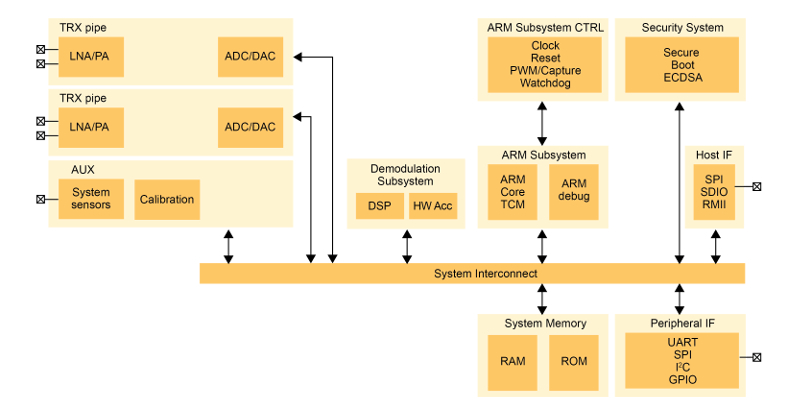
RoadLINK SAF5400 Single Chip Modem for V2X - NXP Semiconductors
Wireless technologies for V2X perfectly complement the existing infrastructure, for example, 3G or LTE networks, but still sometime we will wait for the introduction of 5G networks. Obviously, it is no coincidence that leading automakers and companies engaged in the field of electronics and telecommunications created the 5G Automotive Association(5GAA). The 5GAA Association is aimed at solving the problems of Cellular-V2X (C-V2X), i.e. V2X and cellular technology to improve transport service and road safety. For example, in anticipation of 5G, Qualcomm and LG announced joint development for Cellular-V2X. LG is developing automotive solutions based on the Qualcomm Technologies platform, which supports Gigabit LTE speeds using the Qualcomm Snapdragon X16 LTE modem and is complemented by QCA65x4 Wi-Fi 802.11ac. The proposed platform for Connected Car also supports 802.11p / DSRC standards.
Also interesting are not only innovations in the field of automotive electronics, but also the very principle by which new solutions for vehicles are now being built. For example, once upon a time, the electronic heart of a car was the engine control unit ECU (Electronic Control Unit), which controlled various actuators, and to which information from various sensors flowed. But soon came the CAN bus (Controller Area Network) and the concept of an intelligent sensor and intelligent executive systems. Those. the sensor began to be not only a sensitive element and a matching device, but also the microcontroller began to be part of the electronic sensor, which added “intelligence” to the system, since it could be programmed to work both autonomously and as part of a network of controllers. The same can be said about actuators. In fact, with the advent of many electronic devices in the car, the vehicle itself has become a platform for a specialized and highly reliable distributed network of microcontrollers.
For IoT solutions, it might seem very attractive to upload all the car’s internal CAN network data to the cloud, but now it seems absurd. It is unlikely that so much data is interesting for analysis, however, if we do not consider the sports car mileage on the track or any test tests. Moreover, as long as cellular communication channels leave much to be desired, such an approach for the consumer market is unlikely to lead to an final solution, by the way, one should not forget that access to the internal network contradicts the basic rules of cybersecurity. However, the processed data at the level of the electronic engine control unit, which are available on the OBD-II interface, as already noted, is consistent with the IoT idea.

Domain-based architecture removes many challenges of distributed architecture.
In general, domain architecture is not something completely new, but for a car it becomes a new round of development, where the electronic ecosystem will no longer represent a network of intelligent sensors and actuators, but a network of intelligent modules and systems. And here, for the IoT or Connected Car approach, the entry points are quite visible, i.e. for a general idea of the movement of the vehicle, aggregated data on various electronic modules of the car will be quite interesting.
And since we are talking about trust domains or, more correctly, segmentation levels of automotive embedded electronic systems, we should immediately recall the information security concept of these modules and systems, both in general and at each level of separation of “powers”. And here we cannot but be interested in the security concept proposed by the same NXP. The engineers of this company also offer multi-level architecture, but already car security. The first level is secure interfaces. Undoubtedly, the vehicle’s external communication channels must be protected to ensure user privacy and the safety of the vehicle itself. For this, traditional encryption and authentication approaches are proposed. At the second level, in a protected car it is proposed to use a gateway (Secure Gateway), which should provide secure Internet access through a firewall, and it should also act as a converter for various interfaces. The gateway should allow the separation of the domains of critical systems and, for example, entertainment systems. The third level is protection against intrusion into the car’s internal networks. Fourth - protection of the built-in control units, for example, the engine control unit from intrusion, program code spoofing, etc. At the last, fifth level, traditional methods of protecting the car from intrusion are offered, for example, electronic locks, immobilizer, etc. The third level is protection against intrusion into the car’s internal networks. Fourth - protection of the built-in control units, for example, the engine control unit from intrusion, program code spoofing, etc. At the last, fifth level, traditional methods of protecting the car from intrusion are offered, for example, electronic locks, immobilizer, etc. The third level is protection against intrusion into the car’s internal networks. Fourth - protection of the built-in control units, for example, the engine control unit from intrusion, program code spoofing, etc. At the last, fifth level, traditional methods of protecting the car from intrusion are offered, for example, electronic locks, immobilizer, etc.
An interesting point is the safety of electronic components of the car at the operating system level. For example, Green Hills Software offers the automotive industry its real-time operating system, INTEGRITY RTOS. This is an operating system for embedded systems (Embedded Systems) is aimed at ensuring reliability, security and maximum performance of real-time data processing. It uses hardware memory protection to isolate and protect embedded applications. Protected sections guarantee the correct operation and protection of the operating system itself and user tasks from erroneous and malicious code. To ensure the convenience of developers, the so-called middleware is proposed, for example, the implementation of file systems and popular network protocols, etc. The modern architecture of INTEGRITY is well suited for multi-core processors oriented to embedded systems. The operating system supports processors: Altera Cyclone, AMD x86, Applied Micro (APM) Power Architecture, ARM Ltd., Fujitsu ARM, IBM Power Architecture, Intel Architecture, Marvell ARM and PXA, MIPS Technologies, NXP Qorivva, NXP QorIQ, NXP ColdFire, NXP I.MX (ARM), NXP Vybrid (ARM), Renesas R-Car, Texas Instruments OMAP, Texas Instruments DaVinci, Texas Instruments Jacinto, Texas Instruments Sitara, Xilinx Zynq. The list, as they say, is impressive. Marvell ARM and PXA, MIPS Technologies, NXP Qorivva, NXP QorIQ, NXP ColdFire, NXP I.MX (ARM), NXP Vybrid (ARM), Renesas R-Car, Texas Instruments OMAP, Texas Instruments DaVinci, Texas Instruments Jacinto, Texas Instruments Sitara, Xilinx Zynq. The list, as they say, is impressive. Marvell ARM and PXA, MIPS Technologies, NXP Qorivva, NXP QorIQ, NXP ColdFire, NXP I.MX (ARM), NXP Vybrid (ARM), Renesas R-Car, Texas Instruments OMAP, Texas Instruments DaVinci, Texas Instruments Jacinto, Texas Instruments Sitara, Xilinx Zynq. The list, as they say, is impressive.
But the most interesting is the proposed INTEGRITY Multivisor approach, i.e. Offers a robust and portable virtualization infrastructure. The system supports high-performance “full virtualization”, where no changes are required in the guest operating system. If access to devices should be shared between guests and / or applications, it is easy to add applications that coordinate access to equipment. On processors that do not have hardware support for hypervisor mode, INTEGRITY Multivisor uses a carefully crafted, minimal modification of the guest operating system to maximize performance without sacrificing ease of migration and portability. Thus,

INTEGRITY Real-time Operating System - Green Hills Software
Get a classic example of using virtualization, but for embedded systems. Undoubtedly, this approach allows you to implement interesting tasks, for example, building an entertainment center based on a universal operating system (Linux or Windows), and at the same time, developers will have the opportunity to create real-time solutions for displaying the instrument panel. On the other hand, the hypervisor will protect systems critical to security from potential malicious code of standard solutions of the universal operating system level. Obviously, virtualization in the classical sense, which has already become the standard for traditional computer solutions, is rapidly moving into the world of highly reliable systems.
Speaking about the domain architecture of hardware solutions for automotive electronics and the modular architecture of the corresponding software systems, perhaps the most rapidly developing area in this area is the construction of autonomous vehicles. To solve this problem, various hardware and software solutions are offered. For example, Tesla Motors aims to use an embedded solution based on NVIDIA DRIVE PX 2 AI . A distinctive feature of such a platform is the implementation of hardware architecture, designed for the application of deep learning algorithms for the implementation of an artificial neural network, which, in turn, will become the basis for the operation of the autopilot. In general, even enthusiasts can offertheir solutions for unmanned cars. However, not all so simple. It is unlikely that someone will agree to drive along the highway on which the "amateur hacker" will learn his autopilot. The good news is that the authorities of most countries at the legislative level control the modification of serial cars, etc.

Autonomous Car Development Platform from NVIDIA DRIVE PX2
But then it turns out that the "technological progress" is only in the hands of corporations? In general, this is not so, it is quite possible to familiarize yourself with various online courses on building autonomous vehicles, for example, MIT 6.S094: Deep Learning for Self-Driving Cars . For experiments and development - it is necessary to use specialized training grounds. Here you can only envy and admire the town of McityUniversity of Michigan. This proving ground is fully designed for testing Connected Car and autonomous vehicles.
It is not difficult to notice that the automotive industry and transport technologies, at present, absorb all the most modern in the field of telecommunications, computer technology, programming electronics and solving machine learning problems. As a result, in the near future we will be able to get more reliable, safe for critical systems approaches and technologies, but already, as derivatives from the automotive industry solutions.
Undoubtedly, now the automotive industry is experiencing a huge leap in development, which is caused by a rapid leap in improving information and communication systems in transport. A breakthrough in the auto industry was made possible by improving the reliability and safety of electronic on-board systems and the formation of new approaches to the design of information networks based on them.
Of course, the future is ahead, but it is very clear that a car from the future will be built on the basis of a network of on-board intelligent modules that will be grouped into unique domains to solve key tasks of ensuring the reliable functioning of vehicle units to ensure ride comfort and safety. Cars themselves will become part of the V2X network and, at the same time, part of the Internet of things. Due to such technologies, it becomes possible to interact, for example, with a car and a drone that will lay a route of movement or, as an option, a specialized drone or their network can become a V2X access point in the air. You can offer many other scenarios, but always, the main thing in the automotive industry should be to ensure the safety, reliability and comfort of the trip.
Traditionally, this publication is a small technology digest. We hope that the links collected during the preparation of the publication will interest blog readers and may become the starting point in the study or improvement of technologies from the scope considered. Note that the idea of publication was inspired by the video plenary reports of the NXP FTF Connects conference held in Detroit. How do you architect the car of the future? and presentation materials from NXP FTF Connects conferences available on the company's website.
Automotive topics and the related concept of social IoT will certainly continue with new posts on our blog. For example, IVI (in-vehicle infotainment) entertainment systems were not mentioned at all in the current publication, but this is a whole area that geeks and car owners are always interested in. And much more, as they say, requires a more detailed study of the topic, for example, the interaction of autonomous vehicles and the emergence of a new trend - a car as a service or service, etc. Your comments on this topic are only welcome.
In turn, I want to congratulate the readers of our blog on the New Year and a series of winter holidays! This year I wish you interesting and exciting projects that will certainly change the world for the better, new gadgets and only positive impressions!
- Toyota is going to create electric cars along with hydrogen cars - Geektimes
- Building the Next-Generation Car with Intel IoT - IoT @ Intel
- Car of the Future — Automotive Safety and Security Trends - IoT @ Intel
- DOU Projector: “Roads of Ukraine” - road monitoring service
- Connected cars - The ultimate Internet of Things thing - IBM developerWorks Blog
- 70 Seconds of Safety with Smart Connected Vehicles - NXP Semiconductors
- Why 802.11p beats LTE and 5G for V2x - eeNews Europe
- Qualcomm and LG Bring 5G and Cellular-V2X Communications Into Vehicles - Press Announcements
-ECMs used on VAZ vehicles - Chip tuning and injection diagnostics
- Multi-layer Automotive Security Architecture - NXP Semiconductors
- Green Hills Software at CES 2017 - Robert Redfield
- A Brief History of Autonomous Vehicle Technology - WIRED
- Get Under the Hood of Parker, Our Newest SOC for Autonomous Vehicles - NVIDIA
- 16 questions about unmanned vehicles and the world with them: presentation of partner Andreessen Horowitz - AIN.UA
- 36 projects of unmanned vehicles - Geektimes
- Machine as a service. How the development of unmanned vehicles is changing the industry - Forbes
- Martti autopilot can drive along a snowy road without marking - HighTech
- Welcome to the city of robotic cars - Geektimes
- Independent city: 3 technologies of "reasonable" traffic control - Geektimes
On the other hand, computer networks and the Internet came close to the whole world, but at the same time, the car and the Internet of Things (IoT) are still quite distant from each other. In the previous article, " OBD-II Diagnostic Connector as an Interface for IoT"it was suggested that for virtually any car, an adapter based on the OBD-II diagnostic interface, a GPS receiver, a 3-axis acceleration sensor, combined with a gyroscope and, of course, with Internet access, actually solves the problem of a“ connected car ”( Connected Car) .Next, this is not so much technology, but the mechanisms of interaction between the car and IoT devices.In this publication, I would like to consider not how many mechanisms to build an IoT platform for road users or go deeper into road safety issues, which is undoubtedly important But, just consider what already exists in the world of the automotive industry, for other industries or your own designs.
Intel IoT Platform Paving the Road to the Car of the Future - IoT @ Intel
Undoubtedly, with an increase in the number of Connected Car on our roads, big data will also be available containing various characteristics and potential statistical information that can now be used by service stations or car manufacturers, for example, to improve the quality of cars and their components, as well as the introduction of intelligent approaches to forecasting and planning vehicle maintenance. Insurance companies will be able to obtain information about the nature of driving and statistics on the failure of certain units of specific brands of cars, which undoubtedly can, and should be taken into account when setting prices for insurance, etc. You can also indirectly take into account the quality of the road surface, for example, by analogy with projects using inertial sensors,
But what will the Connected Car give to its owner? Is a “connected” car just a point of access to the Internet, a bit of multimedia capabilities and some data, which, however, may not be useful. How relevant is the scenario when the car drives up to the house and the “smart home” system initiates raising the garage door, turning on the external lighting of the driveway, the light in the hallway and the room, sets a comfortable floor heating temperature? But, after all, this is comfort. These are such inconspicuous things that in the future will simply complement everyday life. But, as it is not difficult to notice, the progress of IoT is not only Connected Car, "smart home" and other technologies, but all of the above together. Only synergy of collaboration and interaction of IoT components will make a breakthrough in the development of the concept of the Internet of things a reality. In the meantime,
Perhaps, Connected Car through the eyes of automakers is definitely not only the data of OBD-II and several auxiliary sensors. Let's imagine that for a modern car such systems as adaptive cruise control (Adaptive Cruise Control), emergency braking systems (Pedestrian Detection), collision avoidance systems (Collision Avoidance), recognition of road Traffic Sign Recognition, Lane Departure Warning, Cross Traffic Alert, Blind Spot Detection, Rear Collision Warning, help with parking (Park Assistance) and many others. And think about it: what if this data, directly or indirectly,
The interaction between each other at the level of data exchange between vehicles V2V (Vehicle-to-vehicle), vehicles and transport infrastructure V2I (Vehicle-to-Infrastructure), or, quite generally, vehicles with a traffic environment V2X (Vehicle-to-everything) - this is the next step in the development of transport or, simply, intelligent transport technologies (Intelligent Transport System). At the moment, there is an interesting approach, which is actually based on the deployment of Wi-Fi networks according to the IEEE 802.11p standard, which allows to solve the problem of the possible lack of access to the Internet, i.e. V2X systems use this protocol to exchange data with each other without requiring an Internet connection. The exchange of required information between the participants of V2X communications is carried out by the so-called standard messages BSM (Basic Safety Message).
V2X communications: A pointless wait for 5G?
The advantages of V2X are quite understandable, for example, it will be possible to obtain data on a vehicle that is out of sight, on the basis of which various car safety devices can function or it will become possible not to recognize road signs by car intelligent systems, but simply communicate with the corresponding warning systems and etc. Implementation of the IEEE 802.11p standard on board a vehicle, or a component of an embedded system (Embedded System) for a traffic infrastructure, is an easy task, for example, if you use the RoadLINK SAF5400 chip proposed by NXP. This is a high-performance car modem DSRC ( Dedicated short-range communications) for V2X. The SAF5400 modem is capable of relaying up to 2000 basic security messages (BSM) per second, and also integrates high-performance V2X wireless security technology.
RoadLINK SAF5400 Single Chip Modem for V2X - NXP Semiconductors
Wireless technologies for V2X perfectly complement the existing infrastructure, for example, 3G or LTE networks, but still sometime we will wait for the introduction of 5G networks. Obviously, it is no coincidence that leading automakers and companies engaged in the field of electronics and telecommunications created the 5G Automotive Association(5GAA). The 5GAA Association is aimed at solving the problems of Cellular-V2X (C-V2X), i.e. V2X and cellular technology to improve transport service and road safety. For example, in anticipation of 5G, Qualcomm and LG announced joint development for Cellular-V2X. LG is developing automotive solutions based on the Qualcomm Technologies platform, which supports Gigabit LTE speeds using the Qualcomm Snapdragon X16 LTE modem and is complemented by QCA65x4 Wi-Fi 802.11ac. The proposed platform for Connected Car also supports 802.11p / DSRC standards.
Also interesting are not only innovations in the field of automotive electronics, but also the very principle by which new solutions for vehicles are now being built. For example, once upon a time, the electronic heart of a car was the engine control unit ECU (Electronic Control Unit), which controlled various actuators, and to which information from various sensors flowed. But soon came the CAN bus (Controller Area Network) and the concept of an intelligent sensor and intelligent executive systems. Those. the sensor began to be not only a sensitive element and a matching device, but also the microcontroller began to be part of the electronic sensor, which added “intelligence” to the system, since it could be programmed to work both autonomously and as part of a network of controllers. The same can be said about actuators. In fact, with the advent of many electronic devices in the car, the vehicle itself has become a platform for a specialized and highly reliable distributed network of microcontrollers.
For IoT solutions, it might seem very attractive to upload all the car’s internal CAN network data to the cloud, but now it seems absurd. It is unlikely that so much data is interesting for analysis, however, if we do not consider the sports car mileage on the track or any test tests. Moreover, as long as cellular communication channels leave much to be desired, such an approach for the consumer market is unlikely to lead to an final solution, by the way, one should not forget that access to the internal network contradicts the basic rules of cybersecurity. However, the processed data at the level of the electronic engine control unit, which are available on the OBD-II interface, as already noted, is consistent with the IoT idea.
Domain-based architecture removes many challenges of distributed architecture.
In general, domain architecture is not something completely new, but for a car it becomes a new round of development, where the electronic ecosystem will no longer represent a network of intelligent sensors and actuators, but a network of intelligent modules and systems. And here, for the IoT or Connected Car approach, the entry points are quite visible, i.e. for a general idea of the movement of the vehicle, aggregated data on various electronic modules of the car will be quite interesting.
And since we are talking about trust domains or, more correctly, segmentation levels of automotive embedded electronic systems, we should immediately recall the information security concept of these modules and systems, both in general and at each level of separation of “powers”. And here we cannot but be interested in the security concept proposed by the same NXP. The engineers of this company also offer multi-level architecture, but already car security. The first level is secure interfaces. Undoubtedly, the vehicle’s external communication channels must be protected to ensure user privacy and the safety of the vehicle itself. For this, traditional encryption and authentication approaches are proposed. At the second level, in a protected car it is proposed to use a gateway (Secure Gateway), which should provide secure Internet access through a firewall, and it should also act as a converter for various interfaces. The gateway should allow the separation of the domains of critical systems and, for example, entertainment systems. The third level is protection against intrusion into the car’s internal networks. Fourth - protection of the built-in control units, for example, the engine control unit from intrusion, program code spoofing, etc. At the last, fifth level, traditional methods of protecting the car from intrusion are offered, for example, electronic locks, immobilizer, etc. The third level is protection against intrusion into the car’s internal networks. Fourth - protection of the built-in control units, for example, the engine control unit from intrusion, program code spoofing, etc. At the last, fifth level, traditional methods of protecting the car from intrusion are offered, for example, electronic locks, immobilizer, etc. The third level is protection against intrusion into the car’s internal networks. Fourth - protection of the built-in control units, for example, the engine control unit from intrusion, program code spoofing, etc. At the last, fifth level, traditional methods of protecting the car from intrusion are offered, for example, electronic locks, immobilizer, etc.
An interesting point is the safety of electronic components of the car at the operating system level. For example, Green Hills Software offers the automotive industry its real-time operating system, INTEGRITY RTOS. This is an operating system for embedded systems (Embedded Systems) is aimed at ensuring reliability, security and maximum performance of real-time data processing. It uses hardware memory protection to isolate and protect embedded applications. Protected sections guarantee the correct operation and protection of the operating system itself and user tasks from erroneous and malicious code. To ensure the convenience of developers, the so-called middleware is proposed, for example, the implementation of file systems and popular network protocols, etc. The modern architecture of INTEGRITY is well suited for multi-core processors oriented to embedded systems. The operating system supports processors: Altera Cyclone, AMD x86, Applied Micro (APM) Power Architecture, ARM Ltd., Fujitsu ARM, IBM Power Architecture, Intel Architecture, Marvell ARM and PXA, MIPS Technologies, NXP Qorivva, NXP QorIQ, NXP ColdFire, NXP I.MX (ARM), NXP Vybrid (ARM), Renesas R-Car, Texas Instruments OMAP, Texas Instruments DaVinci, Texas Instruments Jacinto, Texas Instruments Sitara, Xilinx Zynq. The list, as they say, is impressive. Marvell ARM and PXA, MIPS Technologies, NXP Qorivva, NXP QorIQ, NXP ColdFire, NXP I.MX (ARM), NXP Vybrid (ARM), Renesas R-Car, Texas Instruments OMAP, Texas Instruments DaVinci, Texas Instruments Jacinto, Texas Instruments Sitara, Xilinx Zynq. The list, as they say, is impressive. Marvell ARM and PXA, MIPS Technologies, NXP Qorivva, NXP QorIQ, NXP ColdFire, NXP I.MX (ARM), NXP Vybrid (ARM), Renesas R-Car, Texas Instruments OMAP, Texas Instruments DaVinci, Texas Instruments Jacinto, Texas Instruments Sitara, Xilinx Zynq. The list, as they say, is impressive.
But the most interesting is the proposed INTEGRITY Multivisor approach, i.e. Offers a robust and portable virtualization infrastructure. The system supports high-performance “full virtualization”, where no changes are required in the guest operating system. If access to devices should be shared between guests and / or applications, it is easy to add applications that coordinate access to equipment. On processors that do not have hardware support for hypervisor mode, INTEGRITY Multivisor uses a carefully crafted, minimal modification of the guest operating system to maximize performance without sacrificing ease of migration and portability. Thus,
INTEGRITY Real-time Operating System - Green Hills Software
Get a classic example of using virtualization, but for embedded systems. Undoubtedly, this approach allows you to implement interesting tasks, for example, building an entertainment center based on a universal operating system (Linux or Windows), and at the same time, developers will have the opportunity to create real-time solutions for displaying the instrument panel. On the other hand, the hypervisor will protect systems critical to security from potential malicious code of standard solutions of the universal operating system level. Obviously, virtualization in the classical sense, which has already become the standard for traditional computer solutions, is rapidly moving into the world of highly reliable systems.
Speaking about the domain architecture of hardware solutions for automotive electronics and the modular architecture of the corresponding software systems, perhaps the most rapidly developing area in this area is the construction of autonomous vehicles. To solve this problem, various hardware and software solutions are offered. For example, Tesla Motors aims to use an embedded solution based on NVIDIA DRIVE PX 2 AI . A distinctive feature of such a platform is the implementation of hardware architecture, designed for the application of deep learning algorithms for the implementation of an artificial neural network, which, in turn, will become the basis for the operation of the autopilot. In general, even enthusiasts can offertheir solutions for unmanned cars. However, not all so simple. It is unlikely that someone will agree to drive along the highway on which the "amateur hacker" will learn his autopilot. The good news is that the authorities of most countries at the legislative level control the modification of serial cars, etc.
Autonomous Car Development Platform from NVIDIA DRIVE PX2
But then it turns out that the "technological progress" is only in the hands of corporations? In general, this is not so, it is quite possible to familiarize yourself with various online courses on building autonomous vehicles, for example, MIT 6.S094: Deep Learning for Self-Driving Cars . For experiments and development - it is necessary to use specialized training grounds. Here you can only envy and admire the town of McityUniversity of Michigan. This proving ground is fully designed for testing Connected Car and autonomous vehicles.
It is not difficult to notice that the automotive industry and transport technologies, at present, absorb all the most modern in the field of telecommunications, computer technology, programming electronics and solving machine learning problems. As a result, in the near future we will be able to get more reliable, safe for critical systems approaches and technologies, but already, as derivatives from the automotive industry solutions.
Undoubtedly, now the automotive industry is experiencing a huge leap in development, which is caused by a rapid leap in improving information and communication systems in transport. A breakthrough in the auto industry was made possible by improving the reliability and safety of electronic on-board systems and the formation of new approaches to the design of information networks based on them.
Of course, the future is ahead, but it is very clear that a car from the future will be built on the basis of a network of on-board intelligent modules that will be grouped into unique domains to solve key tasks of ensuring the reliable functioning of vehicle units to ensure ride comfort and safety. Cars themselves will become part of the V2X network and, at the same time, part of the Internet of things. Due to such technologies, it becomes possible to interact, for example, with a car and a drone that will lay a route of movement or, as an option, a specialized drone or their network can become a V2X access point in the air. You can offer many other scenarios, but always, the main thing in the automotive industry should be to ensure the safety, reliability and comfort of the trip.
Traditionally, this publication is a small technology digest. We hope that the links collected during the preparation of the publication will interest blog readers and may become the starting point in the study or improvement of technologies from the scope considered. Note that the idea of publication was inspired by the video plenary reports of the NXP FTF Connects conference held in Detroit. How do you architect the car of the future? and presentation materials from NXP FTF Connects conferences available on the company's website.
Automotive topics and the related concept of social IoT will certainly continue with new posts on our blog. For example, IVI (in-vehicle infotainment) entertainment systems were not mentioned at all in the current publication, but this is a whole area that geeks and car owners are always interested in. And much more, as they say, requires a more detailed study of the topic, for example, the interaction of autonomous vehicles and the emergence of a new trend - a car as a service or service, etc. Your comments on this topic are only welcome.
In turn, I want to congratulate the readers of our blog on the New Year and a series of winter holidays! This year I wish you interesting and exciting projects that will certainly change the world for the better, new gadgets and only positive impressions!
Interesting resources and links:
- Toyota is going to create electric cars along with hydrogen cars - Geektimes
- Building the Next-Generation Car with Intel IoT - IoT @ Intel
- Car of the Future — Automotive Safety and Security Trends - IoT @ Intel
- DOU Projector: “Roads of Ukraine” - road monitoring service
- Connected cars - The ultimate Internet of Things thing - IBM developerWorks Blog
- 70 Seconds of Safety with Smart Connected Vehicles - NXP Semiconductors
- Why 802.11p beats LTE and 5G for V2x - eeNews Europe
- Qualcomm and LG Bring 5G and Cellular-V2X Communications Into Vehicles - Press Announcements
-ECMs used on VAZ vehicles - Chip tuning and injection diagnostics
- Multi-layer Automotive Security Architecture - NXP Semiconductors
- Green Hills Software at CES 2017 - Robert Redfield
- A Brief History of Autonomous Vehicle Technology - WIRED
- Get Under the Hood of Parker, Our Newest SOC for Autonomous Vehicles - NVIDIA
- 16 questions about unmanned vehicles and the world with them: presentation of partner Andreessen Horowitz - AIN.UA
- 36 projects of unmanned vehicles - Geektimes
- Machine as a service. How the development of unmanned vehicles is changing the industry - Forbes
- Martti autopilot can drive along a snowy road without marking - HighTech
- Welcome to the city of robotic cars - Geektimes
- Independent city: 3 technologies of "reasonable" traffic control - Geektimes