A bit about WSPR, or how far can a 1W signal be transmitted?
Currently, there is a noticeable rise in interest in wireless technologies, which becomes especially relevant in the era of the “Internet of things”, “smart homes”, smart gadgets, various sensors and devices. Indeed, few people want to drill a wall and pull the wire to the temperature sensor outside the window, which is much easier if the data will be transmitted by radio. There are many solutions here, for example, one of the latest developments is LoRa, the transmitters of this system are capable of transmitting data for several kilometers at a power of 10-100mW.
How far can a radio signal be transmitted? This is perhaps the most interesting question that was raised long before the term IoT as such appeared. Joseph Hooton Taylor, an American astrophysicist and Nobel laureate, tried to answer this question most comprehensively by creating the Weak Signal Propagation Reporter (WSPR) program in 2008. The idea of the program is simple - to transmit a signal that carries a minimum of information, which due to this can be decoded at the greatest possible distance.
How it works? Details under the cut. As it turned out, WSPR has never been described on geektimes, it's time to fill this gap.
WSPR is the simplest digital signal possible, transmitting at just 1.4648 bauds (yes, just a little over 1 bit per second). For transmission, frequency modulation (4-FSK) is used with a frequency spacing of 1.4648 Hz, so that the signal bandwidth is only 6 Hz. The transmitted data packet has a size of only 50 bits, error correction bits (non-recursive convolutional code, constraint length K = 32, rate = 1/2) are also added to it, as a result, the total packet size is 162 bits. These 162 bits are transmitted in about 2 minutes (will someone else complain about the slow internet? :).
The 50-bit packet itself contains a minimum set of data sufficient for use by amateur radio stations: the call sign of the transmitting station, the square of the station's location (the so-called grid locator) and signal strength. A more complete description, including distributions for Win / MacOS and Linux, as well as the source code of the program for reception and transmission, is available at http://physics.princeton.edu/pulsar/k1jt/wspr.html .
Thanks to the narrowband signal, the system turned out to be very sensitive. The minimum signal-to-noise level for decoding is –28 dB, which exceeds even the reception of the Morse code by a trained operator. And finally, the most interesting - the site http://wsprnet.org was createdwhere the received data is automatically sent, and anyone (including the station owner or the one who received the signal) can see statistics and visualization on the map of received data.
To receive WSPR signals, it is enough to have a receiver with the ability to receive single-band modulation (Tescun PL-660, Sangean ATS-909x, Sony ICF-SW7600, etc.). Using WSPR is quite simple - just connect the receiver to the line input of the sound card and select it in the program as the signal source. Further in the settings you must specify the location in the form of a grid locator, which you can find out on the website https://www.qrz.com/gridmapper . You can use the original version of WSPR, but it is better to use the newer WSJT , whose interface is more convenient.
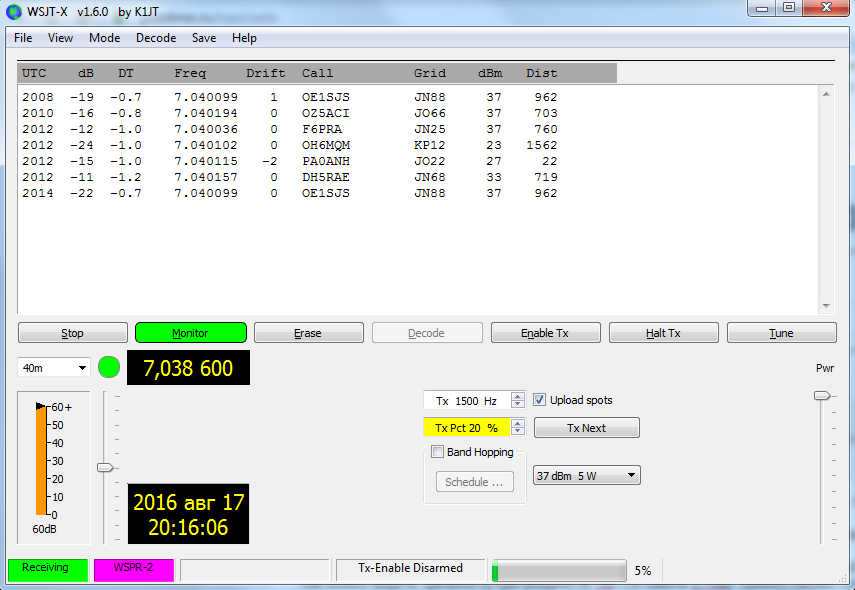
On this, almost all the settings are completed. It is necessary to tune the receiver to the selected frequency (a list of frequencies can be viewed on the website), turn on the program, and you can go drink tea. After about 15 minutes, you can check the program window, which should look something like this:
If the call sign of the receiving station was entered in the program and the “Upload to server” flag was set, then go to http://wsprnet.org/drupal/wsprnet/map and by entering this call sign, you can see the graphic reception card, and by going to http://wsprnet.org/drupal/wsprnet/spots , you can see more detailed text information.
An amateur radio transceiver (for example, Yaesu 857) and an amateur radio license (upon receipt of which a call sign is issued) are also required for transmission. The wspr server does not verify the licenses and callsign; the station owner solves this issue on his own.
Otherwise, the principle is the same: the radio station is connected to the computer, the signal is generated through the sound card. Each transfer session lasts 2 minutes, after some time you can go to the site and see the statistics.
To check, I asked a friend with the appropriate transceiver to do 3 tests:
1) Receive signals at a frequency of 7.038 MHz to a random antenna (piece of wire).
2) Reception of signals at the same frequency on the tuned antenna
3) Signal transmission
This is the most inefficient method in terms of reception quality. The signal level is minimal, in addition, the antenna receives a lot of interference from home electrical appliances. The program was launched for about 15 minutes, the result was immediately visible in the form of a map on the site: The
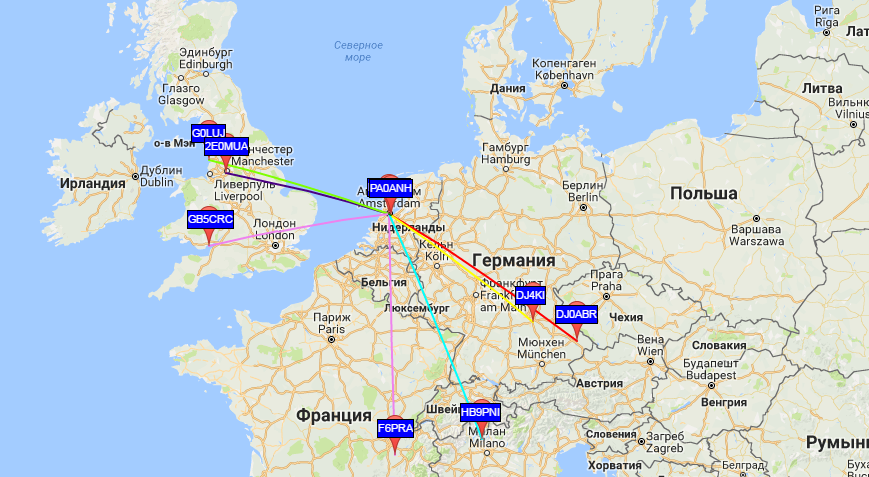
maximum reception range was about 700 km, which in principle is not so bad.
Next, a magnetic loop antenna tuned to the same frequency was tested for reception . The magnetic loop antenna is practically the only antenna capable of receiving and transmitting, which can be placed in the apartment, its size is 1-2m.
The result of the program in 10 minutes:
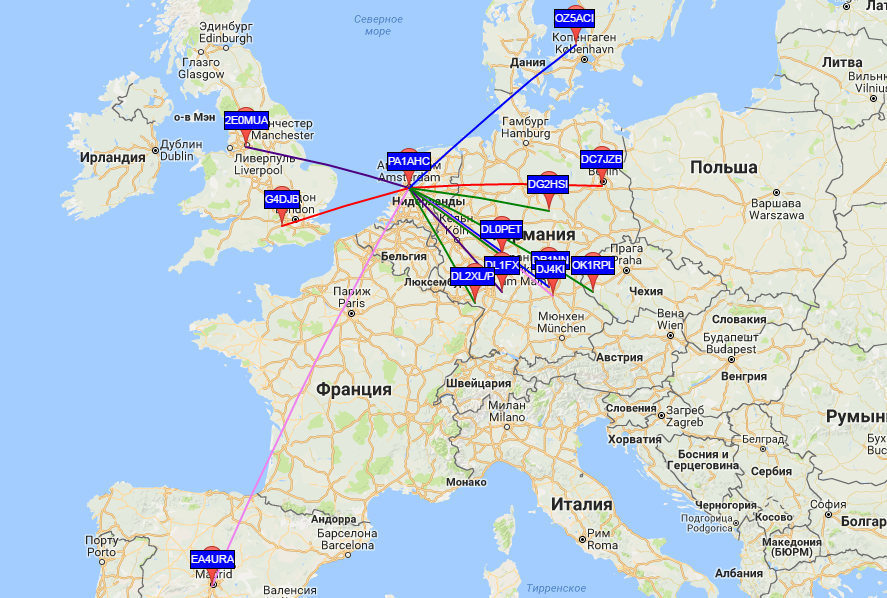
The difference is obvious - in less time more stations were received, well, and the maximum reception range is about twice as much.
It is interesting to analyze the results in text form:
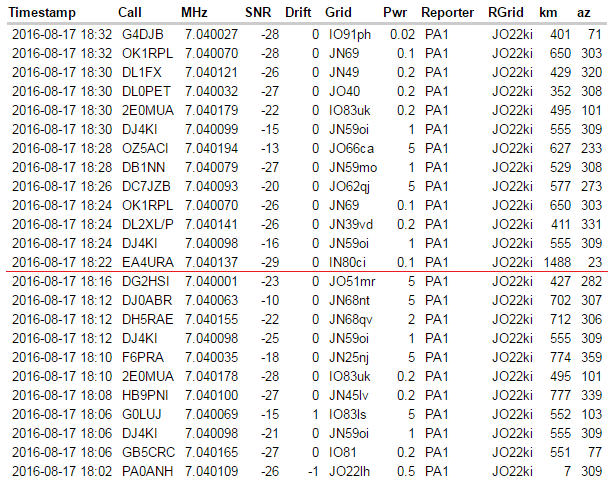
The red line was separated time switching one antenna to another. It can be seen that with a transmission power of 1 Watt, the average range of reception at an indoor antenna is about 500 km. The result at 1488 km with a power of 0.1 W stands apart, but we don’t know if this is true - unfortunately, the program does not check the values entered by the user (you can specify 1 W and transfer to 100 W, it is impossible to verify), maybe that operator simply made a mistake when entering the parameters.
Finally, the last test was signal transmission from the same indoor antenna. The transmitted power was selected in 1 and 2W. The results are shown on the map and in the table:
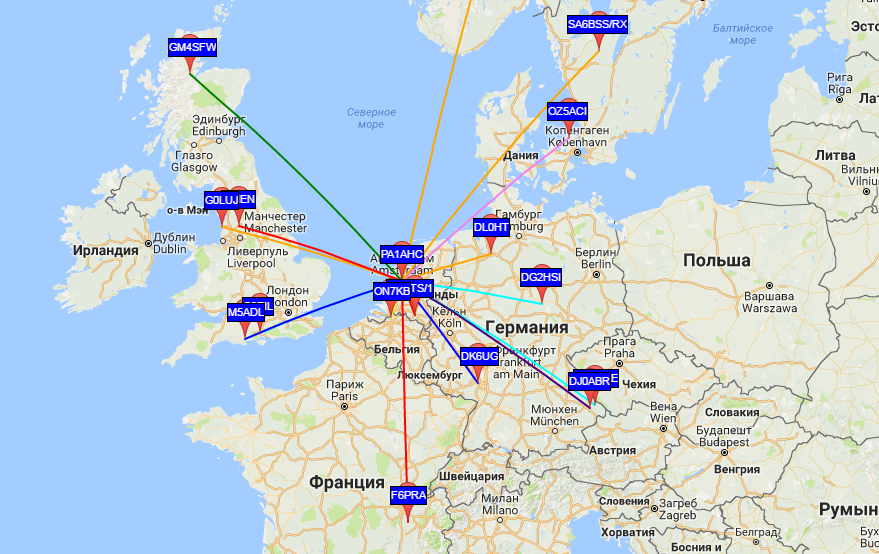
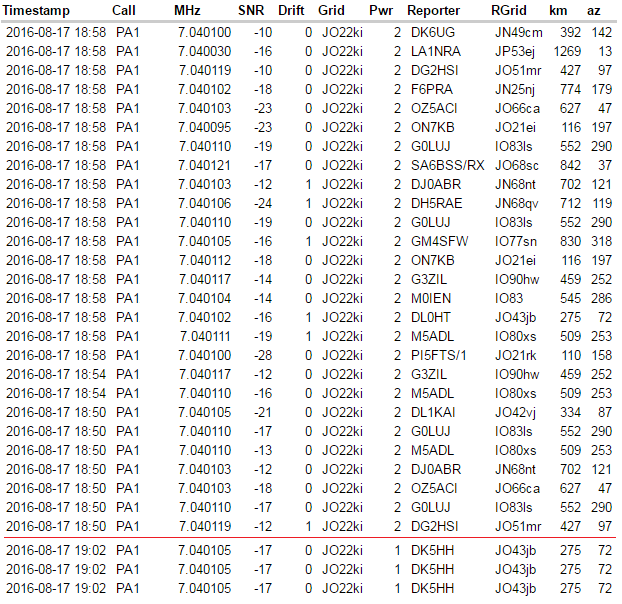
As you can see, the range at a power of 1 W was 275 km, only one operator received the signal. At 2W, the picture is already more interesting - the maximum range was as much as 1200km.
Of course, indoor antennas in urban environments are very imperfect in effectiveness. Outside the city, in conditions of clean air with a minimum amount of interference, much weaker signals can be received.
As you can see, wspr is a very interesting tool that allows you to visually study the passage of radio waves and compare the quality of the antennas. It is also interesting that the whole system works at the expense of enthusiasts and the community, someone transmits signals, someone receives, and due to the large number of participants, the results are very interesting and clear.
Returning to the header question, how far can I transfer data with 1 watt of power. Far enough, as the search on the site database shows, using the example of a radio amateur with the call sign OE3MUC. Here is his 1W transmission card:
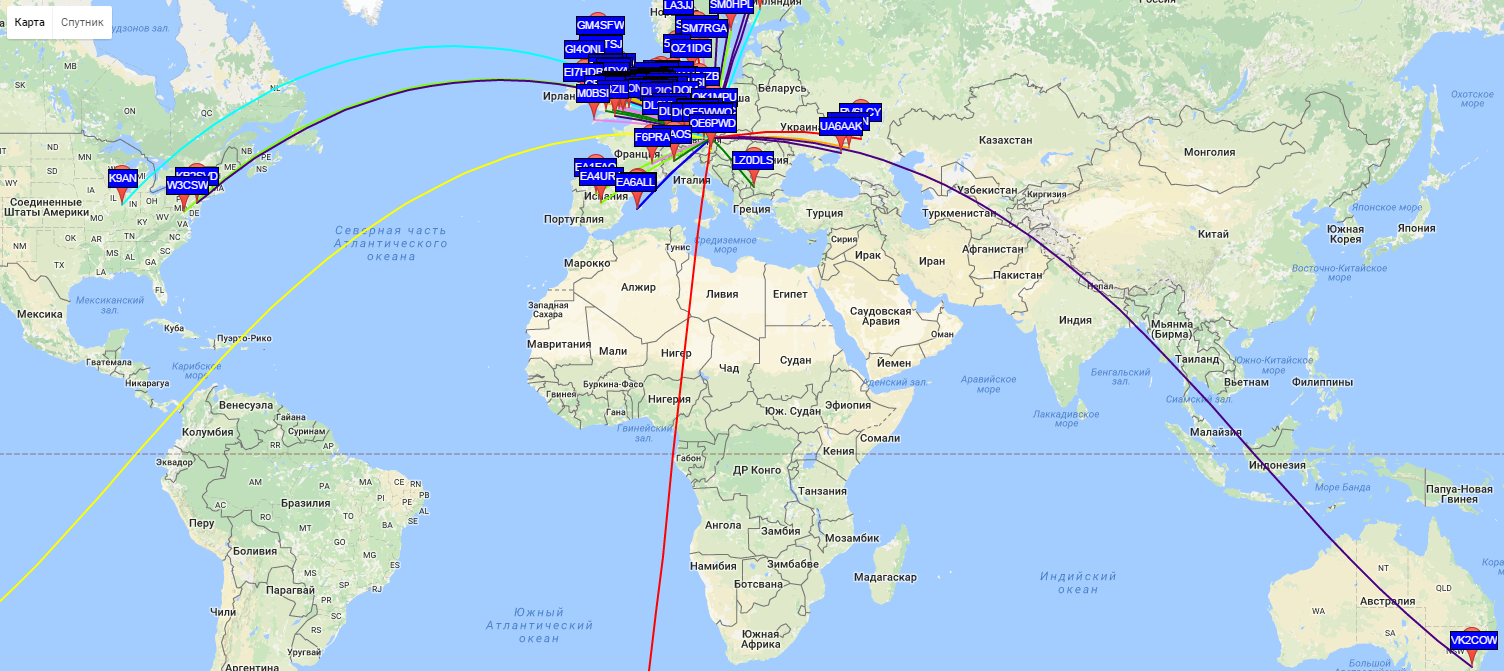
Of course, this is also a question of the availability of good and high-quality directional antennas, but, nevertheless, it is very interesting - with a power of only 1W (that is, hypothetically, such a transmitter can be powered directly from the USB connector), you can transfer without any Internet and cables data across the ocean from Austria to Australia at 15000km. There is something to think about ...
How far can a radio signal be transmitted? This is perhaps the most interesting question that was raised long before the term IoT as such appeared. Joseph Hooton Taylor, an American astrophysicist and Nobel laureate, tried to answer this question most comprehensively by creating the Weak Signal Propagation Reporter (WSPR) program in 2008. The idea of the program is simple - to transmit a signal that carries a minimum of information, which due to this can be decoded at the greatest possible distance.
How it works? Details under the cut. As it turned out, WSPR has never been described on geektimes, it's time to fill this gap.
Signal structure
WSPR is the simplest digital signal possible, transmitting at just 1.4648 bauds (yes, just a little over 1 bit per second). For transmission, frequency modulation (4-FSK) is used with a frequency spacing of 1.4648 Hz, so that the signal bandwidth is only 6 Hz. The transmitted data packet has a size of only 50 bits, error correction bits (non-recursive convolutional code, constraint length K = 32, rate = 1/2) are also added to it, as a result, the total packet size is 162 bits. These 162 bits are transmitted in about 2 minutes (will someone else complain about the slow internet? :).
The 50-bit packet itself contains a minimum set of data sufficient for use by amateur radio stations: the call sign of the transmitting station, the square of the station's location (the so-called grid locator) and signal strength. A more complete description, including distributions for Win / MacOS and Linux, as well as the source code of the program for reception and transmission, is available at http://physics.princeton.edu/pulsar/k1jt/wspr.html .
Thanks to the narrowband signal, the system turned out to be very sensitive. The minimum signal-to-noise level for decoding is –28 dB, which exceeds even the reception of the Morse code by a trained operator. And finally, the most interesting - the site http://wsprnet.org was createdwhere the received data is automatically sent, and anyone (including the station owner or the one who received the signal) can see statistics and visualization on the map of received data.
Use for Reception
To receive WSPR signals, it is enough to have a receiver with the ability to receive single-band modulation (Tescun PL-660, Sangean ATS-909x, Sony ICF-SW7600, etc.). Using WSPR is quite simple - just connect the receiver to the line input of the sound card and select it in the program as the signal source. Further in the settings you must specify the location in the form of a grid locator, which you can find out on the website https://www.qrz.com/gridmapper . You can use the original version of WSPR, but it is better to use the newer WSJT , whose interface is more convenient.
On this, almost all the settings are completed. It is necessary to tune the receiver to the selected frequency (a list of frequencies can be viewed on the website), turn on the program, and you can go drink tea. After about 15 minutes, you can check the program window, which should look something like this:
If the call sign of the receiving station was entered in the program and the “Upload to server” flag was set, then go to http://wsprnet.org/drupal/wsprnet/map and by entering this call sign, you can see the graphic reception card, and by going to http://wsprnet.org/drupal/wsprnet/spots , you can see more detailed text information.
Use for transfer
An amateur radio transceiver (for example, Yaesu 857) and an amateur radio license (upon receipt of which a call sign is issued) are also required for transmission. The wspr server does not verify the licenses and callsign; the station owner solves this issue on his own.
Otherwise, the principle is the same: the radio station is connected to the computer, the signal is generated through the sound card. Each transfer session lasts 2 minutes, after some time you can go to the site and see the statistics.
results
To check, I asked a friend with the appropriate transceiver to do 3 tests:
1) Receive signals at a frequency of 7.038 MHz to a random antenna (piece of wire).
2) Reception of signals at the same frequency on the tuned antenna
3) Signal transmission
Random antenna reception
This is the most inefficient method in terms of reception quality. The signal level is minimal, in addition, the antenna receives a lot of interference from home electrical appliances. The program was launched for about 15 minutes, the result was immediately visible in the form of a map on the site: The
maximum reception range was about 700 km, which in principle is not so bad.
Reception on the tuned antenna
Next, a magnetic loop antenna tuned to the same frequency was tested for reception . The magnetic loop antenna is practically the only antenna capable of receiving and transmitting, which can be placed in the apartment, its size is 1-2m.
The result of the program in 10 minutes:
The difference is obvious - in less time more stations were received, well, and the maximum reception range is about twice as much.
It is interesting to analyze the results in text form:
The red line was separated time switching one antenna to another. It can be seen that with a transmission power of 1 Watt, the average range of reception at an indoor antenna is about 500 km. The result at 1488 km with a power of 0.1 W stands apart, but we don’t know if this is true - unfortunately, the program does not check the values entered by the user (you can specify 1 W and transfer to 100 W, it is impossible to verify), maybe that operator simply made a mistake when entering the parameters.
Signal transmission
Finally, the last test was signal transmission from the same indoor antenna. The transmitted power was selected in 1 and 2W. The results are shown on the map and in the table:
As you can see, the range at a power of 1 W was 275 km, only one operator received the signal. At 2W, the picture is already more interesting - the maximum range was as much as 1200km.
Of course, indoor antennas in urban environments are very imperfect in effectiveness. Outside the city, in conditions of clean air with a minimum amount of interference, much weaker signals can be received.
Conclusion
As you can see, wspr is a very interesting tool that allows you to visually study the passage of radio waves and compare the quality of the antennas. It is also interesting that the whole system works at the expense of enthusiasts and the community, someone transmits signals, someone receives, and due to the large number of participants, the results are very interesting and clear.
Returning to the header question, how far can I transfer data with 1 watt of power. Far enough, as the search on the site database shows, using the example of a radio amateur with the call sign OE3MUC. Here is his 1W transmission card:
Of course, this is also a question of the availability of good and high-quality directional antennas, but, nevertheless, it is very interesting - with a power of only 1W (that is, hypothetically, such a transmitter can be powered directly from the USB connector), you can transfer without any Internet and cables data across the ocean from Austria to Australia at 15000km. There is something to think about ...