
 September 18, 2015 at 21:19
MIPT scientists create a new ultra-sensitive graphene oxide biosensor

Scientists from the laboratory of nanooptics and plasmonics of the Moscow Institute of Physics and Technology have created an ultra-sensitive biosensor based on graphene oxide . He will be able to help create new drugs and vaccines. According to scientists, this is a fundamentally new chip that allows you to test drugs outside of a living organism.
A fundamentally new chip based on graphene oxide allows you to test drugs outside of a living organism. Technology could revolutionize the development of new drugs and help doctors defeat incurable diseases in the near future.
Markerless biosensors make it possible to detect and study the chemical properties of substances at very low concentrations. At the same time, there is no need to attach marker markers (usually they are fluorescent or radioactive) to the molecules of the samples so that this substance becomes visible to the instruments.
The development of the scientists of the Physics and Technology Institute is based on the use of surface plasmons - electromagnetic waves that arise at the boundary of a conductor and a dielectric as a result of resonant interaction between photons and electrons. Due to the fact that the resonance parameters critically depend on the surface properties, a very small amount of the substance present on it can be detected.
For example, on a square millimeter site, such a sensor can find a trillionth of a gram of a substance. Moreover, a device based on such a sensor can observe the reaction of molecules in real time.
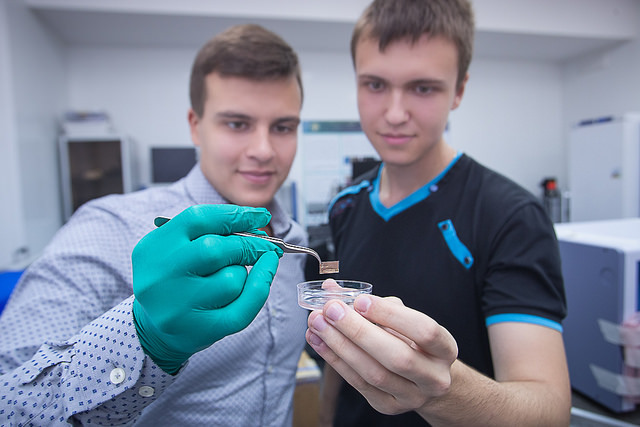
“With their help, we can track how a particular chemical reaction proceeds, we can evaluate its speed, which means we can accurately determine how a particular substance acts on a cell, on a pathogenic bacterium,” says one of the authors of the study, Yuri Stebunov . - This means that in the near future, preclinical trials of drugs can be carried out in a fundamentally new way - to accurately predict the effect of the drug, it will be enough to trace the interaction of drugs with living tissue directly on the biosensor. This is a revolution in the creation of new drugs: biosensors will significantly increase the effectiveness of preclinical studies and, perhaps, in the near future will help to defeat as yet incurable diseases. "
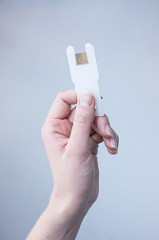
The sensor chips now existing - thin plates the size of a centimeter per centimeter where the test samples are deposited - are mainly made of glass coated with a thin layer of gold. The sensitivity of the biosensor depends on the properties of the surface, that is, on how many molecules of the test substance can join the plate.
Graphene is considered to be a promising material for biosensors: it has a large surface area, is cheap to manufacture, and also interacts with a large number of biological molecules. Stebunov and his colleagues created and patented the type of chips coated with graphene oxide.
Measurements showed that the graphene oxide-based sensor is three times more sensitive than the dextran-based chip and 3.7 times that of pure graphene. This means that the new chip requires several times fewer molecules to detect a particular substance. In addition, such a sensor can be used several times after washing with alkali, and it is also cheaper and easier to manufacture.
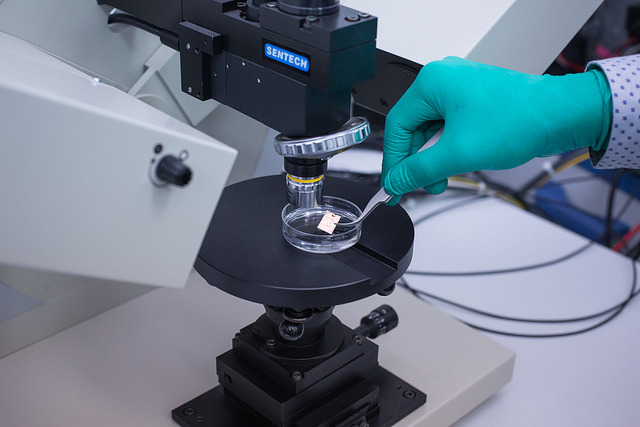
“Our chip can be used in the development of drugs for infectious, oncological and other types of diseases,” says Stebunov. - Therefore, we look forward to serious interest from pharmaceutical companies in our development. "This sensor can also be used to control the quality of products, in the search for toxins and allergens, in medical diagnostics, which will help reduce the time it takes to perform tests from day to minutes."
Prior to implementation in clinical practice, a number of improvements and trials will be required. In mass production, a graphene oxide biochip can cost less than $ 10. Existing biochips on the market cost from 80 to 200 dollars.