February 26, 2015 at 14:13
How I implanted RFID in my hand, and then NFC. Part 1
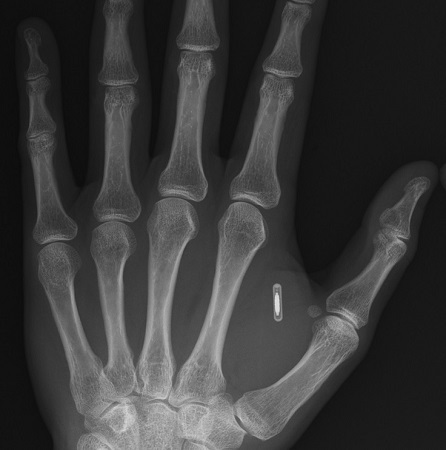
I always liked the idea of a key that cannot be forgotten. And if at the same time the key also fits to standard locks - it is doubly fine.
Therefore, as soon as it became possible to place RFID under my skin that was compatible with at least something common, I did this by implanting the EM4100 tag - many cheap locks and access control systems use it.
And when an NFC-compatible tag was discovered - and capable of being the key to laptops, smartphones and remaining locks - there was absolutely no reason to avoid embedding it.
ATTENTION! This publication is not an instruction, recommendation, guide to action and is intended for reference only. Repetition of the following can be deadly or lead to complications and injuries. The author does not recommend performing the described actions on himself and is not responsible for any consequences caused by reading the publication.
Rfid
RFID - Radio Frequency IDentification - technology for wireless identification of users, equipment. There are a large number of completely different technologies that differ in operating frequency (868 MHz, 13.56 MHz, 125 kHz, etc.), coding, the ability to read-write or read-only, range, battery, purpose.
Reader, reader - an active device for reading labels, sends regular requests in the form of electromagnetic waves to the surrounding space. It can be autonomous with its own memory and the ability to immediately control, for example, a lock; or transfer data via RS-485, USB or otherwise.
Label, key, tag, tag- a device containing a unique identifier, and sometimes a data area. There may be built-in encryption, code execution, other features. Most often does not contain batteries and is powered by EM waves emitted by the reader.
EM4100 standard
EM Microelectronic-Marin Contactless Radio Frequency Identification Card Standard. They operate at a frequency of 125 kHz.
They have a unique number of 40 bits in length, which are transmitted together with service bytes cyclically in open form. There is no encryption and storage of user data, as well as recording capabilities (officially, unofficially, there have already been blank cards where you can record an arbitrary number). Obviously, for serious protection at least something is not suitable at all. However, they are quite widely used in simple SKD, on-door speakerphones instead of Dallas tablets, cheap controllers of electromagnetic locks and similar things. The keys may look like a plastic keychain, a flexible or hard plastic card, or in a different way.
For example, a padlock controller with a keyboard and a dozen keys to it for $ 10.
Implantable tags EM4100
Basic requirements for the implantable device:
- Small size so that it does not stick out too much under the skin
- Streamlined shape, so as not to damage the skin from the inside
- Bioinert material - pure silicone, glass
- Tightness, durability and resistance to sterilization
RFID tags are well suited for implantation, as they do not require replaceable or rechargeable power supplies, contacts, connectors. In 2011, for some reason, it was rather difficult to find tags that were suitable for implantation and at the same time compatible with something widely used. Either EM4100 tags were sold in the form of key chains, cards, cheap and huge, or implantable tags for animals, which can only be considered a special reader. EM4100 or compatible in a glass capsule - was not.
But everything turned out not so bad! At the request of em4100 glass, em4102 glass, rfid glass, we managed to find something similar to eBay and immediately ordered it. Two sets of tags came, here are (the left photo is mine, the right one is rss-systems.de):

The first I got the ones on the left, and upset by their size. They turned out to be larger than in the photo, while not made of glass and not quite rounded. Fortunately, others came for them, turning out to be glass smooth capsules about 12 mm long and 3 mm in diameter. It was decided to implant them.
Label implantation process under the skin

For some time it took a search for a person who was ready to take up implantation. In principle, I was ready to do it myself, if no one was found, or to entrust my friend to the veterinarian, but everything turned out to be simpler. A familiar doctor (by profession - a general practitioner, but, like all doctors, of course, who knows how to suture, make subcutaneous anesthesia and incisions) agreed to do everything in the best possible way, and in the summer of 2013 we purchased the necessary materials (novocaine, antiseptics, several medical instruments, sterile scalpels and needles with thread) and proceeded.
Here's what we did:
- Sterilization of labels. Since the tags came in not sterile, it was necessary to sterilize them. For this, the label was thoroughly washed, then for an hour the label was in iodine solution, immediately before being placed under the skin, it was washed first with alcohol, then with sterile water for injection.
- Sterilization of instruments. Scalpels, gloves, sets of needles and threads were already sterile (and disposable), but the steel tweezers and scapula needed to create space under the subcutaneous tissue for the label required sterilization. There was no access to the autoclave, so I had to use a chemical sterilization method. We used Pu-rust in high concentration. This has a bad effect on instruments (it even corrodes stainless surgical steel), but it is affordable and quite functional.
- Anesthesia. Infiltration anesthesia with novocaine - we introduce a solution of novocaine 20 mg / ml subcutaneously at the intended site of the incision and wait for 5-10 minutes to penetrate the surrounding tissue. Be careful with novocaine - if you have allergies and / or crooked hands can cause many of the most unpleasant consequences, even fatal! Do not do this yourself if you are not a doctor.
- Select a label placement. Usually, small objects are implanted into the space between the thumb and forefinger of the hand (roughly where the mark on the KDPV is) - the least chance of damage to it when working with your hands with anything. For the same reasons, the left hand was chosen.
- Section and label placement. The skin was rubbed three times with alcohol. The incision was made with an ordinary disposable scalpel, about 5 mm in length, after stretching the skin. Since the “bubble” from the novocaine solution is already under the cut point at this point, it is quite simple not to make a mistake with the depth. Then, with a dental scapula (a scapula 5 mm wide, 30 mm long and on the handle), the skin was separated from the fiber and the mark was inserted into it with tweezers. To prevent it from being squeezed back, the mark should be 1-2 cm from the cut, and not back to back.
- Completion. Since the incision was small, there was no point in suturing it; we limited ourselves to treating the wound with hydrogen peroxide and applying a sterile patch. I also took a dose of a broad-spectrum antibiotic inside to reduce the likelihood of inflammation, if something still could not be sterilized well enough.
Healing took place without any problems, large swelling, bruising, inflammation. For three days I drank an antibiotic and changed the patch, washing the incision site with chlorhexidine, then removed it. The mark was felt under the skin, did not cause any discomfort, and - most importantly - it worked!
This is how the place of the cut looked on the second day
A year later, I added to the existing EM4100 tag a second, NFC-compatible, which can be read by a smartphone and generally use a lot of how. I’ll talk about this in the second part of the article (if this is of interest, of course).
What does it look like now
If you don’t stretch the skin on purpose, it’s difficult to notice the marks:

There were no problems, complications, including when working with your hands, falling and other dangerous actions.
Why use?
I use this tag for the same purpose that I wanted - as an electronic key to my room, to the office. The reliability of the standard itself is low, but, as a rule, the electromagnetic lock is not the main one, but only the auxiliary one. In our office, for example, it is used during the day, and at night, when everyone leaves, the door is locked with a mechanical key and the room is armed. So the EM4100 is enough.
The process of opening the lock (you need to hold your back to the reader, since the range is very small):

Access to the apartment, room, car, office space. Simple confirmation of any action. For serious security, this particular label is not suitable (see above), but NFC-compatible is more or less suitable, about it in the second part.
Observations and remarks
- Labels are not felt at all, do not interfere with the work of the hand, for almost two years nothing has broken.
- In metal detectors nothing beeps.
- It is really convenient to have a door key always with you, especially from slamming doors.
- The reading distance is less than a centimeter, most often it should generally be skin contact. Therefore, making a copy of the EM4100 is no more difficult than copying a card that is in your pocket. Normal NFC (ISO 14443) is not copied at all + cryptography inside.
- No, I’m never bothered by the unique identifier in the body. The body is already full of unique identifiers, we carry even more in the form of equipment and documents.
- KDPV is not mine, taken from here , the rights to it belong to its author.
Conclusion and Part Two
The experience in introducing the first tag was quite successful, and after a year I decided to expand the functionality with the help of an NFC tag compatible including with smartphones and allowing them to unlock.
In the second part of the article I want to talk about such tags, the ability to unlock the phone or log into Windows using the tag, as well as about another, simpler way of implanting with a syringe.
References
- habrahabr.ru/post/153047 - "The American freak offers kits for implanting an RFID chip under the skin."
- habrahabr.ru/post/153389 - “Everything you wanted to know about implantable tags, but were afraid to ask.”
- habrahabr.ru/post/182846 - "RFID implantation - results after 7 months."