July 17, 2017 at 15:48
Fujitsu ETERNUS DX entry-level storage upgrade
In mid-May, Fujitsu Corporation introduced the first three models of a new generation of hybrid storage systems from the ETERNUS DX S4 series. The previous generation of these ETERNUS DX S3 storage systems was released in 2013 - 2015, now it is time to upgrade the line, which began with the younger class models designed for small and medium-sized enterprises. We’ll talk about them today.
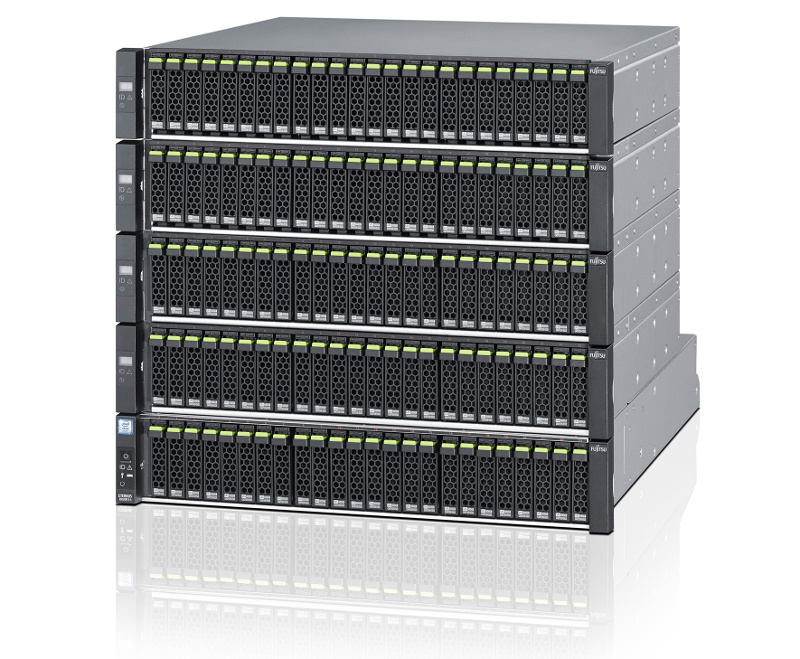
Unlike a number of other players in the storage market, in which the product line is a combination of often not perfectly compatible systems of both their own design, products of OEM partners and absorbed companies, Fujitsu offers customers a series of systems of junior, middle and senior class , which is fully developed within the corporation and uses a single architecture and controls, and is licensed under a single scheme. Many of the functions of high-end ETERNUS DX systems are also supported in mid-range and entry-level systems, which reduces the cost of maintaining the storage infrastructure and training system administrators, for example, you can easily migrate data between ETERNUS DX arrays not only of different classes, but also even different generations.
When developing the entry-level ETERNUS DX S4, the storage problems that small companies face today were taken into account: fast data growth and increasing their importance for business, which requires improved scalability, performance, efficiency and reliability of storage systems. At the same time, in small companies, as a rule, there is no dedicated system administrator serving the storage system, therefore ETERNUS DX S4 uses functions that automate the operation of the disk array.
Compared to similar ETERNUS DX S3 models, the new hybrid systems provide a twofold increase in maximum capacity, a threefold increase in the maximum number of processed transactions. In addition, the number of supported virtual machines and the number of supported users doubled in size by a factor of 1.5. Another improvement to the Fujitsu disk arrays, which is also available for ETERNUS DX S4 owners, are the new solid state drives with a capacity of 15.36 and 7.68 TB. Relatively recently, Fujitsu launched the production of fully solid-state ETERNUS AF systems, however, according to analysts, in the coming years the difference in the cost of storage on flash drives and Nearline SAS hard drives will continue, therefore, according to Fujitsu, the demand for hybrid storage systems will remain high for a long time .
The older model ETERNUS DX200 S4, in which the controllers are built on six-core processors, according to the independent testing SPC-1storageperformance.org, performance exceeds 300 thousand IOPS with access delays of less than 0.6 milliseconds. It is capable of serving up to 2 thousand virtual machines. This system expands to ten disk shelves with 264 disks with a total capacity of 4055 terabytes and is equipped with 64 GB system memory. It uses deduplication and compression, significantly reducing the cost of storage when using solid-state drives. The new ETERNUS DX microcode release, which can also be used in previously released ETERNUS DX S3 systems, implements an improved data compression mechanism. For example, you can choose from the options “no compression”, “only compression”, “only deduplication” or “compression + deduplication”. The compression mechanism can be disabled in cases where deduplication or compression does not reduce the amount of data
Also ETERNUS DX200 S4 supports functions:
It is worth noting that the continuous reduction in the cost of solid-state drives allows using Autotiering to build two-tier storage using Nearline SAS hard drives for cold data and SSD drives for hot data (in the traditional approach, an intermediate level of 10 thousand and 15 thousand SAS Enterprise hard drives was used rpm / min, but now it is becoming economically feasible to store all the hot data on solid-state drives). If, due to budget constraints, it is possible to purchase only a few SSDs for your array, then in this case you can use them as a cache to speed up access to data stored on hard drives.

ETERNUS DX Architecture
The DX100 S4 model is about half as scalable as the DX200 S4 (it expands to 144 disks and 2212 TB and is equipped with 32 GB of system memory), but does not support deduplication and compression. Both ETERNUS DX S4 models can connect to storage networks and hosts via 8/16 Gb / s Fiber Channel, 1/10 Gb / s iSCSI, 1/10 Gb / s Ethernet and 3/6/12 Gb / SAS. They support the Eternus Storage Cluster software package, with which you can build a failover cluster with availability above six nines (99.9999%), i.e. less than one minute of downtime per year. In such a cluster based on Storage Cluster, you can combine two ETERNUS DX storage systems of different types (hybrid and / or fully solid state). Storage Cluster software mirrors mission-critical data between two arrays through a SAN (based on Fiber Channel or iSCSI) and,more about this decision ).
Finally, the youngest model DX60 S4, designed for small companies with a limited budget, scales up to three shelves and 96 disks with a capacity of 480 TB and is equipped with a system memory of 8 GB. Unlike more expensive models, it does not support the functions of remote replication, deduplication / compression, Autotiering and automatic QoS. It is worth noting that the new ETERNUS S4 supports upgrading to a more powerful model by replacing controllers and without migrating data-in-place data on disks, which significantly reduces the risks of upgrading the storage infrastructure and downtime of business applications due to lack of access to data .
To manage all three models, the ETERNUS Storage Foundation (SF) v16 software package is used, which is also used to administer middle and high class ETERNUS DX, as well as fully solid ETERNUS AF. The standard delivery of these storage systems includes the Storage Foundation Express package, which implements the basic storage management functionality, and a 90-day trial version of almost all possible licenses for ETERNUS.
In the near future, Fujitsu plans to introduce several more models of hybrid storage systems from the ETERNUS DX S4 series.
Unlike a number of other players in the storage market, in which the product line is a combination of often not perfectly compatible systems of both their own design, products of OEM partners and absorbed companies, Fujitsu offers customers a series of systems of junior, middle and senior class , which is fully developed within the corporation and uses a single architecture and controls, and is licensed under a single scheme. Many of the functions of high-end ETERNUS DX systems are also supported in mid-range and entry-level systems, which reduces the cost of maintaining the storage infrastructure and training system administrators, for example, you can easily migrate data between ETERNUS DX arrays not only of different classes, but also even different generations.
When developing the entry-level ETERNUS DX S4, the storage problems that small companies face today were taken into account: fast data growth and increasing their importance for business, which requires improved scalability, performance, efficiency and reliability of storage systems. At the same time, in small companies, as a rule, there is no dedicated system administrator serving the storage system, therefore ETERNUS DX S4 uses functions that automate the operation of the disk array.
What's new?
Compared to similar ETERNUS DX S3 models, the new hybrid systems provide a twofold increase in maximum capacity, a threefold increase in the maximum number of processed transactions. In addition, the number of supported virtual machines and the number of supported users doubled in size by a factor of 1.5. Another improvement to the Fujitsu disk arrays, which is also available for ETERNUS DX S4 owners, are the new solid state drives with a capacity of 15.36 and 7.68 TB. Relatively recently, Fujitsu launched the production of fully solid-state ETERNUS AF systems, however, according to analysts, in the coming years the difference in the cost of storage on flash drives and Nearline SAS hard drives will continue, therefore, according to Fujitsu, the demand for hybrid storage systems will remain high for a long time .
The older model ETERNUS DX200 S4, in which the controllers are built on six-core processors, according to the independent testing SPC-1storageperformance.org, performance exceeds 300 thousand IOPS with access delays of less than 0.6 milliseconds. It is capable of serving up to 2 thousand virtual machines. This system expands to ten disk shelves with 264 disks with a total capacity of 4055 terabytes and is equipped with 64 GB system memory. It uses deduplication and compression, significantly reducing the cost of storage when using solid-state drives. The new ETERNUS DX microcode release, which can also be used in previously released ETERNUS DX S3 systems, implements an improved data compression mechanism. For example, you can choose from the options “no compression”, “only compression”, “only deduplication” or “compression + deduplication”. The compression mechanism can be disabled in cases where deduplication or compression does not reduce the amount of data
Also ETERNUS DX200 S4 supports functions:
- snapshots snapshots
- cloning
- synchronous and asynchronous replication
- Autotiering automatic tiered storage using flash memory and hard drives, which significantly reduces the total cost of ownership
- Thin Provisioning Capacity Allocation
- Automatic Quality of Service (QoS) management to provide high-priority service (for example, minimal latency) to business-critical applications
It is worth noting that the continuous reduction in the cost of solid-state drives allows using Autotiering to build two-tier storage using Nearline SAS hard drives for cold data and SSD drives for hot data (in the traditional approach, an intermediate level of 10 thousand and 15 thousand SAS Enterprise hard drives was used rpm / min, but now it is becoming economically feasible to store all the hot data on solid-state drives). If, due to budget constraints, it is possible to purchase only a few SSDs for your array, then in this case you can use them as a cache to speed up access to data stored on hard drives.
ETERNUS DX Architecture
The DX100 S4 model is about half as scalable as the DX200 S4 (it expands to 144 disks and 2212 TB and is equipped with 32 GB of system memory), but does not support deduplication and compression. Both ETERNUS DX S4 models can connect to storage networks and hosts via 8/16 Gb / s Fiber Channel, 1/10 Gb / s iSCSI, 1/10 Gb / s Ethernet and 3/6/12 Gb / SAS. They support the Eternus Storage Cluster software package, with which you can build a failover cluster with availability above six nines (99.9999%), i.e. less than one minute of downtime per year. In such a cluster based on Storage Cluster, you can combine two ETERNUS DX storage systems of different types (hybrid and / or fully solid state). Storage Cluster software mirrors mission-critical data between two arrays through a SAN (based on Fiber Channel or iSCSI) and,more about this decision ).
Finally, the youngest model DX60 S4, designed for small companies with a limited budget, scales up to three shelves and 96 disks with a capacity of 480 TB and is equipped with a system memory of 8 GB. Unlike more expensive models, it does not support the functions of remote replication, deduplication / compression, Autotiering and automatic QoS. It is worth noting that the new ETERNUS S4 supports upgrading to a more powerful model by replacing controllers and without migrating data-in-place data on disks, which significantly reduces the risks of upgrading the storage infrastructure and downtime of business applications due to lack of access to data .
To manage all three models, the ETERNUS Storage Foundation (SF) v16 software package is used, which is also used to administer middle and high class ETERNUS DX, as well as fully solid ETERNUS AF. The standard delivery of these storage systems includes the Storage Foundation Express package, which implements the basic storage management functionality, and a 90-day trial version of almost all possible licenses for ETERNUS.
In the near future, Fujitsu plans to introduce several more models of hybrid storage systems from the ETERNUS DX S4 series.