March 16, 2017 at 18:23
How to increase production efficiency with augmented reality?
Experienced business leaders are familiar with the formula for increasing labor productivity. The role of innovation in this process is obvious to everyone. However, not everyone can recognize in time technologies that can help increase productivity, especially in a conservative and not inclined to investment in innovation market, such as Russian industry. At one time, Autodesk and Consistent Software made their way to designers and constructors for a rather long time — they did not understand why they should spend millions for the work that was done with pencils and a whatman paper. As a result, some of the enterprises that did not adopt new technologies on time left the market.
In this article, we would like to attract your attention and talk about a new technology that has already been successfully applied in industry and production around the world.
Paul Milgram (Paul Milgram) and Fumio Kishino (Fumio Kishino) in 1994 described augmented reality as a kind of space between reality and virtuality. Augmented reality technologies project any digital information (images, video, text, graphics, etc.) over the screen of any devices.
If you watched the movie "Iron Man", then just all the graphical indicators that were displayed on the helmet screen and belong to the concept of augmented reality ("augmented reality").

Perhaps this sounds and looks more than fantastic, but such solutions have already been successfully used at many industrial and production companies, including Russian ones.
Today, among augmented reality devices, portable devices, stationary and projection systems, glasses and augmented reality lenses can be distinguished.
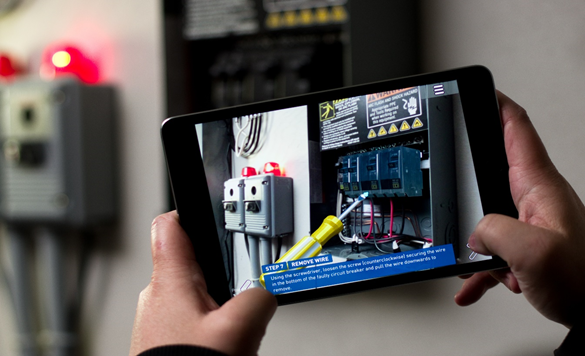
Portable devices are the most affordable way to experience augmented reality. These include mobile phones and tablet computers. The main requirement for the device is the presence of a high-quality camera with high resolution.
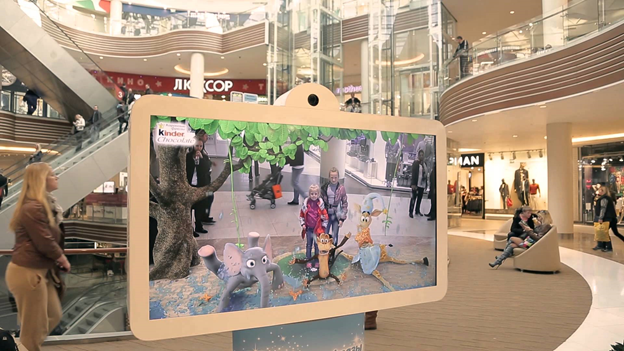
Stationary systems are large-format screens equipped with high-resolution cameras that are located in one place. Such systems are not very convenient in mobile work, but demonstrate a more realistic visualization.
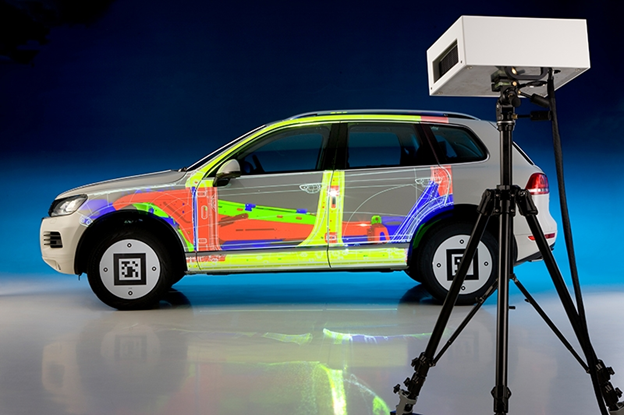
Unlike stationary systems of augmented reality, projection systems impose an image on any surface, and for their work does not require a separate screen.
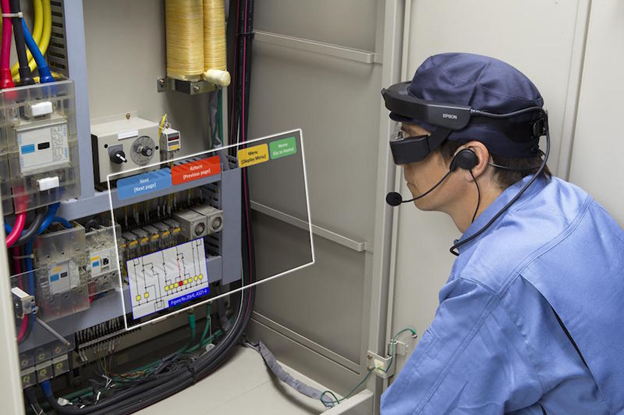
The most widely used glasses are augmented reality, wearing which a person sees virtual objects superimposed on the surrounding reality. The most famous devices in Russia include Google Glass ($ 1,600), as well as Moverio from Epson ($ 799.99).
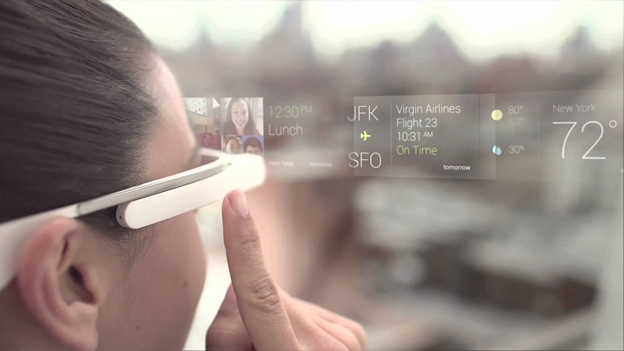
Augmented reality lenses are still the subject of research by technology giants including Samsung, Google and Microsoft. The idea is to turn ordinary lenses into a transparent electronic screen containing a control system, a miniature camera, an antenna, LEDs and other optoelectronic components. In particular, Samsung has already filed a patent for “smart” contact lenses, so we have every reason to expect the device to enter the market in the next 5-10 years.

Existing solutions already cover many areas: tools for automating processes and increasing productivity, employee training, reducing product rejects, improving the efficiency of logistics processes, and ensuring labor safety.
For example, with the help of augmented reality, workers can quickly access instructions and manuals for any detail. They receive information in the form of visual three-dimensional animation, video, audio, photographs, pictures or graphs. This approach allows to reduce the requirements for the qualifications of specialists, and to reduce the time for studying and viewing work instructions. Moreover, the system itself is able to recognize the shape of the part and its number and prompt in time if the technician has taken erroneous actions for its installation.
The Augmented Reality Implementation Effectiveness Issues are covered in great detail in the Augmented Reality Efficiency in Manufacturing Industry case study , sponsored by Juha Sääski, Tapio Salonen and several others (Tapio Salonen) .
A narrower study is “ Evaluating the Benefits of Augmented Reality for Task Localization in Maintenance of an Armored Personnel Carrier Turret”). Its authors are employees of Columbia University Stephen Henderson (Steven J. Henderson) and Stephen Feiner (Steven Feiner). The study will be useful for acquaintance with top managers of production and industrial enterprises to decide on the effectiveness of investments in new technology.
Both studies are freely available on the Internet.
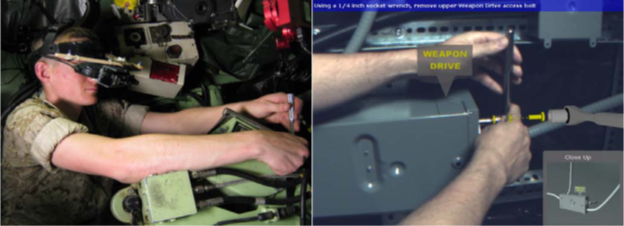
Let's look at some more impressive examples of using augmented and virtual reality in production and industrial companies.
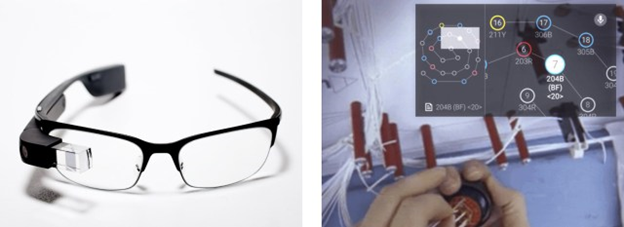
Boeing is one of the largest aerospace companies on the planet, which builds aircraft for 150 countries. On-board systems of the aircraft contain many components that are interconnected by a system of wires. The cables are laid and connected according to a special template, after which they are fastened into bundles, and connectors are installed on the ends of the cables. The work process takes a long time and requires special attention and responsibility. For the past 20 years, Boeing has been looking for a system that can reduce production time and eliminate errors. In early 2014, the company introduced an augmented reality solution on the Google Glass glasses platform. Using the application, the operator gives a voice command: “Ok, Skylight. Start creating a harness.
According to Boeing ’s report on the project, “Using Google Glass has reduced production time by one quarter and halved errors.”

Another example is Lockheed Martin, where NGRAIN was involved in the implementation of the project. Plant engineers use augmented reality to get a visual hint on the assembly of the F-35 aircraft. The company uses Epson Moverio BT-200 augmented reality glasses equipped with special motion and depth sensors as the main platform. When a technician mounts a brake part on a chassis, he sees all the data on where and in what order to assemble and connect the cables with the augmented reality glasses. As a result, the whole process of work resembles the assembly of the LEGO designer, when the worker is only required to take a suitable part and place it in the right place.
According to NGRAIN“The software allows engineers to work 30 percent faster with an accuracy of 96 percent.”
Car models are available in various trim levels and colors. Therefore, automakers often seek to strike a balance between mass production and individual consumer preferences. Of course, during the time of Henry Ford, everything was much simpler. The organization of such production is often accompanied by complex work instructions that can provoke downtime, errors and reduced productivity.
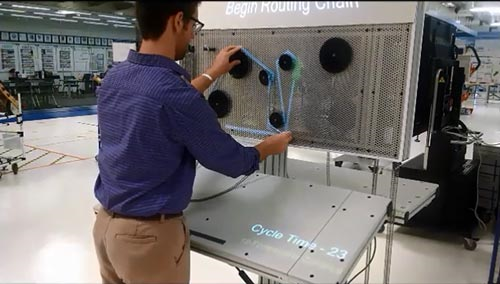
Fiat Chrysler Automobiles (FCA) has used the OPS Solutions augmented reality projection system. Now, at each stage of the assembly process, workers receive visual information about their next step.
After the introduction of innovation, an experiment was organized. The operators were faced with the task of assembling gears and chains. The whole process went in ten consecutive steps. Employees had to choose the right components, carry out the installation and make sure that everything was done correctly. Some operators performed the task using paper instructions, while others used augmented reality tools. You can evaluate the results of the experiment in the table below.
80% reduction in errors;
38% reduction in duty cycle;
82% increase in throughput

Another automobile company that has adopted the technology of augmented reality, became the concern Volkswagen. Volkswagen uses Google Glasses augmented reality glasses at its factory in Wolfsburg to complete orders. Workers automatically receive all the information they need about storage locations or part numbers.

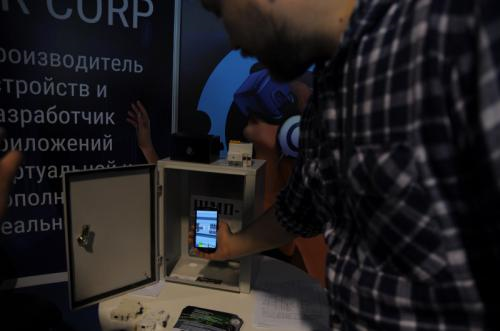
The first Russian augmented reality application was released by VR CORP for electrical manufacturing. The management of Siberian Energy Saving Technologies faced a staff turnover, as a result of which a lot of money and effort was spent on training new employees. An application was created for the office staff, with the help of which any employee could point the smartphone at the electrical circuit and consider in detail the 3D model of the finished product, including all its components. This application is especially relevant for young professionals without work experience. The introductory course of the specialty was reduced to a simple scheme: I took a smartphone, launched the application, pointed it to the electrical circuit and examined all the details about the product in its finished form.
A similar functionality application was developed for assembly shop workers. Instead of the wiring diagram, the specialist receives information about the location of parts and cables in the future product, and the illumination of each part warns in time if the wrong components are used.
For its development, VR CORP received a diploma from the Urban Technology Forum from the Department of Industry, Innovation and Entrepreneurship of the Novosibirsk City Hall.

Augmented reality technologies offer a new interesting look at solving problems of staff turnover, training, production errors and downtime. It is not always clear where to start, what costs it will require and how soon the investment will return.
Start small. There are not many companies in the Russian market working with augmented reality for production and industry, and yet there is a choice. Here are our recommendations:
1. Contact the developer’s representatives and tell us in detail about the tasks you are facing.
2. Create a working group together to analyze and develop the solution in detail.
3. Do not try to immediately grasp the immense. Choose one of the small stages of the production process and develop a test solution for it. According to the Russian developer of augmented reality solutions company VR CORP, the cost of such a solution is from 50,000 to 100,000 rubles.
4. Compare performance indicators for workers using augmented reality and those who work the old fashioned way.
5. Based on the indicators, evaluate the investment attractiveness of the integrated project.
6. If you are pleased with the project indicators, coordinate its budget and implementation stages.
7. Get started.
In the competition many enterprises offer identical products and therefore seek to win mainly due to lower prices. Such a competitive strategy creates difficult conditions in which the profit on transactions ranges from 3 to 7%.
Augmented reality can serve not only for the needs of its own production, but also to create goods with unique properties. Many products require some effort from the user to understand and use. For example, electrical panels, generators, cars and furniture from IKEA. Using augmented reality, the manufacturer can add online help for the user, which he can use using his tablet or phone. This certificate will clearly show how to use the product, eliminate a lot of mistakes and generally increase customer satisfaction.
BMW has already launched a similar solution for the maintenance and repair of its cars. Immediately after the launch, many media outlets announced the end of the era of service stations, because now it has become possible for everyone to detect and fix a malfunction in the car. Using the application, the user sees a sequential instruction, which step by step shows how to diagnose and fix any part and what tools will be required for this.

Many manufacturers are aware of the tough competitive bidding conditions where they have to drastically lower their profits. If you convince the client to include the requirements for such an online help in the augmented reality of the delivered goods, then the manufacturer will receive a direct competitive advantage and a guarantee of victory.
In any case, until the augmented reality turns into a mass phenomenon.
In this article, we would like to attract your attention and talk about a new technology that has already been successfully applied in industry and production around the world.
What is augmented reality?
Paul Milgram (Paul Milgram) and Fumio Kishino (Fumio Kishino) in 1994 described augmented reality as a kind of space between reality and virtuality. Augmented reality technologies project any digital information (images, video, text, graphics, etc.) over the screen of any devices.
If you watched the movie "Iron Man", then just all the graphical indicators that were displayed on the helmet screen and belong to the concept of augmented reality ("augmented reality").
Perhaps this sounds and looks more than fantastic, but such solutions have already been successfully used at many industrial and production companies, including Russian ones.
Augmented Reality Device Overview
Today, among augmented reality devices, portable devices, stationary and projection systems, glasses and augmented reality lenses can be distinguished.
Portable devices are the most affordable way to experience augmented reality. These include mobile phones and tablet computers. The main requirement for the device is the presence of a high-quality camera with high resolution.
Stationary systems are large-format screens equipped with high-resolution cameras that are located in one place. Such systems are not very convenient in mobile work, but demonstrate a more realistic visualization.
Unlike stationary systems of augmented reality, projection systems impose an image on any surface, and for their work does not require a separate screen.
The most widely used glasses are augmented reality, wearing which a person sees virtual objects superimposed on the surrounding reality. The most famous devices in Russia include Google Glass ($ 1,600), as well as Moverio from Epson ($ 799.99).
Augmented reality lenses are still the subject of research by technology giants including Samsung, Google and Microsoft. The idea is to turn ordinary lenses into a transparent electronic screen containing a control system, a miniature camera, an antenna, LEDs and other optoelectronic components. In particular, Samsung has already filed a patent for “smart” contact lenses, so we have every reason to expect the device to enter the market in the next 5-10 years.
Where is augmented reality possible?
Existing solutions already cover many areas: tools for automating processes and increasing productivity, employee training, reducing product rejects, improving the efficiency of logistics processes, and ensuring labor safety.
For example, with the help of augmented reality, workers can quickly access instructions and manuals for any detail. They receive information in the form of visual three-dimensional animation, video, audio, photographs, pictures or graphs. This approach allows to reduce the requirements for the qualifications of specialists, and to reduce the time for studying and viewing work instructions. Moreover, the system itself is able to recognize the shape of the part and its number and prompt in time if the technician has taken erroneous actions for its installation.
The Augmented Reality Implementation Effectiveness Issues are covered in great detail in the Augmented Reality Efficiency in Manufacturing Industry case study , sponsored by Juha Sääski, Tapio Salonen and several others (Tapio Salonen) .
A narrower study is “ Evaluating the Benefits of Augmented Reality for Task Localization in Maintenance of an Armored Personnel Carrier Turret”). Its authors are employees of Columbia University Stephen Henderson (Steven J. Henderson) and Stephen Feiner (Steven Feiner). The study will be useful for acquaintance with top managers of production and industrial enterprises to decide on the effectiveness of investments in new technology.
Both studies are freely available on the Internet.
Let's look at some more impressive examples of using augmented and virtual reality in production and industrial companies.
Aviation industry
Boeing is one of the largest aerospace companies on the planet, which builds aircraft for 150 countries. On-board systems of the aircraft contain many components that are interconnected by a system of wires. The cables are laid and connected according to a special template, after which they are fastened into bundles, and connectors are installed on the ends of the cables. The work process takes a long time and requires special attention and responsibility. For the past 20 years, Boeing has been looking for a system that can reduce production time and eliminate errors. In early 2014, the company introduced an augmented reality solution on the Google Glass glasses platform. Using the application, the operator gives a voice command: “Ok, Skylight. Start creating a harness.
According to Boeing ’s report on the project, “Using Google Glass has reduced production time by one quarter and halved errors.”
Another example is Lockheed Martin, where NGRAIN was involved in the implementation of the project. Plant engineers use augmented reality to get a visual hint on the assembly of the F-35 aircraft. The company uses Epson Moverio BT-200 augmented reality glasses equipped with special motion and depth sensors as the main platform. When a technician mounts a brake part on a chassis, he sees all the data on where and in what order to assemble and connect the cables with the augmented reality glasses. As a result, the whole process of work resembles the assembly of the LEGO designer, when the worker is only required to take a suitable part and place it in the right place.
According to NGRAIN“The software allows engineers to work 30 percent faster with an accuracy of 96 percent.”
Automotive Production
Car models are available in various trim levels and colors. Therefore, automakers often seek to strike a balance between mass production and individual consumer preferences. Of course, during the time of Henry Ford, everything was much simpler. The organization of such production is often accompanied by complex work instructions that can provoke downtime, errors and reduced productivity.
Fiat Chrysler Automobiles (FCA) has used the OPS Solutions augmented reality projection system. Now, at each stage of the assembly process, workers receive visual information about their next step.
After the introduction of innovation, an experiment was organized. The operators were faced with the task of assembling gears and chains. The whole process went in ten consecutive steps. Employees had to choose the right components, carry out the installation and make sure that everything was done correctly. Some operators performed the task using paper instructions, while others used augmented reality tools. You can evaluate the results of the experiment in the table below.
80% reduction in errors;
38% reduction in duty cycle;
82% increase in throughput
Another automobile company that has adopted the technology of augmented reality, became the concern Volkswagen. Volkswagen uses Google Glasses augmented reality glasses at its factory in Wolfsburg to complete orders. Workers automatically receive all the information they need about storage locations or part numbers.
Assembly wiring production
The first Russian augmented reality application was released by VR CORP for electrical manufacturing. The management of Siberian Energy Saving Technologies faced a staff turnover, as a result of which a lot of money and effort was spent on training new employees. An application was created for the office staff, with the help of which any employee could point the smartphone at the electrical circuit and consider in detail the 3D model of the finished product, including all its components. This application is especially relevant for young professionals without work experience. The introductory course of the specialty was reduced to a simple scheme: I took a smartphone, launched the application, pointed it to the electrical circuit and examined all the details about the product in its finished form.
A similar functionality application was developed for assembly shop workers. Instead of the wiring diagram, the specialist receives information about the location of parts and cables in the future product, and the illumination of each part warns in time if the wrong components are used.
For its development, VR CORP received a diploma from the Urban Technology Forum from the Department of Industry, Innovation and Entrepreneurship of the Novosibirsk City Hall.
Implementing Augmented Reality in Your Own Enterprise
Augmented reality technologies offer a new interesting look at solving problems of staff turnover, training, production errors and downtime. It is not always clear where to start, what costs it will require and how soon the investment will return.
Start small. There are not many companies in the Russian market working with augmented reality for production and industry, and yet there is a choice. Here are our recommendations:
1. Contact the developer’s representatives and tell us in detail about the tasks you are facing.
2. Create a working group together to analyze and develop the solution in detail.
3. Do not try to immediately grasp the immense. Choose one of the small stages of the production process and develop a test solution for it. According to the Russian developer of augmented reality solutions company VR CORP, the cost of such a solution is from 50,000 to 100,000 rubles.
4. Compare performance indicators for workers using augmented reality and those who work the old fashioned way.
5. Based on the indicators, evaluate the investment attractiveness of the integrated project.
6. If you are pleased with the project indicators, coordinate its budget and implementation stages.
7. Get started.
Commercial Opportunities
In the competition many enterprises offer identical products and therefore seek to win mainly due to lower prices. Such a competitive strategy creates difficult conditions in which the profit on transactions ranges from 3 to 7%.
Augmented reality can serve not only for the needs of its own production, but also to create goods with unique properties. Many products require some effort from the user to understand and use. For example, electrical panels, generators, cars and furniture from IKEA. Using augmented reality, the manufacturer can add online help for the user, which he can use using his tablet or phone. This certificate will clearly show how to use the product, eliminate a lot of mistakes and generally increase customer satisfaction.
BMW has already launched a similar solution for the maintenance and repair of its cars. Immediately after the launch, many media outlets announced the end of the era of service stations, because now it has become possible for everyone to detect and fix a malfunction in the car. Using the application, the user sees a sequential instruction, which step by step shows how to diagnose and fix any part and what tools will be required for this.
Many manufacturers are aware of the tough competitive bidding conditions where they have to drastically lower their profits. If you convince the client to include the requirements for such an online help in the augmented reality of the delivered goods, then the manufacturer will receive a direct competitive advantage and a guarantee of victory.
In any case, until the augmented reality turns into a mass phenomenon.