March 16, 2017 at 10:03
Autistic Programming Prodigies: Breaking Myths
- Transfer

In April 2016, Alex St. John, one of the developers of Microsoft's DirectX technology platform, wrote an article in which he defended an eighty-hour workweek, spoke contemptuously about balancing work and personal life, and called porcelain toilets "incredibly decadent luxury." St. John's article has been heavily criticized for supporting what many consider the exploitation of work and relationships in the video game industry.
In the wake of criticism , a PowerPoint presentation by St. John surfaced , on one of the slides of which engineers with Asperger Syndrome are called the “Holy Grail” for employers. “They work like mechanisms,” he wrote. “They are not interested in politics, do not get involved in relationships and never change jobs.”
The error of genius
A popular idea in fiction is that people with autism spectrum disorders become ideal programmers. Lisbeth Salander, the protagonist of The Girl with the Dragon Tattoo by Stig Larsson, is highly introverted and makes friends with great difficulty, but is also a very talented hacker. The prodigy hacker Elliot Alderson, the hero of the series Mr. Robot, also has a disorder in this spectrum.
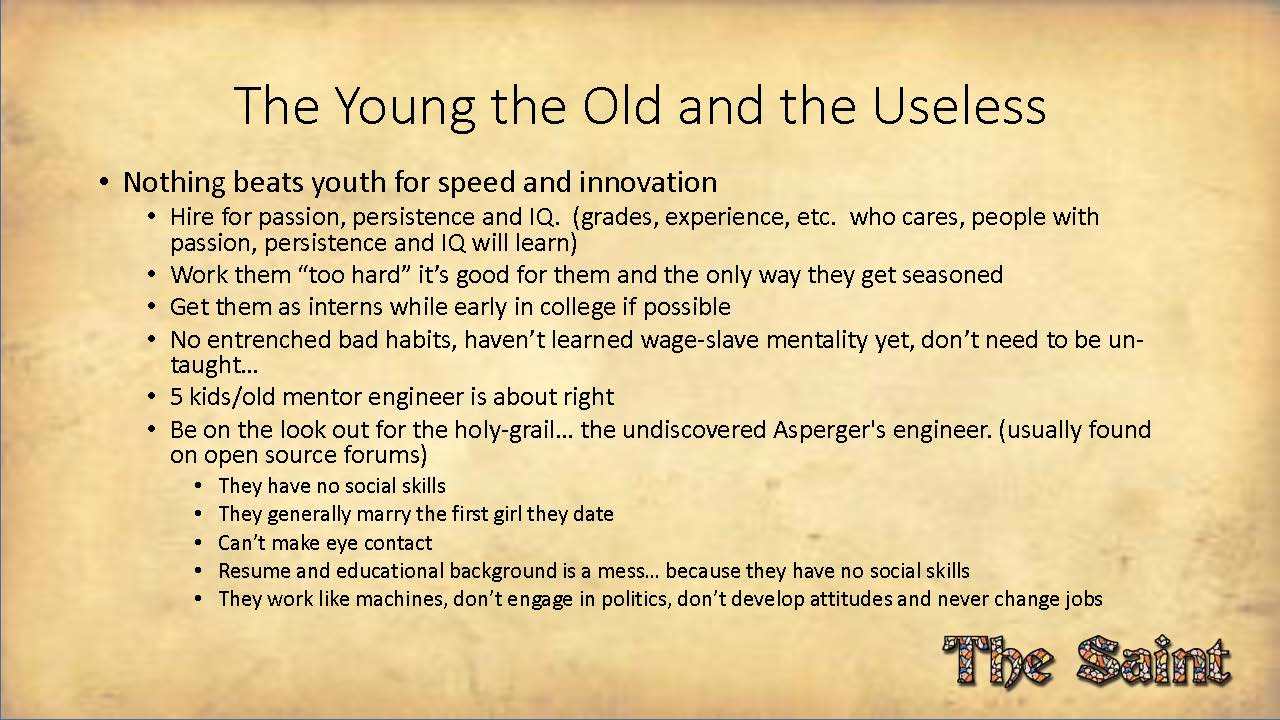
"Be on the lookout for the Holy Grail - an engineer with Asperger Syndrome." From the sensational presentation of Alex St. John.
“I think all techies are a little autistic,” Douglas Copeland wrote in his novel Microsoft Slaves. This cliché from a fictional world turned into the real one. Catherine Stewart, principal of the Orion Academy High School in Morag, California, for children with high-functioning autism, once described Asperger Syndrome as an “engineering disorder.” In 2011, Wikileaks founder Julian Assange told a newspaper reporter: “I, like all hackers, are a bit autistic.”
This stereotype has been fully accepted by many software companies. In April 2016, Microsoft launched the Microsoft Autism Hiring Program.for the purpose of hiring full-time people with autism. The CV sent over 700 candidates, and the company has currently hired 11 people. Now she implements this program in the United Kingdom. Many people believe that autism is in the DNA of Microsoft. At the founder of the company, Bill Gates, the press was constantly diagnosed with autistic habits: focus on small things, swinging, monotonous speech in an interview. The stereotype of a brilliant programmer is stable. But is he true?
“It's a fallacy,” says Gary Moore, one of the founders of Nonpareil Institute. His Texas-based company is educating youth with autism and creating software. “One of the misconceptions is that all people with autism are considered smart. In fact, they are like any other section of society. Not all of them will become programmers or technical geniuses. Some will be able to go to college, get a degree and get a job at Microsoft. But most are not capable of it. ”
Moore founded the Nonpareil Institute in 2008 with his friend Dan Selec. Both have sons with autism ("He is not a rain man. He is not a genius or savant. He is a guy with an average IQ and a serious stage of autism.") And they wanted to create a program that helps people like their children find work.
However, some as a result of this process managed to get jobs that, according to Moore, often claimed hundreds of candidates. “In reality, most adults with autism cannot find work,” says Moore. “The problem with the tech industry is that most companies require four years of college and interview skills.”
Create a more comfortable work environment
In addition to the complexities of the job placement process, significant limitations for highly functional autistic individuals may be limited by their work environment.
“Many people find it difficult to collaborate with other people, and such collaboration is a must in software development,” says Moore. Working conditions in large gaming studios can exacerbate these problems, especially in companies that stimulate employees in the ways described by St. John.
“The gaming industry is extremely exhausting,” says Moore. “60-70-hour work weeks and tight deadlines. All this puts pressure on autistic weaknesses. Most can't handle it. ” In fact, autism spectrum disorders are diagnosed in approximately one percent of the world's population, and about 80 percent of this group is unemployed.
23-year-old Cody Gillmer (Cody Gillmer) - an independent game developer from Longview, Washington. Gillmer was diagnosed with Asperger Syndrome at age 10, and at 16 he began developing video games. The stereotypes distributed by the press are completely unsuitable for Gillmer.
“Autism is perceived as a kind of mental superpower, as if we are seeing mathematical constructions in the air. In my case, this is completely wrong. Programming with complex math takes me a lot of time. ”
To date, Gillmer has managed to participate in various open source projects, but has not yet worked in game studios for most of the reasons Moore has indicated. “For me, the big problem is to“ disconnect ”from noise, both visual and sound,” he says. “I still have some kind of anxiety disorder, probably related to this reason. Disagreements exhaust me greatly. I feel that the other person does not understand something that I cannot explain to him, and it hurts me almost physically. I constantly have background anxiety. Do they understand me correctly? Am I logical? Are they underestimating me because of a strange speech? All of this contributes. ”
To solve the problem, Nonpareil Institute itself has become a software developer and provides work to students who have completed its programs.. The Institute currently employs approximately 30 former students. The company is currently developing four games.
“We want to create console games that someday will make millions of dollars,” says Moore. “Of course, this is a serious bar, so we start small, learn and master the creation of small mobile games. You never know - suddenly we will create a hit that will earn enough money so that we can support ourselves. ”
Despite the misconceptions and erroneous information that surrounds the advantages and disadvantages of hiring autistic people in video game companies, there are large studios that seek, like Microsoft, to hire employees with autism. Moore gives them unequivocal advice. “Employees in the human resources departments of gaming companies often tell us“ not for the record ”about the difficulties of hiring people with autism spectrum disorders,” says Moore. “Our advice is simple: lower the bar of requirements. Organize an internship that does not require a diploma. Check for yourself if the candidate will be able to cope with the work. "
This is exactly the approach Microsoft uses in its new program. Instead of an interview, the company holds an event that allows candidates to show their skills.
Kyle Schwaneke, Xbox Software Development Engineer with Asperger Syndrome. He owes his device at Microsoft a unique interview process for people with autism spectrum disorders.
Despite all the books, films, and television series featuring autistic prodigy programmers, autism is still highly stigmatized. “The internet has killed my“ pride in being autistic, ”says Gillmer. “The constant use of this diagnosis as an insult made me hide it. Therefore, I try not to report it until I feel that communication with me is starting to cause problems. ” For this reason, candidates often hide their neurological condition from employers.
“Many people don’t talk about their diagnosis with their superiors,” says Moore. “They are shy about him. Therefore, it is very important to carry out educational program on autism. Hiring autistic workers is one of the problems. But it takes a lot of patience, understanding the essence of the disorder and ways to work with such people in order to avoid behavioral problems and difficulties that are not always obvious to the employer. ”
For Gillmer, the biggest problem with autistic disorder is self-doubt and loneliness. “I am constantly worried that I am saying illogical. This often kills my desire to communicate with people. Because of this, it is difficult to make connections and meet other game developers. Therefore, I feel like an outsider or an imposter. ” Despite the difficulties, Gillmer hopes that someday he will be able to open his own studio. He already came up with her name: Creative 3 Games.