
 December 20, 2016 at 06:00
Java hardcore in Novosibirsk: review and video of the best reports of JBreak 2016. And the announcement of JBreak 2017
Whatever you say, the situation in Novosibirsk is harsh: harsh weather, harsh architecture - now we can say with confidence that a harsh Java conference is also being held in Nsk. Without simple reports, without adjail and scrum, only hardcore, in the best traditions of Joker and JPoint, and the name of this conference is JBreak .

In this post you will find:
We posted the JBreak 2016 reports a long time ago, but I found that we did not make a separate habropost about this. I take this opportunity to correct the situation: all the reports presented below received a rating of participants of 4.5+ (out of five). All videos are in a playlist where you will find JBreak 2016 reports that are not in the top 10.
Alexey Shipilev, Oracle
The Lord of the Strings: Two Scours The
best report by Joker / JPoint, which broke the hall in Novosib, which helps to understand how much the development of JDK differs from ordinary projects. This report discusses two features in the upcoming JDK 9 aimed at optimizing strings: Compact Strings , compressing strings with single-byte characters, which improves footprint and even overall performance; and Indify String Concatusing invokedynamic magic to concatenate strings, allowing you to twist the implementation of concatenation without recompiling programs.
Tagir Valeev
Stream API: recommendations of the best dog breeders
Tagir began his victorious march as early as Joker 2015, securing in Novosibirsk the title of one of the best Java speakers in Russia.
In the report, together with Tagir, you will get acquainted with all the features of the Stream API, you will be able to understand for what operations in the standard library there are not enough tools and how to replace them with your own elegant solutions. And if you understand by the end of the report, you don’t want to build bicycles, the report will offer you a couple of libraries that make life easier.
A lot of hardcore, a lot of humor. Must see, as they say:
Alexander Matorin, SberTech
Non-obvious Generics ();
The report from the developer of Sberbank-Technology, which received high marks not only in Novosibirsk, but in Moscow, is devoted to pitfalls and amazing behaviors of generics in JDK, to what they are compiled (when compiled) and why Java generics are so strange.
The report has a lot of code, puzzles and cool examples.
Michal Kordas
Groovier BDD with Spock
Report in English on Behavior Driven Development and tools to bring it to perfection. The combination of Groovy and Spock allows you to write tests and specifications for your code in almost pure English, so even your PM.which the IDE has not opened for five years , will be able to read them:

It looks fresh and impressive, see for yourself:
Alexey Shipilev, Oracle
Squeeze me completely.
In this report, Alexey is publicly delving into the guts of the JVM and JDK, looking for how the platform itself is trying to save on memory. Let's look at packing headers and fields of objects, compressing pointers, taking into account intergenerational links on the heap, tricks in the generated code, autoboxing cache, etc.
Want to smash your head over tricky questions from Alexei? Then you here:
Oleg m0nstermind Anastasiev, Odnoklassniki
Distributed systems in Odnoklassniki A
report on how one of the most heavily loaded systems in Russia works, processing up to 500,000 (half a million, yes) requests per second on 8000 servers in three data centers, which was included in the list of the best reports in our Java -conferences in Moscow, St. Petersburg and, as you see, Novosibirsk.
The talk in the talk is not about how to “assemble classes”: here you will find an example of building a fault-tolerant distributed system in Java, based on errors and failures, methods for testing and diagnosing them. We will also talk about accidents in distributed systems and methods for their prevention. See if you are interested in distributed architectures:
Roman Artemyev, Sergey Andreyenko
Features of Java implementation on Elbrus processor
Report on how two students sawed their Javawith blackjack and ... under the exotic VLIW-architecture of Elbrus. Together with the speakers, you will go all the way from choosing the JDK and the compiler to “manual” garbage collection and solving problems with exception handling.
In the end, you will learn about the approaches and non-trivial solutions that were used when porting the JVM, about how using seemingly insignificant architectural features can give much more acceleration than various classical optimizations, and also why everyone says that Elbrus is slow , and as far as this is true:
Two reports by Vladimir Krasilshchik, Luxoft
Vert.x: an operating manual A
technocratic play from a pragmatic Java programmer, dedicated to Vert.x, a modern polyglot toolkit for creating responsive web and more.
Vert.x is a kind of methodology and toolkit for building a scalable and high-performance server side, which however do not impose any restrictions on the frameworks and tools that you are already used to working with.
If you are familiar with or similar to such terms as Node.js, Actors Model, Erlang, Akka and microservices, you will definitely be interested in getting to know Vert.x better, to write very fast JVM code in any language, be it Java, Javascript, Scala, Groovy or Ruby.
What you need to know about logging to a pragmatic Java programmer. The
report is based on a project consisting of 40 microservices that (not all, but some) have been maintained by a team of 20 developers for 6 years. In the work of professional Java programmers, such an aspect as logging does not seem to be something important, significant, only when the application begins to live its own life, pass from the hands of programmers and testers, break, repair, fall in every way and be supported, and even more so when it starts to integrate with other subsystems or upgrade to new versions of libraries, here logging shows its true face and asks merrily: "Well, @ # $%, didn’t wait?".
From the report you will learn how modern logging libraries are combined, how logs can and should be used, as well as about possible "unexpected" that can happen, for example, in the simplest line:
Nikita pjBooms Lipsky, Excelsior
Support for Java 8 in Excelsior JET
Report by Nikita Lipsky, a JVM developer who does not write on the pluses - AOT Excelsior JET is written in Scala, and the runtime is written in Java, which discusses the implementation of Excelsior JET of new features added in Java 8.
As a result, after the presentation, you will refresh what appeared in Java 8, how it affected the JVM specification, what lambda expressions in Java bytecode turn into, how they can be statically optimized, and also get some idea about the internal structure of another JVM.
As you can see, the top of the last conference was almost entirely occupied by hardcore JVM gut reports. In 2017, the rates will not decrease, we already have 7 speakers, four of whom to this day work with the insides of the platform - a good start:
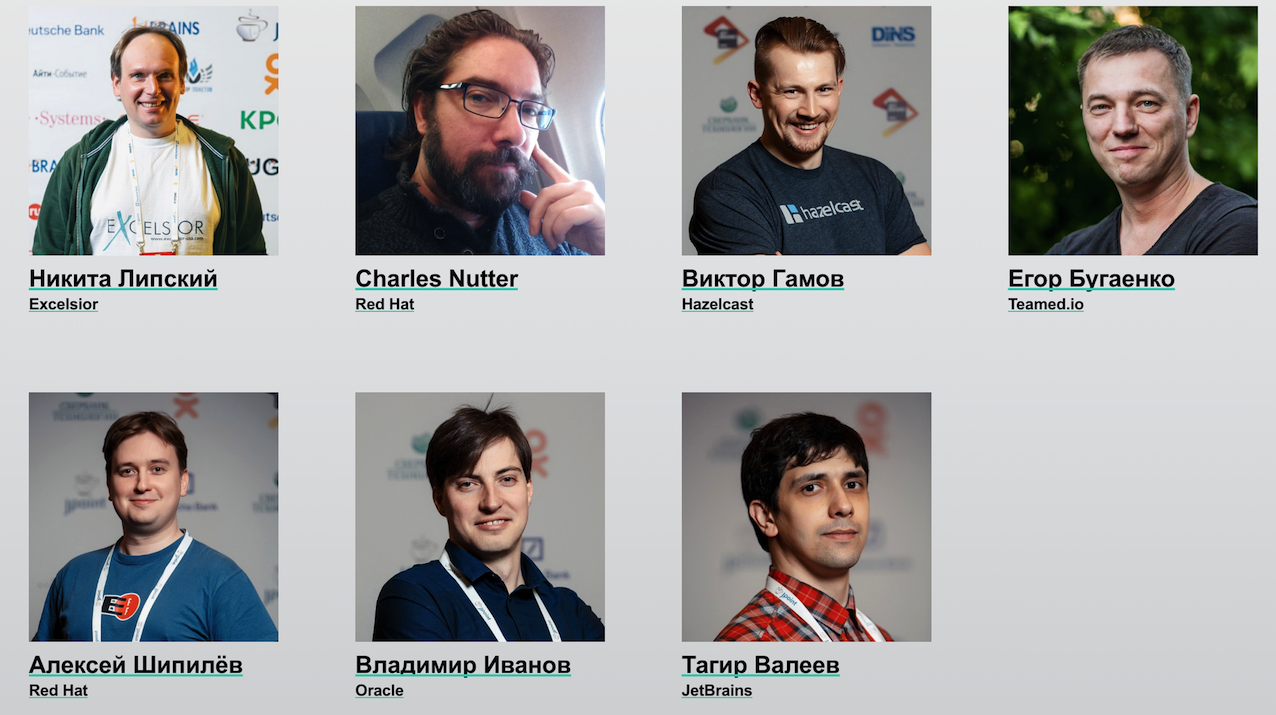
Of the newcomers to JBreak (each of which is actually a proven veteran of the Java world), we will have:
However, in 2017 you will find the best speakers of the last conference:
In general, as you can see, already three and a half months before the conference, the composition of the speakers is such that you can run to register , but remember - we will have at least three tracks, which means that there will be more than 20 speakers. Stay tuned for updates on the site conferences .
During the closing ceremony of JBreak 2016, Aleksey 23derevo Fedorov noted: the full house that happened on this day in Technopark means, firstly, that you can’t do without JBreak 2017 in a year, and secondly, that he will have to look for a room more spacious, and JBreak 2017 came out will be held at the Novosibirsk Expocenter.
PS
By the way, we had people who complained that there was neither a rumor nor a spirit about the conference. Can you advise where to write so that more Novosibirsk Java developers learn about JBreak?
In this post you will find:
- The best reports of JBreak 2016;
- A link to generally all reports of JBreak 2016;
- Announcement of who will perform this time;
- An explanation of why the conference will move out of Akademgorodok.
The best reports of 2016
We posted the JBreak 2016 reports a long time ago, but I found that we did not make a separate habropost about this. I take this opportunity to correct the situation: all the reports presented below received a rating of participants of 4.5+ (out of five). All videos are in a playlist where you will find JBreak 2016 reports that are not in the top 10.
Alexey Shipilev, Oracle
The Lord of the Strings: Two Scours The
best report by Joker / JPoint, which broke the hall in Novosib, which helps to understand how much the development of JDK differs from ordinary projects. This report discusses two features in the upcoming JDK 9 aimed at optimizing strings: Compact Strings , compressing strings with single-byte characters, which improves footprint and even overall performance; and Indify String Concatusing invokedynamic magic to concatenate strings, allowing you to twist the implementation of concatenation without recompiling programs.
Tagir Valeev
Stream API: recommendations of the best dog breeders
Tagir began his victorious march as early as Joker 2015, securing in Novosibirsk the title of one of the best Java speakers in Russia.
In the report, together with Tagir, you will get acquainted with all the features of the Stream API, you will be able to understand for what operations in the standard library there are not enough tools and how to replace them with your own elegant solutions. And if you understand by the end of the report, you don’t want to build bicycles, the report will offer you a couple of libraries that make life easier.
A lot of hardcore, a lot of humor. Must see, as they say:
Alexander Matorin, SberTech
Non-obvious Generics ();
The report from the developer of Sberbank-Technology, which received high marks not only in Novosibirsk, but in Moscow, is devoted to pitfalls and amazing behaviors of generics in JDK, to what they are compiled (when compiled) and why Java generics are so strange.
The report has a lot of code, puzzles and cool examples.
Michal Kordas
Groovier BDD with Spock
Report in English on Behavior Driven Development and tools to bring it to perfection. The combination of Groovy and Spock allows you to write tests and specifications for your code in almost pure English, so even your PM.
It looks fresh and impressive, see for yourself:
Alexey Shipilev, Oracle
Squeeze me completely.
In this report, Alexey is publicly delving into the guts of the JVM and JDK, looking for how the platform itself is trying to save on memory. Let's look at packing headers and fields of objects, compressing pointers, taking into account intergenerational links on the heap, tricks in the generated code, autoboxing cache, etc.
Want to smash your head over tricky questions from Alexei? Then you here:
Oleg m0nstermind Anastasiev, Odnoklassniki
Distributed systems in Odnoklassniki A
report on how one of the most heavily loaded systems in Russia works, processing up to 500,000 (half a million, yes) requests per second on 8000 servers in three data centers, which was included in the list of the best reports in our Java -conferences in Moscow, St. Petersburg and, as you see, Novosibirsk.
The talk in the talk is not about how to “assemble classes”: here you will find an example of building a fault-tolerant distributed system in Java, based on errors and failures, methods for testing and diagnosing them. We will also talk about accidents in distributed systems and methods for their prevention. See if you are interested in distributed architectures:
Roman Artemyev, Sergey Andreyenko
Features of Java implementation on Elbrus processor
Report on how two students sawed their Java
In the end, you will learn about the approaches and non-trivial solutions that were used when porting the JVM, about how using seemingly insignificant architectural features can give much more acceleration than various classical optimizations, and also why everyone says that Elbrus is slow , and as far as this is true:
Two reports by Vladimir Krasilshchik, Luxoft
Vert.x: an operating manual A
technocratic play from a pragmatic Java programmer, dedicated to Vert.x, a modern polyglot toolkit for creating responsive web and more.
Vert.x is a kind of methodology and toolkit for building a scalable and high-performance server side, which however do not impose any restrictions on the frameworks and tools that you are already used to working with.
If you are familiar with or similar to such terms as Node.js, Actors Model, Erlang, Akka and microservices, you will definitely be interested in getting to know Vert.x better, to write very fast JVM code in any language, be it Java, Javascript, Scala, Groovy or Ruby.
What you need to know about logging to a pragmatic Java programmer. The
report is based on a project consisting of 40 microservices that (not all, but some) have been maintained by a team of 20 developers for 6 years. In the work of professional Java programmers, such an aspect as logging does not seem to be something important, significant, only when the application begins to live its own life, pass from the hands of programmers and testers, break, repair, fall in every way and be supported, and even more so when it starts to integrate with other subsystems or upgrade to new versions of libraries, here logging shows its true face and asks merrily: "Well, @ # $%, didn’t wait?".
From the report you will learn how modern logging libraries are combined, how logs can and should be used, as well as about possible "unexpected" that can happen, for example, in the simplest line:
log.info("personalId="+id)Nikita pjBooms Lipsky, Excelsior
Support for Java 8 in Excelsior JET
Report by Nikita Lipsky, a JVM developer who does not write on the pluses - AOT Excelsior JET is written in Scala, and the runtime is written in Java, which discusses the implementation of Excelsior JET of new features added in Java 8.
As a result, after the presentation, you will refresh what appeared in Java 8, how it affected the JVM specification, what lambda expressions in Java bytecode turn into, how they can be statically optimized, and also get some idea about the internal structure of another JVM.
More hardcore
As you can see, the top of the last conference was almost entirely occupied by hardcore JVM gut reports. In 2017, the rates will not decrease, we already have 7 speakers, four of whom to this day work with the insides of the platform - a good start:
Of the newcomers to JBreak (each of which is actually a proven veteran of the Java world), we will have:
- Charles Nutter , Red Hat JVM Developer, JRuby Project Maintainer .
- Vladimir @ iwan0www Ivanov , engineer of the HotSpot JVM team.
- Victor gAmUssA Gamow , Senior Solution Architect at Hazelcast, an expert in the field of distributed systems, co-founder of the Debriefing podcast .
- Egor yegor256 Bugaenko , CTO at Teamed.io, founder of the trueOOP movement and ideological inspirer of the JVM language EO.
However, in 2017 you will find the best speakers of the last conference:
- Alexey Dzhiviemovich Shipilev , JVM developer at Red Hat, performance engineer with more than 10 years of experience,
godexpert in the field of benchmarking. - Tagir lany Valeev , Engineer in the Novosibirsk office of JetBrains, is engaged in the IntelliJ IDE (A) static code analyzer, inspections and quick fixes. Contributor OpenJDK, author opensorsnoy library StreamEx and analyzer bytecode the Java HuntBugs .
- Nikita pjBooms Lipsky , One of the initiators and managers of the Excelsior JET project, a certified Java SE implementation developed by Excelsior. Also, by the way, Siberian :)
In general, as you can see, already three and a half months before the conference, the composition of the speakers is such that you can run to register , but remember - we will have at least three tracks, which means that there will be more than 20 speakers. Stay tuned for updates on the site conferences .
During the closing ceremony of JBreak 2016, Aleksey 23derevo Fedorov noted: the full house that happened on this day in Technopark means, firstly, that you can’t do without JBreak 2017 in a year, and secondly, that he will have to look for a room more spacious, and JBreak 2017 came out will be held at the Novosibirsk Expocenter.
PS
By the way, we had people who complained that there was neither a rumor nor a spirit about the conference. Can you advise where to write so that more Novosibirsk Java developers learn about JBreak?