October 31, 2016 at 15:21
Huawei Hosting Platform
In 2016, the Russian hosting provider RUVDS , which provides virtual server services ( VPS / VDS ), began cooperation with Huawei, a major provider of communication solutions and hardware infrastructure for modern data centers. In particular, as part of a joint project, Huawei equips the RUVDS data center, located in the Moscow region, with its equipment. This guarantees a faster and more stable operation of virtual servers, allows you to offer customers even better and more modern services. In addition, these reliable and cost-effective server platforms allow you to optimize the cost of the services provided to customers.
Huawei is more widely known in our country as a supplier of network and telecommunication equipment. Huawei solutions are used by enterprises working with telecommunications and Internet technologies in more than 150 countries. However, it is also a major manufacturer of servers that it has been developing for over 14 years. All server solutions of Huawei Enterprise are the company's own development.
The hallmarks of Huawei Enterprise servers are high performance, ease of management and operation, and the high reliability needed for the telecommunications industry. This is a powerful and inexpensive equipment aimed at real tasks. Huawei Enterprise servers are popular with service providers (ISPs). And this is not surprising, because the servers of this manufacturer have already proven themselves in the process of operating the Chinese search engine Baidu in the data center. The company is among the Top 5 x86 architecture server suppliers in China.

Currently, Huawei offers a full line of servers based on Intel x86 architecture processors.
RH Series servers are standard rack-mount servers in a 1U \ 2U \ 4U \ 8U package with support from 2 to 8 Intel Xeon processors. This equipment helps customers get high performance while reducing costs in any field - from business-critical applications, virtualization and cloud services to high-performance computing. These servers provide high storage density, high performance, reliability and scalability.
The Huawei RH2288 servers are among the industry's first systems with SSD accelerators certified by Microsoft SQL Server 2012 Fast Track Data Warehouse. A similar hardware solution is used as a platform for Microsoft Exchange.
Today, when promoting servers in regional markets, Huawei Enterprise does not rely solely on its long-standing relationships with operators. To expand the server business, the company demonstrates its products at industry exhibitions, great emphasis is placed on expanding channel sales.
It is obvious that Huawei will try to actively promote its products to the "external" market, that it is ready for favorable price conditions. The quality of the products is at a fairly high level, and the equipment boasts an excellent price / quality ratio.
Taking into account the discounts, Huawei Enterprise servers are cheaper on average than competitors, and in addition, the vendor invests impressive funds in research and development. The company pays great attention to the development of new technologies. This makes Huawei products more recognizable in the server market.
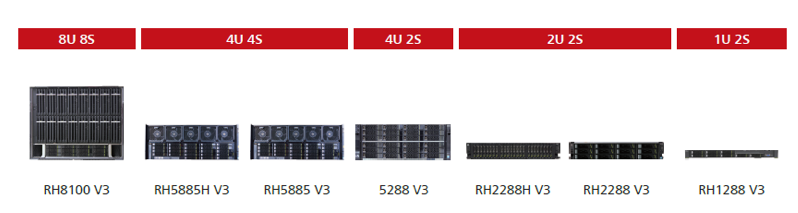
Huawei Rack Server Line
It is no coincidence that one of the company's decisions chosen to equip the RUVDS data center was Huawei RH1288 V3 servers. We will meet them in this short review.
The Huawei RH1288 V3 is a low-cost 1U rackmount dual-socket server. The developers tried to achieve a balance between performance and layout density due to the optimal design. It is a good choice for enterprise applications with intensive computing, workloads requiring both computing power and storage capacity, virtualization systems and cloud applications.

The Huawei RH1288 V3 servers are the right solution for applications with high computing requirements.
These servers support up to two Intel Xeon E5-2600 v3 processors (up to 14 cores each, 35 MB L3 cache and 9.6 Gt / s QuickPath Interconnect (QPI)), up to 16 2133 MHz DDR4 DIMMs provide maximum operational capacity memory up to 1 TB. Using Power Supplies (PSUs) The 80 Plus Platinum provides efficient power consumption. Moreover, depending on the equipment of the server, PSUs with power of 460, 750, 800 and 1200 W are supported. For reliability, PSUs are reserved (1 + 1).

Typical use of Huawei FusionServer RH1288 V3: database server (50-100 users), terminal server, application server, cluster computing node. Among the interesting functions, it is worth noting a system of quality monitoring of the level of energy consumption and quick control of the system.

The Huawei RH1288 V3 server is a worthy representative among competitors, to which you can also add the Lenovo X3550.
The server provides dynamic energy management. To monitor the temperature in real time, temperature sensors are built into the key components of the server. And the use of cooling modules with feedback increases the energy efficiency and cooling of the system.
Remote server management is performed using the iBMC module, which, in general, is functionally no different from the development of competitors - iDrag or iLo. The independent iBMC management module implements the functions of Serial over LAN (SOL), remote KVM and remote server on / off functions. This server also provides a wide selection of management interfaces, including IPMI, CLI, HTTPS, SNMP and WSMAN, which facilitates integration with systems from other manufacturers.
To accurately localize problems that occur in the event of a server failure, an error code is displayed on the front panel.
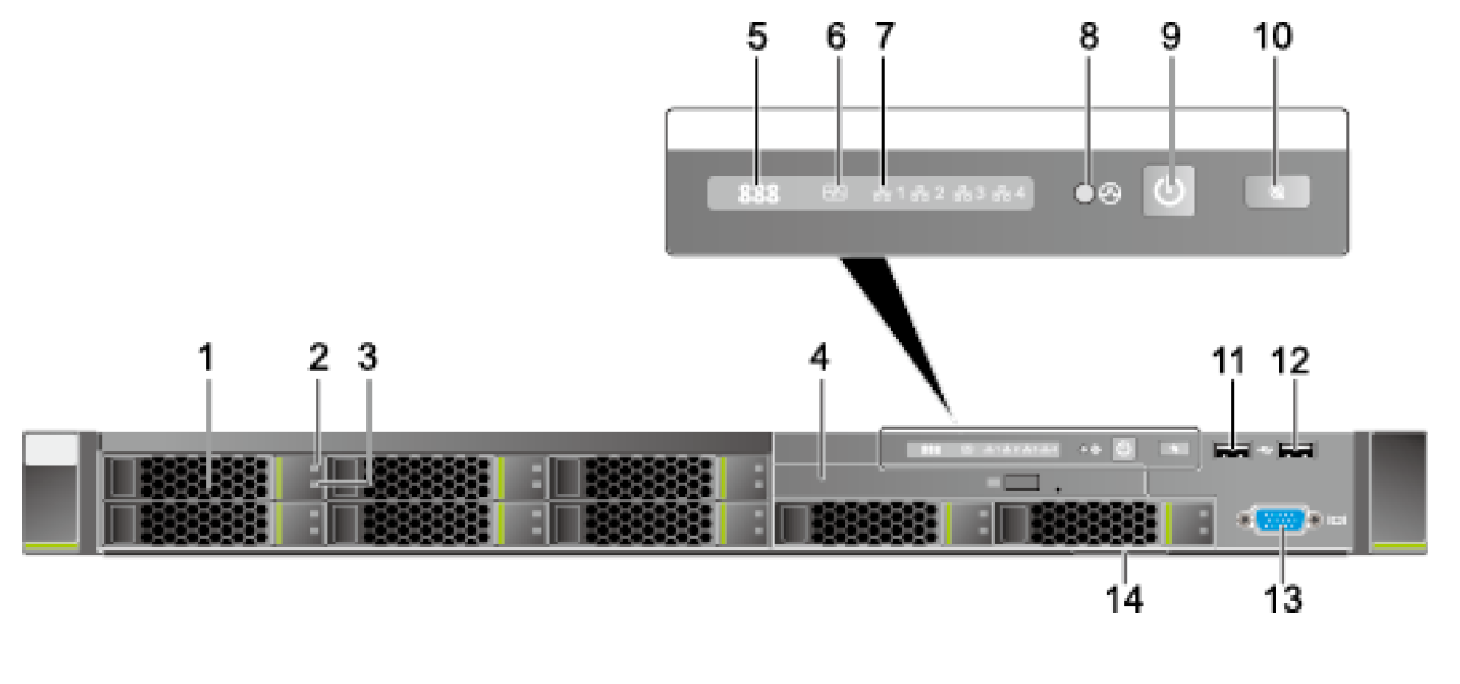
Huawei RH1288 V3 server - front view.

The back panel of the Huawei RH1288 V3 server with a 10GbE port.
The server can be rack mounted on rails or adjustable rails so that it can be easily removed if necessary.

The high-performance and compact 1U rack-mount Huawei RH1288 V3 rack-mount servers support enterprise and cloud applications, save energy, reduce TCO, simplify management and maintenance. So they look in the new pressurized data center RUVDS .
The maximum server RAM capacity of 1 TB and internal storage capacity of up to 16 TB provide a balance between performance and density. To connect to a local network, the server supports two or four GbE ports or two 10GbE ports. This can satisfy the requirements of a wide variety of applications, so PCIe slots for additional network adapters are not required. The internal structure of the server is quite standard and simple. Nothing extra.
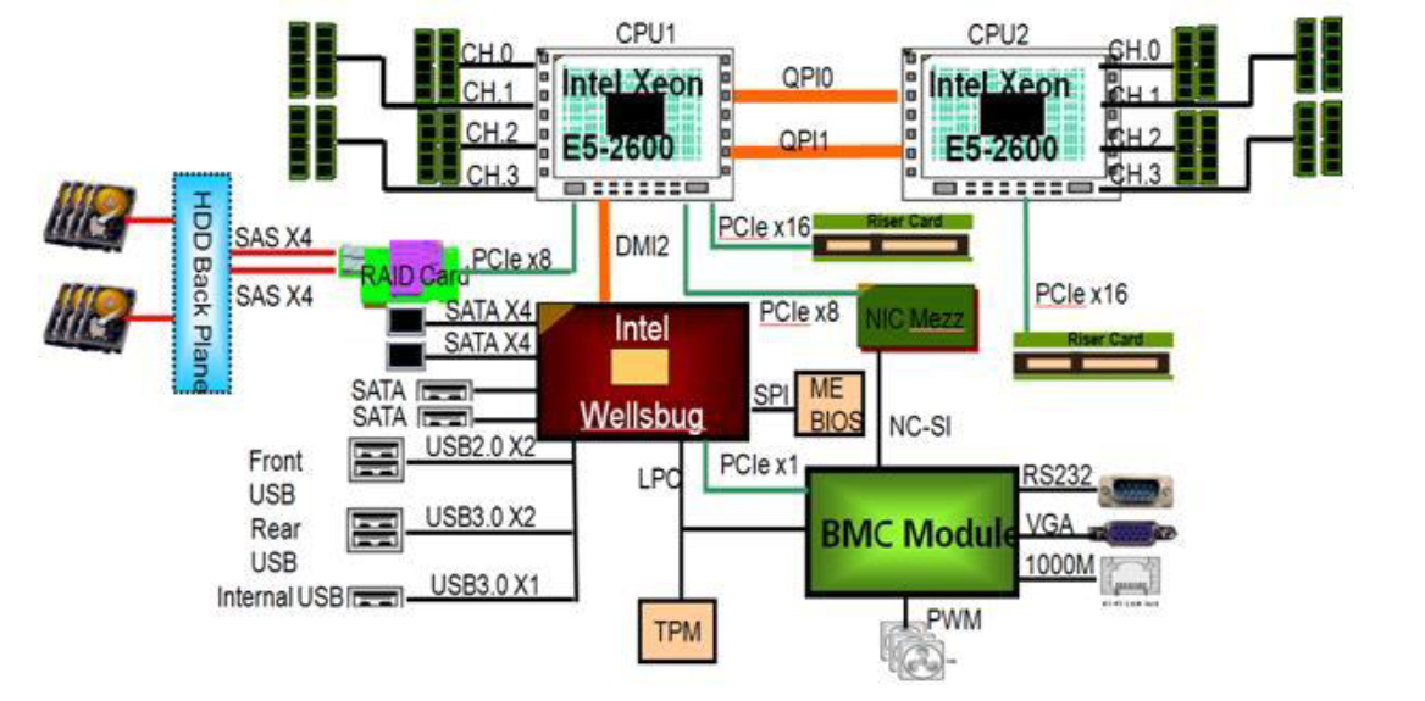
Logical architecture of the server Huawei RH1288 V3.
Servers Huawei RH1288 V3 can be equipped with solid state drives. Currently, the vast majority of hosting providers in the world use servers with HDDs, since this is the cheapest option, disk drives have a large capacity, are easily configured to work with servers, and do not require special hardware.
However, modern SSD SSDs offer a good combination of low cost and high performance for data centers and offer significant speed gains and reduced latency compared to traditional HDDs used in data centers. Equipped with flash drives, servers and storage systems today can solve the most demanding tasks, such as searching in large databases, online transaction processing, business analytics and large-scale virtualization in cloud computing.
In the configuration of the Huawei RH1288 V3 with SSD, it is not PCIe that is used for connecting solid-state drives, but the NVMe interface. Interestingly, the model with NVMe supports several types of drives: up to four HDD SAS or SATA and up to four NVMe SSDs, instead of which the same HDD SAS or SATA can be used. Great scope for various peering options - tiered storage of hot / cold data - or caching.

Thanks to NVMe, data becomes “closer” to the processor, which, of course, has the most favorable effect on system performance .


It looks like the server Huawei RH1288 V3 after opening. Bottom right - a couple of power supplies in 1 + 1 mode, an internal USB 3.0 port, two SATA DOM ports, in the center - 2 CPU slots and 16 slots for DDR4 memory modules, at the top - a network card, SD and RAID mezzanine cards, on the right - blocks hot swappable fans.
Having examined all this by components, we get the following picture:
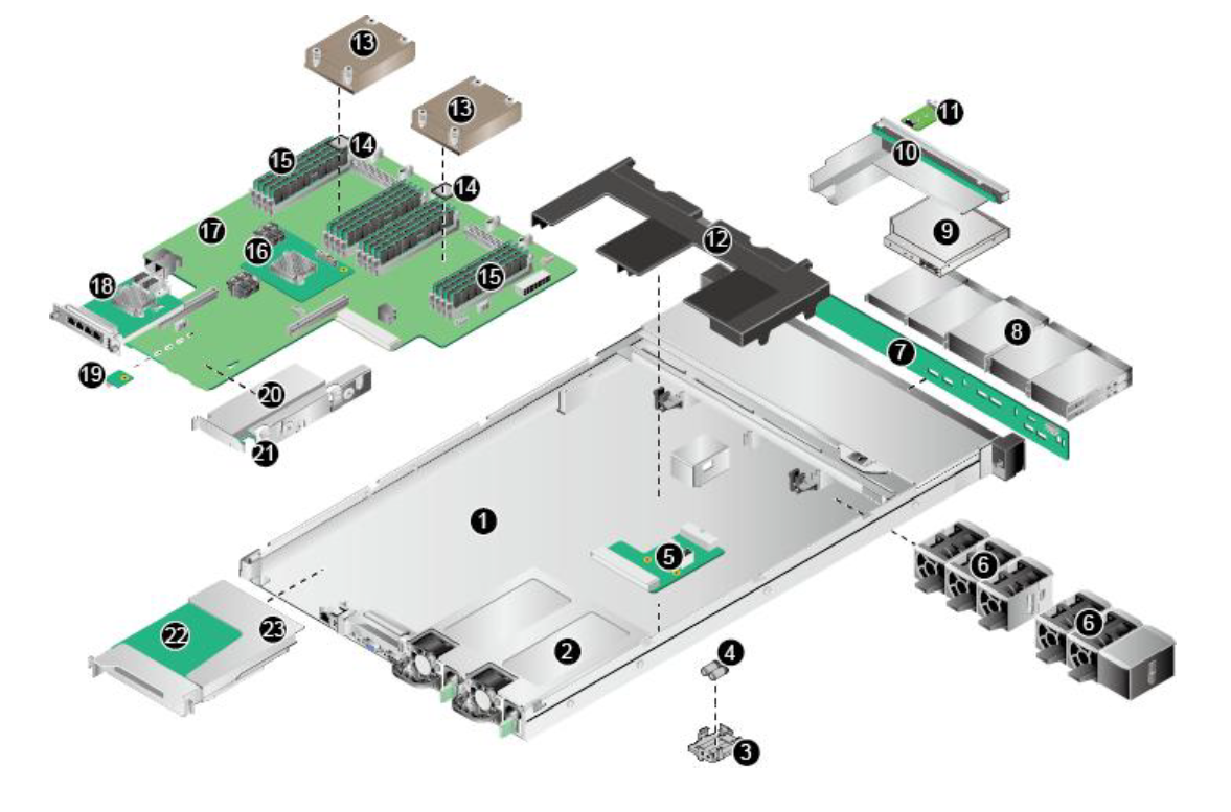
Components of the Huawei RH1288 V3 server.
In conclusion, we present the technical characteristics of the RH1288 V3 server:
In recent years, in the global market, Huawei has been ranked second in terms of business growth among server manufacturers, and first among storage providers. Its data storage systems are used by more than 2,000 customers in more than 100 countries, and its servers are used by more than 5,000 customers from 50 countries. In one of the projects, more than 100 thousand Huawei servers were deployed.
In the world, Huawei equipment is used in more than 500 data centers. Of these, 160 are innovative platforms for providing cloud services. Huawei has partnered with more than 500 customers using cloud computing. The latest approaches to creating data centers are rapidly developing - software-configured networks (SDN) and data centers (SDDC).
Huawei equipment is not inferior to competitors in price and functionality, and in addition, the vendor invests heavily in research and development. The company pays great attention to the development of new technologies. Huawei data center solutions help hosting providers , data center owners grow their businesses in the era of cloud computing thanks to their rapid deployment, flexible expansion, efficiency and reliability, as well as intelligent management.
Huawei is more widely known in our country as a supplier of network and telecommunication equipment. Huawei solutions are used by enterprises working with telecommunications and Internet technologies in more than 150 countries. However, it is also a major manufacturer of servers that it has been developing for over 14 years. All server solutions of Huawei Enterprise are the company's own development.
The hallmarks of Huawei Enterprise servers are high performance, ease of management and operation, and the high reliability needed for the telecommunications industry. This is a powerful and inexpensive equipment aimed at real tasks. Huawei Enterprise servers are popular with service providers (ISPs). And this is not surprising, because the servers of this manufacturer have already proven themselves in the process of operating the Chinese search engine Baidu in the data center. The company is among the Top 5 x86 architecture server suppliers in China.
Currently, Huawei offers a full line of servers based on Intel x86 architecture processors.
RH Series servers are standard rack-mount servers in a 1U \ 2U \ 4U \ 8U package with support from 2 to 8 Intel Xeon processors. This equipment helps customers get high performance while reducing costs in any field - from business-critical applications, virtualization and cloud services to high-performance computing. These servers provide high storage density, high performance, reliability and scalability.
The Huawei RH2288 servers are among the industry's first systems with SSD accelerators certified by Microsoft SQL Server 2012 Fast Track Data Warehouse. A similar hardware solution is used as a platform for Microsoft Exchange.
Made in China
Today, when promoting servers in regional markets, Huawei Enterprise does not rely solely on its long-standing relationships with operators. To expand the server business, the company demonstrates its products at industry exhibitions, great emphasis is placed on expanding channel sales.
It is obvious that Huawei will try to actively promote its products to the "external" market, that it is ready for favorable price conditions. The quality of the products is at a fairly high level, and the equipment boasts an excellent price / quality ratio.
Taking into account the discounts, Huawei Enterprise servers are cheaper on average than competitors, and in addition, the vendor invests impressive funds in research and development. The company pays great attention to the development of new technologies. This makes Huawei products more recognizable in the server market.
Huawei Rack Server Line
It is no coincidence that one of the company's decisions chosen to equip the RUVDS data center was Huawei RH1288 V3 servers. We will meet them in this short review.
Workhorse: RH1288 V3
The Huawei RH1288 V3 is a low-cost 1U rackmount dual-socket server. The developers tried to achieve a balance between performance and layout density due to the optimal design. It is a good choice for enterprise applications with intensive computing, workloads requiring both computing power and storage capacity, virtualization systems and cloud applications.
The Huawei RH1288 V3 servers are the right solution for applications with high computing requirements.
These servers support up to two Intel Xeon E5-2600 v3 processors (up to 14 cores each, 35 MB L3 cache and 9.6 Gt / s QuickPath Interconnect (QPI)), up to 16 2133 MHz DDR4 DIMMs provide maximum operational capacity memory up to 1 TB. Using Power Supplies (PSUs) The 80 Plus Platinum provides efficient power consumption. Moreover, depending on the equipment of the server, PSUs with power of 460, 750, 800 and 1200 W are supported. For reliability, PSUs are reserved (1 + 1).
Typical use of Huawei FusionServer RH1288 V3: database server (50-100 users), terminal server, application server, cluster computing node. Among the interesting functions, it is worth noting a system of quality monitoring of the level of energy consumption and quick control of the system.
The Huawei RH1288 V3 server is a worthy representative among competitors, to which you can also add the Lenovo X3550.
The server provides dynamic energy management. To monitor the temperature in real time, temperature sensors are built into the key components of the server. And the use of cooling modules with feedback increases the energy efficiency and cooling of the system.
Remote server management is performed using the iBMC module, which, in general, is functionally no different from the development of competitors - iDrag or iLo. The independent iBMC management module implements the functions of Serial over LAN (SOL), remote KVM and remote server on / off functions. This server also provides a wide selection of management interfaces, including IPMI, CLI, HTTPS, SNMP and WSMAN, which facilitates integration with systems from other manufacturers.
To accurately localize problems that occur in the event of a server failure, an error code is displayed on the front panel.
Huawei RH1288 V3 server - front view.
1 - hard drive, 2 - hard drive health indicator, 3 - drive activity indicator, 4 - DVD drive, 5 - LED indicators for troubleshooting, 6 - status indicator, 7 - network port indicator, 8 - NMI button, 9 - button power, 10 - button / UID indicator, 11,12 - USB 2.0 port, 13 - VGA port, 14 - label.
The back panel of the Huawei RH1288 V3 server with a 10GbE port.
1 - PSU power socket, 2 - PSU indicator, 3 - PSU, 4 - serial port, 5 - VGA port, 6 - UID indicator, 7.8 - USB 3.0 port, 9 - control network port, 10 - LINK indicator, 11 - ACT indicator, 12 - 10GbE port, 13 - 10bGE port, 14 - data transfer status indicator, 15 - network status indicator, 16 - full-sized PCIe slot, 17 - half-height PCIe slot.
The server can be rack mounted on rails or adjustable rails so that it can be easily removed if necessary.
The high-performance and compact 1U rack-mount Huawei RH1288 V3 rack-mount servers support enterprise and cloud applications, save energy, reduce TCO, simplify management and maintenance. So they look in the new pressurized data center RUVDS .
What's inside?
The maximum server RAM capacity of 1 TB and internal storage capacity of up to 16 TB provide a balance between performance and density. To connect to a local network, the server supports two or four GbE ports or two 10GbE ports. This can satisfy the requirements of a wide variety of applications, so PCIe slots for additional network adapters are not required. The internal structure of the server is quite standard and simple. Nothing extra.
Logical architecture of the server Huawei RH1288 V3.
Servers Huawei RH1288 V3 can be equipped with solid state drives. Currently, the vast majority of hosting providers in the world use servers with HDDs, since this is the cheapest option, disk drives have a large capacity, are easily configured to work with servers, and do not require special hardware.
However, modern SSD SSDs offer a good combination of low cost and high performance for data centers and offer significant speed gains and reduced latency compared to traditional HDDs used in data centers. Equipped with flash drives, servers and storage systems today can solve the most demanding tasks, such as searching in large databases, online transaction processing, business analytics and large-scale virtualization in cloud computing.
In the configuration of the Huawei RH1288 V3 with SSD, it is not PCIe that is used for connecting solid-state drives, but the NVMe interface. Interestingly, the model with NVMe supports several types of drives: up to four HDD SAS or SATA and up to four NVMe SSDs, instead of which the same HDD SAS or SATA can be used. Great scope for various peering options - tiered storage of hot / cold data - or caching.
Thanks to NVMe, data becomes “closer” to the processor, which, of course, has the most favorable effect on system performance .
It looks like the server Huawei RH1288 V3 after opening. Bottom right - a couple of power supplies in 1 + 1 mode, an internal USB 3.0 port, two SATA DOM ports, in the center - 2 CPU slots and 16 slots for DDR4 memory modules, at the top - a network card, SD and RAID mezzanine cards, on the right - blocks hot swappable fans.
Having examined all this by components, we get the following picture:
Components of the Huawei RH1288 V3 server.
1 - chassis, 2 - PSU, 3 - tray for supercapacitor, 4 - supercapacitor itself, 5 - power adapter board, 6 - fan module, 7 - hard drive backplane, 8 - disk drive, 9 - DVD drive, 10 - indicator board, 11 - VGA board, 12 - duct, 13 - heatsink, 14 - CPU, 15 - DIMM, 16 - RAID controller board, 17 - motherboard, 18 - NIC, 19 - Trusted platform module (TPM) 20 is a half-height PCIe card, 21 is a half-height transition card, 22 is a full-size PCIe card, 23 is a full-size transition card.
In conclusion, we present the technical characteristics of the RH1288 V3 server:
| Form factor | 1U Rack Server |
| Number of processors | 1 or 2 |
| Processor model | Intel Xeon E5-2600 v3 |
| RAM capacity | 16 DDR4 RDIMM or LRDIMM memory modules |
| Storage subsystem |
|
| RAID support | RAID 0, 1, 10, 5, 50, 6, and 60 |
| RAID protection in case of power failure: | iBBU or supercapacitor |
| Network port | 2 or 4 GbE ports, or 2 10GbE ports |
| Expansion slots | Up to three PCIe slots |
| Ventilation module | 5 hot swappable fans, ventilation modules with opposite direction of rotation with redundancy N + 1 |
| Power Supplies (PSU) | Two Standby N + 1 Hot Swap PSUs |
| Control | Integrated iBMC controller that supports: IPMI, SOL, KVM over IP, IPMI tools, 1 Gb / s RJ45 port for control via Network Controller Sideband Interface (NC-SI) |
| Supported Operating Systems and Hypervisors | Microsoft Windows Server Red Hat Enterprise Linux SUSE Linux Enterprise Server CentOS Citrix XenServer VMware ESXi Microsoft Hyper-V |
| Source of power | ~ 110 V / 220 V AC or –48 V DC |
| Working temperature | 5ºC - 40ºC |
| Dimensions (WxDxH) | Height: 447 mm (447 mm) Width: 750 mm (710 mm) Depth: 43.6 mm (43.6 mm) |
In recent years, in the global market, Huawei has been ranked second in terms of business growth among server manufacturers, and first among storage providers. Its data storage systems are used by more than 2,000 customers in more than 100 countries, and its servers are used by more than 5,000 customers from 50 countries. In one of the projects, more than 100 thousand Huawei servers were deployed.
In the world, Huawei equipment is used in more than 500 data centers. Of these, 160 are innovative platforms for providing cloud services. Huawei has partnered with more than 500 customers using cloud computing. The latest approaches to creating data centers are rapidly developing - software-configured networks (SDN) and data centers (SDDC).
Huawei equipment is not inferior to competitors in price and functionality, and in addition, the vendor invests heavily in research and development. The company pays great attention to the development of new technologies. Huawei data center solutions help hosting providers , data center owners grow their businesses in the era of cloud computing thanks to their rapid deployment, flexible expansion, efficiency and reliability, as well as intelligent management.