July 22, 2016 at 17:10
Who was Ramanujan?
- Transfer

Stephen Wolfram's " Who Was Ramanujan? " Post translation .
Many thanks to Polina Sologub for help in translating and preparing the publication.
Content
Awesome letter
The beginning of the story
Who was Hardy?
The letter and its consequences
Ramanujan's working style
See what is important
Truth or explanation
Moving to Cambridge
Ramanujan in Cambridge
What happened next
What happened to Hardy?
Ramanujan Math
Facts - Random or Not?
Automation of Ramanujan work.
Modern Ramanujan?
What would happen if Ramanujan had Mathematica?
This week came the film "The Man Who Knew Infinity " (which Manjul Bhargava and Ken Ono showed me last fall ), so I could not help but write about his main character, Srinivas Ramanujan.

Amazing letter
They used to come by regular mail. Now - by email. For many years letters from all over the world have flocked to me containing bold statements about primes, the theory of relativity, artificial intelligence, consciousness and many other things. Looking at these messages, I recall the story of Ramanujan and invariably put off my ideas and projects in order to at least view them.
Around January 31, 1913, a mathematician named Hardy from Cambridge, England , received a package of documents with a cover letter that began as follows: " Dear sir, I want to introduce myself to you: I am a clerk from the accounting department of the port in Madras with a salary of £ 20 per year. I am 23 years old ....". And he continued: he wrote that he had made “amazing” progress in the theory of divergent series in mathematics and had solved the long-standing problem of the distribution of primes . The cover letter ended with the words: “ I am poor; if you decide that there is anything valuable here, I would like my theorems to be published ... I am inexperienced and any of your advice is valuable to me. I apologize for the inconvenience. Sincerely Yours, Best Regards, S. Ramanujan . "
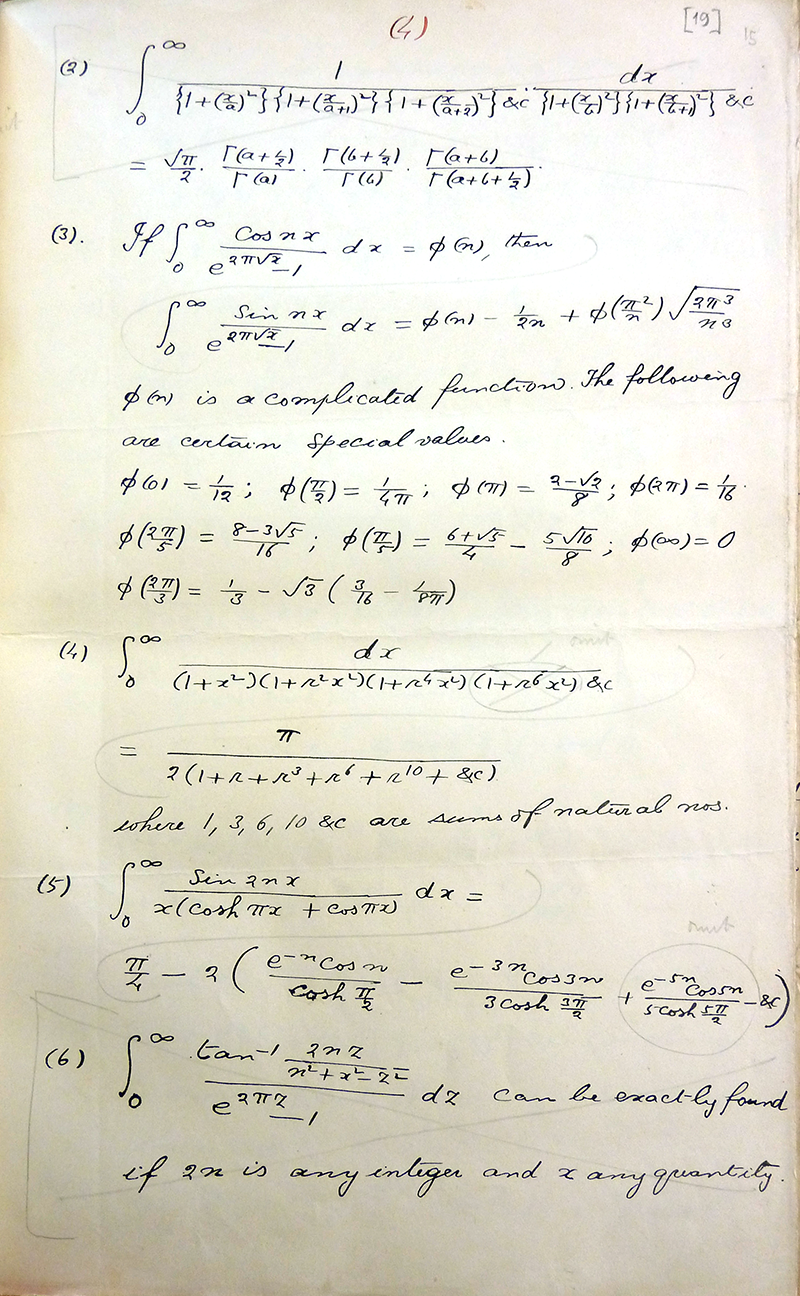
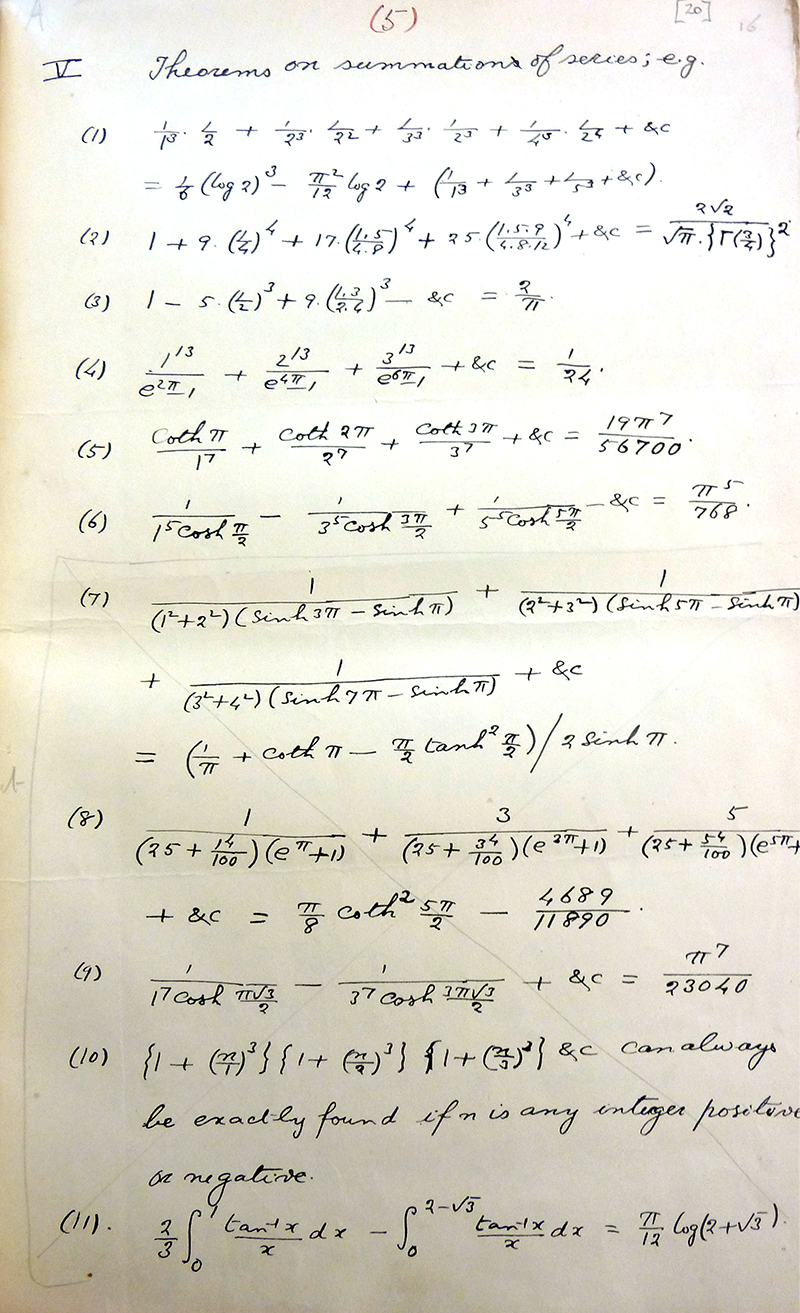
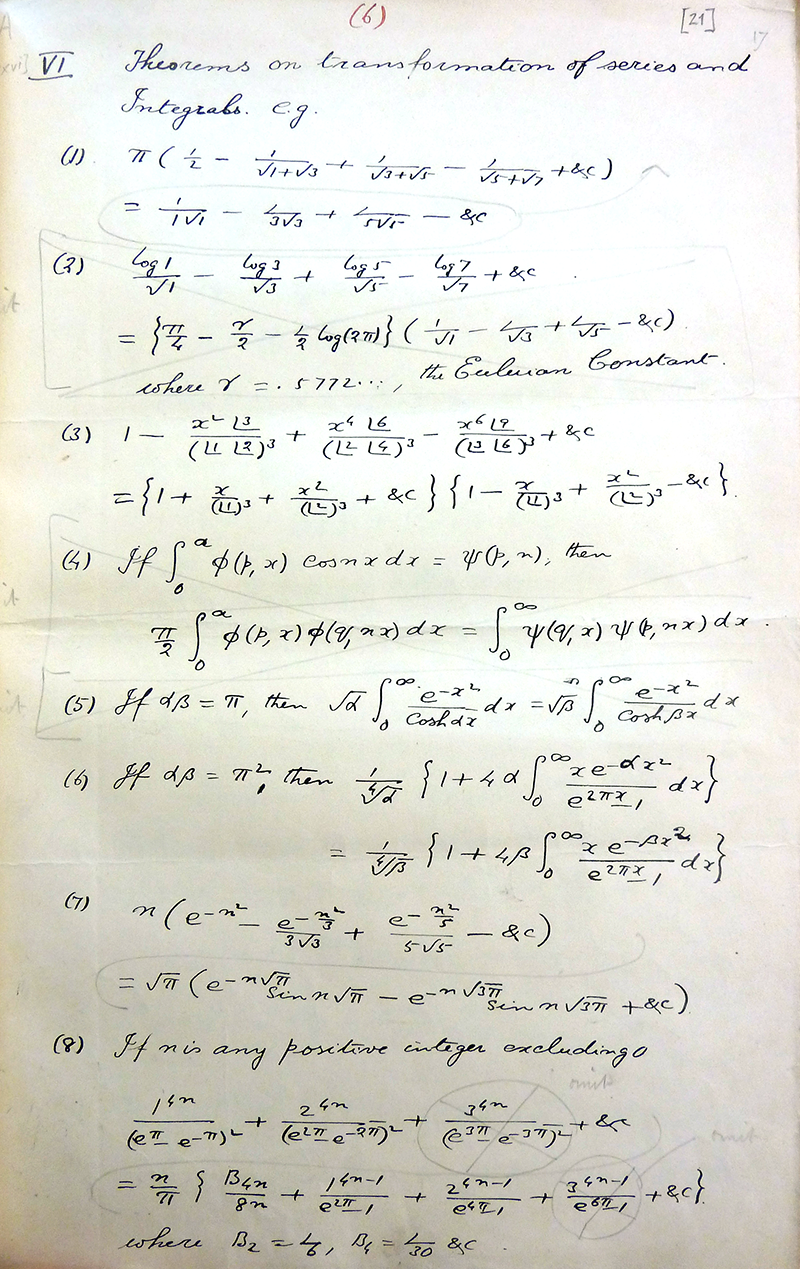
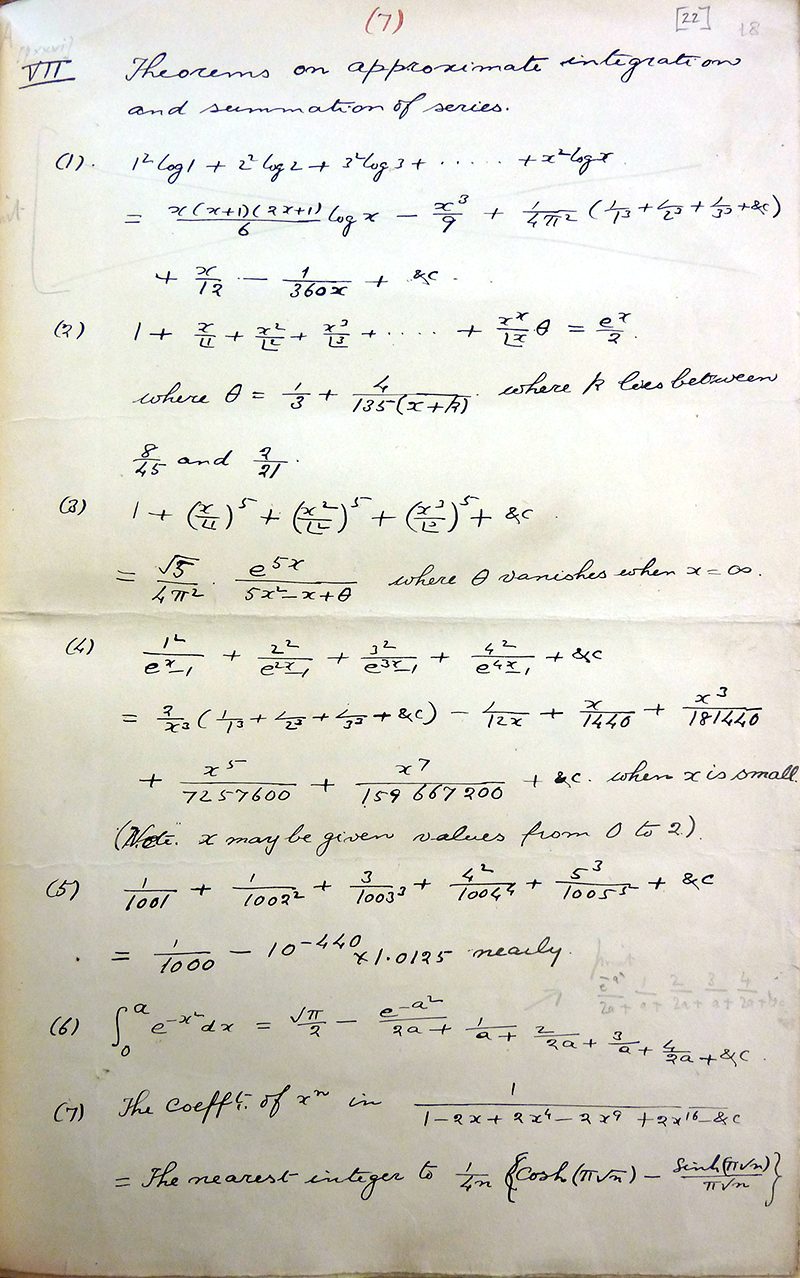
This was followed by at least 11 pages of technical results from a number of areas of mathematics (of which 2 were lost). There was an absurd statement at first glance that the sum of all positive numbers is -1/12 :


There were statements suggesting a kind of experimental approach in mathematics:

There were more exotic pages with formulas like this:

What is this? Where did they come from? Are they right?
The concepts themselves should be familiar to the person who studied college analysis. However, not just complex college-level exercises were attached to the letter. If you look closely, something completely unusual and unexpected happens on each page of the letter — it seems to be mathematics of a different level.
To date, we can use Mathematica or Wolfram | On Alpha . And sometimes we can even just enter a question and get an answer right away:
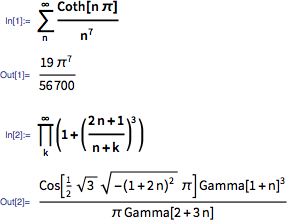
You can verify (like G. H. Hardy in 1913) that the formulas are correct. However, what kind of person could bring them out? And How? Are they part of a wider picture or, in a sense, simply chaotic random facts from mathematics?
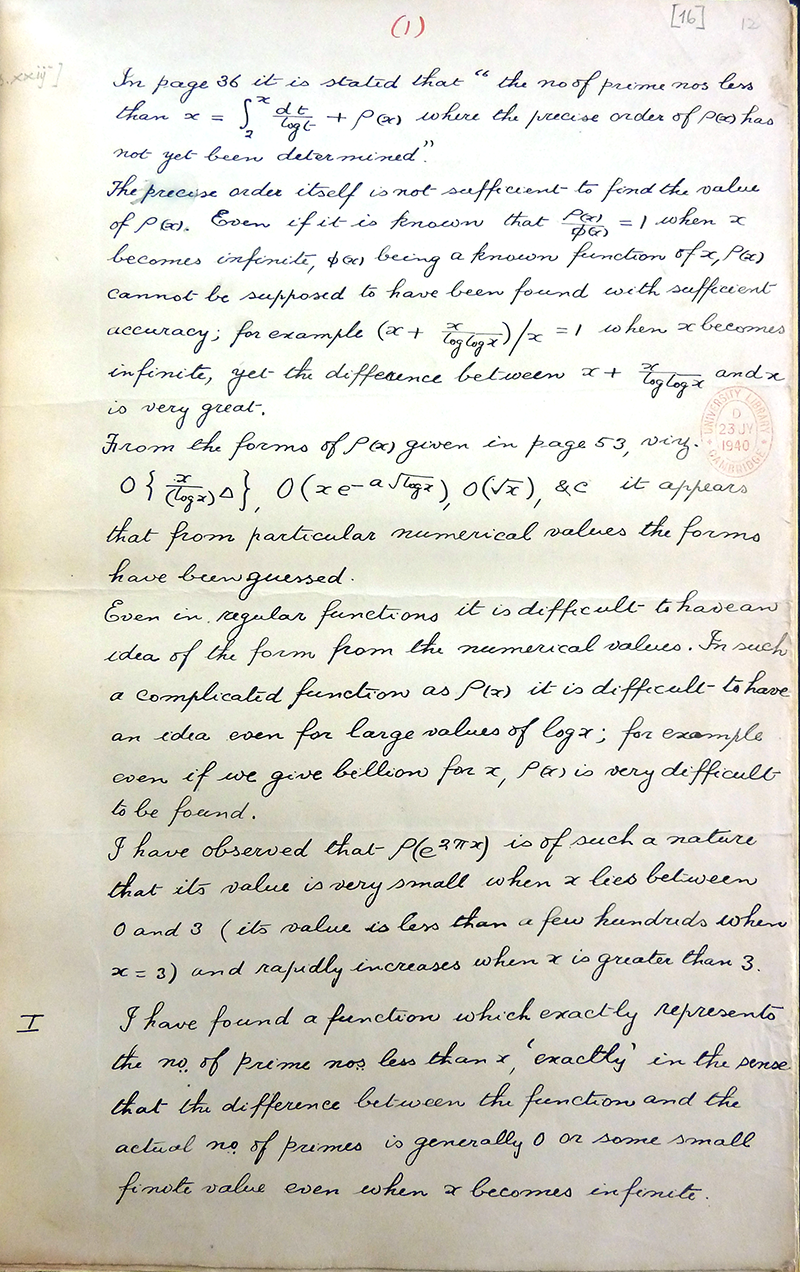
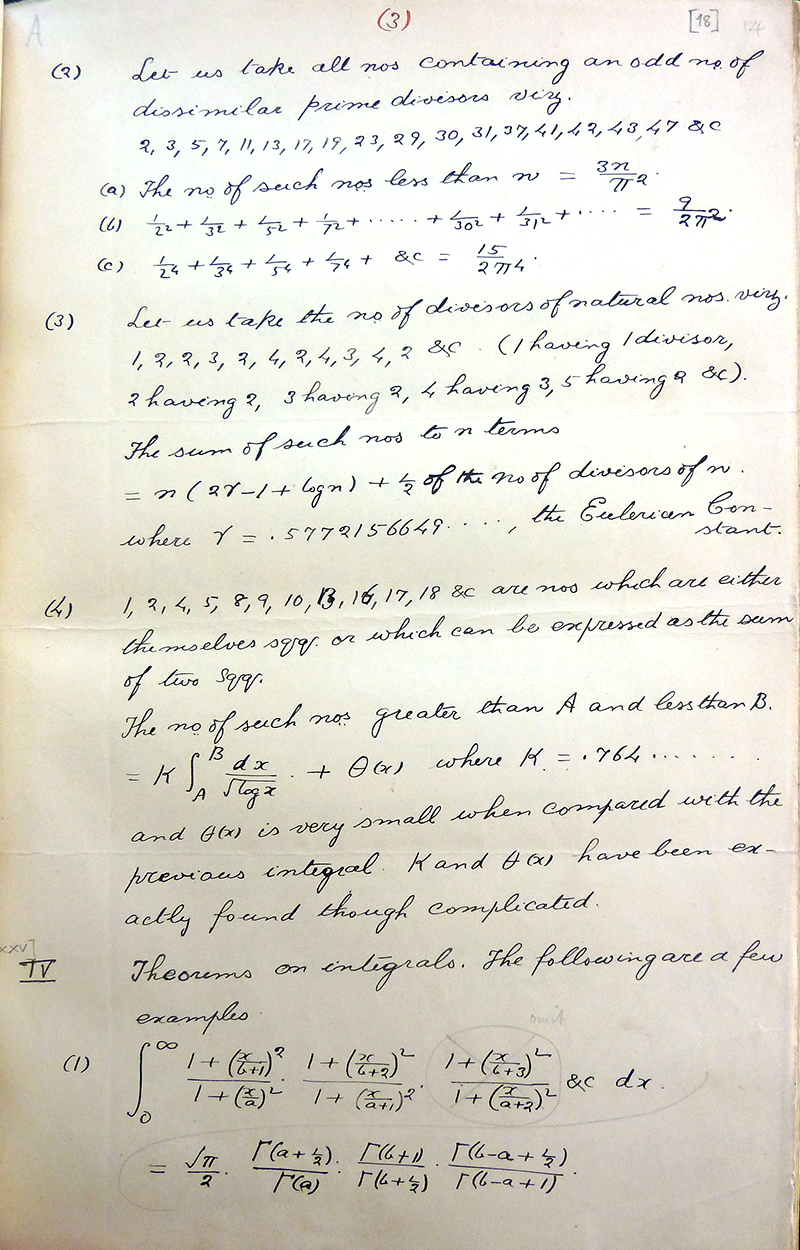
Other pages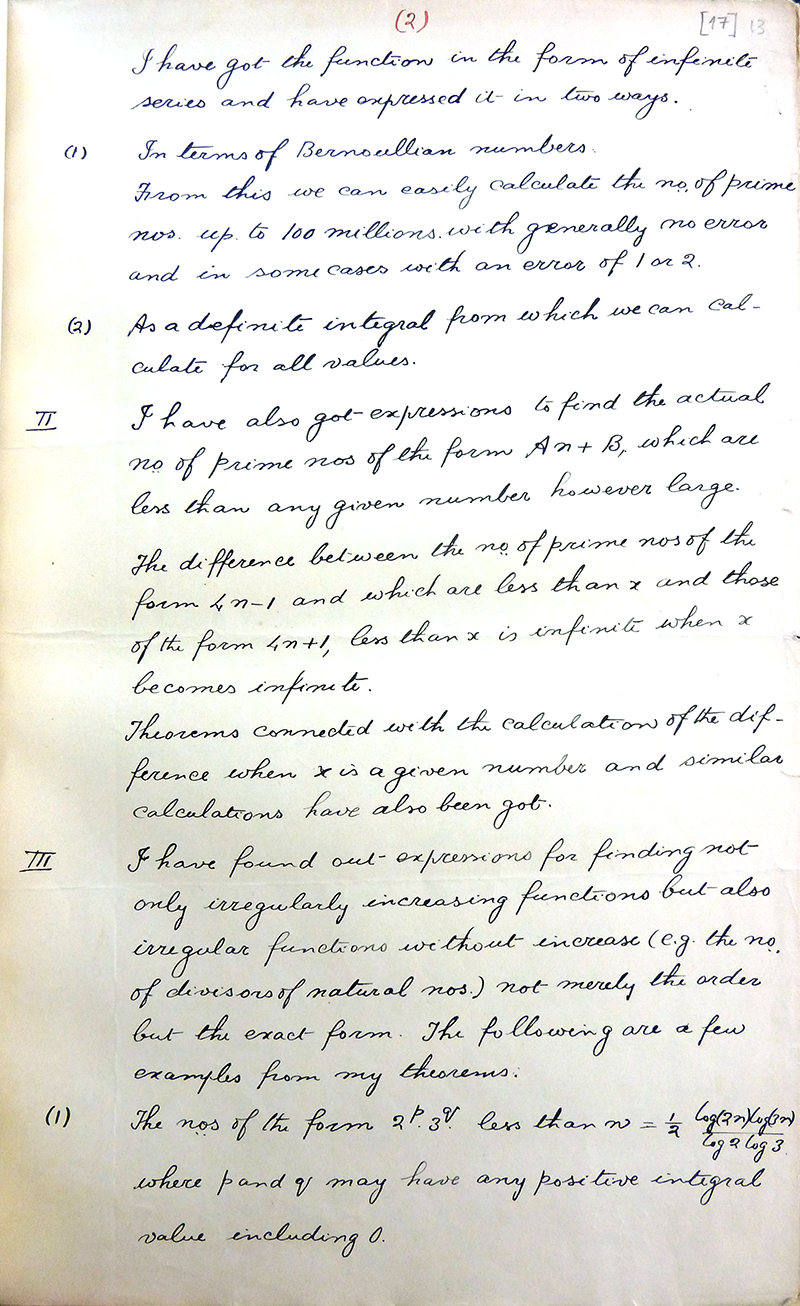
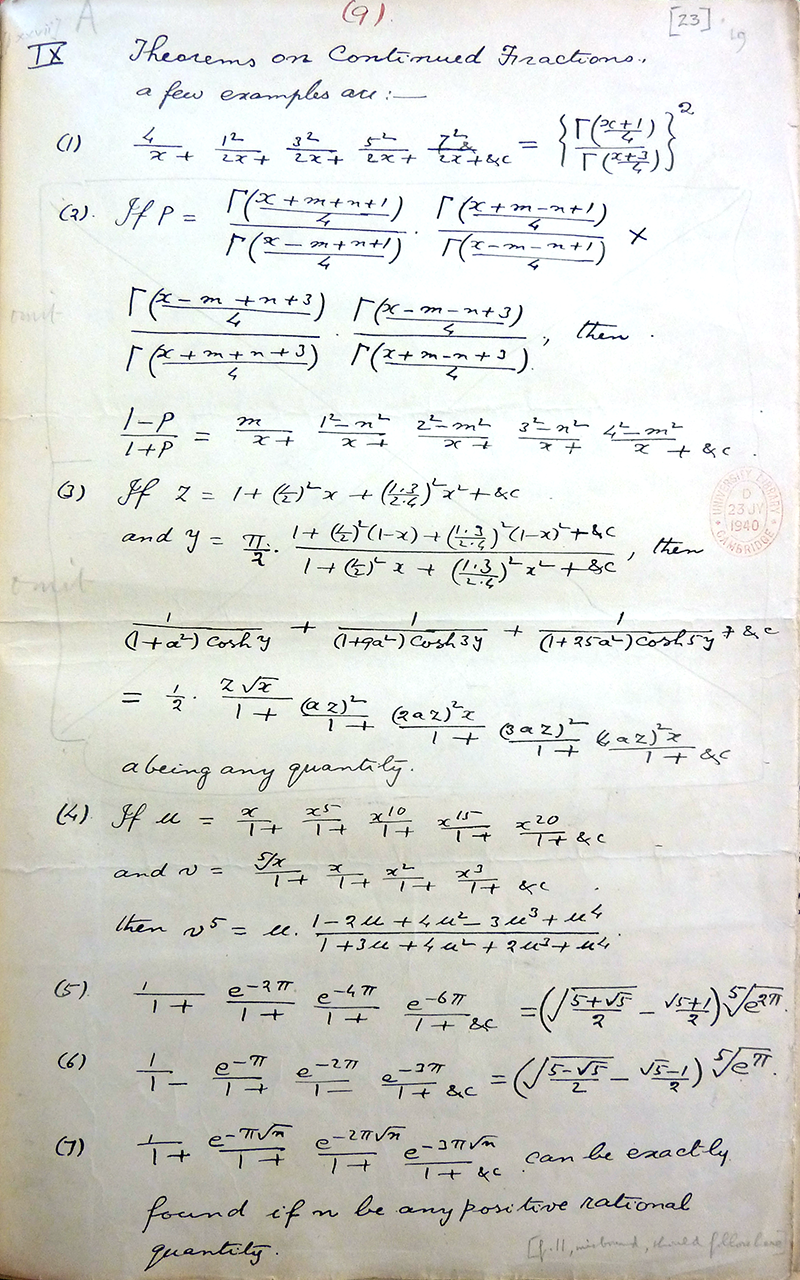
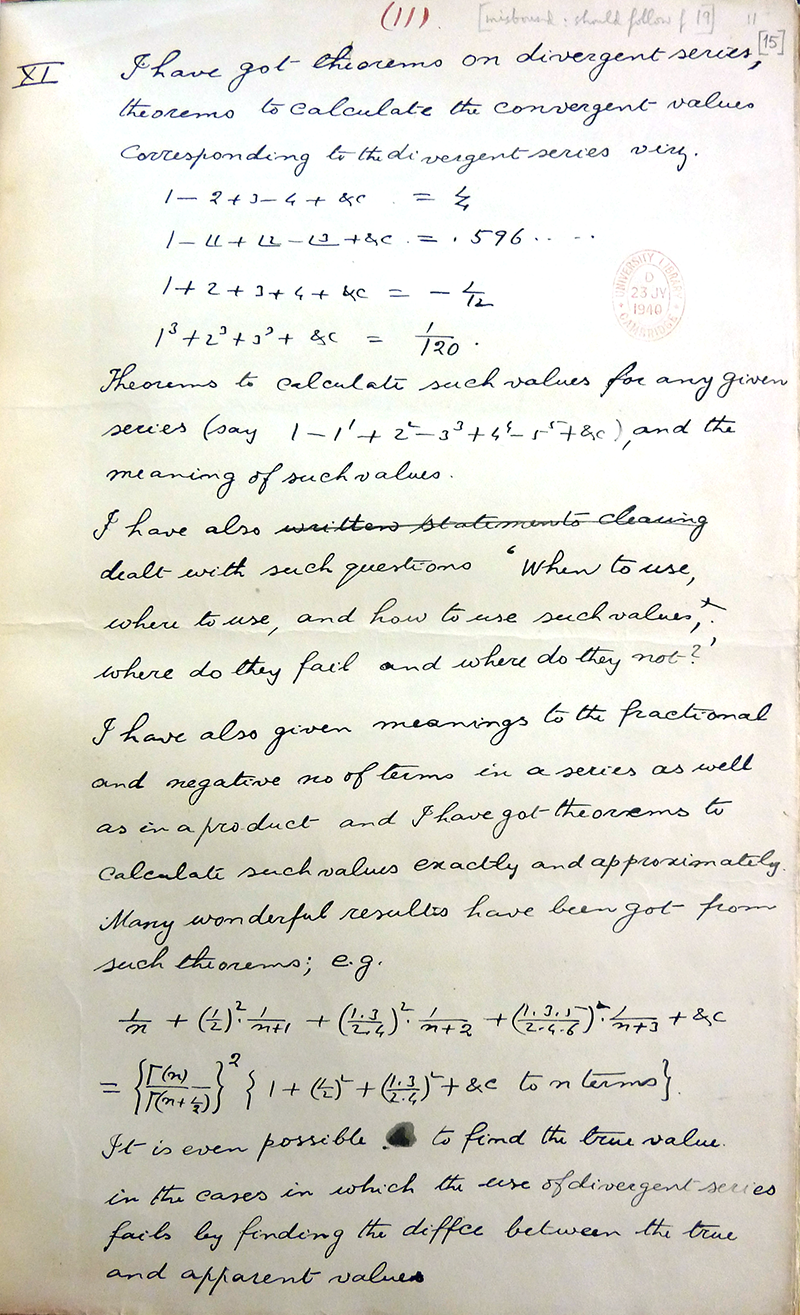
The beginning of the story
Behind this letter is the wonderful story of Ramanujan .
He was born in a small town in India on December 22, 1887 (this means that he was not “about 23” years old when he wrote his letter to Hardy, but all 25 ). His family was not rich and belonged to the Brahmin caste (priests, teachers, etc.). As early as 10 years old, Ramanujan clearly stood out among others by the results of exams in the updated school system. He was also famous because of his exceptional memory: he could recite the digits of pi as well as the roots of Sanskrit words. When he graduated from high school at the age of 17, he was given a scholarship to study in college.
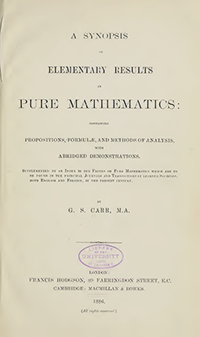
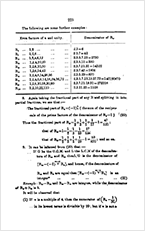
In high school, Ramanujan began to study mathematics on his own and conduct his own study of the numerical estimation of the Euler constant and the properties of Bernoulli numbers . He was lucky that at 16 years old (in those days, long before the Internet!) He received a copy of a surprisingly good and complete (at least as of 1886) abstract on mathematics for high school students , consisting of 1,055 pages! The book was written by a teacher in a three-year math program to prepare for exams in Cambridge, and his avaricious “facts-only” format was very similar to the one Ramanujan used in his letter to Hardy.


By the time Ramanujan went to college, he only wanted to do math, and as a result failed the rest of the exams and ran away, so his mother even had to write a letter to the newspaper about the missing person: Ramanujan moved to Madras (now Chennai ), where I tried to study at various colleges, was ill, and as a result continued my independent study in mathematics. In 1909, when he was 21 years old, his mother, in accordance with the customs of that time, arranged for his wedding with a 10-year-old girl named Yanaki, who began to live with him a couple of years later. Ramanujan supported himself by doing tutoring in mathematics, but he soon became known in the vicinity of Madras as a mathematician and began to print in the recently launched

Journal of the Indian Mathematical Society . His first article , published in 1911, was devoted to the computational properties of Bernoulli numbers (the same Bernoulli numbers that Ada Lovelace (see article " Unraveling the story of Ada Lovelace (the first programmer in history) " on Habré) used in his article from 1843 about the analytical machine). Although his results were not very impressive, Ramanujan's approach was interesting and original: it combined continuous ("what is the numerical value?") And discrete ("what is the decomposition into prime factors?") Mathematics.

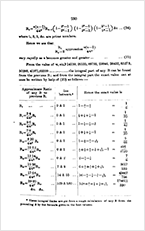
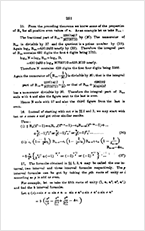
After the mathematics friends of Ramanujan fail to get a scholarship, he starts looking for work, and in March 1912, Ramanujan gets an accountantto the port of Madras . His boss - the chief accountant - was interested in academic mathematics and became his lifelong supporter. The head of the port of Madras at that time was an outstanding British civil engineer, so Ramanujan through him began to interact with some British expatriates. They talked about whether he has “the ability of a great mathematician” or is he just a “calculator boy”. They wrote to Professor Hill in London, who looked at a number of outlandish statements by Ramanujan about divergent ranks and stated that " Mr. Ramanujan is obviously a man with a taste for mathematics, and even with some abilities, but he is going the wrong way ." Hill invited Ramanujan to study some books.
While Ramanujan’s friends continued to look for a way to support him, he decided to start writing to British mathematicians himself - albeit with some help in writing letters in English. We do not know exactly to whom he wrote the first, although long-time associate Hardy John Littlewood, shortly before his death 64 years later, mentioned two names: H.F. Baker and E.V. Hobson . Both of them were not very good choices: Baker worked in the field of algebraic geometry, and Hobson was engaged in mathematical analysis: far enough from what Ramanujan did. In any case, not one of them answered.
And on Thursday, January 16, 1913 , Ramanujan writes his letter to G.Kh. Hardy.
Who was Hardy?
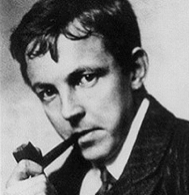
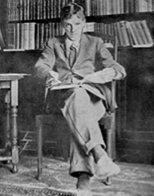
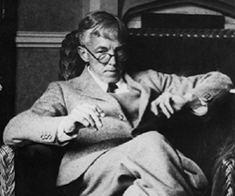
Godfrey Harold Hardy was born in 1877 in a family of school teachers. They lived roughly in the 30 miles to the south of London . From the very beginning he was the best student - especially in the field of mathematics. Even when I grew up in England in the early 1970s, such high school students usually moved to Winchester , and then went to Cambridge . This is exactly what Hardy did. Others were a little more famous, a little less rigorous and less mathematically oriented - these are Eaton and Oxford (which I entered).
Cambridge undergraduate students then tackled the ornately designed calculus problems (it was like a serious sporting event), and in the end they ranked students who ranged from Senior Wrangler (highest score) to Wooden Spoon (lowest passing score) ) Hardy thought he would be the first on the course, but ended up fourth. He came to the conclusion that he liked the strict and formal approach to mathematics, which then became popular in continental Europe.
The British academic system worked at that time (and until the 1960s) in such a way that after graduation, the best students could be elected as college fellows and receive scholarships even for life. Hardy was in the Trinity - College- The largest and best scientifically college at Cambridge University, and after graduating in 1900, he was elected a college scholar.
Hardy’s first research paper was about integrals like these:

For ten years, Hardy worked mainly on the intricacies of computation, figured out how to take different kinds of integrals and their sums, and insisted on a more rigorous approach to convergence and permutation of integration limits.
His works were neither great nor visionary, but they became excellent examples of mathematical skill. Like his colleague Bertrand Russell , he soon began to study a new field - transfinite numbers, but he did not work with them for long. Then in 1908 he wrote the textbook "The course of pure mathematics "- it was a good and even very successful book in its time (in the preface to it it was said that the textbook was intended for students whose abilities reach the level of the" scholarship standard ").
By 1910, Hardy was immersed in the routine of the life of a professor at Cambridge University and was engaged in academic work, and then he met John Littlewood. Littlewood grew up in South Africa and was eight years younger than Hardy, the recent Senior Wrangler and in many ways much more entrepreneurial. And in 1911, Hardy, who previously bot only himself, joined in collaboration with Littlewood, which lasted the rest of his life.
As a man, Hardy made the impression of a good schoolboy who would never grow up. He seemed to enjoy living in a structured environment, concentrating on his math exercises. He was very boring - whether it concerned scoring while playing cricket, proof of the absence of God, or writing rules for his collaboration with Littlewood. As a typical British, he could express himself with intelligence and charm, but he was tough and alienated: he even called himself “G. H. Hardy ”, being a“ Harold ”with only his mother and sister.
Thus, by the beginning of 1913, Hardy was a respectable and successful British mathematician, interested in a new collaboration with Littlewood, who pulled him into the field of number theory that interests him. But then he received a letter from Ramanujan.
The letter and its consequences
Ramanujan’s writing did not start very well: he seemed to think that he was describing for the first time the well-known technique of analytic continuation to generalize such ideas and concepts as factorial to non-integer numbers . He stated: " I have so developed these ideas in my research that local mathematicians are not able to understand me and my work ." However, after the cover letter, more than nine pages followed, which contained more than 120 different mathematical results.
There were rather vague statements at the beginning. But on the third page there were formulas for sums and integrals and other things. Some of them vaguely resembled those in Hardy's work. And some of them were definitely more exotic. Their general structure was characteristic of these types of mathematical formulas, however, some specific formulas were surprising: they stated that some things were mathematically equal, while they could not even be expected to be related.
At least two pages of the original letter were missing. The last page that we have, again, seems to end unsuccessfully: Ramanujan, describing the achievements of his theory of divergent series, comes to the seemingly absurd result that the sum of all positive integers is 1 + 2 + 3 + 4 + ... equal to -1 / 12.
How did Hardy react? First, he consulted Littlewood. Was this letter a hoax? Were these formulas already known, or perhaps completely wrong? Some they identified. But the rest - no. Hardy later said that they must be correct, " because if they were not true, no one would have the imagination to come up with them ."
Bertrand Russell wrote that the next day he "found Hardy and Littlewood in a wild state of excitement because they thought they had found a second Newton - a Hindu clerk who earns £ 20 a year in Madras . "Hardy showed Ramanujan's letter to many people and then began to make inquiries to the government departments that run India. All it took him a week, and then he wrote a reply letter to Ramanujan, in which the excitement read clearly: " I was very interested by your letter and theorems that you have formulated ."
he continued: " However, you must onyat that, before I can judge properly of the value of what you have done, I should see proofs of some of your assertions"It is curious that he said this. It was not enough for Hardy to just know that this was true; he needed evidence. Of course, Hardy could have found it on his own. However, it seems to me that he partially wrote so because he wanted to get a more complete the idea of how good a mathematician Ramanujan was.In
his letter, with his characteristic accuracy, Hardy divided the contents of Ramanujan's letter into three categories: what was already known; new and interesting, but not very important; and, finally, new and potentially important but one What was relevant to the third category was Ramanujan’s statement on the calculation of primes, adding that “ almost everything depends on the accuracy and rigor of the proof methods you used .”
Hardy, obviously, had done some preliminary studies of Ramanujan's work by that time, since in his letter he referred to his article on Bernoulli numbers . He writes: " I really hope that you will send me as soon as possible ... some of your evidence, " and then ends with the words: " in the hope of receiving an answer from you as soon as possible ."
Ramanujan really quickly responded to Hardy's letter. First, he wrote that he expected the same answer from Hardy as he did from one " professor of mathematics in London, " who simply told him " not to fall into the trap of divergent series ." He then responds to Hardy’s wish for rigorous evidence,if I showed you my methods of proof, then I’m sure you would join the opinion of the London professor . "Then he mentions his result
1 + 2 + 3 + 4 + ... = -1 / 12,
and adds that" ... if I I tell you, you will answer that my place is in the psychiatric hospital . "And he continues:" I am talking about this only to convince you that you will not be able to follow my methods of proof ... based on one letter . "He says that his first goal is to find someone like Hardy, to check his results, which means to have the opportunity to receive a scholarship, because " I already live half-starving. To save my brains, I need food ... "
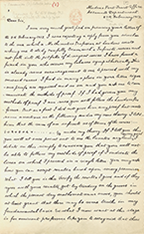
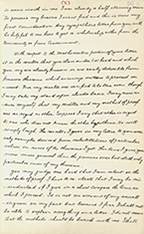
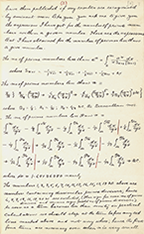

Ramanujan concludes with the words that the presence of the first category of results that are already known made him very happy, because " my results are verified - otherwise my position would be too shaky ." In other words, Ramanujan himself was not sure of the correctness of the results, and he was glad that he was right.
How did he get his results? Later I will talk about this in more detail. But he, of course, did all kinds of calculations with numbers and formulas - in fact, he was engaged in experiments. And he probably looked at the results of these calculations to see which ones were correct. It is still unknown how he defined this; in addition, some of his results in the end did not hold water. Perhaps he used both traditional methods of mathematical proofs and confirmation using calculations, and trusted his intuition. However, he said none of this to Hardy.
Instead, he simply corresponded with him about the details of the results, and also cited fragments of evidence that he was able to give. It seemed that Hardy and Littlewood deliberately offset his efforts: for example, Littlewood wrote about some of his results: "(d) this, of course, is not true . ”However, they both wondered if Ramanujan was“ Euler ”or simply“ Jacobi . ”However, Littlewood said:“ the material on primes is incorrect ”- in the sense that Ramanujan was wrong that zeta - Riemann zeta function has no complex zeroes, although in reality there are infinitely many (on this subject at the Riemann was the whole hypothesis ) Riemann hypothesis -. known and still unsolved mathematical problem , which is an optimist, a teacher suggested that Littlewood as project work when he was still a student.
What about the strange expression of Ramanujan 1 + 2 + 3 + 4 + ... = -1/12? It also relates to the Riemann zeta function. For positive integers, ζ (s) is defined as the sum
 . Wolfram Language has an interesting function - Zeta [s] - which can be obtained by expanding its scope to the entire set of complex numbers. Then, based on the formula for positive arguments, we can say that Zeta [-1] is the sum of 1 + 2 + 3 + 4 + ... But you can simply calculate Zeta [-1] :
This is too strange a result to just in believe him. However, not as crazy as it might seem at first glance. This is a result that is currently considered quite reasonable forcertain calculations in quantum field theory (in which, to be fair, all current infinities are designed to be canceled at the end).
Back to our story. Hardy and Littlewood did not have an acceptable mental model for Ramanujan. Littlewood suggested that Ramanujan did not want to provide evidence, because he was afraid that they would steal his work (the theft, as now, was a serious problem in the scientific community). Ramanujan said that he was “hurt” by these assumptions, and assured them that he “was not in the least afraid” that someone else would use his method. He added that he had invented the method eight years ago, but so far he had not found anyone who could appreciate it, and now he was “ready to hand over ... everything that is.”
At the same time (even before answering Ramanujan's first letter), Hardy, together with the government department responsible for Indian students, was studying how to transfer Ramanujan to Cambridge. It is not entirely clear what happened in this section of their correspondence, but Ramanujan replied that he could not go - perhaps because of his Brahmin beliefs, or because of his mother, or perhaps because he simply thought that he didn’t will fit into the new environment. But in any case, the supporters of Ramanujan made sure that he received a scholarship at the University of Madras . Other experts expressed the view that “ his results are remarkable; but he cannot at the moment provide any intelligible evidence of some of them ”; wherein "he possesses sufficient knowledge of English and is not too old to learn modern methods from books . "
The university administration said that their rules do not allow a graduate scholarship to those who, like Ramanujan, did not receive a bachelor's degree. However, they proposed a way out:" section XV registration Act and article 3 of the Indian universities from 1904 allows for the issuance of such a scholarship [by the State Department of Education] subject to the consent of the governor of Fort St. George in the Council. "and, in spite of the Bureau ratiyu, things moved quickly, and within a few weeks, Ramanujan was duly received a scholarship for two years with the only requirement to provide quarterly reports.
Ramanujan's work style
By the time he received his scholarship, Ramanujan began to write more articles and publish them in the journal of the Indian Mathematical Society. Compared to his ambitious ideas about primes and divergent series, the subject of these works was completely boring. However, they were wonderful.
What immediately amazes - they are full of real, complex formulas. Most math articles are different. They can be difficult to write and not contain large expressions, including complex combinations of roots or long integers.
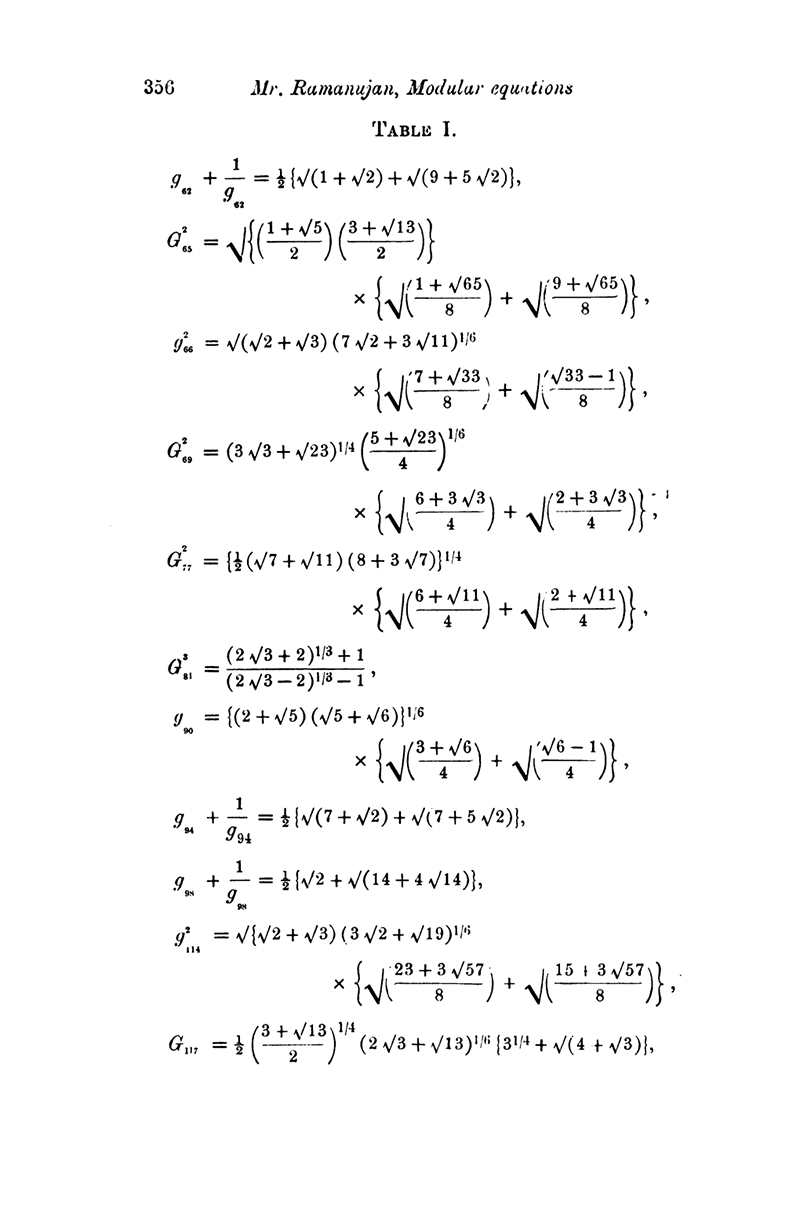
Other pages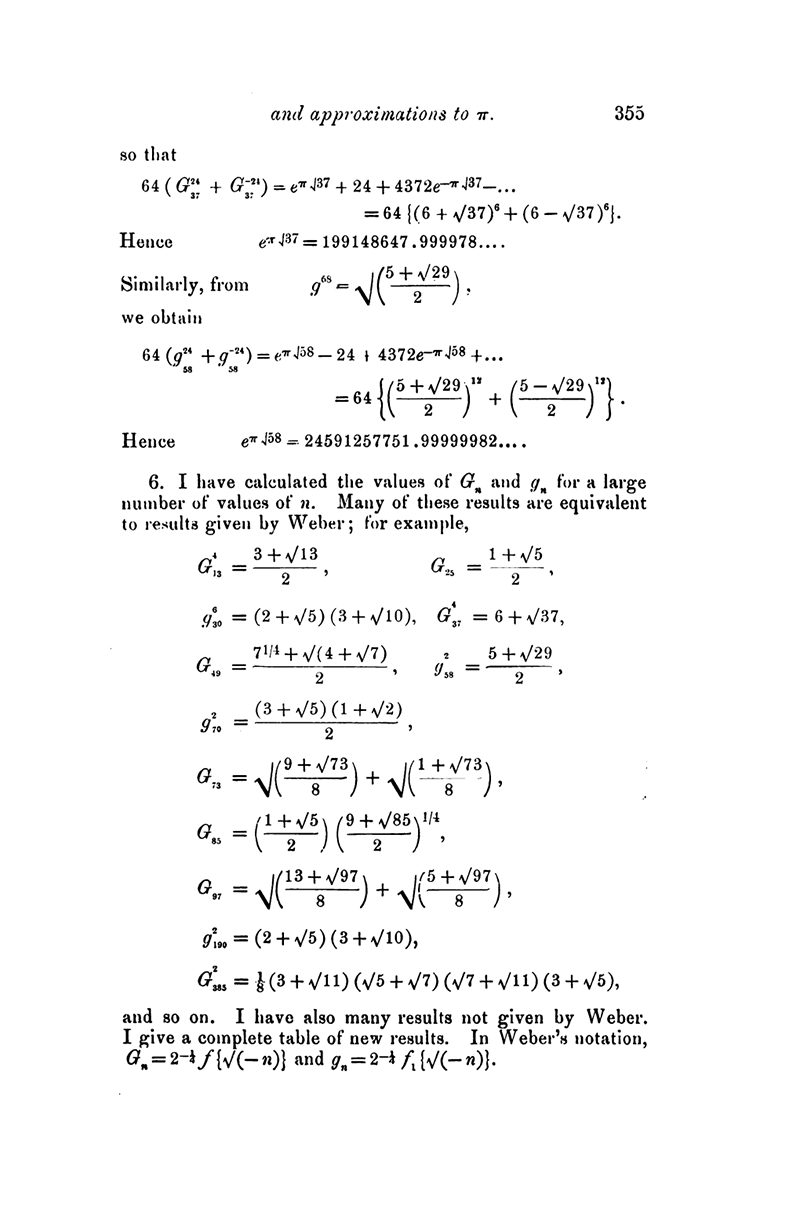
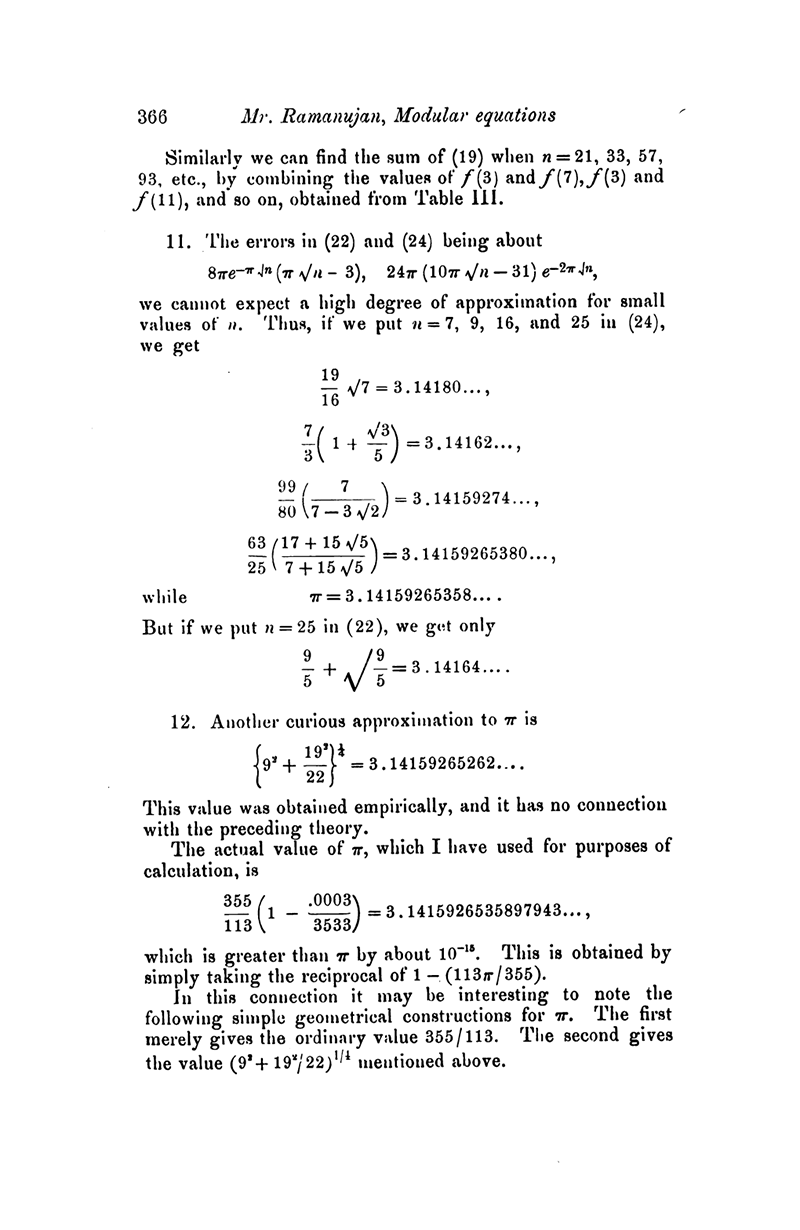
Now we are used to seeing incredibly complex formulas generated with Mathematica . However, they are intermediate steps, not topics for detailed discussion in articles. Ramanujan’s complex formulas hid history. It is incredibly impressive that he could bring them out without computers and other modern tools.
(By the way, back in the late 1970s, I started writing articles that included computer-generated formulas. And in one specific article , one of the formulas repeated the number 9 many times in a row. But the experienced typist who printed the article - yes, from manuscripts - replaced each “9” with “g.” When I asked her why, she said: “ Well, articles never have as many as 9 ”!).
Another distinguishing feature of Ramanujan's work is the frequent use of numerical approximations as arguments leading to accurate results. People tend to think of working with algebraic formulas as an exact process - for example, that the coefficient is exactly 16, not about 15.99999 exactly. However, for Ramanujan, approximations were commonplace, with the final results being accurate.
In a sense, it is not surprising that approximations to numbers are useful. Say we want to know which is more:
 or
or . We can begin to do all kinds of transformations for square roots and try to derive theorems from them. Or we can simply evaluate each expression numerically and find that the result of the first expression (2.9755 ...) is less than the second (3.322 ...). In the mathematical tradition, for someone like Hardy - or, for that matter, in typical modern calculus - such a direct way of calculating the answer to a question seems something inappropriate and wrong.
 And, of course, if the numbers are close, you need to be careful about numerical rounding and other things. Although today in Mathematica and with Wolfram Language with their integrated tracking systemsof numbers, we often use numerical approximations to obtain accurate results in the same way as Ramanujan did.
When Hardy asked Ramanujan for evidence, in part he only wanted to get a kind of story for each result that would explain it. But in a sense, the methods of Ramanujan are not amenable to this method. It is easy to understand that this is true, but it is very difficult to prove why this is so.
And the same thing happens when the key part of the result is obtained solely from the calculation of complex formulas - or, in our time, from the automatic proof of theorems. Yes, you can trace the steps and see that they are true. But the lack of context will not fully understand the results.
It would be unpleasant in the end to get some complex expression or seemingly random number, because such results would not tell most people anything. But Ramanujan was different. Littlewood once said of Ramanujan that " every positive number was his personal friend ." With a wonderful memory and good ability to notice patterns, Ramanujan could learn a lot from a complex expression or a long number. Each object as if asked to tell him its story.
Ramanujan generated all these things with his own efforts. But in the late 1970s and early 1980s. have I had an experienceautomatic generation of a large number of complex results using a computer. I did this for a while, and something interesting happened: from now on I was able to quickly recognize the “texture” of the results and could immediately see what would be true with a high degree of probability. If I was dealing with, say, some complex integrals, it was not the same as knowing theorems about it. My intuition worked - for example, I could guess which functions would appear as a result. Given this, I could make the computer continue and get a detailed picture - and therefore, make sure that the result was correct. But at the same time I could not deduce why the result was true; I just got it with intuition and calculation.
Now, of course, pure mathematics is enough, where it is impossible (for now) to do calculations in order to check whether or not some result is correct. This often happens, for example, when it comes to infinity or infinitesimal quantities or limits. In 1910, Hardy wrote a book called Orders of Infinity - about the intricacies that arise when infinite limits are taken (in particular, in the form of an algebraic analogue of the theory of transfinite numbers; he talked about comparing the growth rates of phenomena such as embedded exponential functions, and we even have gained some benefit from what are now called Hardy fields with respect to power series in Wolfram Language).
So when Hardy saw Ramanujan’s “quick and free” treatment with infinite limits and the like, it is not surprising that he reacted negatively and thought that he needed to “tame” Ramanujan - to accustom him to more subtle European ways of getting the right answers.
See what's important
Ramanujan was undoubtedly a great calculator man — and especially impressed with his knowledge of whether a particular mathematical fact or attitude was true or not. However, his greatest skill was the supernatural ability to distinguish the most essential and understand what exactly can be deduced from.
For example, take his article “ Modular Equations and Approximations of the Number P ” published in 1914 , in which he performs calculations (without a computer, of course):

Most mathematicians would say: “ the result is so close to an integer, it's just funny coincidence; so what? "But Ramanujan understood more . He found other relationships (these "=" should be ≅):
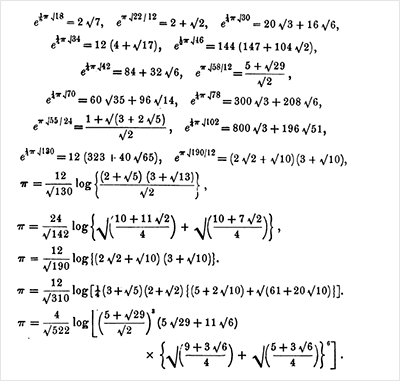
Then he began to build a theory that included elliptical functions (although Ramanujan did not yet know such a name at that time) and began to work on new approximations for pi:
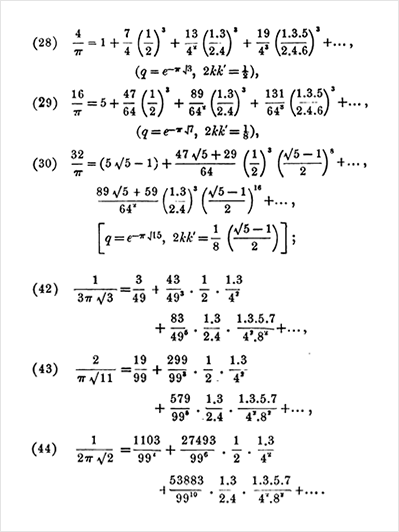
Previous approximations to pi were in a sense much more “robust” (although one of The best options before Ramanujan was Machina's formula of 1706), which included a random number 239:

But the strange series of Ramanujan had one important feature: they required much less conditions for calculating π with a given accuracy. In 1977, Bill Gosperwhich I had the pleasure of knowing for more than 35 years, took the last of the ranks of Ramanujan from the list above and used it to calculate the record number of digits of pi. Other calculations soon followed, based on the idea of Ramanujan, the method we use to calculate pi in Mathematica and Wolfram Language.
If you look at the articles of Ramanujan, it becomes clear that even he himself sometimes did not know what was (or was not) statistically significant. For example, he noted:
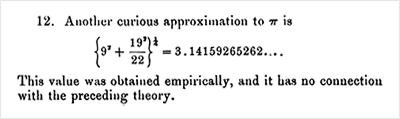
And then (this is practically his only published example from geometry), on the basis of this formula, he presented a peculiar geometric construction of the “quadrature of a circle”:

Truth or explanation
Surely for Hardy, the way Ramanujan worked was alien. Ramanujan was an experimenter in mathematics : he freely entered the universe of mathematical possibilities and made calculations in order to find interesting and significant facts - and only then built theories based on them.
Hardy, on the other hand, worked in a traditional way, gradually expanding the descriptive part of existing mathematics. Most of his work begins - explicitly or implicitly - with a citation of some result from the mathematical literature, and then continues with a story about how this result can be distributed using a number of precise steps. He does not have sudden empirical discoveries, nor does he have inexplicable leaps based on intuition. His math is carefully argued and built brick by brick.
A century later, almost all the work in mathematics is done like this. And even if you discuss the same subject, perhaps something should not be called "mathematics" because the methods are too different. At that time, as I own forces investigated the computational universe simple program , I have done a fair amount of what might be called "mathematical" in the sense that, for example, I have examined the system , based on numbers .
Over the years, I have found all kinds of interesting results. Bizarrely nested recurrence relations that generate prime numbers. Peculiar representations of integersin the form of XOR trees. But empirical facts alone are not yet part of the tradition of existing mathematics.
For many mathematicians like Hardy, the proof process is the foundation of mathematical activity. It is easy to speculate what is true; it’s more important to create a proof that explains why something is true, so that other mathematicians understand it.
Today, when we are able to automate more and more evidence, this process begins to resemble manual labor, where the result can be interesting, but the process of obtaining it is not. But the proof process can also go a long way. Evidence can become the material with the help of which new abstract concepts are introduced that go beyond the details of this proof, and also provide “raw materials” for understanding many other mathematical results.
I suspect that Ramanujan, for whom these facts and results were the center of his mathematical thinking, felt like a strange European customs, necessary to remove his results from their specific context, and to convince European mathematicians that they were true.
Going to Cambridge
But back to the story of Ramanujan and Hardy.
By early 1913, Hardy and Ramanujan continued to exchange letters. Ramanujan described his results; Hardy criticized him and insisted on the evidence and its traditional presentation. Then there was a long break, but in December 1913 Hardy wrote again, saying that Ramanujan’s most ambitious results on the distribution of primes were definitely wrong, adding that " ... the theory of primes is full of pitfalls, overcoming of which requires the application of modern rigorous methods ." He also said that if Ramanujan could prove his results, it would become " one of the most remarkable mathematical achievements in the history of mathematics ."
In January 1914, a young Cambridge mathematician, E. H. Neville, came to Madras to give lectures and announced that Hardy was "seeking to transfer Ramanujan to Cambridge." Ramanujan replied that back in February 1913, he and his boss had a meeting with the secretary of the advisory student committee of Madras, who asked if he was ready to go to England. Ramanujan wrote that he suggested that he should have passed the exams in the same way as other Indian students who were leaving for England (and he thought that he would not be able to cope with this), and that his supervisor was “a very orthodox Brahmin, and since he doubted whether it was worth going to a foreign land, he told me that he was not worth it . "
He later said that Neville “dispelled [his] doubts”, explaining that he did not have to worry about expenses, that his English was happy for everyone, that he would not have to take exams and that he could remain a vegetarian in England. Ramanujan concluded by saying that he hoped that Hardy and Littlewood would be " kind enough to take the trouble to accept me [in England] for several months ."
Hardy suggested that there would be no bureaucratic problems and that Ramanujan would easily fall into England; however, it didn’t. Trinity College, in which Hardy worked, was not ready to provide any real funding. Hardy and Littlewood offered their money, but Neville wrote to the secretary of the University of Madras : "the discovery of the genius of S. Ramanujan from Madras promises to be the most interesting event of our time in the mathematical world , "he suggested that the university find money. Experts-supporters of Ramanujan took active steps, eventually got the attention of the governor of Madras, and the money was found: they were taken from the government a five-year-old grant intended for “instituting lectures at the university during the holidays”, and in the language of the bureaucracy it sounded something like this: “Document No. 182 of the Department of Education” ... “not used .-label "
in the bureaucratic protocols were strange registry - for example, on February 12," To what caste he belongs urgently "But in the end all the difficulties have been overcome, and?. March 17, 1914after seeing off with the participation of local dignitaries, Ramanujan gets on a ship to England, going up the Suez Canal , and arrives in London on April 14 . Before leaving India, Ramanujan prepared for European life: he wore Western clothes, learned to eat with a knife and fork and tie a tie. For those Indian students who came to England earlier, there was a whole procedure. A few days later, Ramanujan arrived in Cambridge, and Indian newspapers proudly reported that " Mr. S. Ramanujan from Madras, whose work in higher mathematics was astonishing in Cambridge, is currently in a residence in Trinity ."
(In connection with the first days of Ramanujan in Cambridge, in addition to the names Hardy and Littlewood, two other names appear:Neville and Barnes . They are not particularly known in the general history of mathematics, but it so happened that in Wolfram Language their names carry built-in functions: NevilleThetaS and BarnesG ).
Ramanujan in Cambridge


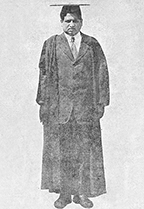

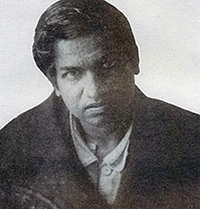
What was Ramanujan like when he arrived in Cambridge? He is described as enthusiastic and active, albeit unsure of himself. He joked, sometimes at his address. He could speak not only about mathematics, but also about politics and philosophy. He was not too reflective. When communication was official, he was polite and respectful and tried to follow local customs. His mother tongue was Tamil., and he had previously failed by failing English exams, but by the time he arrived in England his English was excellent. He loved hanging out with other Indian students, sometimes going to music events or boating on the river. He was short and full; his main remarkable feature was his eyes - bright and shiny. He worked hard, solving one mathematical problem after another. His meager living space was composed of only a few books and articles. He was prudent in practical things: for example, in solving problems with cooking and finding vegetarian products. We can say that in Cambridge he was happy.
However, later, on June 28, 1914 (just two and a half months after Ramanujan arrived in England), Archduke Ferdinandwas killed, and on July 28 the First World War began. This immediately affected Cambridge. Many students were called up for military service. Littlewood joined the military and eventually developed a way to calculate range tables for anti-aircraft guns. Hardy was not a big supporter of the war (not least because he loved German mathematicians), but he also volunteered and was subsequently rejected for medical reasons.
Ramanujan described the war in letters to his mother, saying, for example: “ they fly in airplanes at high altitude, bomb cities and destroy them. As soon as enemy planes appear in the sky, airplanes standing on the ground take off and attack them at great speed that brings destruction and death . "
Nevertheless, Ramanujan continued his studies in mathematics, explaining to his mother that "the war is fought in territories so remote as far as Rangoon is far from [Madras] ." There were also practical difficulties - for example, the lack of vegetables, which prompted Ramanujan to ask a friend from India to send him a parcel “ some tamarind seeds and good coconut oil ”. More importantly, as Ramanujan wrote, "the professors here ... have lost interest in mathematics because of the current war ."
Ramanujan also wrote to a friend that “he changed the plan for publishing his results"He said that he would wait for the end of the war in order to publish any of his old results. But he said that since arriving in England he had mastered" their methods, "and was trying to" get new results by their methods in order to easy and published without delay ".
in 1915 Ramanujan published a lengthy document entitled" vysokosostavnye numbers "for the peaks function ( DivisorSigma in Wolfram Language), which counts the number of divisors of a given number. Hardy, in all probability, was actively involved in the preparation of the hundred Lu, who became the foundation of the theses for doctoral dissertation Ramanujan.
Over the next few years, Ramanujan worked fruitfully and wrote articles that, despite the war, were published. Together with Hardy, he wrote a significant article on the distribution function ( PartitionsP in Wolfram Language), which describes how to write an integer as the sum of positive numbers. This article is a classic example of mixing approximate and accurate calculations. The article begins with a result for large n :
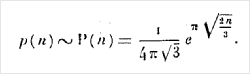
But then, using the ideas of Ramanujan developed in India, the score gradually improves to the point where you can get the resulting integer. At the time Ramanujan lived, calculating the exact value of PartitionsP [200]was a big deal - and the culmination of his article. But today, thanks to the Ramanujam method, these calculations can be carried out instantly:

Cambridge was crushed by the war - better students perished at terrifying speeds on the front lines. The large quadrangle of Trinity College has become a military hospital. But, despite all this, Ramanujan continued to study mathematics - and with the help of Hardy earned himself fame.
In May 1917, Ramanujan became ill. As far as one can judge, it was probably some kind of parasitic infection of the liver brought by him from India. But then no one could make a diagnosis. Ramanujan went from doctor to doctor, but he did not believe what he was told, and it seemed that nothing would help. In some months, he felt good enough to do math; in others, no. He became depressed, and at some point, apparently, was prone to suicide. He did not help that his mother returned his wife back to India, protecting him from talking to her and fearing that she would distract him.
Hardy tried to help: sometimes by interacting with doctors, sometimes by providing mathematical data. One doctor told Hardy that the cause could be "some unknown pathogen from the East, completely unexplored at the present time . "Hardy wrote:" Like all Indians, Ramanujan is a fatalist, and therefore it is terribly difficult to make him take care of himself . "Later, Hardy told the now famous story about how once he visited Ramanujan in the hospital and said that he had arrived in a taxi with the number 1729, and that he thought it was a rather dull number, to which Ramanujan replied: “ No, this is a very interesting number; this is the smallest number that can be represented as the sum of two cubes in two different ways ":
 (Wolfram | Alpha now also reports on some of its other properties ).
However, despite all the problems, Ramanujan's reputation as a mathematician continued to grow. He was elected a member of the Royal Society (which included Hobson and Baker, none of which responded to his original letter), and in October 1918 he was elected a member of Trinity College, which provided him with financial support. A month after the end of World War I, the threat of a submarine attack, which made travel to India dangerous, disappeared.
And on March 13, 1919, Ramanujan returned to India - very famous and respected and very sick. He is still engaged in mathematics and, in particular, writes Hardy a notable letter about “false” theta functions ( January 12, 1920) He decided to live modestly, and largely ignored the little that medicine could do for him. And on April 26, 1920, at the age of 32 and three days after the last entry in his notebook, he dies.

What happened next
When Ramanujan began to study mathematics, he wrote down his results in hardcover notebooks , publishing only a small part of them. When Ramanujan died, Hardy wanted to study and publish all 3,000 (or so) results from Ramanujan's notebooks. Several people also worked on this in the 1920s and 1930s, and as a result a lot of things were published. However, the project was not completed - they will return to it only in the 1970s.


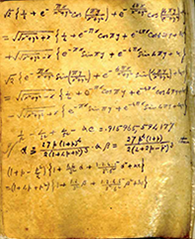


Download the first , second , third notebook.
In 1940, Hardy handed over all of Ramanujan's letters to the University of Cambridge.but the original letter that Ramanujan sent in 1913 was not among them, so now the only thing we have is the later published arrangement of this letter to Hardy . The three main notebooks of Ramanujan lay for many years on a cabinet in the office of a librarian at the University of Madras, where they suffered from insects, but were not lost. His other notes went through several hands, and some of them ended up in the incredibly dirty office of a Cambridge mathematician ; however, when he died in 1965, they were noticed and sent to the library, where they gathered dust until they were "rediscovered" in 1976 as lost records of Ramanujan .
When Ramanujan died, his relatives almost immediately began to ask for financial support. Large bills for treatment came from England, and talk began of selling Ramanujan's papers to raise money.
The wife of Ramanujan was 21 years old when he died, but she never married again. She lived very modestly, earning her living by sewing. In 1950, she took on the upbringing of the son of a deceased friend. By the 1960s Ramanujan became something like an Indian hero, and she began to receive various awards and pensions. Over the years, many mathematicians came to visit her, one of whom she gave a photograph from Ramanujan’s passport, which became his most famous image.
She lived a long life and died in 1994 at the age of 95, having outlived Ramanujan for 73 years.
What happened to Hardy?
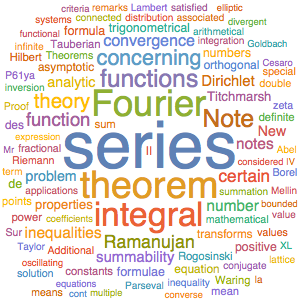
Hardy was 35 years old when he received Ramanujan's letter, and 43 years old when he died. Hardy viewed Ramanujan's “discovery” as his greatest achievement, and described their collaboration as “the first romantic event of his life .” After the death of Ramanujan, Hardy worked for some time, continuing to decode and develop his results, but for the most part he returned to his previous mathematical trajectory. The complete collection of his works consists of seven large volumes (whereas the publication of Ramanujan is one thin book). These clouds from the names of his works show only some of the changes that occurred (the first cloud - before meeting with Ramanujan, the second - after):

Shortly before Ramanujan came into his life, Hardy began to collaborate with John Littlewood (he would later say that Littlewood had even more influence on his life than Ramanujan). After Ramanujan died, Hardy moved to Oxford to work and lived there for 11 years before returning to Cambridge. His absence did not affect collaboration with Littlewood, as they worked primarily through written messaging, even if their rooms were only a few hundred feet apart. After 1911, Hardy was published without a co-author; most fruitfully he worked with Littlewood, having published over 38 years 95 articles with co-authorship with him.
Hardy's math has always been of the highest quality. He dreamed of creating something similar to the solution of the Riemann hypothesis, but in reality did nothing truly exciting. He wrote two books that are read to this day: "Introduction to Number Theory" with EM Wright ; and “Inequalities” with Littlewood and D. Poia .
Hardy lived his life among the intellectual elite. In the 1920s, he hung an image of Leninin his apartment and briefly was the president of the union of “workers from science”. He wrote elegantly: mainly about mathematics, and sometimes about Ramanujan. He eschewed technical innovations and always lived with his students and professors in his college. He never married, and towards the end of his life, his younger sister joined him in Cambridge (she also was never married and spent most of her teaching life in a girls' school, in which she studied as a child).
In 1940, Hardy wrote a small book called Apology of Mathematics. When I was about 12, I got a copy of this book. I think that many people saw it as a kind of manifesto or advertisement of pure mathematics. I must say that I do not agree with this at all. I immediately felt that he was a strict hypocrite, and his attempts to describe the aesthetics and joys of mathematics did not impress me at all, as well as the pride with which her author said that “ nothing of what I have ever done has not the least practical value "(in fact, he became the co-promoter of the Hardy-Weinberg law used in genetics). I doubt that one way or another I would choose the path of pure mathematics, but Hardy's book helped me to be convinced of this.

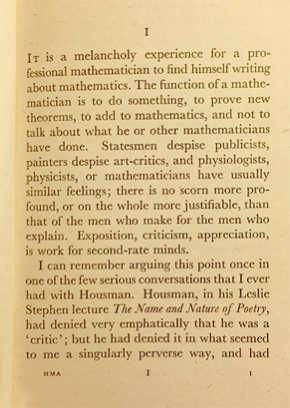
In fairness, it is worth noting, however, that Hardy wrote this book during the black streak in his life, when he was concerned about his health and the loss of his mathematical abilities. Perhaps this will explain why he ends it with the words " math ... this is a game for young people ." And in an article about Ramanujan, he wrote that "the mathematician at 30 is already relatively old, and his death may be a lesser catastrophe than it seems ." I do not know whether such an opinion was expressed before, but in the 1970s it was accepted as a fact, extending to all science and mathematics - in particular.


Is it really? I doubt it. It is difficult to obtain clear evidence, but as an example I took data on well-known mathematical theorems (in Wolfram | Alpha and Wolfram Language) and made a histogram of the age of the people who proved them. The distribution is not quite even (the peak before 40 is probably related to the effect of selecting theorems related to the Fields Prize ), but even if we adjust the life expectancy now and in the past, we will not see that mathematical performance is depleted by 30 years.

I think at least until my agescientific productivity is actually steadily increasing. My best ideas were born out of the fact that I found connections between things that I learned with a difference of decades. Age is also at hand in the sense that over the years more and more experience and intuition is accumulating about how everything will work. And your earlier successes can help provide confidence in order to move forward. Of course, you need to maintain a certain level in order to focus for a long time, thinking over complex things. I think that in some ways I became slower with age, and in some ways - faster. I am slower because I know more about the mistakes that I usually make, and I try to work more carefully to avoid them. But I'm faster because I know more and can shorten many operations. In particular, it helps me a lot,all types of automation that are able to use.
It is a completely different matter that creating a contribution to an existing field (as Hardy did) can be done by a young man, while creating a new structure, as a rule, requires wider knowledge and experience that comes with age.
But back to Hardy. I suspect that it was the lack of motivation and not ability in recent years that led him to become completely depressed and quit mathematics. He died in 1947 at the age of 70.
Littlewood, who was ten years younger than Hardy, survived until 1977. Littlewood has always been more active and adventurous than Hardy, and a little less austere and majestic. Like Hardy, he never married, although he had a daughter, who for some reason he called his niece until she was forty. Littlewood, who began taking antidepressants on time at the age of 72, was extremely productive in his 80s, refuting Hardy’s claim that math is a game for young people.
Math Ramanujan
What happened to the math of Ramanujan? In the early decades, not too much. Hardy continued to do something, but the whole number theory , in which most of Ramanujan's work was concentrated, went out of fashion. Below is a graph that shows the proportion of all mathematical work labeled “number theory” as a function of time ( Zentralblatt database ):
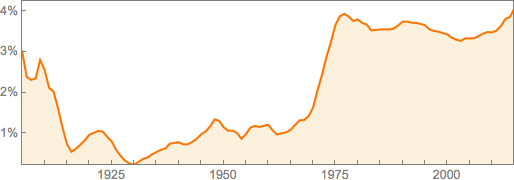
Ramanujan’s interest was to a certain extent due to the peak of the early 1900s. (which would probably be even higher given earlier data). However, by the 1930s. The attention of mathematicians has shifted from number theory and mathematical analysis to the side of greater generality and formality, which are characteristic of the sphere of algebra.
However, in the 1970s, number theory suddenly became more popular again, driven by advances in algebraic number theory (among other subcategories showing significant growth at that time, it is worth noting automorphic forms, elementary number theory and sequences).
In the late 1970s, of course, I had already heard about Ramanujan, although more about his history, not mathematics. And when I wrote about the vacuum in quantum field theory in 1982 , I was pleased to use the results of Ramanujan to propose closed forms for specific cases (infinite sums in different sizes of quantum field modes corresponding to the Epstein zeta function):

Since the 1970s, much work has begun to prove the results of the work of Ramanujan (the very ones from the notebooks), but it is still far from complete. As this work progresses, connections between his results grow, and new general topics arise in the field of number theory.
For the most part, Ramanujan studied the so-called special functions and came up with some new ones. Special functions (zeta functions, elliptic, theta functions, etc.) can be considered as convenient mathematical “packages”. You can define an infinite number of possible functions; however, those called “specials” survived because they proved their need more than once.
And today, for example, in Mathematica and Wolfram Language, we have special features like RamanujanTau ,RamanujanTauL , RamanujanTauTheta and RamanujanTauZ . I have no doubt that over time there will be more functions with his name. In the last year of his life, Ramanujan defined some particularly ambitious special functions, which he called "imaginary theta functions" (however, they still need refinement in order to be able to define them constantly).
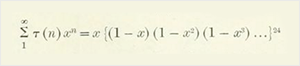
If you look at the definition of the tan function of Ramanujan , it will seem very strange (pay attention to “24”): In my opinion, the most remarkable thing in Ramanujan is that he was able to randomly identify some things that turned out to be useful for a century later.
Are the facts random or not?
In ancient times, the Pythagoreans attached great importance to the fact that 1 + 2 + 3 + 4 = 10. Today it seems to us that this is a random fact that does not have much significance. When I look at the results of Ramanujan, many of them also seem to me to be random facts from mathematics. However, work on his recordings (especially in recent decades) shows that they are not accidental. On the contrary, it is increasingly being discovered that they are consistent with serious and elegant mathematical laws.
In order to state these principles in a formal way, a number of abstract mathematical concepts and a language are required, the development of which takes decades. However, through experience and intuition, Ramanujan was able to find concrete examples illustrating these principles. Often his examples look full of random definitions and numbers. But perhaps this is exactly what is needed in order to express modern abstract principles in terms of concrete mathematical constructions of the early twentieth century. This is a bit like the poet trying to express deep general ideas, but is forced to use only an imperfect tool - human language.
To prove many of the results of Ramanujan was a difficult task. Partly because creating the kind of context necessary for proof requires building up much more abstract and conceptually complex structures.
So how did Ramanujan actually manage to predict all these deep principles of later mathematics? I think that there can be two options. Firstly, if someone, having received a rather unexpected result, say, in number theory, goes further in an attempt to understand it, then in the end he will achieve a certain principle. The second possibility is that Ramanujan seemed to have an aesthetic feeling that helped him to combine seemingly random facts that fit together and have a deeper meaning.
I do not know exactly which of the assumptions is true; perhaps they are combined. To understand this a little better, it’s worth talking about the general structure of mathematics. In a sense, mathematics in practice is strangely suspended between the trivial and the impossible. At a deep level, mathematics is based on simple axioms. For example, for a Boolean algebra , taking into account the axiom, there is a simple procedure to find out if any particular result is true or not. However, starting with Gödel’s theorem of 1931 (which Hardy should have known, but apparently never commented on), it became known that things are different for a field like number theory: in the context of the theory, there are statements whose truth or falsity is insoluble from axioms.
In the early 1960s It was proved that there are polynomial equations with integers, from which (from the axioms of arithmetic or from formal methods of number theory) it is impossible to understand whether they have solutions. Concrete examples of such classes of equations are extremely complex. But, following my research in the computing universe , I have long concluded that there are much simpler equations where this also happens. Over the past few decades, I have interviewed many of the world's leading theorists about where, in their opinion, lies the boundary of unsolvability. Opinions differ, but they certainly lie within the boundaries of the possible (for example, cubic equations with three variables).
It is possible that Ramanujan could set forth a result that simply cannot be proved using the axioms of arithmetic. The Goldbach hypothesis can be cited as an example . The same may apply to other results of Ramanujan.
It took several decades to prove some of the results of Ramanujan, but the important fact is that they are generally provable. This is important because it is not just random facts; these are facts that in one way or another may be connected with evidence of the main axioms.
In general, I support the idea that Ramanujan possessed such aesthetic criteria and intuition that in his works he was able to “capture” some of the deep principles that we learned much later.
Automation of Ramanujan
It is not difficult to collect mathematical statements in random order, and then to obtain empirical evidence of whether they are true. Gödel’s theorem actually means that you will never know how far you have to go in order to be sure of any particular result. Sometimes not far, and sometimes vice versa.
Ramanujan convinced himself that many of his results were equal to empirical methods, and this often worked. Hardy noted that in the case of counting primes, a lot of subtleties appear, and results that could work up to very large numbers will ultimately fail.
Let's say someone looks at the space of possible mathematical statements and selects those of them that may turn out to be true. Now the next question is: are these statements related?
Imagine that you could find evidence of true statements. This evidence actually corresponds to a trajectory along a directed graph, which begins with axioms and leads to true results. Alternatively, you can imagine the graph as a star, when the proof of each of the results from the axioms occurs independently of each other. Another option is that in the process of moving from axioms to results, there are many common “waypoints”. And it is these waypoints that actually represent the general principles.
If there is a certain sparseness in the results, it is inevitable that many of them are connected through a small number of general principles. It may also be that there are results that are not related in this way, and they (simply because of the lack of connections) are not considered “interesting” and fall out of the discussion of a specific topic.
I must say that these considerations lead to an important issue for me. I spent many years studying what constitutes a generalization in mathematics: the behavior of arbitrary simple programs in the computing universe. I found that in such programs you can see all the wealth of complex behavior. But I also found evidence (not least using the principle of computational equivalence ) that there is more than enough insolubility.
When you look at all this rich and complex behavior, is it possible to find facts there, similar to those that Ramanujan had? In the final analysis, there will be many of those that cannot be easily discussed in the framework of axiomatic systems. But perhaps there are networks of facts that are associated with some deeper principles.
According to the principle of computational equivalence, there will always exist a kind of zone of “computational reducibility”: places where it will be possible to identify abstract examples and draw abstract conclusions without running into unsolvability. Trivial examples are repetitive behavior and nested behavior . But now the question arises: are there any general forms of organization among all the specific details of specific programs.
While repetition and nesting are observed in so many systems, it may turn out that another form of organization will be considered much more narrowly. But we do not know how. And even today we won’t learn much until a researcher like Ramanujan arrives - not only in the field of traditional mathematics, but in the field of the computing universe.
Modern Ramanujans?
Will there ever be another Ramanujan? I don’t know whether the legend of Ramanujan influenced this or if it’s just how our world works, but for at least 30 years I’ve been receiving a constant stream of letters — like what Hardy received from Ramanujan back in 1913. Just a few months ago, for example, I received a letter (from India) depicting a notebook in which various mathematical expressions were listed, very reminiscent of the work of Ramanujan
 .
. 
Do these facts matter? I don’t know ... Wolfram | Alpha can generate many similar facts , but without Ramanujan understanding one cannot say which ones are significant.

Over the years, I have received countless messages of this kind. Their common theme is number theory, relativity theory and gravitational theory. Also in recent years, AI and consciousness topics have become popular . What is good in letters related to mathematics is the specifics: some formulas, or fact, or theorem. In Hardy's day, such things were hard to verify; Today it is much easier. However (as in the case of the almost integer above), the question still remains whether this fact is “interesting” or is it random and has no value.
Of course, the very definition of “interesting” is neither simple nor objective. And the problems are the same as Hardy’s with Ramanujan’s letter. If one could see how this fact fits into a wider picture (some description), then one could understand this at least approximately. However, if a person does not have a wider picture, then there is no way to decide what should be considered interesting.
When I first began to study the behavior of simple programs, there really was no context that would help to understand what was going on in them. The resulting pictures from meturned out to be interesting. However, it was still unclear what story was behind them. It took many years before I accumulated enough empirical data to formulate hypotheses and develop principles that allow me to return and see what was interesting in what I observed.
I spent several decades developing the science of the computing universe. But she is still young, and much of what can be found is accessible and does not require complex technical knowledge. Therefore, I often receive letters that demonstrate the wonderful behavior of a particular cellular automaton or other simple program. Often I find out the general form of behavior, because it refers to things that I saw before, but sometimes not, and therefore I can’t be sure that it will be interesting in the end.
At the time of Ramanujan many “random facts” were published: a special type of integral, taken for the first time, or a new class of equations that could be solved. Many years later, we collected as many of them as we could and created using them the algorithms and knowledge bases of the Mathematica and Wolfram Language systems . But at that time, the most important aspect of their publication was the evidence that was attached: stories that explain why the results are true. Because there was at least the likelihood that concepts that could be reused were introduced in this evidence.
A detailed discussion would lead us too far, but there is a kind of analogue in the doctrine of the computational universe: this is the methodology of computer experiments. Just as the proof may contain elements that determine the general methodology needed to obtain a mathematical result, specific methods of search, visualization and analysis can determine something in computer experiments (something general and suitable for reusable use) and give an idea of some basic ideas or principles.
Like many mathematical journals during the time of Ramanujan, I created a journal and forum in which specific results about the computing universe can be presented (although much more could be done in these areas).
When the received letter contains a certain mathematical terminology, then at least there is something concrete that can be understood. However, there are many things that cannot be formulated in mathematical terminology. And too often, unfortunately, letters written in plain English (or, worse for me, in other languages), I can not understand. However, now more and more people are formulating something using the Wolfram Language . In this case, I can always say what exactly someone is trying to say, although I still can’t understand whether the contents of the letter are important or not.
Over the years, I met many interesting people through letters that they wrote to me. They often come to our summer school (see article "Wolfram summer school: a participant’s story "on Habré) or publish something in one of our channels. I have not had (yet) such a dramatic story as Hardy and Ramanujan did. It’s very good that it’s possible to connect with people in this way “Especially in their formative years. And I cannot forget that a long time ago I was a 14-year-old teenager who sent articles about research that I would like to do to physicists from around the world ...”
What would happen if Ramanujan had Mathematica?
Ramanujan did his calculations manually - with chalk on a blackboard, and later - with pencil on paper. Today we have very powerful tools (Mathematica and Wolfram Language) with which you can conduct experiments and make discoveries in mathematics (not to mention the computing universe as a whole).
It is interesting to imagine what Ramanujan would do with these modern tools. I think that he would find all sorts of unusual and amazing things in the mathematical universe, and then, using his intuition and aesthetic feeling, he would see what converges and what needs to be investigated.
Ramanujan had wonderful skills. But it seems to me that in order to follow in his footsteps, you need to be brave: not to remain in the comfort of well-established mathematical theories, but instead to go into a wider mathematical universe and begin to experiment.
It took almost a century to put many of Ramanujan's discoveries into a wider and more abstract context. Ramanujan inspires us to take a big step forward - even before a wider context has been understood. And I hope that many more people will use the tools that we have today to follow the example of Ramanujan and make great discoveries in experimental mathematics - whether they write about it in letters or not.