July 21, 2016 at 14:36
Yota on Sakhalin: how communication comes to the island

Cape Aniva, Sakhalin Island. Image: World of Travel .
Yota is becoming available to subscribers in the most remote corners of the country. We went beyond the borders of mainland Russia and launched work on Sakhalin - more than 9,000 kilometers from Moscow. We will tell about how modern forms of communication come to the islands under the cut.
The most remote Internet

One of the most remote pieces of land on the planet from the mainland is the island of Pitcairn . The nearest village is 2100 kilometers away. The entire population of the island is a few dozen people, presumably descendants of the rebels from the British ship Bounty .
There is a store, warehouse, library, medical center, 126 kbps Internet and its own domain - .pn. Internet at Pitcairn is provided via satellite.
But not all islands use space communications. In some cases, submarine fiber optic cables are laid across the islands, which are used to exchange information between continents.
World underwater internet
habrastorage.org/getpro/habr/post_images/0af/936/80a/0af93680a6fdfe8398b0b7c7471a3d78.gif
Schematic illustration of the laying of the underwater cable .
For laying an underwater trunk cable, a special installation is lowered from the ship. She buries the cable in the seabed so that it is not damaged by sea vessels or animals.

In this photo you can see the installation for deepening, reminiscent of a conventional plow.
To deepen the cable, underwater chain mechanisms, rotary excavators (for dense deposits), as well as systems that erode the trench with a powerful pressure of water (for sandy bottom sediments) are used. Now they know how to deepen the cable into the ground at depths of up to 2,500 m.
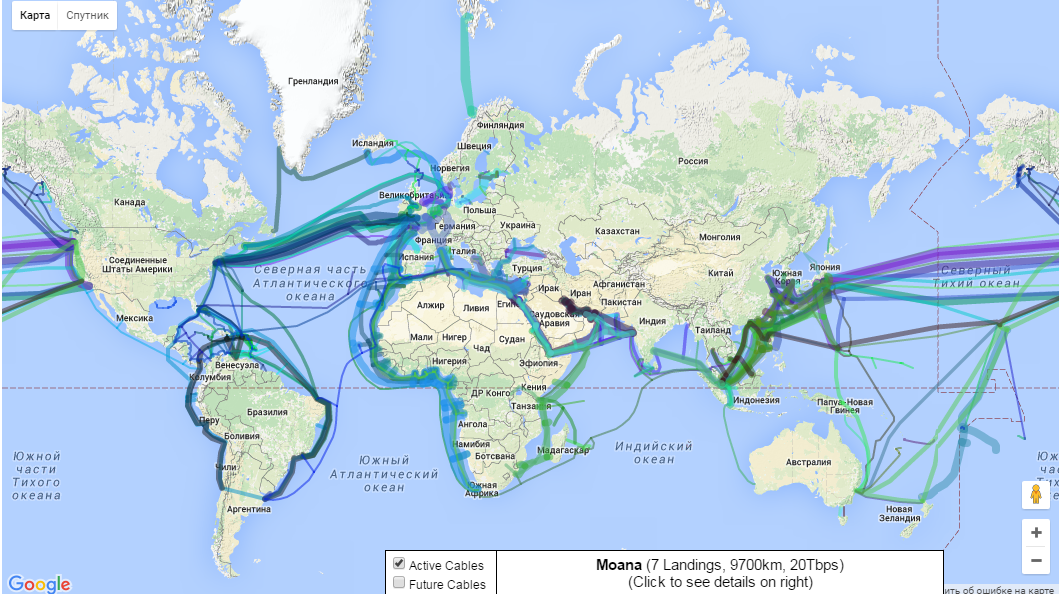
This is how the world map of submarine cables looks. Bylink you can see the bandwidth of the cables and their length, as well as the layout of future projects of submarine cables. We are interested in Sakhalin.

On the left you see the existing cable, in the center and on the right - future projects.
Communication history on Sakhalin

The first communication line was laid from the mainland to the island in 1881: a telegraph cable connected De Kastri (a village on the shores of the Sea of Japan, Khabarovsk Territory) and the center of Sakhalin penal servitude - Aleksandrovsky post. In July 1901, the cable failed - this is how the first, but far from the last, disconnection from the island happened.

The accident was so serious that it was not possible to restore the communication line. In 1902, a bypass line was built along the bottom of the Nevelsky Strait from Cape Lazarev to Cape Pogibi - this is the narrowest point of the strait (3.7 km). However, this option turned out to be even less reliable: almost every year, floating ice damaged the cable in shallow waters. Only the construction of a radio telephone exchange on the island allowed us to resolve the issue of sustainable communication with the mainland. However, attempts to lay the cable along the bottom of the strait did not end. In the mid-1930s, when the island belonged to Japan, a cable was laid between Sakhalin and Hokkaido.
In the 1970s, a copper line was laid between Cape Pogibi and the mainland. The PCM-15 system worked on it, designed to organize group telephone paths. Through two twisted pairs, the system was able to transmit up to 15 telephone channels. However, this cable also periodically failed due to damage by fishing vessels.
In 1969, the Great Northern Telegraph Company built the JASC coaxial cable line between Sakhalin and Japan, which has been successful for several decades. Replaced it in 1995, when the first fiber optic line was built. Surprisingly, Sakhalin did not connect the “mainland” to the Internet, but another island - the project was implemented by the Japanese company KDD.
In 2005, a cable was finally stretched from mainland Russia. Alas, the project was implemented with a large number of violations, and the cable itself was not fixed in the ground. He received several critical injuries and soon stopped working .
In 2007, Transtelecom launched a new fiber-optic line from Sakhalin to Hokkaido by NEC. Its length was 570 km, and throughput - 640 Gbit / s. With the Internet on Sakhalin, it has become much better: the cost of the Internet has fallen from 3,500 to 1,400 rubles for 0.1 Mbps.
In the same year, another Transtelecom cable was commissioned: from Sovetskaya Gavan (Khabarovsk Territory) to Ilyinsky (Sakhalin Oblast, Tomarinsky District), its total length was 214 kilometers. Designers buried the cable into the ground to a depth of 1 meter, but this did not help much: accidents occurred with enviable frequency.
Future plans
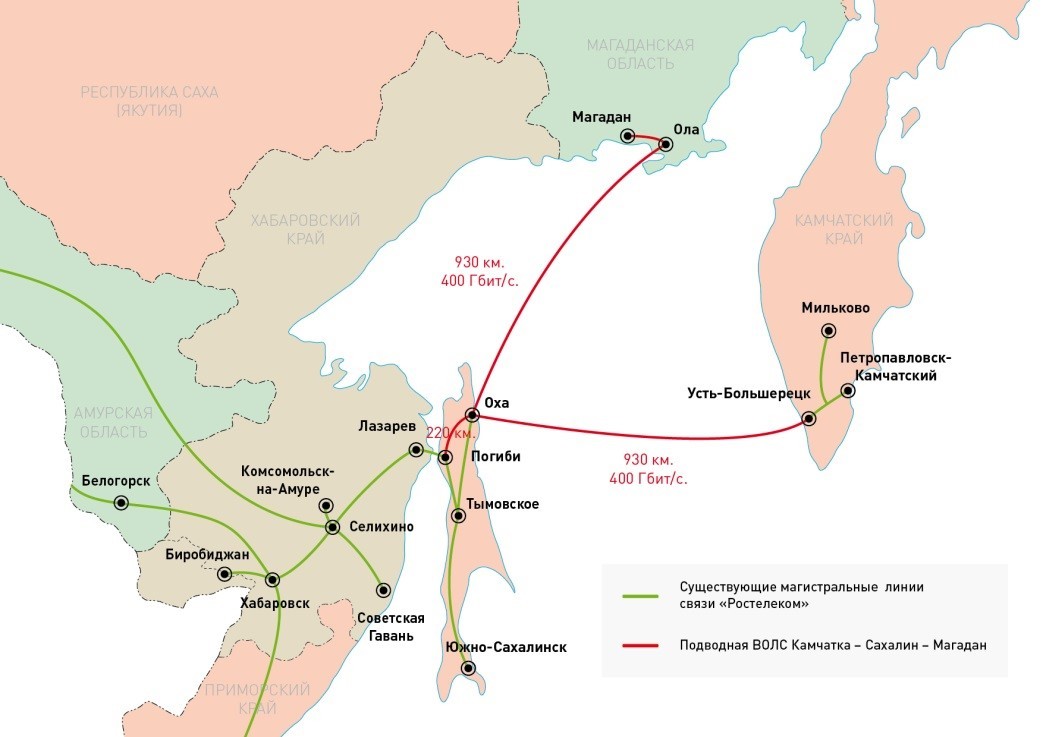
In 2014, Huawei announced that it had commissioned Rostelecom to create new submarine cables for the Russian Far East. After the project is completed, the entire cable infrastructure will have a length of 1900 kilometers, and will connect the most remote settlements of the Kamchatka Territory, as well as the Magadan and Sakhalin Regions with the mainland. The commissioning of the first communication line with a length of 930 kilometers is planned for 2017.

The work on laying the cable along the bottom of the Sea of Okhotsk is carried out by Huawei Marine using a special cable laying ship - Cable Innovator. The length of the vessel is 146 m, the width is 24 m, the transportable stock of cable is 8.5 thousand tons.

The cable leading from Vladivostok to Yuzhno-Sakhalinsk and beyond is part of the Russian Transarctic Cable System ( ROTAX ) project , which began in 1999. A few years ago, the total cost of ROTAX was estimated at $ 800 million. Despite the support of the Ministry of Communications of Russia, the authors of the project have been looking for sources of financing for 10 years, and they are constantly shifting the deadlines for the start of implementation. If the construction does begin this year, then the stage of testing the system starts no earlier than the first quarter of 2019.
Given the monopoly that had prevailed on the market, Sakhalin subscribers for a long time could not get alternative (and good in quality) communication services. According to the FAS, prices for communication services in the Sakhalin region roseto absurd values: 250% higher than in other cities of the Far East, and 1800-5100% higher than in the west of the country.
Today, everything is different: in 2016, the island even took third place in the ranking of regions with the most affordable mobile communications. The affordability index shows the real cost of operator services, taking into account the average income of the region’s population.

Map of the availability of mobile communications in Russia: the lighter, the more accessible.
The speed of mobile Internet is also not inferior to the “average in the hospital” and allows Sakhalin residents not only to check mail from a smartphone, but to watch videos, use streaming music services, play online games.
With the advent of Yota, residents of Sakhalin and tourists got access to a truly unlimited mobile Internet and can take full advantage of fast communication without saving traffic.