Learning is light: UC MUK training program for information security specialists
Information security is one of the most important areas in the IT field. The dynamic development of the industry requires businesses to be prepared for new challenges, fully justifying the need for investment in the training and professional development of information security specialists .
In connection with the rapid development of information technology in general and information security as a science in particular, an information security specialist needs to solve the problem of maintaining his qualifications. This statement has been true for more than a year, however, in our time, the following conclusions from it on the solution to this problem differ significantly from those that were relevant before. One of the main reasons for these differences is the completed transition from a risk-based approach to building automated systems to a normative one.
In the era of the risk-based approach, the main focus was on building a business model and determining the necessary and sufficient conditions for fulfilling the requirements of a security policy. The created security systems were piece goods, demanded mainly by government agencies and major commercial organizations. For a full-fledged work in the field of security, it was enough for a specialist to have a developed mathematical apparatus, which is obtained in the framework of higher professional education by students of technical universities.
With all the variety of business models being created and the requirements of security policies, the conditions for their implementation are overwhelmingly the same. This fact, as a result, allowed us to move on to the normative approach to building security systems, when experts focus on finding, analyzing, and adapting a suitable family of open security standards.
Subtleties of training
In connection with the above, a specialist in the field of information security needs to specialize in one of the following areas:
- implementation of the requirements of national laws and / or regulators (for example, admission to state or commercial secrets);
- the use of certified information security tools of specific manufacturers (design, commissioning, etc.);
- recognized international vendor-independent certification.
Education in the first two areas is conducted by a number of educational institutions within the framework of both higher and additional professional education. But these areas bind the specialist to employers in a particular country, or rather, allow them to conduct their activities only within the framework of national legislation and standards.
Benefits of International and Vendor Independent Certifications
If we talk about the third area, it initially focuses on international open standards and methodologies for ensuring security, based on the fact that developed and developing countries strive to harmonize their national laws and standards with international ones in connection with the fundamental advantages of the latter. A specialist with such qualifications is ready to adapt his experience to work in any country and confirm his qualifications to any employer, which, all other things being equal, gives him an advantage over other job seekers. Due to a number of reasons, the domestic IT market belatedly adopts international security standards.
Widespread international certification in Ukraine, depending on specific manufacturers (Microsoft, Cisco, HP and others), is primarily associated with the requirements of the manufacturers themselves to ensure a guaranteed level of quality of service in the sale, design, commissioning and maintenance of solutions created using their technology. The preparation for passing exams for such certifications consists in remembering to a greater extent the multitude of facts specific to a particular technology and, to a lesser extent, the principles of their use.
Universal principles that allow creating effective security systems without being tied to the technologies of specific manufacturers remain in such certifications “behind the scenes”, which does not suit those who claim to be a security expert in their specialization. It is precisely these principles that make it possible to identify preparations for vendor-independent certifications, and their successful receipt and maintenance - to confirm current experience as a specialist in the field of information security.
Course Features
The MUK Training Center offers a unified training program for employees of automation / information security departments. Its uniqueness lies in the fact that it:
- is developed in accordance with the latest family of open standards for training and certification ISO / IEC Standart 17024;
- considers practical aspects of applying the dominant international information security standards (ISO \ IEC 27000-series) and information system survey methodologies (COBIT);
- prepares to receive globally recognized vendor-independent certifications from leading operators (CompTIA, ISACA, ISC2);
- uses a modern adult education methodology from State University of New York;
- supports the concept of continuous education (Continuous Professional Education).
An intensive course common to all IT professionals that meets the requirements of the American National Standards Institute ( www.ansi.org) to a minimum set of knowledge and skills on the basics of information security. He will prepare for the exam for obtaining Security + international certification status from the leading provider of vendor-independent IT certifications Computing Technology Industry Association (CompTIA). CompTIA certifications are counted in undergraduate / graduate programs and professional retraining programs in most universities in developed countries.
Information system auditors will be able to prepare for certification status as Certified Information Systems Auditor (CISA) from the largest international professional association of auditors, Information Systems Audit and Control Association (ISACA).
MUK training center prepares middle and senior managers for certification that is the gold standard in the field of information security - Certified Information Systems Security Professional (CISSP) from the ISC2 consortium and Certified Information Systems Manager (CISM) from the largest international professional association of auditors Information Systems Audit and Control Association (ISACA).
Curriculum levels
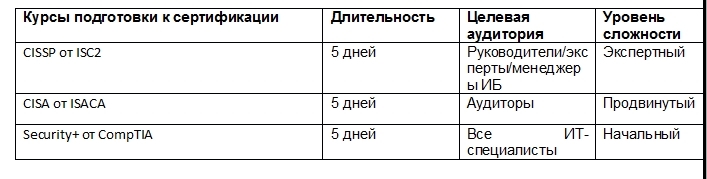
A growing number of universities in developed countries include professional certifications CISSP, CISM and CISA from ISC2 and ISACA operators, for example, Capella University or Vanguard Institute of Technology, in their master's programs.
All courses of the program are updated in accordance with the concepts of continuous training of the listed operators. This means that passing these courses is also relevant for current holders of these certifications as a measure for obtaining status maintenance points.
These requirements are satisfied not only included in the certification program, but also many others. If there is a steady demand for training services on this topic, the authors of the program plan to include in its composition training courses for certification on ethical hacking from the EC-Council, investigation of computer incidents from GIAC and business continuity from the British Standarts Institute.
Learn more about training courses in the field of information security at. The most relevant information about the MUK training center can always be found on our website . Country contact information can be found here .
In connection with the rapid development of information technology in general and information security as a science in particular, an information security specialist needs to solve the problem of maintaining his qualifications. This statement has been true for more than a year, however, in our time, the following conclusions from it on the solution to this problem differ significantly from those that were relevant before. One of the main reasons for these differences is the completed transition from a risk-based approach to building automated systems to a normative one.
In the era of the risk-based approach, the main focus was on building a business model and determining the necessary and sufficient conditions for fulfilling the requirements of a security policy. The created security systems were piece goods, demanded mainly by government agencies and major commercial organizations. For a full-fledged work in the field of security, it was enough for a specialist to have a developed mathematical apparatus, which is obtained in the framework of higher professional education by students of technical universities.
With all the variety of business models being created and the requirements of security policies, the conditions for their implementation are overwhelmingly the same. This fact, as a result, allowed us to move on to the normative approach to building security systems, when experts focus on finding, analyzing, and adapting a suitable family of open security standards.
Subtleties of training
In connection with the above, a specialist in the field of information security needs to specialize in one of the following areas:
- implementation of the requirements of national laws and / or regulators (for example, admission to state or commercial secrets);
- the use of certified information security tools of specific manufacturers (design, commissioning, etc.);
- recognized international vendor-independent certification.
Education in the first two areas is conducted by a number of educational institutions within the framework of both higher and additional professional education. But these areas bind the specialist to employers in a particular country, or rather, allow them to conduct their activities only within the framework of national legislation and standards.
Benefits of International and Vendor Independent Certifications
If we talk about the third area, it initially focuses on international open standards and methodologies for ensuring security, based on the fact that developed and developing countries strive to harmonize their national laws and standards with international ones in connection with the fundamental advantages of the latter. A specialist with such qualifications is ready to adapt his experience to work in any country and confirm his qualifications to any employer, which, all other things being equal, gives him an advantage over other job seekers. Due to a number of reasons, the domestic IT market belatedly adopts international security standards.
Widespread international certification in Ukraine, depending on specific manufacturers (Microsoft, Cisco, HP and others), is primarily associated with the requirements of the manufacturers themselves to ensure a guaranteed level of quality of service in the sale, design, commissioning and maintenance of solutions created using their technology. The preparation for passing exams for such certifications consists in remembering to a greater extent the multitude of facts specific to a particular technology and, to a lesser extent, the principles of their use.
Universal principles that allow creating effective security systems without being tied to the technologies of specific manufacturers remain in such certifications “behind the scenes”, which does not suit those who claim to be a security expert in their specialization. It is precisely these principles that make it possible to identify preparations for vendor-independent certifications, and their successful receipt and maintenance - to confirm current experience as a specialist in the field of information security.
Course Features
The MUK Training Center offers a unified training program for employees of automation / information security departments. Its uniqueness lies in the fact that it:
- is developed in accordance with the latest family of open standards for training and certification ISO / IEC Standart 17024;
- considers practical aspects of applying the dominant international information security standards (ISO \ IEC 27000-series) and information system survey methodologies (COBIT);
- prepares to receive globally recognized vendor-independent certifications from leading operators (CompTIA, ISACA, ISC2);
- uses a modern adult education methodology from State University of New York;
- supports the concept of continuous education (Continuous Professional Education).
An intensive course common to all IT professionals that meets the requirements of the American National Standards Institute ( www.ansi.org) to a minimum set of knowledge and skills on the basics of information security. He will prepare for the exam for obtaining Security + international certification status from the leading provider of vendor-independent IT certifications Computing Technology Industry Association (CompTIA). CompTIA certifications are counted in undergraduate / graduate programs and professional retraining programs in most universities in developed countries.
Information system auditors will be able to prepare for certification status as Certified Information Systems Auditor (CISA) from the largest international professional association of auditors, Information Systems Audit and Control Association (ISACA).
MUK training center prepares middle and senior managers for certification that is the gold standard in the field of information security - Certified Information Systems Security Professional (CISSP) from the ISC2 consortium and Certified Information Systems Manager (CISM) from the largest international professional association of auditors Information Systems Audit and Control Association (ISACA).
Curriculum levels
A growing number of universities in developed countries include professional certifications CISSP, CISM and CISA from ISC2 and ISACA operators, for example, Capella University or Vanguard Institute of Technology, in their master's programs.
All courses of the program are updated in accordance with the concepts of continuous training of the listed operators. This means that passing these courses is also relevant for current holders of these certifications as a measure for obtaining status maintenance points.
These requirements are satisfied not only included in the certification program, but also many others. If there is a steady demand for training services on this topic, the authors of the program plan to include in its composition training courses for certification on ethical hacking from the EC-Council, investigation of computer incidents from GIAC and business continuity from the British Standarts Institute.
Learn more about training courses in the field of information security at. The most relevant information about the MUK training center can always be found on our website . Country contact information can be found here .