February 2, 2016 at 09:17
Guidelines for Identifying Ineffective Marketers

Who is an ineffective marketer? How to identify it? How to instill a desire to learn and tune in to constant growth? The service team is responsible for an effective hopox marketer .
Most marketers are copy machines. They can create 200 ads in Direct by template, pick up 1000 keywords, spread them over 50 pages of the site and wait for the effect. Then the effect is either there or not. Further optimization is of course possible, but the most important thing happens the first time, or does not happen. If there is no effect, the marketer says: something is wrong with the product and is waiting for its improvement, then again pounces on direct and seo. Is that familiar?
Most marketers do not take responsibility for the result and get paid for the process.
But there are others, those who are ready to answer for the result and, if not achieved, fight for it to the last. Such people already have experience, they are constantly trained, although no one asks them about it.
An effective marketer works for the result, not for the sake of the process, and is able to constantly improve this result.
In other words, an effective marketer receives a salary / bonus not for the number of created ads in the context, posts in the group or words in the top, but for the improvement of specific business indicators: new customers, number or cost of leads. In addition, an effective marketer has enough experience, tools and creativity to improve business performance indefinitely.
Do you think there are no such marketers? By the end of the article, you will learn how to grow it in your company.
By the way, about marketing tools. A lot of them. In total, there are hundreds of tools: analytics systems, search engines, social networks, contextual advertising and optimization systems, lead generators, CRM systems, email services, questionnaires, content platforms, video hosting, event registration systems, CMS, user support, affiliate programs, and so on.
Establishing effective work in them is not easy, but the main message of the article is the root of effective marketing not in tools or even employees, but in the process of employees working with tools.
Algorithm of how to make high-performance marketing specialists out of ordinary linear marketing employees
How to become an effective marketer?
1. Ask the question: “Why are you doing this?” The answers will not fit: “the boss said” or “obviously, it will get better.” For each task, ask the question “what effect do you expect in numbers?” The answer: “to make 200 announcements in context” is also not suitable, since we are interested in changing business metrics as a result of our actions, and not just measuring the number of our actions.
For example, if this is a context:
- If you are editing ad texts / bids / connecting a context broker, what will change and in which metric? Is this done to reduce customer value? Increased impression reach? How much?
Content:
- If you post on Facebook, then what effect do you expect in numbers? How many views are you hoping for? How many conversions, leads or paid customers do you expect? Why are you posting this post for some reason?
- Diluting content with entertainment contests, what changes do you expect? How much will the virality of the blog, the number of reposts and comments increase?
Activation:
- By changing the texts on the site, what metric and how do you want to influence? How much to increase the conversion? How many transitions from the channel? Specifically, in numbers.
Product development:
- If you make a welcome wizard with tips in the product, the conversion to user-created projects will increase by 5%.
Etc…
For each marketing task, you can specify the expected effect in numbers. It will be difficult at first, but then it will be easier.
2. Write down the expected effect of the task in numbers.
In a notebook, Trello, on a blackboard in an office. The main thing is to save the data until it can be compared with the result. The format of the task is convenient to use “If the action, then change the metrics in numbers.” This type of record is also called a hypothesis.
3. Collect the data . Stop acting “by eye”. Implement data-driven marketing.
Data-Driven Marketing is a type of marketing where ALL marketing decisions and actions are based on data about users and their behavior.
Today, 80% of organizations make marketing decisions based on data. At the same time, the remaining 20% is leading the market (From the book “Marketing based on data. 15 indicators everyone should know.” Mark Jeffrey).
Collecting data is not difficult. In most cases, analytics systems like Google Analytics or Yandex Metrics are enough. You need to use UTM tags to analyze where the user came from, and goals to analyze the actions performed.
4. Discuss the findings with the whole team and write them down. This is the most important action that will educate marketers. Books will never train marketing like real cases. It’s a pity that we rarely draw conclusions. It's time to fix it. Try to answer the questions: What prevented you from reaching your goal? How to improve the hypothesis? How to deploy a test for another channel, value proposition, functionality?
These four simple steps form the process of creating an effective marketing department. Formulate tasks as hypotheses indicating the expected effect in numbers, organize hypotheses, collect data and draw conclusions. This is the Build-Measure-Learn cycle from Eric Rhys's Business from the Ground Up.
To organize hypotheses, you can use Trello or a whiteboard in the office with columns from the HADI cycle.
Hypothesis - A list of tasks with expectations in numbers.
Action - tasks that are currently being performed.
Data - tasks for which data is being collected.
Insight - completed tasks for which conclusions are made and recorded.
But the title of this article was different)
How to identify an ineffective marketer?
By the method of exclusion. Ask him what effect does he expect in numbers? Ask to draw conclusions from a past assignment. Make systematize the task in the form of hypotheses. If he wakes hiss like a vampire in the sunlight, then drive him in the neck)
Where to begin?
Try to start the process of continuous training and development in your company. To simplify this process, a specialized tool for effective teamwork of marketers - hopox will help. He ties the result of the performance in numbers to the tasks.
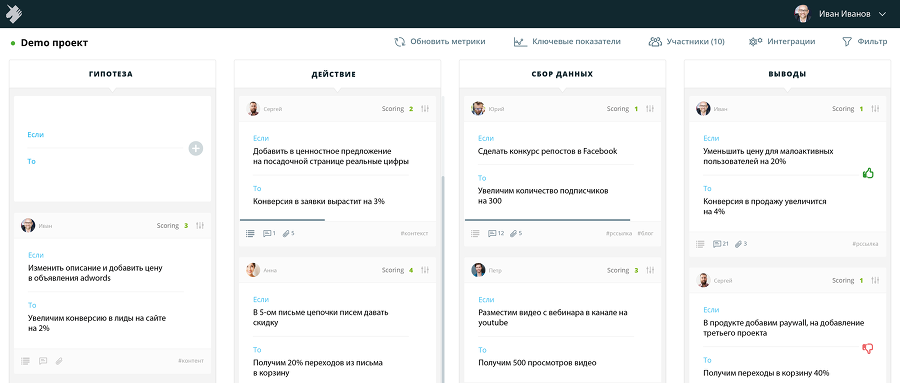
hopox is a board with tasks (hypotheses), where the user sets criteria for the success of the task in advance, and the result of the analysis is analyzed by the service itself, automatically loading data from various third-party tools.
The service allows you to control the work of marketers, not only at the level of processes, but also the results. You will always know who does what and what effect to expect from this.
hopox fosters a culture of continuous learningon the results of their own actions, when each new task contains the experience of all previous ones. Marketers fall into the inevitable cycle of their own learning.
Automatic collection of data from various marketing tools and analytics systems simplifies the process of aggregating various data and does not allow employees to distort or manipulate them.
Test your team’s effectiveness in two weeks of free access to hopox .
Write in the comments what tools or tricks you use to increase the effectiveness of marketers?