December 14, 2015 at 10:30
HP P2000 MSA G3 Performance Testing
In one of our previous articles on the performance of server disk systems, we talked about the testing methodology and tool selection.
Now, we decided to compare the performance of entry-level storage systems and the array on the P410 controller. Let me remind you that the parameters we are interested in are: IOPS - the number of disk operations per second (the more the better) and latency - the processing time of the operation (the less the better).
Stand Configuration:
Chassis HP C7000
Blade BL460C G6
Server HP Proliant DL360 Gen7
Couple of switches AE372A
Shelf HP StorageWorks P2000 G3 MSA
Couple of controllers AP837B
Disks 2.5 "HP 146Gb SAS 15k 6G HDD (512547-B21, 512544-001)

Blade BL460C G6
Server HP Proliant DL360 Gen7
Couple of switches AE372A
Shelf HP StorageWorks P2000 G3 MSA
Couple of controllers AP837B
Disks 2.5 "HP 146Gb SAS 15k 6G HDD (512547-B21, 512544-001)

We tested everything with the same fio utility under Debian GNU / Linux according to the method described in the previous article , using the same toolkit. We still access raw-device via libaio.
$cat ~/fio/oltp.conf
[oltp-db]
blocksize=8k
rwmixread=70
rwmixwrite=30
rw=randrw
percentage_random=100
ioengine=libaio
direct=1
buffered=0
time_based
runtime=2400
The configuration is as follows: the volume of LUNs is equal to the volume of Vdisk and in all configurations RAID10 is used, multipathing is enabled, connection via Fiber Channel.
#multipath -ll
3600c0ff000199b069319335601000000 dm-1 HP,P2000G3 FC/iSCSI
size=956G features='1 queue_if_no_path' hwhandler='0' wp=rw
|-+- policy='service-time 0' prio=50 status=active
| |- 0:0:0:8 sdc 8:32  active ready running
| `- 2:0:0:8 sdg 8:96  active ready running
`-+- policy='service-time 0' prio=10 status=enabled
  |- 0:0:1:8 sde 8:64  active ready running
  `- 2:0:1:8 sdi 8:128 active ready running
Tested with increasing the number of threads from 16 to 256, in order to catch where the lack of performance begins. The duration of each test is 40 minutes.
So, we will consider the results using the OLTP-DB profile as an example, illustrating the dependence of IOPS and system responsiveness on the number of threads:
4KB block size, 70% / 30% read / write, 100% random access
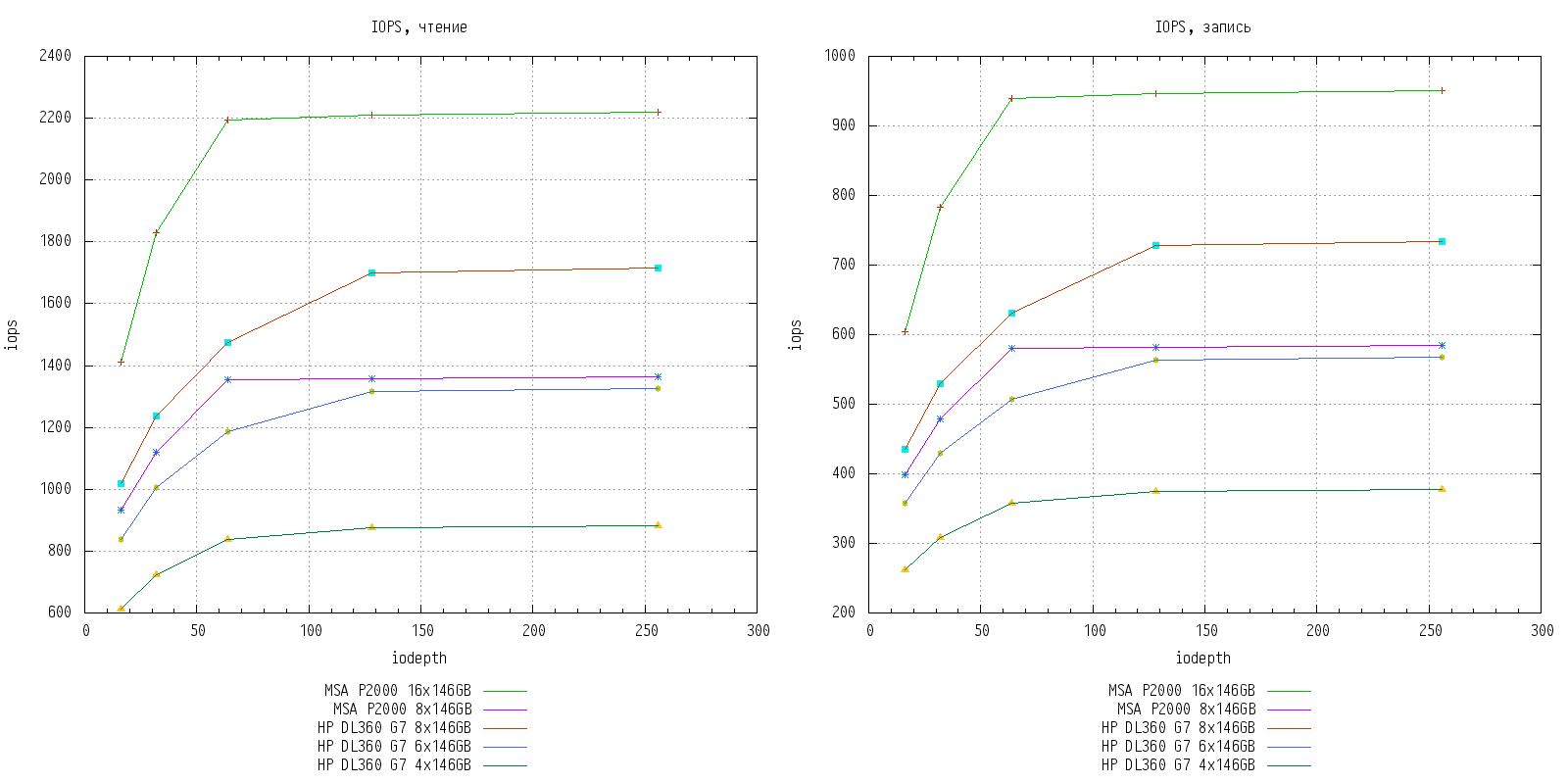
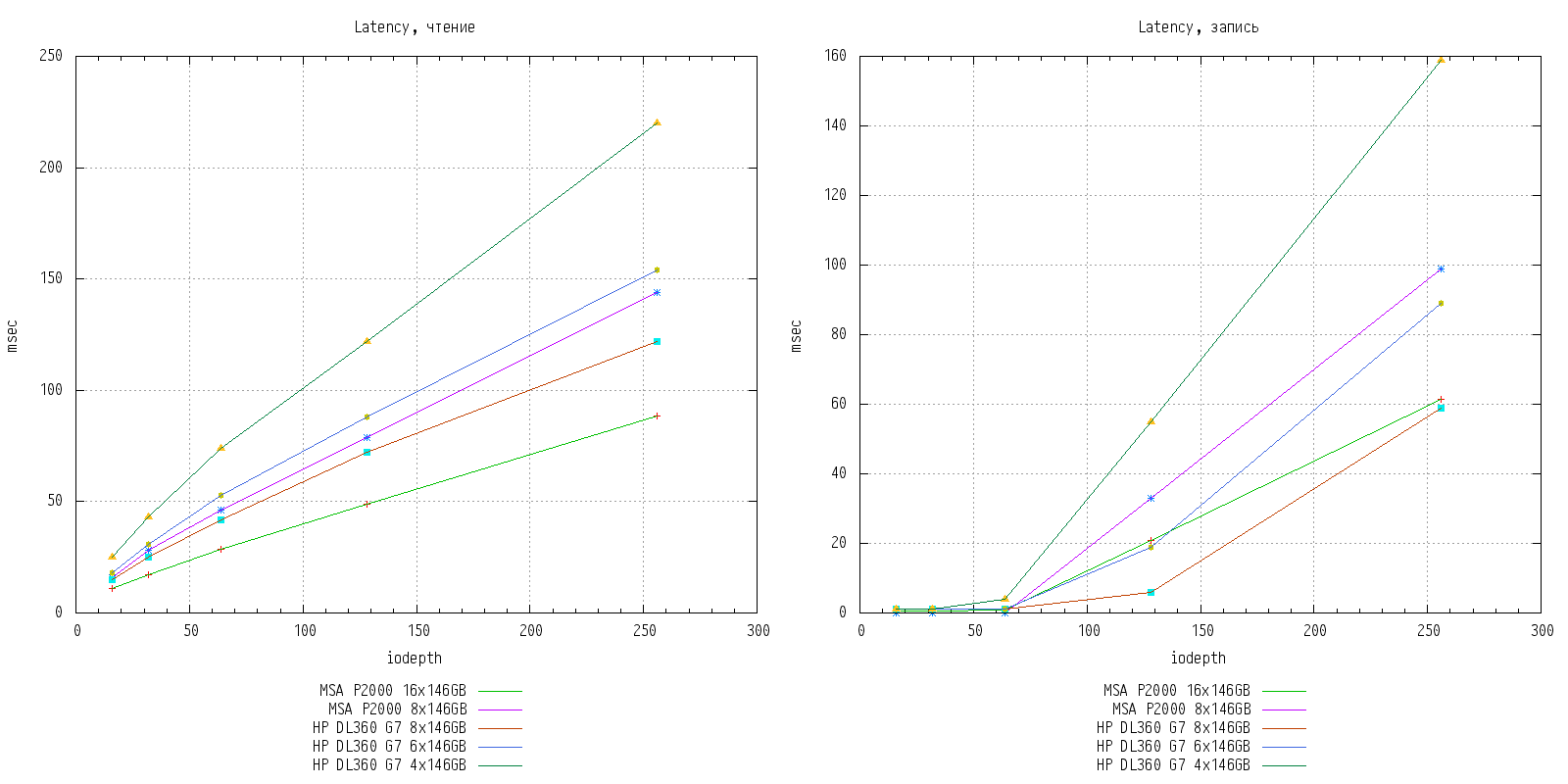
Looking at the upper graph, it becomes clear how you can evaluate the system performance in isolation from latency: as soon as the growth in the number of IOPS has stalled, we got the result and only latency will continue to grow.
It turned out to be unexpected that an array of eight disks shows much higher performance than storage with the same number of media, and this is especially noticeable with increasing load. MSA P2000 stalled on 64 threads, while the growth in the number of IOPS on the P410 controller stopped by 128.
The dependence of system performance on the number of hard drives in the array is also clearly visible. Here, I think the comments are superfluous.
And the conclusion from this can be drawn as follows: this storage system makes sense when you need more flexibility in the allocation of disk space between virtual or physical servers and you need the ability to connect a large number of hard drives, including through expansion shelves. However, hoping that all this will work faster than the local disk array of the server with the same number of disks, alas, is not necessary.
And, as always, we post the detailed file with the results .