
 November 17, 2015 at 04:04
We write our own interface for managing corporate FMC SIM cards
What modern cloud service does without a personal account and API platform on which this service is spinning? Perhaps the only service that works on mobile devices, and even then, not everyone. Our company had a short but stormy affair with a simple proprietary softphone for Android and even in such a seemingly unpretentious project, we had a long time “filing” the backend and admin web interface.
Since then, our developers have developed a specific approach: when product experts come up with another mega-product, approve it at the highest level and put it into development, the first thing the Chief Developer is interested in is “Will there be a personal office?”. “Yes,” the product experts answer. “My account will be. Even two. ” For obvious reasons, a personal account was written for our project with special AltegroSIM SIM cards. It is written so that customers can manage their SIM cards. We hope not to stop and eventually “hang” on your personal account and API so that third-party services, those that may be of interest, do integrations and their own personal computers.

About AltegroSIMWe have already written on our blog more than once. These are FMC SIM cards issued as part of a joint project with the mobile operator Megafon and intended for corporate use. AltegroSIM connects directly to the virtual and IP-PBX via SIP and works like regular SIP devices, our switch acts as a gateway between GSM and SIP networks and, thanks to this, voice traffic from SIM cards is routed first to our switch, and then sent to the PBX client. Partially, SIM cards are controlled by us, which allows us to implement part of the management on the side of our platform.
The scheme of the work of SIM cards is simple and complex at the same time, and looks like the one shown in the diagram below.

Traffic from the GSM network, through the inter-operator interface, comes to our switch via SIP, we see the SIM card IDs, their statuses, a set of connected services and we can implement a SIM management interface that mimics the IP phone management interface: with logins, passwords, proxies, STUN on / off and almost all other VoIP stuffing.
For the client, the service looks as if the SIM is a SIP device and is managed as a SIP device. The mobile phone turns into a “sip phone with legs”.
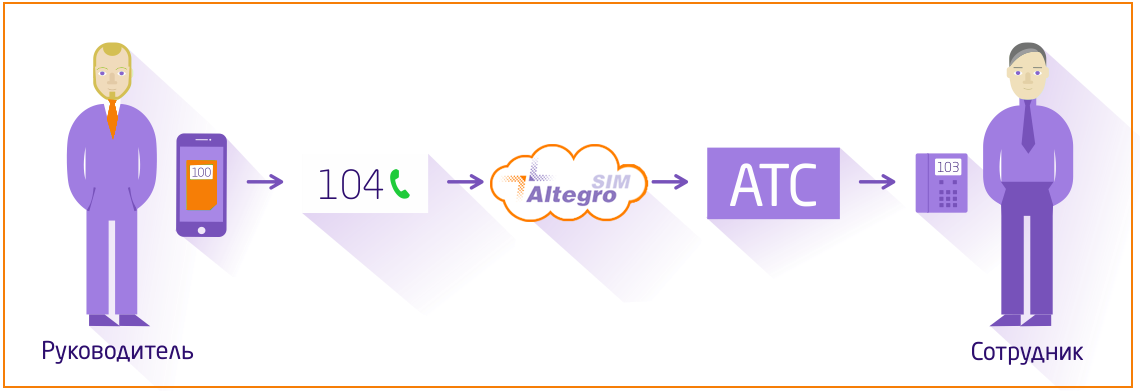

Employees from fixed phones call their colleagues' mobile phones on short numbers, employees on mobile phones also call bookkeeping using a short number, all calls within the mobile and office network go along approximately the same routes, GSM is used only as the last mile.
Product managers decided that since the modified FMC SIM card had turned into an IP phone, it was logical and justifiable to write a control interface, which was done for the convenience of our customers and partners. Now there is no need to fill out accounting cards and order forms when connecting SIM cards, configure everything yourself through your personal account - assign short numbers, enter username and password of internal extensions of IP-PBX and start working immediately.
The client, after signing the contract, gets access to the management interface and sees a list of all SIM cards, the traffic from which is routed to his voice platform.

To configure SIM cards as subscriber devices for an arbitrary IP-PBX, you need to add this PBX by specifying its IP and port.
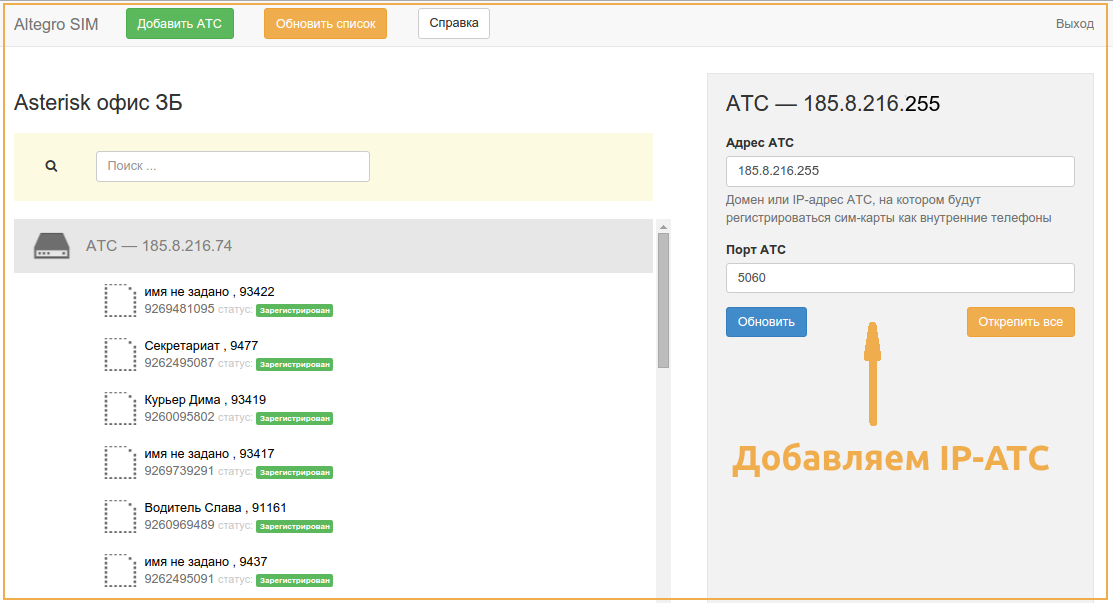
Everything is quite simple. Now you can make changes to the mobile network of the company, change short numbers, block SIM cards, disconnect or connect them to internal extensions or directly to trunks.
To add a new SIM to the company’s mobile network, just specify its identifier, which is issued when connected.
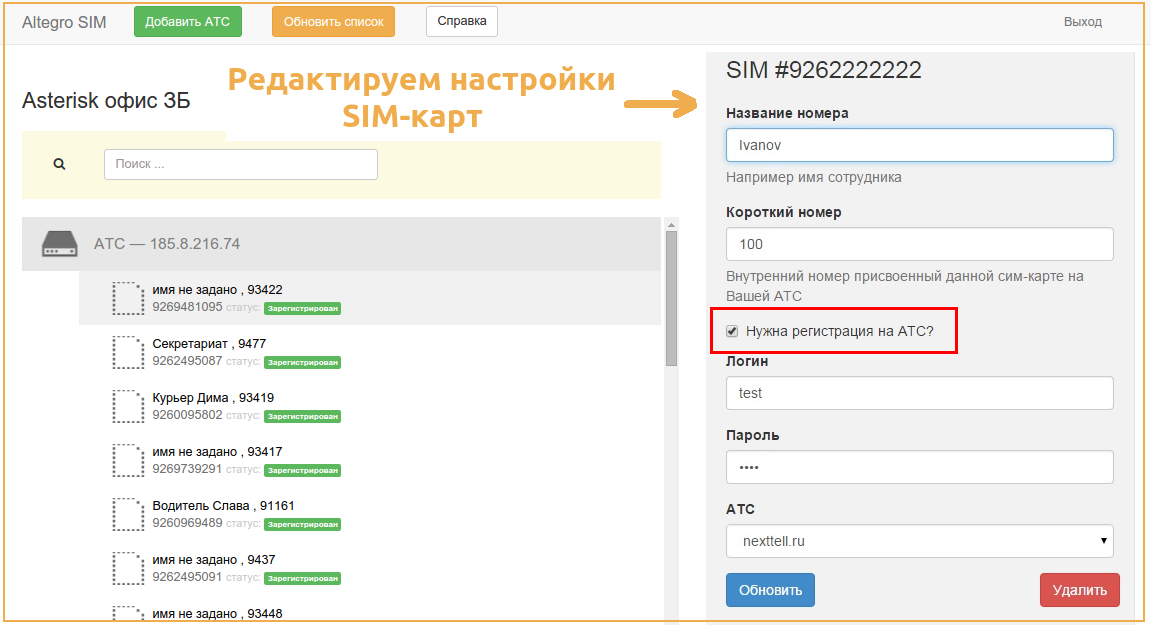
An important and very pleasant moment, which will certainly be of interest to our integration partners and developers of our own services, is the checkmark “Do you need registration on your PBX?” If you uncheck this box, then the traffic from the selected SIM card will be marching directly to the specified IP address without any changes on the side of our switch.
This means that we simply perform the transit function of mobile voice traffic and if the integrator has an idea of his own product, he can easily implement it by replacing the numbers A or B, caller ID, making the necessary comparisons, i.e. In fact, you can combine SIM cards into your own number plan.
The interface so far allows you to control only the alarm and voice, connecting or disconnecting additional services is possible only in manual mode when requesting our support. But we are working to ensure that in the end a full-fledged API appears, with which our clients or partners can independently connect and disconnect the necessary services (for example, Internet or SMS packages), geodata and data from billing.
We are not trying to repeat the popular in foreign networks MVNE circuit, we are building an advanced customer service that allows integrators or customers to independently add the necessary functionality to our product as part of the allowed options. We would be grateful for the wishes and feedback regarding the functionality of the AltegroSIM management interface . It is already obvious that a certain ecosystem is taking shape around our product and we want to contribute to its full development.
Since then, our developers have developed a specific approach: when product experts come up with another mega-product, approve it at the highest level and put it into development, the first thing the Chief Developer is interested in is “Will there be a personal office?”. “Yes,” the product experts answer. “My account will be. Even two. ” For obvious reasons, a personal account was written for our project with special AltegroSIM SIM cards. It is written so that customers can manage their SIM cards. We hope not to stop and eventually “hang” on your personal account and API so that third-party services, those that may be of interest, do integrations and their own personal computers.
About AltegroSIMWe have already written on our blog more than once. These are FMC SIM cards issued as part of a joint project with the mobile operator Megafon and intended for corporate use. AltegroSIM connects directly to the virtual and IP-PBX via SIP and works like regular SIP devices, our switch acts as a gateway between GSM and SIP networks and, thanks to this, voice traffic from SIM cards is routed first to our switch, and then sent to the PBX client. Partially, SIM cards are controlled by us, which allows us to implement part of the management on the side of our platform.
The scheme of the work of SIM cards is simple and complex at the same time, and looks like the one shown in the diagram below.
Traffic from the GSM network, through the inter-operator interface, comes to our switch via SIP, we see the SIM card IDs, their statuses, a set of connected services and we can implement a SIM management interface that mimics the IP phone management interface: with logins, passwords, proxies, STUN on / off and almost all other VoIP stuffing.
For the client, the service looks as if the SIM is a SIP device and is managed as a SIP device. The mobile phone turns into a “sip phone with legs”.
Employees from fixed phones call their colleagues' mobile phones on short numbers, employees on mobile phones also call bookkeeping using a short number, all calls within the mobile and office network go along approximately the same routes, GSM is used only as the last mile.
Product managers decided that since the modified FMC SIM card had turned into an IP phone, it was logical and justifiable to write a control interface, which was done for the convenience of our customers and partners. Now there is no need to fill out accounting cards and order forms when connecting SIM cards, configure everything yourself through your personal account - assign short numbers, enter username and password of internal extensions of IP-PBX and start working immediately.
The client, after signing the contract, gets access to the management interface and sees a list of all SIM cards, the traffic from which is routed to his voice platform.
To configure SIM cards as subscriber devices for an arbitrary IP-PBX, you need to add this PBX by specifying its IP and port.
Everything is quite simple. Now you can make changes to the mobile network of the company, change short numbers, block SIM cards, disconnect or connect them to internal extensions or directly to trunks.
To add a new SIM to the company’s mobile network, just specify its identifier, which is issued when connected.
An important and very pleasant moment, which will certainly be of interest to our integration partners and developers of our own services, is the checkmark “Do you need registration on your PBX?” If you uncheck this box, then the traffic from the selected SIM card will be marching directly to the specified IP address without any changes on the side of our switch.
This means that we simply perform the transit function of mobile voice traffic and if the integrator has an idea of his own product, he can easily implement it by replacing the numbers A or B, caller ID, making the necessary comparisons, i.e. In fact, you can combine SIM cards into your own number plan.
The interface so far allows you to control only the alarm and voice, connecting or disconnecting additional services is possible only in manual mode when requesting our support. But we are working to ensure that in the end a full-fledged API appears, with which our clients or partners can independently connect and disconnect the necessary services (for example, Internet or SMS packages), geodata and data from billing.
We are not trying to repeat the popular in foreign networks MVNE circuit, we are building an advanced customer service that allows integrators or customers to independently add the necessary functionality to our product as part of the allowed options. We would be grateful for the wishes and feedback regarding the functionality of the AltegroSIM management interface . It is already obvious that a certain ecosystem is taking shape around our product and we want to contribute to its full development.