November 6, 2015 at 15:04
Violet M-125
Special communication is a very difficult thing.
And the role of the cryptographer is very important
for secrecy.
Everywhere, even where the ocean boils,
hiding submarines, the
skilled "shaman" will send
its cryptogram reports in seconds .
Cryptomachine M-125 is the granddaughter of the legendary Enigma

M-125, codenamed Violet, is an electromechanical 10 rotor cryptographic machine. It was first introduced in 1956, and became the most popular encryption machine in the Warsaw Pact countries. Each version of the participating country has its own version of Violets (keyboard and writing head adapted to the language of the country). Most cars perceived the Latin alphabet and Cyrillic alphabet. The Latin alphabet could be different, the Cyrillic alphabet had no punctuation marks and was the same for all machines. Cryptographic strength is estimated at about 10 ^ 18.

Violet is often considered the "granddaughter" of Enigma, although it has fewer discs, and the wheels rotate in one direction. In addition to the punch card, letter keys are used, each disk has its own letter, the disks are typed on the shaft, then, according to another key, they are put in a certain sequence by rotation.
This model is free from Enigma's lack of exclusion of the possibility of encrypting a letter by itself. Although the car is more similar to the American Sigaba, KL-7 and - to a lesser extent - Enigma, it is called the Russian Enigma.

Violet


sigaba
It was developed in the 1930s for the US Army and Navy and was intended to store high-level critical messages. It was used throughout the Second World War until the 1950s, as it showed its reliability. After the fifties it was replaced by KL-7.

KL-7
In the mid-1960s, the M-125 changed the M-125-3 model, was in use until the early 1990s. M - indices of equipment preliminary closure of information. In principle, the machine is called M-125, and Violet is the name of the procedure code. In the history of cryptography, little is known about Violet, because until 2005 all information about the device was kept under the heading "secret." Three versions of the encryption machine were demonstrated in 2011 at the exhibition of the U.S. Air Force intelligence agency in San Antonio. It should be noted that all three devices were from Eastern Europe, primarily from the GDR.
From the memories:
Nowadays, it’s not like a photograph, because I saw such a thing, it was sent far and long.
Since 1962, this model began to go into operation in the USSR and socialist countries. In fact, little is known about Violet in the history of cryptography, because until 2005 all information was inaccessible and was kept under the heading "secret."
He served in training near Podolsk in 1986. Just for one word, “violet,” or God forbid, “Camomile,” and you’ll suddenly blurt out something other than the “Plane” case or, all the more so, “Air” with two zeros ... they won’t take me to prison - execution on the spot. They didn’t really get demobilized in 1988, he served 2 months due to a delay in graduation (there was no change) Someone, stole something ..., they were looking for the whole Union. For two years I went under the article, and another 5 years they called home, checked, whether they were at home ...

Most of the machines after the collapse of the USSR were disassembled or destroyed. Several copies are kept in private collections and museums. A working model is presented at the Computer History Museum in the USA and Bletchley Park in the UK. Three versions of the encryption machine were demonstrated in 2011 at the exhibition of the U.S. Air Force intelligence agency in San Antonio. It should be noted that all three devices were from Eastern Europe, primarily from the GDR.
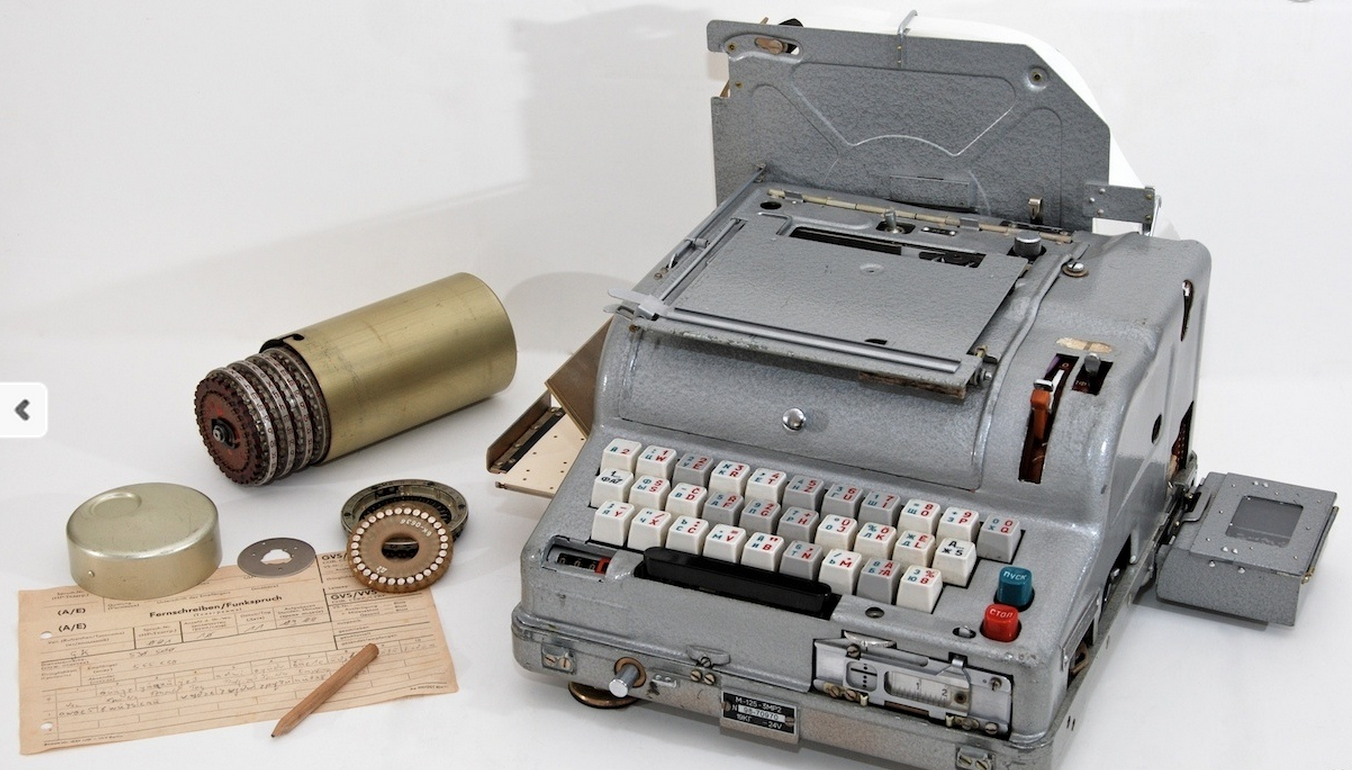
On the right side of the machine there is a paper tape reader, on the left side there is a punch tape insertion device for entering a key, and on top is a device for printing and punching a tape.


As far as you know, under the Violet encryption device, two different power supplies could be used. One of them is a very simple option, while the other contained advanced developments that protect against compromising radiation, minimizing the risk of leakage of classified information by intercepting and analyzing spurious electromagnetic radiation with various technical means.


The standard power supply unit (PSU) is 26 x 17 x 17 cm, the device was powered from a 24 V DC source, and through a separate power supply unit from a 90 - 260 V AC network (about 10-30 V step).
Magic Circuit
It consists of several transistors, diodes and resistors that are mounted on a curved bakelite medium, similar to a printed circuit board (PCB). The violet used a reflector that connected the pairs of wires in place. In earlier versions, Russian transistors P701A were used, in later 2D603A.
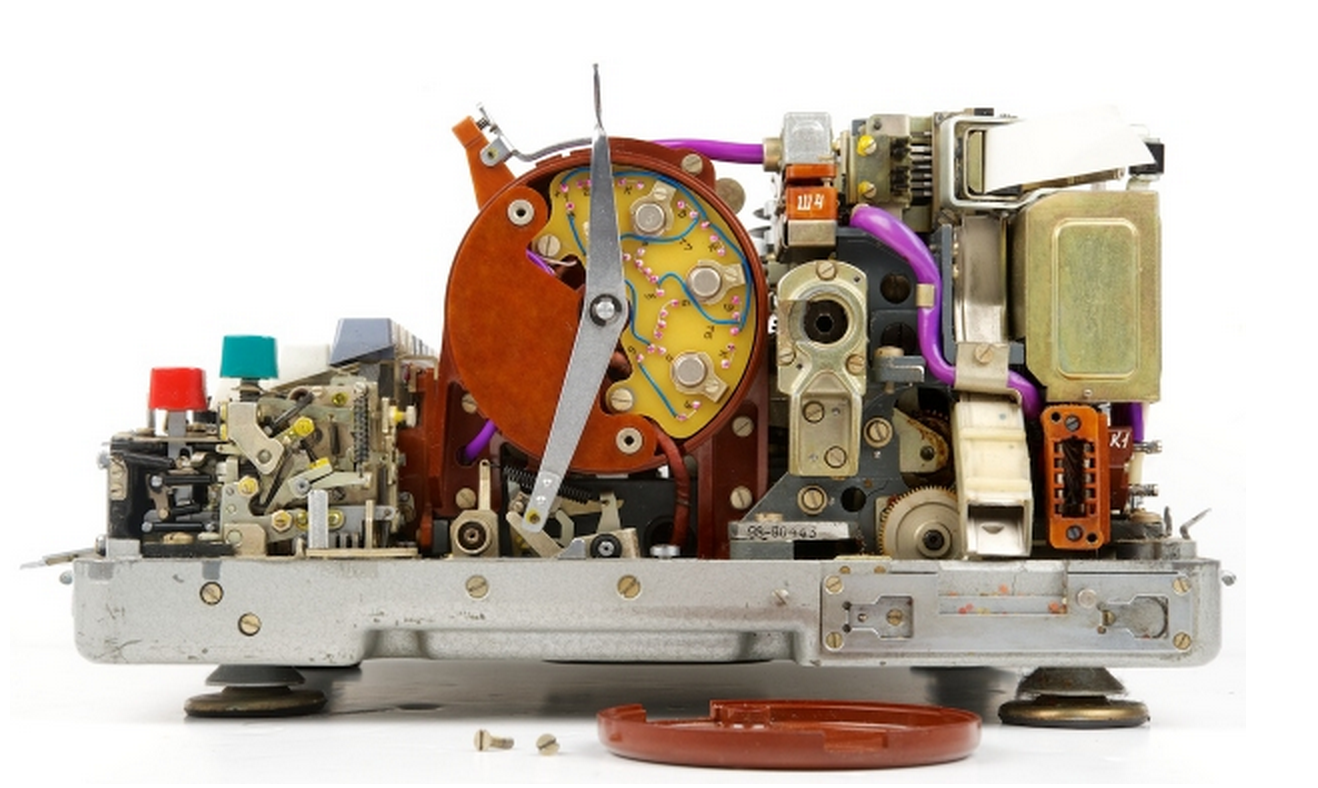


Like Enigma, Violet also had a reflector connecting pairs of wires together. The presence of a reflector guaranteed that the transformation being carried out was involution. Only 30 contacts, 26 of which are connected to each other in pairs, there were 4 more “special” wires. One was used to replace the encrypted letter with the original. The remaining three wires are connected to the Magic Circuit, form a rotary switch. In coding mode, pin “x” is output through “y”, “y” through “z”, “z” through “x”. In decoding mode, the contacts “z” and “y” are swapped.
The drawing below shows a simplified diagram of such a reflector


The Magic Circuit is actually a binary rotator (German: Dreipunktschaltung) that combines three signals in a special order. This is best explained in the figure below. If the current enters the contact of the reflector (18), it returns from the contact (24). However, if the current comes into contact (24), it returns from contact (16). And finally, when he enters (16) he returns from (18).

Rotors

In the center of each Violet machine there are 10 different cryptographic wheels (rotors), marked with the letter of the Russian alphabet:

Each Warsaw Pact country had its own set of 10 rotors. And only in the event of a war with the West, there was a 0K series that would be used to send encoded messages between these allied powers. A rotor is a disk of about 10 cm in diameter made of ebonite or bakelite, with 30 spring pin contacts on one side of the rotor located around the circumference. On the other side was the corresponding number of flat electrical contacts. The pin and flat pins matched the letters in the alphabet. The letters "ё", "» "and" b "were not taken into account. When in contact, the contacts of adjacent rotors closed the electric circuit. There were two types of rotors: fixed and adjustable. Fixed were used in the first M-125 cars since 1956, only in 1978, adjustable began to be used as an improvement. A collection of these 10 unique wheels is sometimes called the Proton. In adjustable sets, it was possible to change the settings of the outer ring, thereby obtaining 30 possible positions. A significant difference between Violets and other rotary machines - each of the rotors rotated in the opposite direction to the neighboring ones.
Fixed rotors


Adjustable rotary punched


cards
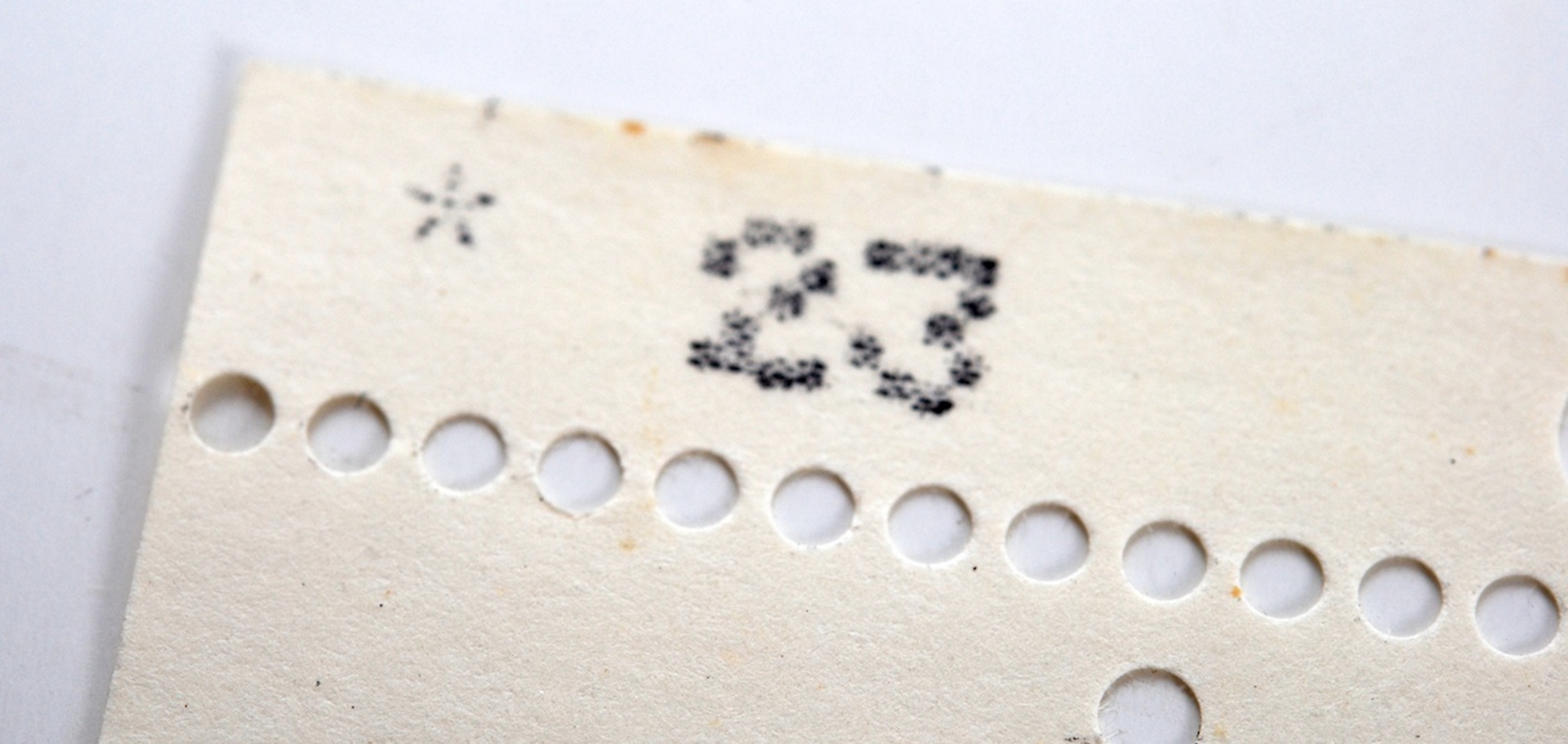
Until recently, it was believed that the original punched cards for Violets were not preserved, since all of them, according to the protocol, had to be destroyed after use. The top photo with the number 23 is one surviving original punch card (Tom Perera donated it to the Crypto Museum). The M-125 Violet had a card reader in the lower left.


Violet ZIP .
Spare parts and accessories were placed in a wooden box 268 x 138 x 60 mm. It was believed that not a single such box has survived to our days, but in 2015, collectors assembled a complete set of spare parts for Violets.


An amazing engineering work with the romantic name "Violet" - the Soviet cryptographic machine, created back in the 1950s, has remained unbroken, the highest achievement of engineering for intelligence and counterintelligence.