July 31, 2015 at 15:57
HP ProLiant Gen9 Server Line
Hello, Habr! Today we would like to tell you about the junior representatives of the well-known line of HP ProLiant servers, which belong to the ninth generation of products. These are reliable "workhorses" that are designed for small and medium-sized businesses. Servers from the Gen9 lineup have proven themselves well for solving various simple tasks, which, as a rule, are accompanied by a small budget. The heirs of the Compaq brand, they are worthy of comparing with their more powerful brothers and proudly bear the name Hewlett Packard, so well known in the "server" world.
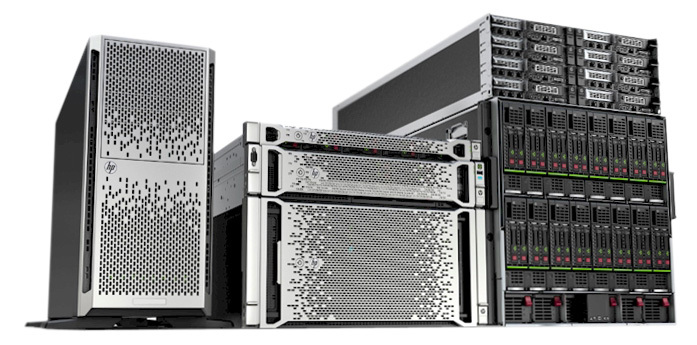
However, quite the lyrics. Meet the heroes of our material today: the HP ProLiant DL60 and DL80 Gen9, designed for rack mounting, and the “two towers” to the delight of fans of the Lord of the Rings Tolkien: HP ProLiant ML10 v2 and HP ProLiant ML110 Gen9. The first three belong to the HP ProLiant 10 series, which was recently added to the HP server catalog, as a result of which these models simply do not have predecessors from the eighth generation. As for the HP ProLiant ML110 Gen9 server, this is one of the junior representatives of the "hundredth" series, which is positioned by the company as the "first server" for those companies that previously exclusively used desktop computers.
As you know, HP currently produces products for three series: 10, 100 and 300, which vary in design, reliability and power.
The younger series are distinguished by a compact size (small racks up to 24 inches are used for placement) and a simplified cooling subsystem, which dictates restrictions on the use of powerful processors. At the same time, talk about a weak "stuffing" is inappropriate, because the basis of the new servers is based on the Intel Haswell processor microarchitecture, as a result of which even the third-generation 12-core Intel Xeon E5 2660 is supported. In addition, the presence of 8 slots for DDR4 memory modules allows limiting 32 GB per bar to pump the system up to 256 GB and even split the streams using dual-processor models, which are available along with single-processor servers.
If we talk about network capabilities, models of the tenth series are equipped with two built-in gigabit Ethernet ports. At the request of the user, the functionality of the server can be expanded using separate network PCI-cards and adapters. HP also integrated the v140i software raid controller, which provides support for SATA drives out of the box, as a result of which the user does not have to think about a separate purchase of the module and the corresponding license for its full operation. If you really need a high-performance solution and support for SAS disks, you can buy, for example, an HP Smart Array controller or a host bus adapter (HBA), which allows you to realize the capabilities of a RAID controller.
Of the minuses of the younger series, for example, a limited number of PCI-E slots and the lack of integrated solutions of this kind on the main board can be noted. However, those tasks for which the younger representatives of the HP ProLiant server line are designed and do not require the connection of a large number of additional modules - for this there is the same 300 series where you can install network cards without using a single PCI-Express slot.
Let's take a closer look at the servers themselves.

» Product page on the official website
One of the most affordable representatives of the" tenth "series is excellent for small and medium-sized businesses that require a server for dedicated hosting and typical business applications. The model is also used to solve various simple problems: printing, various file processing, messaging.
In addition, the HP ProLiant DL60 Gen 9 has proven itself in the cloud and in collaboration with users. Despite its low cost, the server is equipped with basic tools for monitoring and management, which are usually inherent in models for the corporate sector.
Main technical specifications:
The model is made in the 1U form factor and can work with two processors (limitation - 12 cores and 105 W heat dissipation for each chip). Eight slots for DDR4 SmartMemory modules allow you to install up to 256 GB of memory with the prospect of increasing to 512 GB in the very near future, when 64 GB modules will be presented.
Supports the installation of up to 4 large format drives - 3.5 inches (LFF), and can be used as hard drives and solid state drives (SSD). For management here, as in all models of the ninth generation servers, standard tools are intended: iLO 4 (iLO Management and Intelligent Provisioning), UEFI BIOS and REST API, which allows you to use HP ProLiant DL60 Gen 9 in large quantities, for example, when creating server farms.
A power supply is available on request with features such as redundancy and hot swapping. We also note the possibility of installing a second power supply unit of standard 80+ Gold for an additional fee. As for the warranty, everything is simple - one year for each type of free services from the manufacturer, which traditionally includes component repair, replacement and on-site maintenance.

» The product page on the official website The
HP ProLiant DL80 Gen9 two-unit server from the" tenth "series, like its" smaller brother "HP ProLiant DL60 Gen 9, is attractive in price and has good features. The developer positions it as an affordable storage server with a low cost of data storage (based on the cost of 1 GB).
This model can be used as a mail or file server, as well as a domain controller, it will cope with most small business operations and the basic tasks of web and IT infrastructure. One of the advantages of the HP ProLiant DL80 Gen9 is that with the licensed software from Hewlett-Packard, the server can be used for efficient data storage. So, with the HP StoreOnce VSA utility, this model becomes a disk system for backup storage, and thanks to HP StoreVirtual, you can implement a network storage system. In this case, you get a good list of corporate features.
Main technical specifications:
As you may have noticed, the vast majority of the technical characteristics of the server coincide with the parameters of the younger model, which is not surprising. The main difference here is the 2U form factor, thanks to which you can install up to 12 “large-format" LFF and SSD hard drives. Due to this, the ProLiant DL80 Gen 9 server will "make friends" with especially "gluttonous" applications, which require a lot of disk space to install normal operation. This low-cost model also has three PCIe slots more than the HP ProLiant DL60 Gen 9 - a total of 6. The
manufacturer gives a year of warranty on accessories and the same number on server maintenance and replacement.
 » Product page on the official website.
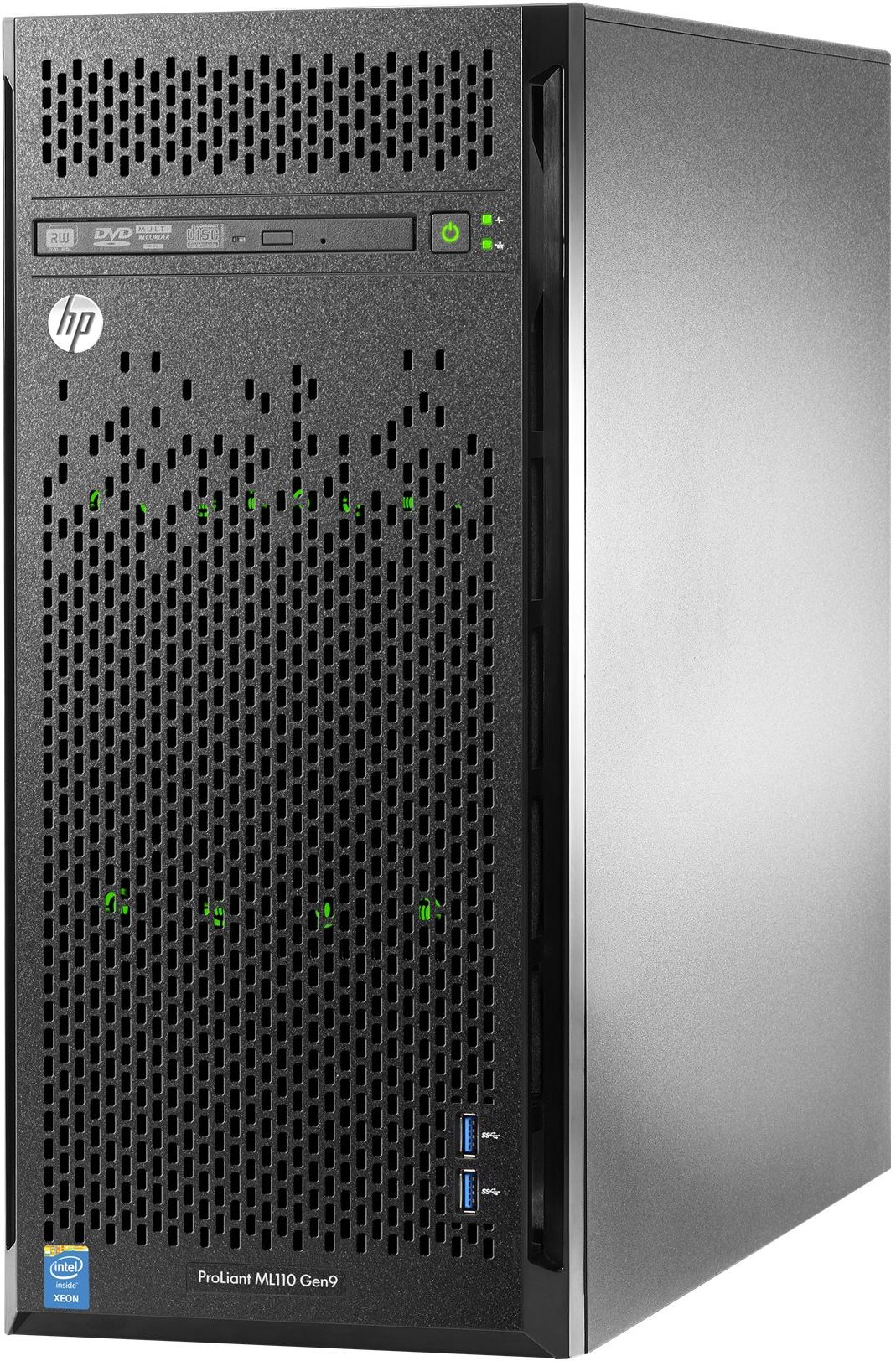
This tower model is an excellent server solution for small and medium-sized enterprises due to its compact size, almost silent operation and opportunities for inexpensive expansion of functionality. As already mentioned at the very beginning of our review, the server with the easy hands of marketers received the title of“first guy in the area”, “first server in the enterprise”, which is very useful if a small company needs to switch to a full server.
Despite the small size of the case, whose height is 4.5U, the server’s technical specifications leave the most pleasant impression: the user has 8 slots for memory modules with a maximum capacity of 256 GB, up to 5 PCIe slots, up to 8 LFF format disks or up to 16 SFF disks.
Two third-generation Intel Xeon processors, the E5-2600 or E5-1600, are offered as the “heart” of the tower server. The latter, as a rule, has fewer cores, but compensates for this drawback with higher frequencies of the CPU.
Let's compare the HP ProLiant ML110 Gen9 with its predecessor, the ML310e Gen8 v2, which represents the eighth generation of Hewlett-Packard servers.
The main difference that catches your eye is, of course, processors. Interestingly, the E3-1200 model used in the HP Proliant ML310e Gen8 v2 model is a slightly improved version of the Core i3 desktop processor, which is much worse optimized for server operation than the new E3-1600 and E5-2600 CPUs. Also, the transition to DDR4 memory and an 8-fold increase in maximum capacity from 32 GB to 256 GB had a favorable effect on increasing the performance of the new model.
Another major change is an increase in the number of disks that can be installed in the system, exactly 2 times. The ability to connect 16 SFF-formatted drives inspires respect for this low-cost server. We also note the “graphic” potential of the new model - at the request of the client, the server can be equipped, for example, with Nvidia video cards. As a result of significant changes regarding server functionality, the size of the chassis also increased, but at the same time, the possibility of installing in a rack remained.
Thanks to certification according to the American standard ASHRAE A3, the server can be used without problems at temperatures up to 40 degrees Celsius and relative humidity up to 85%. Of course, it is desirable to provide the HP ProLiant ML110 Gen9 models with more comfortable operating conditions, but you can be calm for data safety even on the hottest days, say, during the repair of a household air conditioner.
Main technical specifications:
Now is the time to briefly talk about the appearance of the server. The manufacturer produces two different chassis, sharpened for use with disks of a different form factor, that is, the user pre-selects which disks he will work with - SFF or LFF. In addition to numerous disk slots, on the front of the HP ProLiant ML110 Gen9 you can also see a special slot for installing an optical drive, as well as 2 USB 3.0 ports at the bottom.

The location of the components inside the case is standard, and the heatsink of impressive size, designed for passive cooling of the processor, attracts attention. In general, there are no complaints about the implementation of SO: in addition to the main case cooler on the rear side, there is the possibility of installing additional fans in the center and bottom of the chassis - in case of adding a large number of drives and connecting “hot” expansion modules (for example, video cards).
On the back panel, as a rule, there is a bunch of two power supplies with a simple status indication system, VGA video output, USB ports and 2 network interfaces. At the bottom there is a dedicated iLO port, which you can use to configure a separate network through which all traffic for server management will go.

 » Product page on the official website
This budget option, made in the Tower format, is designed for start-up companies, acting as an effective solution for small corporate networks. Despite the low price, the HP ProLiant ML10 v2 provides the necessary level of fault tolerance, the ability to flexibly configure the server and expansion slots for building a storage system. The server is equipped with a third-generation Intel Xeon E3-1200 processor (supports up to 4 cores). HP ProLiant ML10 v2 allows you to use up to 4 DDR3 memory modules, which help achieve a maximum capacity of 32 GB. It is also worth mentioning the ability to connect an impressive number of 3.5-inch (LFF format) drives - 6 pieces. Server management is carried out using iLO Management 4 proprietary software.
It is noteworthy that the case and all the main characteristics of this model were completely borrowed from the eighth generation HP ProLiant ML310e Gen8, which we already talked about when comparing the latter with our follower, the ML110 Gen9 model.
Since we're talking about server comparison, let's take a look at the technical data of the HP ProLiant ML10 v2 and its predecessor, the ML10.
As you can see, the updated HP ProLiant ML10 v2 model received a slightly modified design, got USB 3.0 ports, a new 332i network card and support for more disks. Changes have affected the model of warranty support. In an effort to make the server as accessible as possible for purchase, the company decided to remove the possibility of free model maintenance on the user's territory from the main guarantee package, that is, if there are any problems with the product, the client will have to visit the Hewlett-Packard service center.
However, this inconvenience is partially offset by the presence of a special set of accessories, available only for the HP ProLiant ML10 v2 model at a special, reduced price. Thanks to this innovation, the user can significantly reduce server maintenance costs.
Main technical specifications:
Let's take a closer look at the server. There is a drive cage on the front panel (unfortunately, hot swapping is not supported). Here you can fit 4 discs, 2 more pieces can be installed in the corresponding slots located in the upper part. Alternatively, they can also be used to install an optical drive. If you need to use 6 discs and a DVD-ROM, for the latter there is an option for internal connection using special tapes. Behind the housing grill are the power supply and system cooler. In addition to them, on the rear panel there are 4 USB ports of different standards (2.0 and 3.0), 2 network interfaces and a VGA video output. An iLO port can optionally be located at the bottom. Unlike their older brothers,

If you look inside the server, the power supply housing located at the top of the case immediately catches your eye and the passive CPU cooling system that hides the HP SmartSocket is a “smart” socket developed by the company to prevent the processor from installing incorrectly, as a result of which the latter often legs break. Previously, this was considered one of the most common problems that caused users to contact support. Thanks to the new HP solution, the number of such incidents was significantly reduced.

The last two servers we reviewed (ML110 Gen9 and ML10 v2) can boast of full support for all current versions of the Windows Server operating system, including the 2008 R2 distribution. The required certification went through modern versions of SUSE Linux Enterprise Server, Red Hat Enterprise Linux, and Ubuntu.
In addition, an informal community consisting of owners and "server" enthusiasts successfully tested several desktop Windows operating systems on the models presented in our review, including, for example, the very popular Windows 7. In addition, the operation of various Linux distributions was confirmed , as well as systems such as CentOS, Fedora, Asianux and others. The current list can always be found on this page from the official site.
All of the above servers are equipped with built-in HP Intelligent Provisioning technology, which allows you to quickly deploy the server and easily configure the system. In this case, you do not need to use traditional disks with the HP SmartStart utility, since all software tools and drivers are already preinstalled on the servers. For deployment, USB keys and Scripting Toolkits for Windows and Linux operating systems can be used, as well as iLO (Integrated-Lights Out) technology.
Drivers and server firmware are updated using HP Smart Update Manager technology and the HP Service Pack for ProLiant Series servers. Since the update package has the latest drivers and firmware for a wide list of servers of different generations, the image is suitable for updating the "motley" server infrastructure of enterprises, which simplifies the work and saves engineers time.
Thanks to the proprietary HP Care Pack Next Business Day package, server installation, as well as diagnostics of the problems that occur, are carried out the next business day after contacting the manufacturer’s support service. And often even a server repair can be done right away. If you decide to purchase OEM versions of the servers, the manufacturer will also give a guarantee for the operating system that comes with the product. Then a single support service - Hewlett-Packard, which is very convenient for the user, will be responsible for troubleshooting both the "iron" and the software component of the servers. It is worth paying attention to the fact that the servers of the eighth and ninth generations are characterized by increased reliability and resistance to breakdowns compared to their predecessors.
With the launch of the new HP ProLiant Gen9 server line, the company has expanded its list of budget offers aimed at small and medium enterprises. At the same time, the buyer receives an product at an attractive price, the creation of which used the same production facilities as when assembling other more expensive server models. The manufacturer itself does not reduce the functionality and potential of product management systems of the ninth generation.
Prepared according to the materials of the company "Technologies and Machines". See the text of the article here .
However, quite the lyrics. Meet the heroes of our material today: the HP ProLiant DL60 and DL80 Gen9, designed for rack mounting, and the “two towers” to the delight of fans of the Lord of the Rings Tolkien: HP ProLiant ML10 v2 and HP ProLiant ML110 Gen9. The first three belong to the HP ProLiant 10 series, which was recently added to the HP server catalog, as a result of which these models simply do not have predecessors from the eighth generation. As for the HP ProLiant ML110 Gen9 server, this is one of the junior representatives of the "hundredth" series, which is positioned by the company as the "first server" for those companies that previously exclusively used desktop computers.
As you know, HP currently produces products for three series: 10, 100 and 300, which vary in design, reliability and power.
| Episode 10 | 100 series | 300 Series | |
| Chassis Depth | Up to 24 inches | Up to 24 inches | Standard |
| CPU Limitations | Yes (heat dissipation up to 105 W) | Yes (heat dissipation up to 105 W) | No (heat dissipation up to 145 W) |
| RAM | Up to 8 slots (DDR4 modules) | Up to 16 slots (DDR4 modules) | Up to 24 slots (DDR4 modules) |
| Cooling system | Hot swap support, redundancy possible | Hot swap support, redundancy possible | Hot Swap Support, Mandatory Redundancy |
| Network support | 2x1 Gbit / s; Flexible LOM (riser) - varies by model | 2x1 Gbit / s; Flexible LOM (riser) - varies by model | 4x1 Gbit / s; Flexible LOM (motherboard) - varies by model |
| Disk subsystem | Built-in SATA controller; PCI-e Smart Array / HBA Cards - Model Dependent | Integrated SATA controller, PCI-e Smart Array / HBA Cards - model dependent | Integrated SATA controller, Flexible Smart Array / PCI-e cards - model dependent |
| Ability to expand the disk subsystem | + | +++ | +++ |
| GPU support | No / Partial | Partial | Full |
| The presence of PCI-e slots | + | +++ | +++ |
| Power Supply | Standard, Redundancy and Hot Swap - Model Dependent | Standard, Redundancy and Hot Swap - Model Dependent | Flex Slot Hot Swap |
| Warranty period, years (accessories / replacement / on-site maintenance) | 1/1/1 | 3/1/1 | 3/3/3 |
The younger series are distinguished by a compact size (small racks up to 24 inches are used for placement) and a simplified cooling subsystem, which dictates restrictions on the use of powerful processors. At the same time, talk about a weak "stuffing" is inappropriate, because the basis of the new servers is based on the Intel Haswell processor microarchitecture, as a result of which even the third-generation 12-core Intel Xeon E5 2660 is supported. In addition, the presence of 8 slots for DDR4 memory modules allows limiting 32 GB per bar to pump the system up to 256 GB and even split the streams using dual-processor models, which are available along with single-processor servers.
If we talk about network capabilities, models of the tenth series are equipped with two built-in gigabit Ethernet ports. At the request of the user, the functionality of the server can be expanded using separate network PCI-cards and adapters. HP also integrated the v140i software raid controller, which provides support for SATA drives out of the box, as a result of which the user does not have to think about a separate purchase of the module and the corresponding license for its full operation. If you really need a high-performance solution and support for SAS disks, you can buy, for example, an HP Smart Array controller or a host bus adapter (HBA), which allows you to realize the capabilities of a RAID controller.
Of the minuses of the younger series, for example, a limited number of PCI-E slots and the lack of integrated solutions of this kind on the main board can be noted. However, those tasks for which the younger representatives of the HP ProLiant server line are designed and do not require the connection of a large number of additional modules - for this there is the same 300 series where you can install network cards without using a single PCI-Express slot.
Let's take a closer look at the servers themselves.
HP ProLiant DL60 Gen 9
» Product page on the official website
One of the most affordable representatives of the" tenth "series is excellent for small and medium-sized businesses that require a server for dedicated hosting and typical business applications. The model is also used to solve various simple problems: printing, various file processing, messaging.
In addition, the HP ProLiant DL60 Gen 9 has proven itself in the cloud and in collaboration with users. Despite its low cost, the server is equipped with basic tools for monitoring and management, which are usually inherent in models for the corporate sector.
Main technical specifications:
- Processor: Intel Xeon E5-2600v3 - x2
- RAM: 32 GB DDR4 DIMM - x8 (up to 256 GB in total)
- Disk Controller: HP Dynamic Smart Array B140i
- Network: 1Gb x2 + FlexibleLOM optional
- Drives: HDD / SSD - x4 LFF (3.5``)
- Management: HP iLO 4 (v.2.0), UEFI
- Power supply: 80+ Gold, second PSU - optional
- PCI: PCIe x3
- Warranty: 1/1/1
The model is made in the 1U form factor and can work with two processors (limitation - 12 cores and 105 W heat dissipation for each chip). Eight slots for DDR4 SmartMemory modules allow you to install up to 256 GB of memory with the prospect of increasing to 512 GB in the very near future, when 64 GB modules will be presented.
Supports the installation of up to 4 large format drives - 3.5 inches (LFF), and can be used as hard drives and solid state drives (SSD). For management here, as in all models of the ninth generation servers, standard tools are intended: iLO 4 (iLO Management and Intelligent Provisioning), UEFI BIOS and REST API, which allows you to use HP ProLiant DL60 Gen 9 in large quantities, for example, when creating server farms.
A power supply is available on request with features such as redundancy and hot swapping. We also note the possibility of installing a second power supply unit of standard 80+ Gold for an additional fee. As for the warranty, everything is simple - one year for each type of free services from the manufacturer, which traditionally includes component repair, replacement and on-site maintenance.
HP ProLiant DL80 Gen 9
» The product page on the official website The
HP ProLiant DL80 Gen9 two-unit server from the" tenth "series, like its" smaller brother "HP ProLiant DL60 Gen 9, is attractive in price and has good features. The developer positions it as an affordable storage server with a low cost of data storage (based on the cost of 1 GB).
This model can be used as a mail or file server, as well as a domain controller, it will cope with most small business operations and the basic tasks of web and IT infrastructure. One of the advantages of the HP ProLiant DL80 Gen9 is that with the licensed software from Hewlett-Packard, the server can be used for efficient data storage. So, with the HP StoreOnce VSA utility, this model becomes a disk system for backup storage, and thanks to HP StoreVirtual, you can implement a network storage system. In this case, you get a good list of corporate features.
Main technical specifications:
- Processor: Intel Xeon E5-2600v3 - x2
- RAM: 32 GB DDR4 DIMM - x8 (up to 256 GB in total)
- Disk Controller: HP Dynamic Smart Array B140i
- Network: 1Gb x2 + FlexibleLOM optional
- Drives: HDD / SSD - x12 LFF (3.5``)
- Management: HP iLO 4 (v.2.0), UEFI
- Power supply: 80+ Gold, second PSU - optional
- PCI: PCIe x6
- Warranty: 1/1/1
As you may have noticed, the vast majority of the technical characteristics of the server coincide with the parameters of the younger model, which is not surprising. The main difference here is the 2U form factor, thanks to which you can install up to 12 “large-format" LFF and SSD hard drives. Due to this, the ProLiant DL80 Gen 9 server will "make friends" with especially "gluttonous" applications, which require a lot of disk space to install normal operation. This low-cost model also has three PCIe slots more than the HP ProLiant DL60 Gen 9 - a total of 6. The
manufacturer gives a year of warranty on accessories and the same number on server maintenance and replacement.
HP ProLiant ML110 Gen9
» Product page on the official website.This tower model is an excellent server solution for small and medium-sized enterprises due to its compact size, almost silent operation and opportunities for inexpensive expansion of functionality. As already mentioned at the very beginning of our review, the server with the easy hands of marketers received the title of
Despite the small size of the case, whose height is 4.5U, the server’s technical specifications leave the most pleasant impression: the user has 8 slots for memory modules with a maximum capacity of 256 GB, up to 5 PCIe slots, up to 8 LFF format disks or up to 16 SFF disks.
Two third-generation Intel Xeon processors, the E5-2600 or E5-1600, are offered as the “heart” of the tower server. The latter, as a rule, has fewer cores, but compensates for this drawback with higher frequencies of the CPU.
Let's compare the HP ProLiant ML110 Gen9 with its predecessor, the ML310e Gen8 v2, which represents the eighth generation of Hewlett-Packard servers.
| HP ProLiant ML310e Gen8 v2 | HP ProLiant ML110 Gen9 | |
| CPU | Intel Xeon E3-1200 (v.3); kernels - 2/4 | Intel Xeon E5-2600 (v.3) / E5-1600 (v.3); cores - 4/6/8/10 |
| RAM | 4 DDR3 slots (max. 32 GB); up to 1333 MHz | 8 DDR4 slots (max. 256 GB); up to 2133 MHz |
| Disk controller | Built-in HP Dynamic Smart Array B120i; HP Smart Array - optional | Integrated HP Dynamic Smart Array B140i, HP Smart Array and HP Smart HBA - optional |
| Cache | 512Mb FBWC SATA | Optional |
| I / O (PCI-e) | PCIe 2.0 x2 + PCIe 3.0 x2 | PCIe 3.0 x5 |
| Battery | Not | Optional |
| Network support | Built-in 1GbE x2 module | Built-in 1GbE x2 module |
| Disk support | 8 SFF / 4 LFF, HDD / SSD | 16 SFF / 8 LFF (hot swap) / 4 LFF (without); SATA / SAS; HDD / SSD |
| GPU | Yes (Built-in) | Optional (150 W) |
| Interfaces | VGA, Serial Port, USB x8, Micro-SD | VGA, USB x8, Micro-SD |
| Control | HP iLO Management Engine | HP iLO 4 (also HP iLO Essentials), HP SUM, UEFI, HP Intelligent Provisioning |
| Power and cooling | Efficiency up to 92% | Efficiency up to 92%; 350 W / 550 W, 750 W (redundancy) |
| Certification | Not | ASHRAE A3 |
| Chassis format | 18.7 inch | Less than 19 inches |
| Warranty period, years (accessories / replacement / on-site maintenance) | 1/1/1 | 3/1/1 |
The main difference that catches your eye is, of course, processors. Interestingly, the E3-1200 model used in the HP Proliant ML310e Gen8 v2 model is a slightly improved version of the Core i3 desktop processor, which is much worse optimized for server operation than the new E3-1600 and E5-2600 CPUs. Also, the transition to DDR4 memory and an 8-fold increase in maximum capacity from 32 GB to 256 GB had a favorable effect on increasing the performance of the new model.
Another major change is an increase in the number of disks that can be installed in the system, exactly 2 times. The ability to connect 16 SFF-formatted drives inspires respect for this low-cost server. We also note the “graphic” potential of the new model - at the request of the client, the server can be equipped, for example, with Nvidia video cards. As a result of significant changes regarding server functionality, the size of the chassis also increased, but at the same time, the possibility of installing in a rack remained.
Thanks to certification according to the American standard ASHRAE A3, the server can be used without problems at temperatures up to 40 degrees Celsius and relative humidity up to 85%. Of course, it is desirable to provide the HP ProLiant ML110 Gen9 models with more comfortable operating conditions, but you can be calm for data safety even on the hottest days, say, during the repair of a household air conditioner.
Main technical specifications:
- Processor: Intel Xeon E5-1600v3 / E5-2600v3
- RAM: 32 GB DDR4 DIMM - x8 (up to 256 GB in total)
- Disk controller: HP Dynamic Smart Array B140i, HP Smart Array / HBA - optional
- Network: 1Gb x2
- Drives: HDD / SSD - x8 LFF (3.5``) / x16 SFF (2.5 '')
- Management: HP iLO 4, HP SUM / SPP, UEFI, HP Intelligent Provisioning
- Power supply: 80+ Gold x2, multi-channel output
- PCI: PCIe 3.0 x5
- Warranty: 3/1/1
Now is the time to briefly talk about the appearance of the server. The manufacturer produces two different chassis, sharpened for use with disks of a different form factor, that is, the user pre-selects which disks he will work with - SFF or LFF. In addition to numerous disk slots, on the front of the HP ProLiant ML110 Gen9 you can also see a special slot for installing an optical drive, as well as 2 USB 3.0 ports at the bottom.
The location of the components inside the case is standard, and the heatsink of impressive size, designed for passive cooling of the processor, attracts attention. In general, there are no complaints about the implementation of SO: in addition to the main case cooler on the rear side, there is the possibility of installing additional fans in the center and bottom of the chassis - in case of adding a large number of drives and connecting “hot” expansion modules (for example, video cards).
On the back panel, as a rule, there is a bunch of two power supplies with a simple status indication system, VGA video output, USB ports and 2 network interfaces. At the bottom there is a dedicated iLO port, which you can use to configure a separate network through which all traffic for server management will go.
HP ProLiant ML10 v2
» Product page on the official websiteThis budget option, made in the Tower format, is designed for start-up companies, acting as an effective solution for small corporate networks. Despite the low price, the HP ProLiant ML10 v2 provides the necessary level of fault tolerance, the ability to flexibly configure the server and expansion slots for building a storage system. The server is equipped with a third-generation Intel Xeon E3-1200 processor (supports up to 4 cores). HP ProLiant ML10 v2 allows you to use up to 4 DDR3 memory modules, which help achieve a maximum capacity of 32 GB. It is also worth mentioning the ability to connect an impressive number of 3.5-inch (LFF format) drives - 6 pieces. Server management is carried out using iLO Management 4 proprietary software.
It is noteworthy that the case and all the main characteristics of this model were completely borrowed from the eighth generation HP ProLiant ML310e Gen8, which we already talked about when comparing the latter with our follower, the ML110 Gen9 model.
Since we're talking about server comparison, let's take a look at the technical data of the HP ProLiant ML10 v2 and its predecessor, the ML10.
| X | HP ProLiant ML10 | HP ProLiant ML10 v2 |
| CPU | Intel Xeon E3-1200 (v.2); kernels - 2/4 | Intel Xeon E3-1200 (v.3); kernels - 2/4 |
| RAM | 4 DDR3 slots (max. 32 GB); up to 1600 MHz | 4 DDR3 slots (max. 32 GB); up to 1600 MHz |
| Disk controller | HP Dynamic Smart Array B110i RAID 0/1/10 | HP Dynamic Smart Array B120i RAID 0/1/10 |
| I / O (PCI-e) | PCIe 2.0 x4 | PCIe 2.0 x2 + PCIe 3.0 x2 |
| Network support | Built-in 112i 1GbE x2 | Embedded 332i 1GbE x2 |
| Disk support | 4 LFF; HDD | 6 LFF; HDD |
| GPU | Not | Optional |
| Interfaces | VGA, USB x7 (2.0) | VGA, USB x4 (3.0 x2 / 2.0 x2) |
| Control | HP iLO 3, HP SUM | HP iLO 4 (optional HP iLO Essentials), HP SUM |
| Power and cooling | Efficiency up to 85% | Efficiency up to 85% |
| Certification | Not | Fcc class b |
| Chassis format | 15 inch | 18.71 inch |
| Warranty period, years (accessories / replacement / on-site maintenance) | 1/1/1 | 100 |
As you can see, the updated HP ProLiant ML10 v2 model received a slightly modified design, got USB 3.0 ports, a new 332i network card and support for more disks. Changes have affected the model of warranty support. In an effort to make the server as accessible as possible for purchase, the company decided to remove the possibility of free model maintenance on the user's territory from the main guarantee package, that is, if there are any problems with the product, the client will have to visit the Hewlett-Packard service center.
However, this inconvenience is partially offset by the presence of a special set of accessories, available only for the HP ProLiant ML10 v2 model at a special, reduced price. Thanks to this innovation, the user can significantly reduce server maintenance costs.
Main technical specifications:
- Processor: Intel Xeon E5-1200v3
- RAM: 8 GB DDR3 DIMM - x4 (up to 32 GB in total)
- Disk controller: HP Dynamic Smart Array B140i, HP Smart HBA - optional
- Network: 1Gb x2
- Drives: HDD / SSD - x6 LFF (3.5``)
- Management: HP iLO 4, HP SUM
- Power Supply: 80+, multi-channel output
- PCI: PCIe x4 (PCIe 2.0 x2 + PCIe 3.0 x2)
- Warranty: 1/0/0
Let's take a closer look at the server. There is a drive cage on the front panel (unfortunately, hot swapping is not supported). Here you can fit 4 discs, 2 more pieces can be installed in the corresponding slots located in the upper part. Alternatively, they can also be used to install an optical drive. If you need to use 6 discs and a DVD-ROM, for the latter there is an option for internal connection using special tapes. Behind the housing grill are the power supply and system cooler. In addition to them, on the rear panel there are 4 USB ports of different standards (2.0 and 3.0), 2 network interfaces and a VGA video output. An iLO port can optionally be located at the bottom. Unlike their older brothers,
If you look inside the server, the power supply housing located at the top of the case immediately catches your eye and the passive CPU cooling system that hides the HP SmartSocket is a “smart” socket developed by the company to prevent the processor from installing incorrectly, as a result of which the latter often legs break. Previously, this was considered one of the most common problems that caused users to contact support. Thanks to the new HP solution, the number of such incidents was significantly reduced.
The last two servers we reviewed (ML110 Gen9 and ML10 v2) can boast of full support for all current versions of the Windows Server operating system, including the 2008 R2 distribution. The required certification went through modern versions of SUSE Linux Enterprise Server, Red Hat Enterprise Linux, and Ubuntu.
In addition, an informal community consisting of owners and "server" enthusiasts successfully tested several desktop Windows operating systems on the models presented in our review, including, for example, the very popular Windows 7. In addition, the operation of various Linux distributions was confirmed , as well as systems such as CentOS, Fedora, Asianux and others. The current list can always be found on this page from the official site.
List of officially supported OS
Microsoft:
- Windows Server 2008 R2
- Windows Server 2012 R2
- Windows Server 2012
Linux:
- Red Hat Enterprise Linux 6.5, 6.6, 7.0, 7.1
- SUSE Linux Enterprise Server 11, 12
- Ubuntu
VMware (virtualization)
- VMware vSphere 5.1 U3
- VMware vSphere 5.5 U2
- VMware vSphere 6.0
Citrix (Virtualization)
- Citrix XenServer
- Windows Server 2008 R2
- Windows Server 2012 R2
- Windows Server 2012
Linux:
- Red Hat Enterprise Linux 6.5, 6.6, 7.0, 7.1
- SUSE Linux Enterprise Server 11, 12
- Ubuntu
VMware (virtualization)
- VMware vSphere 5.1 U3
- VMware vSphere 5.5 U2
- VMware vSphere 6.0
Citrix (Virtualization)
- Citrix XenServer
List of Unofficially Supported OS
- Windows (desktop versions)
- Oracle Linux
- Debian
- CentOS
- Fedora
- OpenSUSE
- Asianux
- Oracle Linux
- Debian
- CentOS
- Fedora
- OpenSUSE
- Asianux
In the end
All of the above servers are equipped with built-in HP Intelligent Provisioning technology, which allows you to quickly deploy the server and easily configure the system. In this case, you do not need to use traditional disks with the HP SmartStart utility, since all software tools and drivers are already preinstalled on the servers. For deployment, USB keys and Scripting Toolkits for Windows and Linux operating systems can be used, as well as iLO (Integrated-Lights Out) technology.
Drivers and server firmware are updated using HP Smart Update Manager technology and the HP Service Pack for ProLiant Series servers. Since the update package has the latest drivers and firmware for a wide list of servers of different generations, the image is suitable for updating the "motley" server infrastructure of enterprises, which simplifies the work and saves engineers time.
Thanks to the proprietary HP Care Pack Next Business Day package, server installation, as well as diagnostics of the problems that occur, are carried out the next business day after contacting the manufacturer’s support service. And often even a server repair can be done right away. If you decide to purchase OEM versions of the servers, the manufacturer will also give a guarantee for the operating system that comes with the product. Then a single support service - Hewlett-Packard, which is very convenient for the user, will be responsible for troubleshooting both the "iron" and the software component of the servers. It is worth paying attention to the fact that the servers of the eighth and ninth generations are characterized by increased reliability and resistance to breakdowns compared to their predecessors.
With the launch of the new HP ProLiant Gen9 server line, the company has expanded its list of budget offers aimed at small and medium enterprises. At the same time, the buyer receives an product at an attractive price, the creation of which used the same production facilities as when assembling other more expensive server models. The manufacturer itself does not reduce the functionality and potential of product management systems of the ninth generation.
Prepared according to the materials of the company "Technologies and Machines". See the text of the article here .