May 28, 2015 at 09:06
Reach: GPS accurate to centimeter
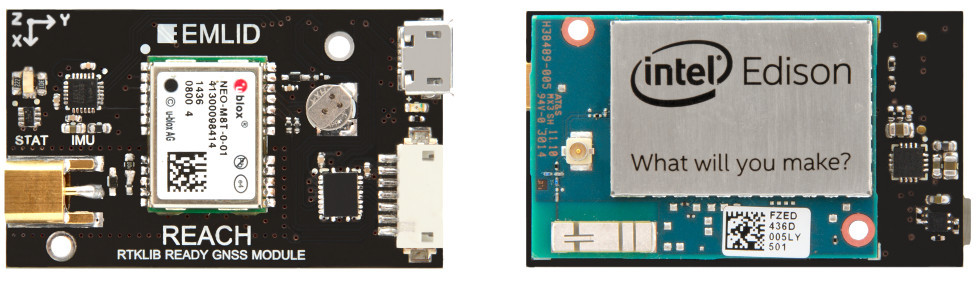
Modern satellite navigation technologies provide positioning with an accuracy of about 10-15 meters. In most cases, this is enough, however, in some cases, more is required: say, an autonomous drone moving quickly enough above the earth's surface will feel uncomfortable in the cloud from coordinates with meter errors.
To refine satellite data, differential systems and RTK (real-time kinematics) technologies are used, but until recently, such devices were expensive and cumbersome. Recent advances in digital technology in the face of the Intel Edison microcomputer have helped solve this problem. So, meet: Reach is the first compact high-precision GPS receiver, very affordable, and, moreover, developed in Russia.
First, let's talk a little about differential technologies that allow Reach to achieve such high results. They are well known and widely implemented. Differential navigation systems (DNS) improve the accuracy of determining the location and speed of mobile users by providing measurement data or corrective information from one or more base stations.
The coordinates of each base station are known with high accuracy, so that the measurement data by the station serves to calibrate the data of adjacent receivers. The receiver can calculate the theoretical distance and propagation time of the signal between itself and each satellite. When these theoretical values are compared with observational data, the differences are errors in the received signals. Corrective information (RTCM data) is obtained from these differences.
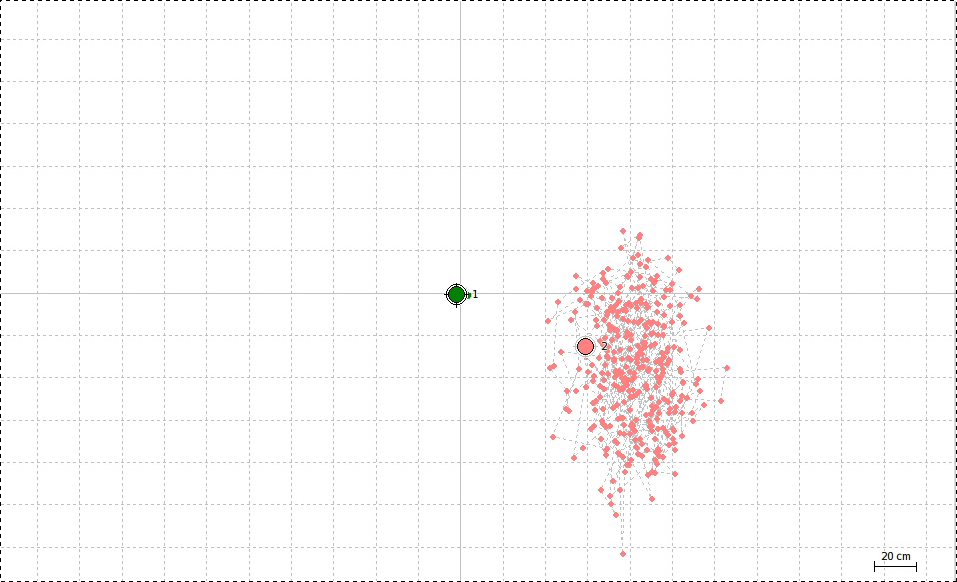
Accuracy of determination of coordinates by means of Reach. Pay attention to the scale.
Corrective information can be obtained by the Reach device from two sources. Firstly, from a public network of base stations via the Internet using the NTRIP protocol (Networked Transport of RTCM via Internet Protocol), which implements the idea described above in relation to a global computer network. Secondly, with the help of the second Reach, which occupies a stationary position near the first and is thus the base station in terms of DNS. The second option is preferable (the accuracy of the DSSS decreases significantly with increasing distance between the receiver and the BS) - it is no accident that within the framework of the crowdfunding campaign on the Indiegogo website, the creators of Reach offer to buy the first set of two devices as the first position.
The device specifications are shown in the table below. As you can see, it consists of 3 parts in hardware: an Intel Edison computer running Linux OS and RTK software RTKLIB; U-blox NEO-M8T GPS receiver and Tallysman TW4721 antennas. Please note that the receiver supports all existing satellite systems: GPS, GLONASS, Beidou and QZSS. All this combination of software and hardware components provides an impressive accuracy in determining coordinates: up to 2 cm!
| Satellite receiver | U-blox NEO-M8T - 72 channels, output rate up to 18Hz, supports GPS / QZSS L1 C / A, GLONASS L10F, BeiDou B1, SBAS L1 C / A: WAAS, EGNOS, MSAS, Galileo-ready E1B / C |
| Computer platform | Intel Edison - dual-core 500MHz |
| Interfaces | I2C, UART, GPIO, TimeStamp, OTG USB, Bluetooth, Wi-Fi, GNSS |
| Antenna | Tallysman TW4721 Dual Feed GPS / BeiDou / Galileo / GLONASS |
| Dimensions | 26x36 mm |
| Weight | 13 g |
The creators of Reach, the company Emlid, successfully performed on the indiegogo website: in less than a month, almost double the requested amount was collected. This means that the project will certainly be implemented. You still have time to pre-order and be among the first to receive a brand new navigation device. Distribution of goods is scheduled for July.