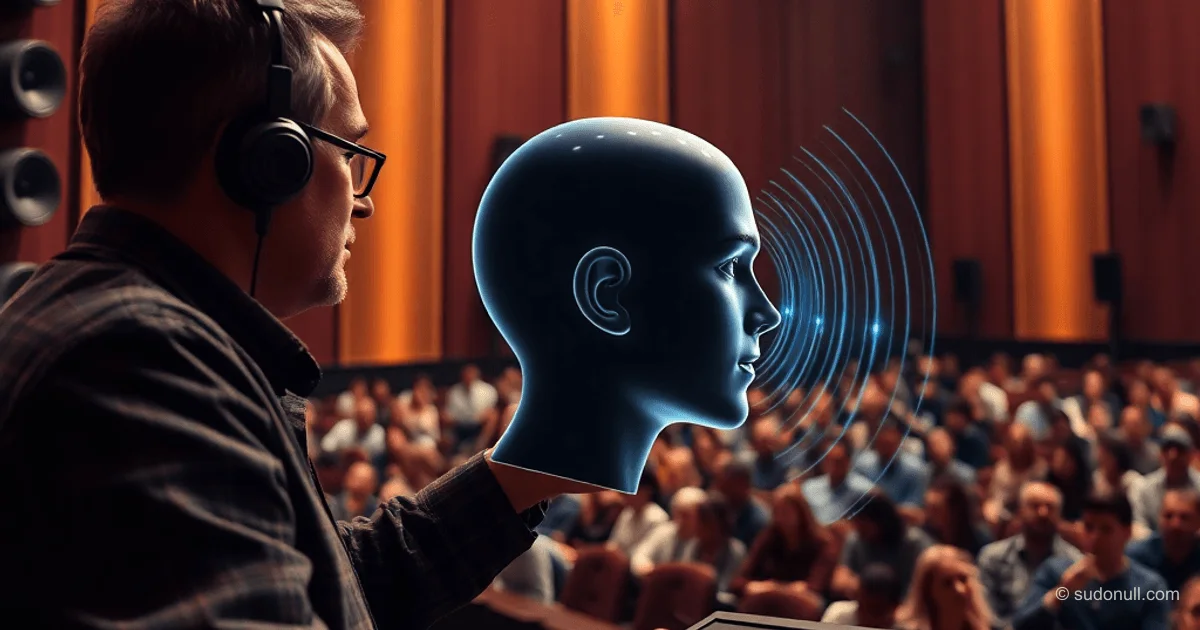
3D Stereo: A Format for Realistic Spatial Audio Without Headphones
The 3D Stereo format enables playback of binaural audio through external speaker systems, minimizing crosstalk. Placing speakers at the sides at 90° to the ears delivers natural localization of sound sources, depth perception, and a stable soundstage. This solution is independent of the listener's individual anatomy and works in rooms of various sizes.
Experiments have shown that the head creates an acoustic shadow, the Haas effect stabilizes positioning, and a wide stereo base preserves spatial volume even with frontal speaker placement. Testing in a 130-seat cinema confirmed its effectiveness: clear localization from the front and rear, detailed rendering of elements like footsteps and rain, and a stable sweet spot.
Experiment in the Cinema
In a real 12-meter-wide hall, binaural recordings were played through linear side arrays along the walls. Results:
- Excellent detail in small sounds (drops, footsteps).
- Clear localization of low frequencies (trains, cars).
- Natural scene depth.
- Wide sweet spot: the effect holds when changing positions.
- Compatibility with multichannel formats (5.1 → 7.1).
Drawbacks: weak vertical localization and a flat phantom center, highlighting the need to model the ear canal.
Anatomical Measurement Rig
To verify the role of the ear canal, a rig was created to simulate head acoustics:
- Geometry based on a 3D model, 20 Shore A silicone for the ears and canal.
- 1 mm flock on the surface for HF diffraction.
- WM-61 microphones at the eardrum locations.
- GoPro stereo camera for synchronized VR recording.
Recordings were made in an open forest (Zoom F3, 32 bit / 192 kHz) using impulse sources (bottle clicks). Movements around a circle, frontal axis, and vertical plane.
Measurement Results and Conclusions
Analysis confirmed the canal's influence:
- Stable phantom center with solidity and depth.
- Accurate horizontal localization without smearing.
- Noticeable vertical positioning.
- Preservation of distance during approach or recession.
This delivers a full 3D scene: direction, depth, and height.
Super HRTF: Digital Model
Super HRTF is an advanced HRTF for real-time processing, listener adaptation, and post-production. It allows modeling dynamic scenes without repeat recordings, integrating synthesized sounds. Data from the anatomical rig is transferred to a digital map for precise emulation of filters, delays, and diffraction.
Methodology:
- Impulse measurements in controlled conditions.
- Building a 3D response map.
- Real-time rendering accounting for ITD, ILD, and HRTF.
Applications: cinema, VR, games—without specialized equipment and with personalization based on head position.
Key Points
- 3D Stereo works with external speakers, bypassing crosstalk via side placement.
- The ear canal is critical for the phantom center and vertical localization.
- Super HRTF digitizes anatomy for dynamic scenes in real time.
- Tested in a cinema: wide sweet spot and compatibility with multichannel formats.
- Prospects: integration into production without recording limitations.
— Editorial Team










No comments yet.