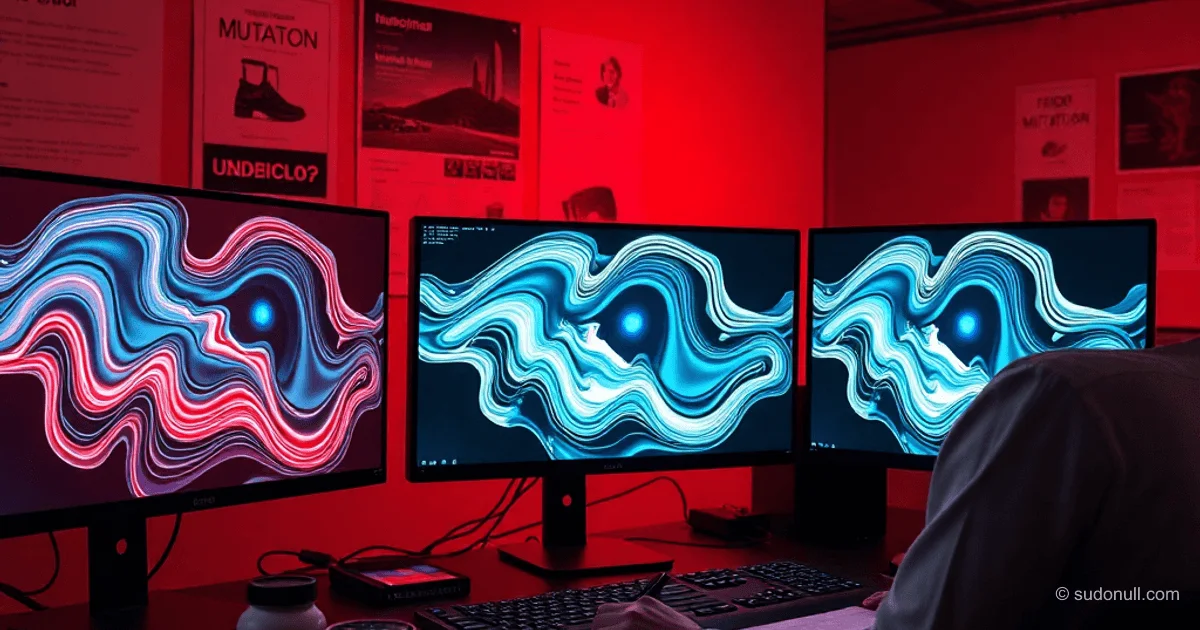
AI-Generated Interfaces as a Catalyst for Visual Innovation
AI-generated interfaces (UI) provide developers and designers not with production-ready screens, but with unique visual combinations. These 'mutations'—new blends of depth, materials, lighting, and geometry—accelerate the search for unconventional solutions. Designers now focus on selection and systematization, rather than the initial invention of forms.
Common Mistakes in Evaluating AI-Generated UI
Evaluating AI-generated UI often starts with questions about layout or transferring to Figma. That's secondary. The primary analysis is identifying new visual logic: unusual shell thickness, contrast between a dark core and a glowing edge, bold color transitions, or glossy forms that maintain readability.
Such elements are valuable even without full production readiness. Strong generation is useful as an idea source, where the crude scale of 'ready/not ready' ignores the intermediate layer of innovation.
A visual mutation is a cohesive, compelling combination of features, rare in manual practice:
- Unfamiliar plasticity and surface thickness
- Dark core with an active glowing edge
- Color shifts that work in assembly despite theoretical excess
- Glossy geometry that preserves readability
The mutation should be noticeable and coherent, capturing attention regardless of debatable details.
Shift in the Role of Designer and Developer
AI strips the designer of the monopoly on the initial visual sketch. Instead of inventing forms in one's head, there's now an external stream of hypotheses from the model.
The new workflow sequence:
- AI generates an array of visual options and mutations
- Designer/developer selects promising ones
- Simplifies and normalizes them
- Transforms the deviation into a repeatable system
The scarcity shifts: from generating forms to selection criteria and visual literacy. The profession evolves toward strengthening analytical skills—separating signal from noise.
AI efficiently iterates through combinations of materials, highlights, transparency, thickness, contrasts, geometry, and depth. Without the inertia of 'mature' solutions, the model produces bold mixes, from which strong ones are selected for moodboards.
AI Limitations in Product Environments
AI struggles with product tasks: arranging real content, error states, focus, accessibility, long strings, localization, and responsiveness. A beautiful empty screen masks weaknesses.
In reality, issues emerge:
- Long titles and complex forms
- Tables, settings, toggles
- Different component states
- Random backgrounds and resolutions
If the logic only holds up at a perfect angle—it's a hypothesis, not a system. Translating into repeatable layers, states, and contrasts determines value.
Glassmorphism Case Study as a Maturity Test
The liquid glass or glassmorphism style illustrates the boundary: a static effect creates a tactile surface with thickness and highlights. Popular on inspiration platforms, but in interfaces, questions arise:
- Text readability in the dark core
- Competition of the bright edge with hierarchy
- Behavior on different backgrounds and devices
- Clear states (hover, disabled)
- Scalability from button to toolbar
This is a stress test: focus on repeatable surface traits, not the object.
Practical Workflow with AI Generations
Working with a strong image:
- Identify the key trait (thickness, rim light, shift)
- Describe it as a rule for repeatability
- Reassemble in a neutral environment without decoration
- Test states: hover, pressed, focus
- Retain what's stable
If the idea holds up—integrate it into the design system.
Key Takeaways
- AI delivers visual mutations as a rapid source of innovation, changing the entry point into the design process.
- Designers transition from generation to selection and systematization, enhancing critical thinking.
- Generations are valuable for new combinations (thickness, edge, depth) but require testing for states and adaptability.
- Glassmorphism illustrates the gap between static renders and product systems.
- Workflow: selection → rule → test → systematization.
— Editorial Team










No comments yet.