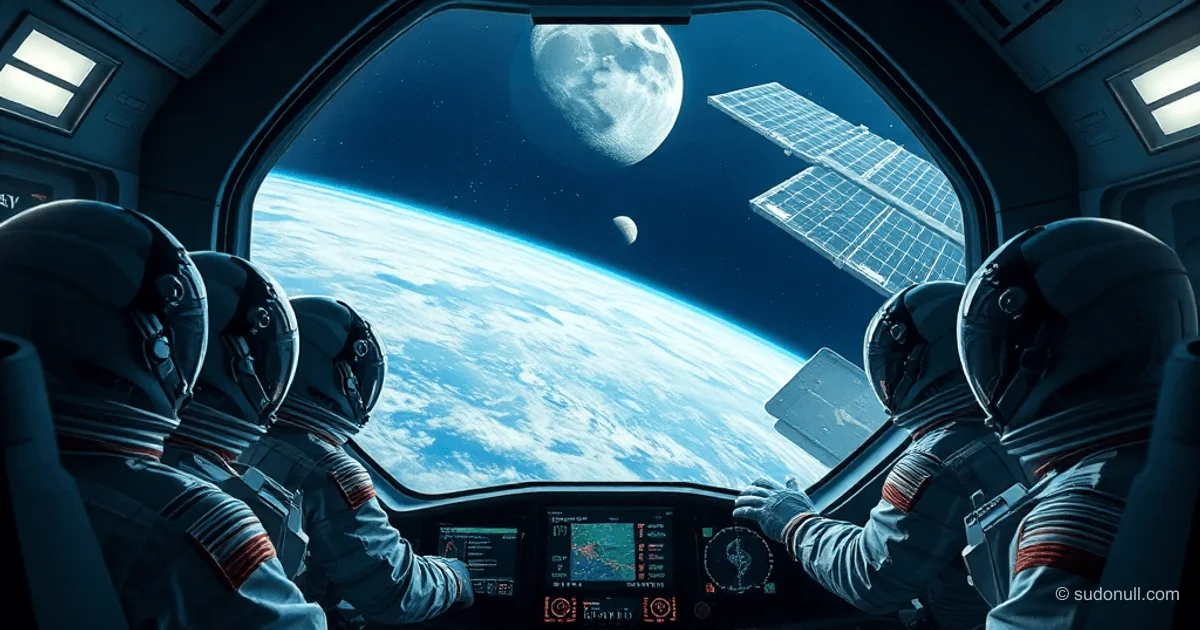
Artemis II Launch: First Crewed Orion Flight to the Moon
The SLS rocket with the Orion spacecraft launched on April 1, 2026, at 18:35 local time from Kennedy Space Center. This is the first crewed launch in the Artemis program. The crew of four astronauts headed to the Moon for a flyby without landing. The mission will last 10 days.
The crew includes experienced specialists:
- Commander Reid Wiseman (over 165 days in space, ISS experience, former NASA astronaut office chief).
- Pilot Victor Glover (168 days, SpaceX Crew-1 mission).
- Mission Specialist Christina Koch (record 328 days in a single mission for a woman).
- Mission Specialist Jeremy Hansen (Canadian Space Agency).
Technical Incidents at Launch
1.5 hours before launch, a problem was detected in the flight termination system — engineers fixed it quickly. After launch, issues arose:
Google AdInline article slot
- Brief loss of communication (several minutes during transmitter switchover).
- Malfunction in the waste management system (toilet) — restored in coordination with the center in Houston.
- Closed valve on the water tank.
- Outlook glitch — team is working on recovery.
Despite the incidents, Orion successfully separated from SLS, deployed solar panels. The crew is in good spirits, currently resting.
Timeline of Key Stages
The mission follows a strict schedule using the SLS upper stage for maneuvers:
- T+49 min: upper stage ignition, elliptical orbit (2222 × 185 km).
- T+1 day 47 min: apogee raise to 70,000 km.
- T+2 days: Trans-Lunar Injection (TLI), departure to the Moon.
- T+4 days 21 hrs: new distance record (over 402,000 km from Earth).
- T+5 days 1 hr: lunar approach (~7400 km from surface).
- T+9 days 1 hr 33 min: atmospheric entry, service module separation.
- T+9 days 1 hr 46 min: ocean splashdown after deceleration and parachutes.
The last crewed lunar mission was Apollo 17 in 1972.
Google AdInline article slot
Key Takeaways
- First crewed test of SLS and Orion paves the way for the U.S. return to the Moon.
- Crew combines ISS experience and international participation (Canada).
- Launch incidents (comms, toilet, water, Outlook) resolved without flight risk.
- Lunar flyby will set NASA distance record since the 1970s.
- Mission lasts 10 days, ending with ocean splashdown.
— Editorial Team










No comments yet.