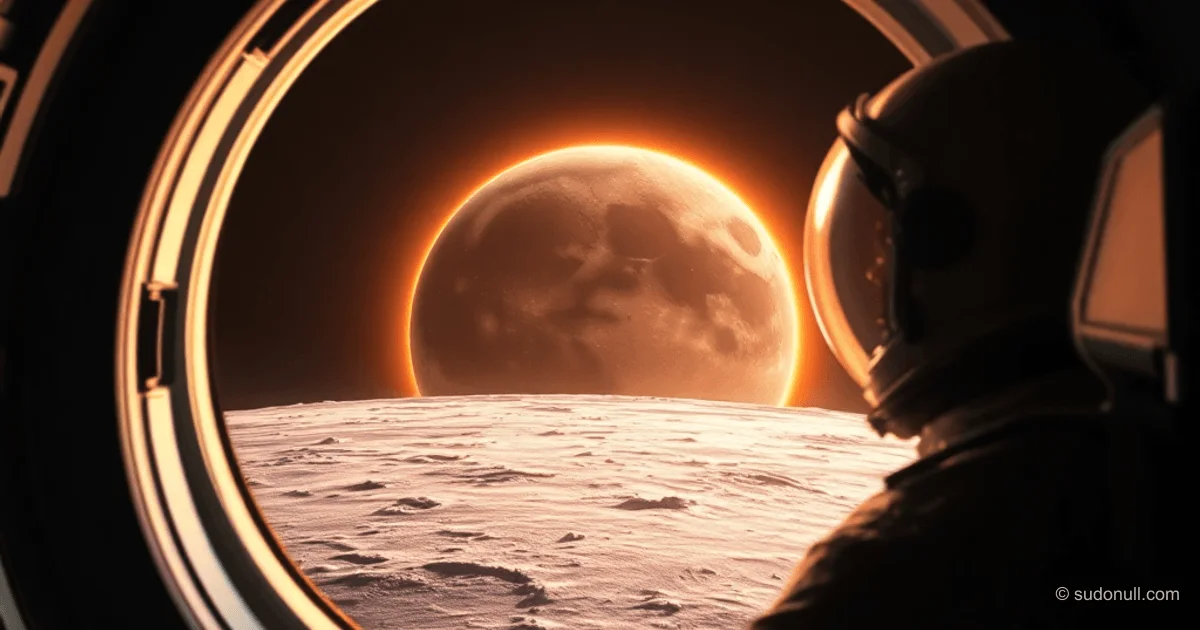
# Artemis II Crew: Stunning Shots of the Moon and Earth from Orion
The Artemis II crew aboard the Orion spacecraft captured a series of images of the Moon and Earth during the lunar flyby, setting a new record for distance from Earth at 406,771 km. For the first time since 1972, humans saw the far side of the Moon with the naked eye and documented an "Earthset," akin to the legendary "Earthrise" from Apollo 8 in 1968. Over the 7-hour flyby, the astronauts conducted scientific observations, photographed more than 30 features, and captured a total solar eclipse beyond Earth.
Key Images: From the Far Side to the Eclipse
Astronauts Reid Wiseman, Christina Koch, Victor Glover, and Jeremy Hansen captured unique shots:
- Setting Earth over the lunar horizon — the first such image from a crewed spacecraft in 53 years (after Apollo 17).
- Far side of the Moon, visible to the naked eye for the first time since 1972.
- Total solar eclipse featuring the Sun's corona, observed from 6,550 km from the lunar surface.
- Earth from the far side of the Moon during set.
During closest approach to the Moon (6,550 km), the crew spent 5 hours observing the sunlit surface, including studies of terrain and craters. A time-lapse of the 9-hour flyby shows Orion's orientation adjustments: every 30 minutes, the spacecraft rotated to optimize solar panel illumination and keep the Moon in the window view, compensating for accumulated drift.
Mission Technical Details
Launch took place on April 2, 2026, at 1:35 a.m. Moscow time from Kennedy Space Center on the SLS rocket. The flyby lasted nearly 7 hours, during which:
- Maximum distance from Earth was recorded — 8,047 km beyond the Moon (April 7, 02:02:51 Moscow time).
- Scientific experiments were conducted observing the lunar surface.
- Data was collected on the solar eclipse and corona.
- A new record was set for crewed flight distance.
The Orion spacecraft returned to Earth on April 12. These images will provide scientists with material for analyzing lunar terrain, orbital dynamics, and visual effects in deep space.
What Matters
- Distance Record: 406,771 km — farther than any previous crewed missions.
- Historic Photos: First human-eye images in 53 years of setting Earth and the far side of the Moon.
- Space Eclipse: Total solar eclipse beyond Earth from a unique vantage point.
- Scientific Haul: More than 30 shots of lunar features for further analysis.
- Technical Stability: Orion's automatic adjustments ensured high-quality time-lapse and observations.
— Editorial Team










No comments yet.