# Atlas 350 on Ascend 950PR: FP4 Performance and Comparison with Nvidia H20
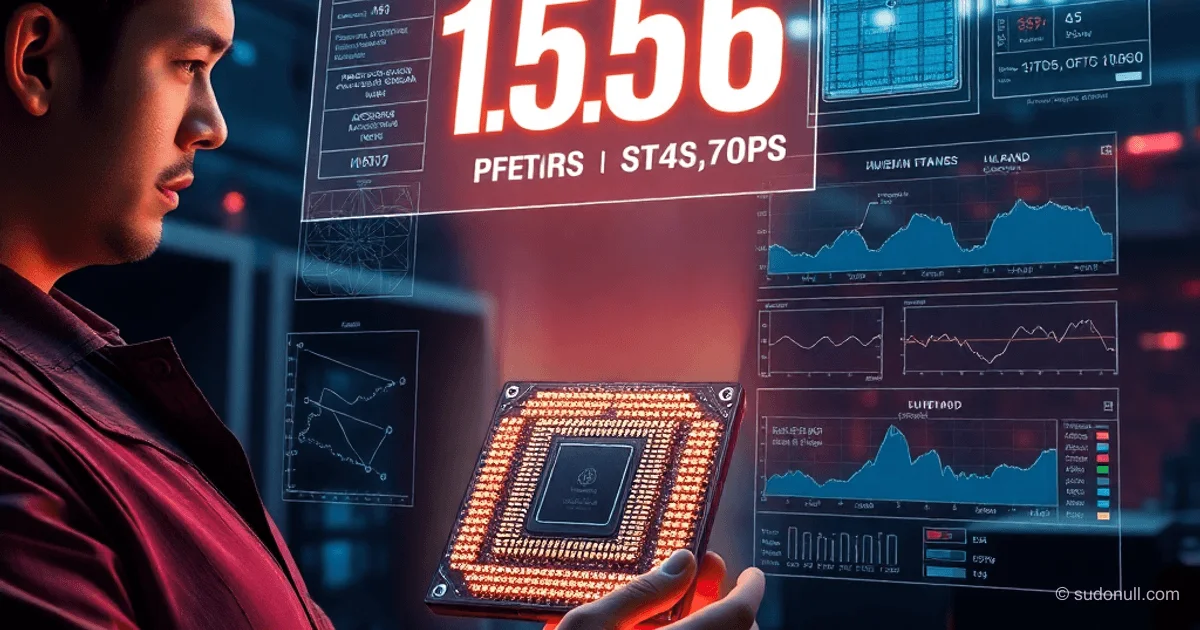
Huawei has announced the AI accelerator Atlas 350 based on the Ascend 950PR chip. The device delivers 1.56 PFLOPS in FP4 format and, according to the manufacturer, outperforms the Nvidia H20 by 2.87 times. It's optimized for inference, especially the prefill stage, with 112 GB HBM memory at 1.4 TB/s bandwidth and a TDP of 600 W.
Technical Specifications and Architecture
Ascend 950PR is the first Chinese chip with native FP4 support, an ultra-low precision format that Nvidia only implements in the Blackwell architecture. The H20 on Hopper doesn't support FP4 natively, making direct comparisons conditional: Huawei is claiming an edge in a capability the competitor lacks.
Atlas 350 features 112 GB of high-speed HBM memory with 1.4 TB/s bandwidth—50% more than the H20. Power consumption is 600 W. The accelerator targets inference, focusing on the prefill stage where FP4 delivers a speed advantage with acceptable accuracy for AI workloads.
- Memory: 112 GB HBM, 1.4 TB/s
- Performance: 1.56 PFLOPS FP4
- TDP: 600 W
- Price: ~111,000 yuan (~16,000 USD)
- Comparison with H20: +2.87x in FP4 (H20 without native support)
Comparison with Nvidia H20 and H200
H20 is a throttled version for the Chinese market based on Hopper, with export restrictions. H20 pricing ranges from 15,000 to 25,000 USD, putting Atlas 350 right around 16,000 USD. Compared to the full Hopper H200, Atlas is about half the price but less versatile.
The key caveat: the FP4 superiority is more of a marketing point since H20 isn't optimized for that format. Still, native FP4 support in Ascend 950PR marks a technological breakthrough for China, reducing reliance on Western architectures.
| Parameter | Atlas 350 | Nvidia H20 | Nvidia H200 |
|--------------|-----------|------------|-------------|
| Memory | 112 GB HBM| ~75 GB | 141 GB |
| Bandwidth | 1.4 TB/s | ~1 TB/s | 4.8 TB/s |
| TDP | 600 W | 400 W | 700 W |
| FP4 PFLOPS | 1.56 | None | None (until Blackwell) |
Independence from External Suppliers
Huawei is pushing toward a full production cycle. Plans include in-house HBM up to 128 GB and 1.6 TB/s, minimizing risks from Samsung and SK hynix. Ascend 950PR uses the CANN stack for AI development, fully independent of CUDA.
Chip roadmap:
- Ascend 950DT — Q4 2026
- Ascend 960 — end of 2027
- Ascend 970 — 2028
This will enable scaling AI infrastructure without external constraints.
What Matters
- FP4 as an edge: Native support speeds up prefill inference, relevant for mid-to-senior AI developers.
- Memory and bandwidth: 112 GB HBM at 1.4 TB/s is competitive for large-model tasks.
- Price/performance: ~16,000 USD with superiority in a niche metric over H20.
- Autonomy: In-house CANN stack and HBM plans reduce vendor lock-in.
- Comparison limits: H20 doesn't support FP4, so real advantages depend on the workload.
Atlas 350 is ideal for deploying AI models in sanctioned regions where CUDA is unavailable. For senior specialists, the key is optimizing for CANN and testing FP4 in production.
— Editorial Team










No comments yet.