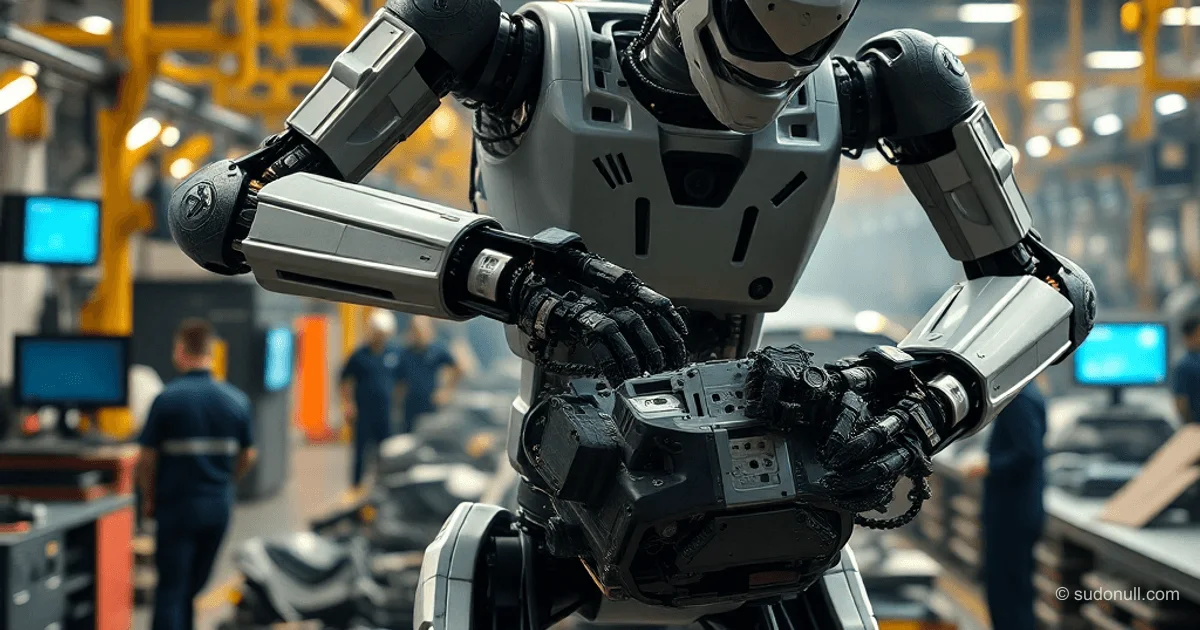
Atlas from Boston Dynamics: Transition to Industrial Deployment at Hyundai Plants
In 2026, Hyundai Motor Group announced the deployment of the Atlas humanoid robot at the Metaplant America facility in Georgia. Starting in 2028, the robot will handle parts sorting and workpiece kitting. Concurrently, Hyundai is building a factory to produce up to 30,000 Atlas units annually. This marks the first case of mass-produced humanoid application in manufacturing, focusing on stability rather than spectacle.
Previous owners—Google and SoftBank—developed the technology but failed to reach an industrial level. Hyundai integrated Atlas into its production ecosystem, solving key reliability and scalability issues.
Ownership Stages and Key Differences
Boston Dynamics changed owners three times: Google (2013–2017), SoftBank (2017–2021), and Hyundai (since 2021). Google focused on R&D without a business model. SoftBank invested in Spot for inspections, but Atlas remained a prototype.
Hyundai, as an automaker with 334,000 employees, approached the task from a cost-reduction perspective. The company owns factories, supply chains, and automation experience.
Key changes in approach:
- Focus on OEE (Overall Equipment Effectiveness) and minimizing downtime.
- Integration with the automotive supply chain via Hyundai Mobis.
- Adaptation for 8-hour shifts without engineering support.
Technical Transformation of Atlas
The 2021 hydraulic version had 20 degrees of freedom but suffered from leaks, complex maintenance, and incompatibility with mass production. An electric model was introduced in 2024, followed by the production version in 2026.
Key specifications of the new version:
- 56 degrees of freedom instead of 20.
- IP67 protection rating.
- Autonomy ~4 hours with self-swapping battery.
- Payload: 50 kg peak, 30 kg continuous.
- Temperature range: −20°C to +40°C.
Electric actuators simplify maintenance and reduce costs. Components are unified with automotive parts, ensuring scalability. Zak Jakowski from Boston Dynamics noted a reduction in unique parts for compatibility with existing chains.
Parkour demonstrations require precise control, but production demands repeatability and fault tolerance. Hyundai reengineered Atlas for these conditions.
Economics of Deployment in Automotive
According to 2025 industry reports, labor costs account for 65–70% of car assembly costs. In Korea, the average Hyundai employee compensation is $84,800 per year, with minimum wage rising 60% over 9 years.
Estimated annual cost of Atlas: $30–38k based on a $150k price and 5-year lifespan. Robot costs decrease with scale, unlike human labor.
Cost comparison:
- Worker: $84,000+ annually, upward trend.
- Atlas: $30–38k/year, decreases with volume.
- The $295/car gap scales to billions.
This makes robotics a necessity for competitiveness.
Success Factors Right Now
Technological maturity, partnerships, and internal demand aligned:
- Electric actuators reached required power levels.
- Integration with Google DeepMind for task learning.
- Specific production requirements framing R&D.
What matters:
- Transition from hydraulic to electric for reliability.
- Integration into the automotive supply chain for scale.
- Economic feasibility: ROI through labor cost reduction.
- Industrial specifications (IP67, 56 DoF, 30 kg load).
- Internal customer ensures real-world testing.
Strategic Perspectives
Hyundai faces a choice: monetize Atlas externally or use it as a competitive advantage. Selling to competitors (Toyota, VW) levels the market, but internal use strengthens positions in the auto industry.
Robotics here is a tool for reducing production margins, not a separate business.
— Editorial Team










No comments yet.